

When sourcing children's markers, finding truly safe food grade marker ink is the biggest worry for most B2B brands. For most businesses, the answer is safety. One chemical risk can lead to recalls, costly legal fights, and a broken brand. Today, buyers demand non-toxic or food-grade products.
As a source factory with years of R&D work, we need to share an industry fact. Not every food-grade marker is truly safe. Let us look at what real chemical safety means. Let us show how our factory uses advanced ink tech to protect children and your business.
1. The Loophole of Fake “Food-Grade” Claims
The term food-grade is often a marketing trick. Many factories use a dangerous shortcut. They use food-grade colorants, the dyes that make ink red or blue. Then they print Food Grade on the pack. They ignore the rest of the ingredients.
Ink is more than color. It needs solvents to keep the liquid flowing. It needs keep-fresh agents to stop mold. In cheap, low-quality markers, these hidden parts are often harsh industrial chemicals.
Children may get ink on their hands or put a cap in their mouth. Check the finished product for its planned age group and likely use. Review the full formula, cap, and end plug. Do not guess a specific illness or long-term effect from the word industrial preservative alone. Ingredient identity, exposure, and product-specific review matter.

2. Our Innovation: The “Ink as Food” Standard
To fix this industry problem, our R&D team built a strict new bar. We call it the Ink as Food idea. Every single part inside our marker ink must meet strict food-additive bars, like the GB 2760 standard. We do not just swap the colorants. We change the solvents, binders, and keep-fresh agents to natural, food-safe picks. Our team owns this work.
You may ask: if you use natural parts, does the marker still draw well? The answer is yes. With advanced blend and emulsion tech, our engineers keep the ink bright, smooth, and steady. The colors are deep and vivid on paper. The ink flows well without drying too fast. We proved you do not need toxic chemicals to make a high-quality art tool for kids.
3. The Hardest Challenge: Natural Preservatives and the USP51 Test
The hardest part of safe ink is stopping bacteria and mold. Markers sit on shelves and in warehouses for months. Without keep-fresh agents, water-based ink can grow mold fast. Old-style factories use strong chemical biocides. We refused that shortcut. We built a defense system with only natural, food-grade keep-fresh agents.
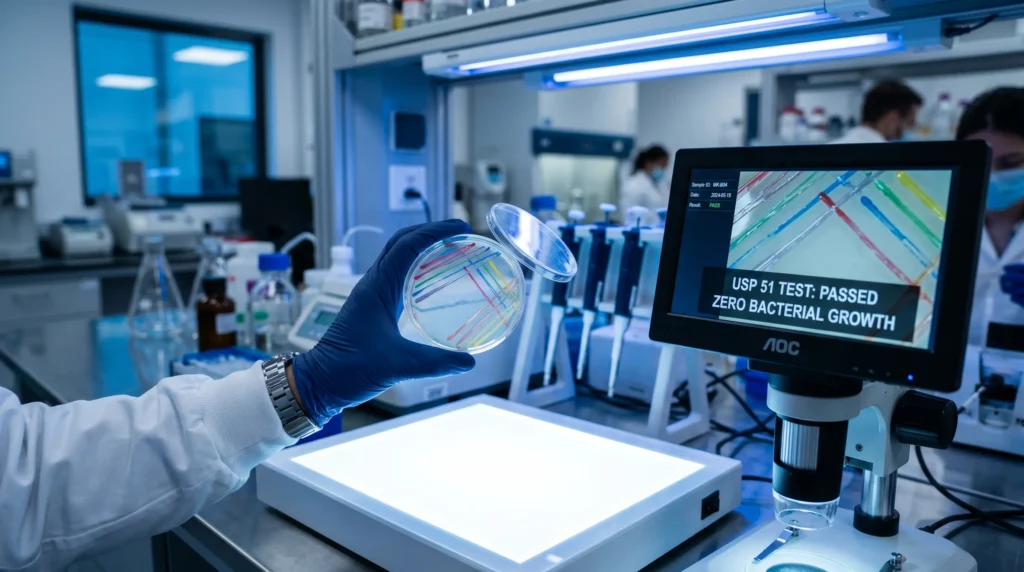
To prove it works, we sent our ink to a certified third-party lab for the USP51 Antimicrobial Effectiveness Test. This is a strict global test. It checks whether a product stops germs from growing. The lab tested against tough bacteria like E. coli and Staphylococcus aureus. It also tested strong molds like Candida albicans.
ZH Stationery has confirmed that supporting USP 51 test records exist. They include counts below 10 cfu/g at days 14 and 28. Review the real report for the tested formula, organisms, method, and pass rules. Below 10 cfu/g is not proof of zero germs. An antimicrobial result does not by itself mean the ink is edible. It also does not review every chemical exposure risk.
4. Honesty and Trust: Why “Food-Grade” Does Not Mean “Edible”
At our factory, we believe in full honesty with B2B partners and final users. So we must state a clear warning. Even though our ink parts are safe enough for food, the markers are not edible.
Why? A writing factory is not a food kitchen. The molding machines, factory air, and assembly lines follow strict industrial safety bars. They do not follow food-baking hygiene bars. A child should never eat a marker.
Food-additive parts do not turn the finished marker into a food or cosmetic product. Keep the writing use and warnings clear. Review skin contact, likely mouthing, and other real exposures through the right product check. Do not call the chemical risk zero or near zero.

5. Build a Trusted Brand with a Reliable Source Factory
If you want a trusted, premium writing brand, you need a manufacturer who takes safety as seriously as you do. Our fully food-grade ink markers pass strict global bars, including the EU's EN71-3 and EN71-9 rules.
By picking a true source factory that controls the deep chemical work of the ink, you protect your users. You also protect your global supply chain from compliance failures. Do not bet your brand on fake safety labels. Work with us to bring truly safe, bright, high-quality markers to classrooms and homes.
Related guide: Why Premium Markers Are Worth the Investment in 2026.
Related Reading
- Children’s Marker OEM Guide: Ergonomics & Safety for B2B Brands
- How to Source Children’s Drawing Markers: A B2B Buyer’s Guide Based on 3-6 Year Olds’ Color Preferences
- How to Read an ASTM D-4236 Test Report for Acrylic Markers
- Are Alcohol Markers Safe for Skin? Why “Non-Toxic” Does Not Mean Skin-Safe
- The Ultimate Guide to Free Formaldehyde Testing in Stationery
- Edible Marker Pens: Creative Food Decoration – From Cookie Icing to Cake Artistry
- What Are the Safest Pens to Write on Skin With?
- classic blackboard material guide
- dry erase marker ink guide
What “Food-Grade” Can and Cannot Mean for a Marker
The phrase gets used loosely, and the looseness is the problem. For a marker, “food-grade” cannot mean the ink is edible. It can mean some narrower and more defensible things: that the ink contains no substance prohibited under food-contact regulations, that the pigments used appear on an approved list, and that the finished ink passes a migration test appropriate to the intended contact scenario.
Each of those claims requires a specific document. “No prohibited substances” needs a formulation review against the relevant positive list. “Approved pigments” needs the color index numbers named. “Passes migration” needs a test report naming the simulant, the temperature, the contact time, and the detection limit.
A supplier who says “food-grade” and produces none of those is using the phrase as marketing. That is common, and buyers who do not ask for the underlying documents are the ones who discover the gap when a retailer’s compliance team reviews the file.
The Regulatory Gap Between Food Contact and Art Material
Food-contact materials and art materials are regulated under separate frameworks with different assumptions about exposure.
Food-contact regulation assumes the material touches food and models migration into the food over a defined time and temperature. Art material regulation assumes the material is used as intended — drawn with, not eaten — and focuses on acute and chronic hazard labeling.
For a marker that might be used on a plate or a cake topper, both frameworks are relevant. The art material review covers the labeling obligation; the food-contact review covers the migration question. Passing one does not satisfy the other, and a supplier that offers only the art material statement has not addressed the part of the risk a food-contact buyer actually cares about.
There is also a practical middle ground worth naming: many products marketed as food-safe are not intended to touch food at all. They are intended to decorate packaging or write on labels. In that case the correct claim is about the packaging material, not about the ink.
Preservatives: The Hardest Formulation Problem
Water-based ink supports microbial growth. Without an effective preservative, a marker reservoir becomes a culture medium within weeks. That is why preservative choice is the hardest part of building a genuinely food-safe water-based ink.
The common preservatives — isothiazolinones, formaldehyde releasers, and various organic acids — are effective and inexpensive. Several of them are also restricted or under scrutiny in food-contact contexts, which puts formulators in a bind: the preservative that works best is often the one that is hardest to defend.
Natural alternatives exist but come with tradeoffs. Some are pH-sensitive and lose effectiveness as the ink ages. Some have narrow spectrum coverage, leaving a gap against either bacteria or fungi. Some interact with pigments and cause color shift over shelf life.
The practical answer for most programs is a preservation system rather than a single agent, validated by a challenge test that models the actual product. A challenge test inoculates the ink with representative organisms and measures whether the system recovers. It is the only credible evidence that a preservative package works in that specific formulation.
How to Verify a Supplier’s Claim
Four documents separate a verifiable claim from a marketing phrase.
Formulation declaration. A list of the substances in the ink, by function, with the regulatory status of each named. A supplier that refuses to disclose the formulation to a buyer under NDA is not protecting a trade secret; it is declining to be checked.
Pigment identification. The color index numbers for every pigment used. This lets the buyer check the pigments against the positive list for the target market independently.
Migration test report. The simulant used, the temperature and contact time, the detection limit, and the result. A report without those parameters is not reproducible.
Challenge test report. The organisms tested and the recovery results, tied to the specific formulation and the specific preservative concentration.
A supplier who can produce all four is doing the work. A supplier who produces one and calls it food-grade is selling a phrase.
Frequently Asked Questions
Does food-grade mean the ink is safe to eat? No. It means the ink meets certain restrictions relevant to food contact. Edibility is a different claim and should never be implied.
Can a marker be both art-material compliant and food-contact compliant? Yes, but both reviews have to be done. One does not imply the other.
Why is preservative choice so difficult? Because the most effective preservatives are often the most restricted, and natural alternatives have narrower coverage or stability problems.
What should I ask for first? The formulation declaration and the pigment color index numbers. Without those, nothing downstream can be verified.
The Cost of Getting This Wrong
A failed food-contact claim is not a marketing embarrassment. It is a recall event. If a retailer discovers that a marker sold as food-safe has no migration test behind it, the product comes off the shelf, the buyer loses the program, and the factory’s name goes on an internal do-not-use list that persists for years.
The cost is asymmetric. Doing the testing costs a few thousand dollars and adds two to three weeks to the timeline. Skipping it costs the entire program plus the relationship. That math is not close.
Buyers should also distinguish between the two failure modes. A product that fails a test is a technical problem with a known fix. A product that claims compliance without testing is a credibility problem, and credibility does not come back through a reorder.