

Beim Beschaffen von Kinder-Markern ist die größte Sorge der meisten B2B-Marken, wirklich sichere Tinte in Lebensmittelqualität zu finden. Für die meisten Unternehmen lautet die Antwort: Sicherheit. Ein einziges chemisches Risiko kann zu Rückrufen, kostspieligen Rechtsstreitigkeiten und einer beschädigten Marke führen. Heute verlangen Käufer ungiftige oder lebensmittelechte Produkte.
Als Quellfabrik mit jahrelanger F&E-Arbeit müssen wir eine Branchentatsache teilen. Nicht jeder lebensmittelechte Marker ist wirklich sicher. Lassen Sie uns betrachten, was echte chemische Sicherheit bedeutet. Lassen Sie uns zeigen, wie unsere Fabrik fortschrittliche Tintentechnologie einsetzt, um Kinder und Ihr Unternehmen zu schützen.
1. Die Gesetzeslücke falscher “Lebensmittelecht”-Behauptungen
Der Begriff lebensmittelecht ist oft ein Marketingtrick. Viele Fabriken nutzen eine gefährliche Abkürzung. Sie verwenden lebensmittelechte Farbstoffe, die Farbstoffe, die Tinte rot oder blau machen. Dann drucken sie Lebensmittelecht auf die Verpackung. Sie ignorieren den Rest der Inhaltsstoffe.
Tinte ist mehr als Farbe. Sie braucht Lösungsmittel, um die Flüssigkeit fließend zu halten. Sie braucht Frischhaltemittel, um Schimmel zu stoppen. In billigen, minderwertigen Markern sind diese versteckten Teile oft aggressive Industriechemikalien.
Kinder können Tinte an die Hände bekommen oder eine Kappe in den Mund nehmen. Prüfen Sie das fertige Produkt für die geplante Altersgruppe und wahrscheinliche Nutzung. Überprüfen Sie die vollständige Formel, Kappe und Endstopfen. Raten Sie keine spezifische Krankheit oder Langzeitwirkung allein aus dem Wort industrielles Konservierungsmittel. Inhaltsstoffidentität, Exposition und produktspezifische Prüfung sind entscheidend.

2. Unsere Innovation: Der “Tinte als Lebensmittel”-Standard
Um dieses Branchenproblem zu beheben, hat unser F&E-Team eine strenge neue Messlatte gesetzt. Wir nennen es die Idee Tinte als Lebensmittel. Jeder einzelne Bestandteil in unserer Markertinte muss strenge Lebensmittelzusatzstoff-Grenzwerte erfüllen, wie die GB 2760-Standard. Wir tauschen nicht nur die Farbstoffe aus. Wir ändern die Lösungsmittel, Bindemittel und Frischhaltemittel zu natürlichen, lebensmittelsicheren Optionen. Unser team besitzt diese Arbeit.
Sie fragen sich vielleicht: Wenn Sie natürliche Bestandteile verwenden, zeichnet der Marker dann noch gut? Die Antwort ist ja. Mit fortschrittlicher Misch- und Emulsionstechnik halten unsere Ingenieure die Tinte hell, geschmeidig und stabil. Die Farben sind tief und lebendig auf Papier. Die Tinte fließt gut, ohne zu schnell zu trocknen. Wir haben bewiesen, dass man keine giftigen Chemikalien braucht, um ein hochwertiges Kunstwerkzeug für Kinder herzustellen.
3. Die größte Herausforderung: Natürliche Konservierungsmittel und der USP51-Test
Der schwierigste Teil sicherer Tinte ist das Stoppen von Bakterien und Schimmel. Marker liegen monatelang in Regalen und Lagerhäusern. Ohne Frischhaltemittel kann wasserbasierte Tinte schnell schimmeln. Altmodische Fabriken verwenden starke chemische Biozide. Wir haben diese Abkürzung abgelehnt. Wir haben ein Verteidigungssystem mit nur natürlichen, lebensmittelechten Frischhaltemitteln aufgebaut.
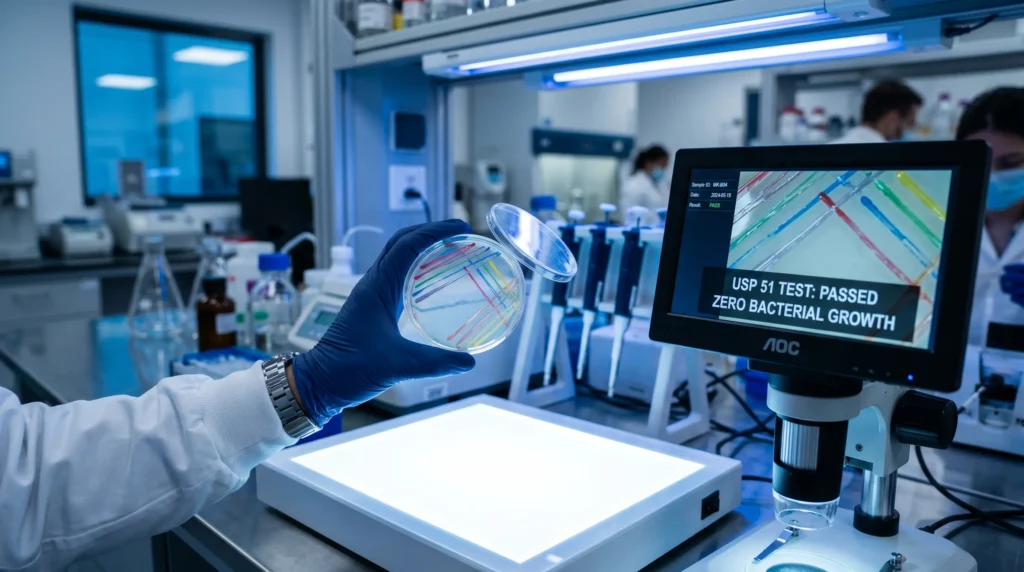
Um zu beweisen, dass es funktioniert, haben wir unsere Tinte an ein zertifiziertes Drittlabor für die USP51-Antimikrobiellen-Wirksamkeitstest. Dies ist ein strenger globaler Test. Er prüft, ob ein Produkt das Wachstum von Keimen stoppt. Das Labor testete gegen robuste Bakterien wie E. coli und Staphylococcus aureus. Es testete auch starke Schimmelpilze wie Candida albicans.
ZH Stationery hat bestätigt, dass unterstützende USP-51-Testaufzeichnungen existieren. Sie enthalten Keimzahlen unter 10 KBE/g an Tag 14 und 28. Prüfen Sie den echten Bericht für die getestete Formel, Organismen, Methode und Bestehensregeln. Unter 10 KBE/g ist kein Beweis für null Keime. Ein antimikrobielles Ergebnis bedeutet nicht von selbst, dass die Tinte essbar ist. Es prüft auch nicht jedes chemische Expositionsrisiko.
4. Ehrlichkeit und Vertrauen: Warum “Lebensmittelecht” nicht “essbar” bedeutet”
In unserer Fabrik glauben wir an volle Ehrlichkeit gegenüber B2B-Partnern und Endnutzern. Daher müssen wir eine klare Warnung aussprechen. Auch wenn unsere Tintenbestandteile sicher genug für Lebensmittel sind, sind die Marker nicht essbar.
Warum? Eine Schreibwarenfabrik ist keine Lebensmittelküche. Die Spritzgussmaschinen, Fabrikluft und Montagelinien folgen strengen industriellen Sicherheitsstandards. Sie folgen nicht den Hygienestandards der Lebensmittelherstellung. Ein Kind sollte niemals einen Marker essen.
Lebensmittelzusatzstoff-Bestandteile machen den fertigen Marker nicht zu einem Lebensmittel- oder Kosmetikprodukt. Halten Sie die Verwendung als Schreibgerät und die Warnungen klar. Überprüfen Sie Hautkontakt, wahrscheinliches In-den-Mund-Nehmen und andere reale Expositionen durch die richtige Produktprüfung. Bezeichnen Sie das chemische Risiko nicht als null oder nahezu null.

5. Bauen Sie eine vertrauenswürdige Marke mit einer zuverlässigen Quellfabrik auf
Wenn Sie eine vertrauenswürdige Premium-Schreibwarenmarke wollen, brauchen Sie einen Hersteller, der Sicherheit genauso ernst nimmt wie Sie. Unsere vollständig lebensmittelechten Tintenmarker bestehen strenge globale Standards, einschließlich der EU-Regeln EN71-3 und EN71-9.
Indem Sie eine echte Quellfabrik wählen, die die tiefe chemische Arbeit der Tinte kontrolliert, schützen Sie Ihre Nutzer. Sie schützen auch Ihre globale Lieferkette vor Compliance-Ausfällen. Setzen Sie Ihre Marke nicht auf gefälschte Sicherheitsetiketten. Arbeiten Sie mit uns zusammen, um wirklich sichere, leuchtende, hochwertige Marker in Klassenzimmer und Zuhause zu bringen.
Verwandter Leitfaden: Warum Premium-Marker im Jahr 2026 eine lohnende Investition sind.
Weiterführende Literatur
- Leitfaden für Kindermarker OEM: Ergonomie & Sicherheit für B2B-Marken
- So beschaffen Sie Zeichenmarker für Kinder: Ein B2B-Einkaufsleitfaden basierend auf den Farbpräferenzen von 3-6-Jährigen
- Wie man einen ASTM D-4236 Prüfbericht für Acrylmarker liest
- Sind Alkoholmarker sicher für die Haut? Warum “ungiftig” nicht hautsicher bedeutet
- Leitfaden zur Prüfung von freiem Formaldehyd in Schreibwaren
- Essbare Marker-Stifte: Kreative Lebensmitteldekoration – Von Keksglasur bis zur Tortenkunst
- Welche Stifte sind am sichersten zum Beschreiben der Haut?
- Leitfaden für klassisches Tafelmaterial
- Leitfaden zur Tinte von Trockenlöschmarkern
What “Food-Grade” Can and Cannot Mean for a Marker
The phrase gets used loosely, and the looseness is the problem. For a marker, “food-grade” cannot mean the ink is edible. It can mean some narrower and more defensible things: that the ink contains no substance prohibited under food-contact regulations, that the pigments used appear on an approved list, and that the finished ink passes a migration test appropriate to the intended contact scenario.
Each of those claims requires a specific document. “No prohibited substances” needs a formulation review against the relevant positive list. “Approved pigments” needs the color index numbers named. “Passes migration” needs a test report naming the simulant, the temperature, the contact time, and the detection limit.
A supplier who says “food-grade” and produces none of those is using the phrase as marketing. That is common, and buyers who do not ask for the underlying documents are the ones who discover the gap when a retailer’s compliance team reviews the file.
The Regulatory Gap Between Food Contact and Art Material
Food-contact materials and art materials are regulated under separate frameworks with different assumptions about exposure.
Food-contact regulation assumes the material touches food and models migration into the food over a defined time and temperature. Art material regulation assumes the material is used as intended — drawn with, not eaten — and focuses on acute and chronic hazard labeling.
For a marker that might be used on a plate or a cake topper, both frameworks are relevant. The art material review covers the labeling obligation; the food-contact review covers the migration question. Passing one does not satisfy the other, and a supplier that offers only the art material statement has not addressed the part of the risk a food-contact buyer actually cares about.
There is also a practical middle ground worth naming: many products marketed as food-safe are not intended to touch food at all. They are intended to decorate packaging or write on labels. In that case the correct claim is about the packaging material, not about the ink.
Preservatives: The Hardest Formulation Problem
Water-based ink supports microbial growth. Without an effective preservative, a marker reservoir becomes a culture medium within weeks. That is why preservative choice is the hardest part of building a genuinely food-safe water-based ink.
The common preservatives — isothiazolinones, formaldehyde releasers, and various organic acids — are effective and inexpensive. Several of them are also restricted or under scrutiny in food-contact contexts, which puts formulators in a bind: the preservative that works best is often the one that is hardest to defend.
Natural alternatives exist but come with tradeoffs. Some are pH-sensitive and lose effectiveness as the ink ages. Some have narrow spectrum coverage, leaving a gap against either bacteria or fungi. Some interact with pigments and cause color shift over shelf life.
The practical answer for most programs is a preservation system rather than a single agent, validated by a challenge test that models the actual product. A challenge test inoculates the ink with representative organisms and measures whether the system recovers. It is the only credible evidence that a preservative package works in that specific formulation.
How to Verify a Supplier’s Claim
Four documents separate a verifiable claim from a marketing phrase.
Formulation declaration. A list of the substances in the ink, by function, with the regulatory status of each named. A supplier that refuses to disclose the formulation to a buyer under NDA is not protecting a trade secret; it is declining to be checked.
Pigment identification. The color index numbers for every pigment used. This lets the buyer check the pigments against the positive list for the target market independently.
Migration test report. The simulant used, the temperature and contact time, the detection limit, and the result. A report without those parameters is not reproducible.
Challenge test report. The organisms tested and the recovery results, tied to the specific formulation and the specific preservative concentration.
A supplier who can produce all four is doing the work. A supplier who produces one and calls it food-grade is selling a phrase.
Häufig gestellte Fragen
Does food-grade mean the ink is safe to eat? No. It means the ink meets certain restrictions relevant to food contact. Edibility is a different claim and should never be implied.
Can a marker be both art-material compliant and food-contact compliant? Yes, but both reviews have to be done. One does not imply the other.
Why is preservative choice so difficult? Because the most effective preservatives are often the most restricted, and natural alternatives have narrower coverage or stability problems.
What should I ask for first? The formulation declaration and the pigment color index numbers. Without those, nothing downstream can be verified.
The Cost of Getting This Wrong
A failed food-contact claim is not a marketing embarrassment. It is a recall event. If a retailer discovers that a marker sold as food-safe has no migration test behind it, the product comes off the shelf, the buyer loses the program, and the factory’s name goes on an internal do-not-use list that persists for years.
The cost is asymmetric. Doing the testing costs a few thousand dollars and adds two to three weeks to the timeline. Skipping it costs the entire program plus the relationship. That math is not close.
Buyers should also distinguish between the two failure modes. A product that fails a test is a technical problem with a known fix. A product that claims compliance without testing is a credibility problem, and credibility does not come back through a reorder.