

Compliance & QA Guide by: ZH Stationery (ISO 9001 & amfori BSCI A-Rated Marker Manufacturer · Tonglu, Hangzhou)
For US retail buyers, private-label stationery brands, and high-volume Amazon importers, an invalid ASTM D-4236 (officially designated ASTM D4236 by ASTM International) file is one of the fastest ways to trigger a US customs hold or an Amazon listing suppression. Most rejections happen for two avoidable reasons: buyers accept a one-page factory self-declaration instead of a multi-page third-party toxicological evaluation, or they confuse federal chronic-hazard labeling law (LHAMA) with commercial platform rules such as ISO/IEC 17025 lab verification, ACMI AP certification, Children’s Product Certificates (CPC), and Amazon’s Direct Validation (TIC) workflow for kids’ kits.
This guide explains how to audit an ASTM D-4236 / ASTM D4236 report at a QA-director level—how to read beyond the cover page of a real toxicological review, which water-based acrylic ink ingredients trigger chronic warnings, when single marker barrels must carry labeling, and how to navigate Amazon’s 2026 compliance gates without wasted retesting.
Quick Links
- Federal Law (LHAMA / 16 CFR 1500.14(b)(8)) vs. Amazon & Retail Rules
- Reading Beyond the Cover Page, Acrylic Ink Risks & 6 Fake-Report Red Flags
- ACMI AP Seal, CPSIA, ASTM F963-23 & CPC: Completing the US Stack
- Master Formula Reports, Batch Linkage & Amazon Direct Validation (TIC)
- Frequently Asked Questions
Federal Law (LHAMA / 16 CFR 1500.14(b)(8)) vs. Amazon & Retail Rules
Many sourcing blogs contradict themselves by calling ASTM D-4236 a toxicological review in one paragraph and an ISO 17025 chemical test in the next. To clear both US CPSC rules and retail onboarding, separate the federal statutory requirement from commercial platform enforcement:
| Compliance Dimension | US Federal Law LHAMA · 16 CFR 1500.14(b)(8) | Amazon US & Major Retail Enforcement |
|---|---|---|
| Core Nature of ASTM D-4236 (ASTM D4236) | A chronic-hazard labeling standard enforced by the US CPSC under the Labeling of Hazardous Art Materials Act (LHAMA). Requires a Toxicological Risk Assessment (TRA) of 100% ink ingredients to set cautionary labeling—not a pass/fail chemical migration test. | Compliance teams audit documentation to verify that the conformance statement (Conforms to ASTM D-4236) or required warning text printed on your retail packaging is backed by an independent third-party file. |
| Authorized Issuer | A board-certified toxicologist (e.g., DABT or ERT) reviewing full quantitative formulation data. Federal law does not mandate ISO 17025 accreditation for the toxicologist. | To filter out forged factory letters, Amazon and mass retailers typically require either a TRA / LHAMA report issued through an ISO/IEC 17025-accredited laboratory (e.g., SGS, Intertek, TUV, Bureau Veritas, or another verifiable accredited lab) or an active ACMI AP Seal certificate. |
| Validity & Renewal Window | Mandatory re-evaluation at least every 5 years—or immediately if any pigment, resin, co-solvent, or preservative/biocide changes. | Internal marketplace policies commonly expect reports dated within the last 12 months (children’s art kits) or 12–24 months (adult art supplies), even when the 5-year statutory period has not expired. |
| Children’s Product Trigger (Ages 12 & Under) | LHAMA alone covers chronic art-material labeling; it does not satisfy federal children’s product safety rules. | If acrylic markers are marketed to or carry play value for children 12 and under, US law and Amazon additionally require CPSC-accepted lab reports (CPSIA + ASTM F963-23), a written Children’s Product Certificate (CPC), and annual Amazon Direct Validation (TIC) for toy/kids-craft listings. |
Reading Beyond the Cover Page, Acrylic Ink Risks & 6 Fake-Report Red Flags
Cover pages alone never prove compliance. When reviewing the interior pages of a multi-page LHAMA / ASTM D-4236 toxicological report for acrylic paint markers, inspect four substantive sections—then run the six red-flag checks below:
- Formulation & Color-Library Scope: Verify that the evaluated ink table explicitly lists water-based acrylic pigment dispersions and covers every shade code in your set—especially high-opacity titanium-dioxide whites, saturated yellows/reds, fluorescent pigments, and metallic aluminum-flake shades.
- Exposure Scenario & User Age Assumption: Check whether the toxicologist modeled worst-case exposure for children (skin contact, mouthing, and estimated ink ingestion) or strictly adult art use. An adult-only exposure assumption cannot support a children’s craft kit.
- Unconditional vs. Conditional Conformance Verdict: Under ASTM Practice D4236, a product can legally conform while still containing a chronic-hazard ingredient—provided it prints the exact mandatory cautionary statement (signal word, hazard description, precautionary instructions, and US contact telephone number). Read the toxicologist’s final Labeling Statement verbatim to confirm whether the formula qualifies for clean Conforms to ASTM D-4236 labeling or requires conditional warnings.
- Single-Pen Barrel vs. Outer Box Labeling (Immediate Container Rule): Under 16 CFR 1500.14(b)(8), for hazard-free formulas qualifying for clean conformance and sold exclusively as a sealed multi-pen retail set (not broken apart for individual sale), printing Conforms to ASTM D-4236 on the outer retail package satisfies the minimum federal requirement. However, if individual markers can be sold open-stock as single units, each marker barrel is the immediate container and must carry the statement directly on the barrel. Likewise, formulas requiring chronic-hazard warnings cannot rely on outer-box labeling alone—under LHAMA / FHSA, immediate-container (barrel) warning rules must be evaluated unless a statutory small-package exemption applies.
Acrylic Paint Marker Formulation Pain Points Under LHAMA: Unlike wax crayons or simple dye markers, water-based acrylic paint markers face three specific formulation risks during toxicological review: (1) in-can preservatives and biocides—such as isothiazolinones (MIT, CMIT, or BIT) added to prevent microbial spoilage in water-based emulsions, which trigger skin-sensitization warnings if dosed too high; (2) specialty pigment chemistry—heavy inorganic pigments, fluorescent dyes, and metallic aluminum flakes that behave differently from standard organic shades; and (3) anti-drying co-solvents and humectants—where compliant factories formulate with low-toxicity propylene glycol or glycerin rather than cheaper ethylene glycol or restricted glycol ethers that carry chronic organ-toxicity warnings.
| Verification Checkpoint | What a Legitimate Third-Party File Shows | Immediate Fake-Report Red Flag |
|---|---|---|
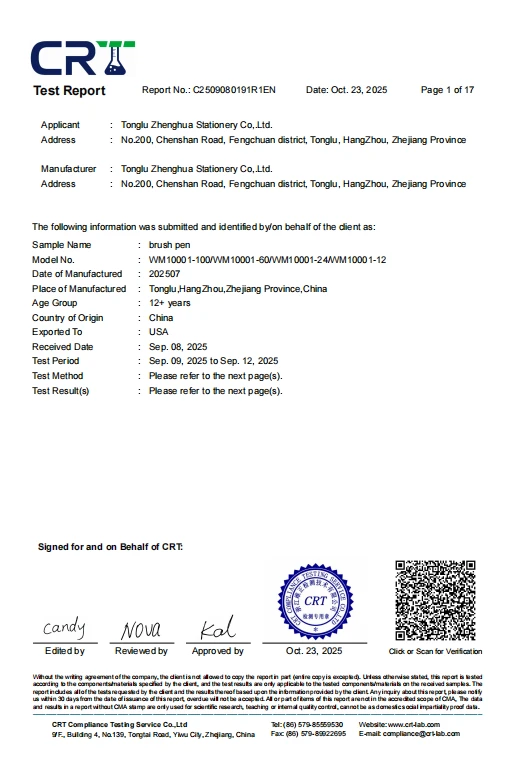
| 1. Issuing Body & Accreditation | Independent accredited lab or toxicology agency (SGS, Intertek, TUV, Bureau Veritas, ACMI, or another lab verifiable via the CPSC lab directory or CNAS / ILAC accreditation lookup) with report number and online verification portal. | ASTM International logo on the header (ASTM writes standards—it never issues test reports), or a factory self-certificate where Prepared For and Prepared By list the same manufacturer. |
| 2. Toxicologist Sign-Off | Named board-certified toxicologist (DABT, ERT, or equivalent) signing off on the chronic-hazard evaluation and exact labeling conclusion. | A single-page flyer bearing a red stamp and a generic line saying PASS — Conforms to ASTM D-4236 with no toxicologist name or methodology. |
| 3. Formula & Model Match | Explicit water-based acrylic ink chemistry, factory model codes, and the full shade library reviewed. | Vague descriptions like Marker Pens, mismatched alcohol/watercolor reports submitted for acrylic markers, or an unrelated factory listed as applicant. |
| 4. Multi-Page Integrity | Complete unedited original PDF (typically 5–20+ pages covering sample photos, scope, methodology, findings, and labeling verdict). | A cropped screenshot, a phone photo of a wall certificate, or a 1-page summary stripped of appendices. |
| 5. Packaging Text Alignment | Exact statement approved in the toxicologist’s conclusion matches the live retail box (and barrel if sold individually). | The report requires conditional chronic warnings, but the retail box prints only unverified Non-Toxic marketing claims. |
| 6. Date & Formula Currency | Issue date falls within your channel window (12–24 months) with no unreported pigment or preservative substitutions. | Expired 4- or 5-year-old files handed over without formula-change confirmation. |
ACMI AP Seal, CPSIA, ASTM F963-23 & CPC: Completing the US Stack
In US retail and e-commerce, ASTM D-4236 rarely stands alone. Buyers sourcing private-label acrylic paint markers must map two additional compliance pillars before printing retail cartons:
- ACMI AP Seal vs. Lab-Issued TRA: The Art & Creative Materials Institute (ACMI) AP Seal (Approved Product) verifies that an independent toxicology panel has evaluated the complete formula under LHAMA / ASTM D-4236 and confirmed no chronic or acute toxicity hazards requiring warning labels. Amazon US and major US craft chains recognize ACMI AP directly; however, because ACMI requires annual brand membership dues and per-product registration, most private-label OEM importers use an ISO/IEC 17025 lab-backed LHAMA / TRA report unless their retail buyer explicitly mandates the AP Seal.
- US Children’s Product Stack (Ages 12 & Under): If your acrylic marker kit targets kids, school crafts, or family gifting—or uses playful cartoon artwork—CPSC and Amazon regulate it as a children’s product. Alongside the ASTM D-4236 TRA, US federal law requires third-party testing at a CPSC-accepted laboratory covering CPSIA (total lead ≤100 ppm in substrates, ≤90 ppm in surface coatings, plus permanent tracking labels under Section 103), 16 CFR Part 1501 and ASTM F963-23 (small parts, mechanical/physical hazards, flammability, and soluble heavy elements), 16 CFR Part 1307 (8 regulated phthalates ≤0.1% each, strictly mandated when a children’s art kit is classified as a children’s toy or child care article), and a written Children’s Product Certificate (CPC) issued by the US importer of record. (Note: ISO 11540 / BS 7272-1 ventilated cap airflow is a European/international mechanical safety standard—not a US CPSC federal rule cited on a CPC—though dual-market US/EU programs often adopt ventilated caps to satisfy both regions.)
Master Formula Reports, Batch Linkage & Amazon Direct Validation (TIC)
Two outdated assumptions regularly stall US shipments: expecting a brand-new ASTM D-4236 report on every production batch, and assuming a factory PDF plus a cross-reference letter automatically clears every Amazon category in 2026. Here is how compliant OEM workflows actually operate:
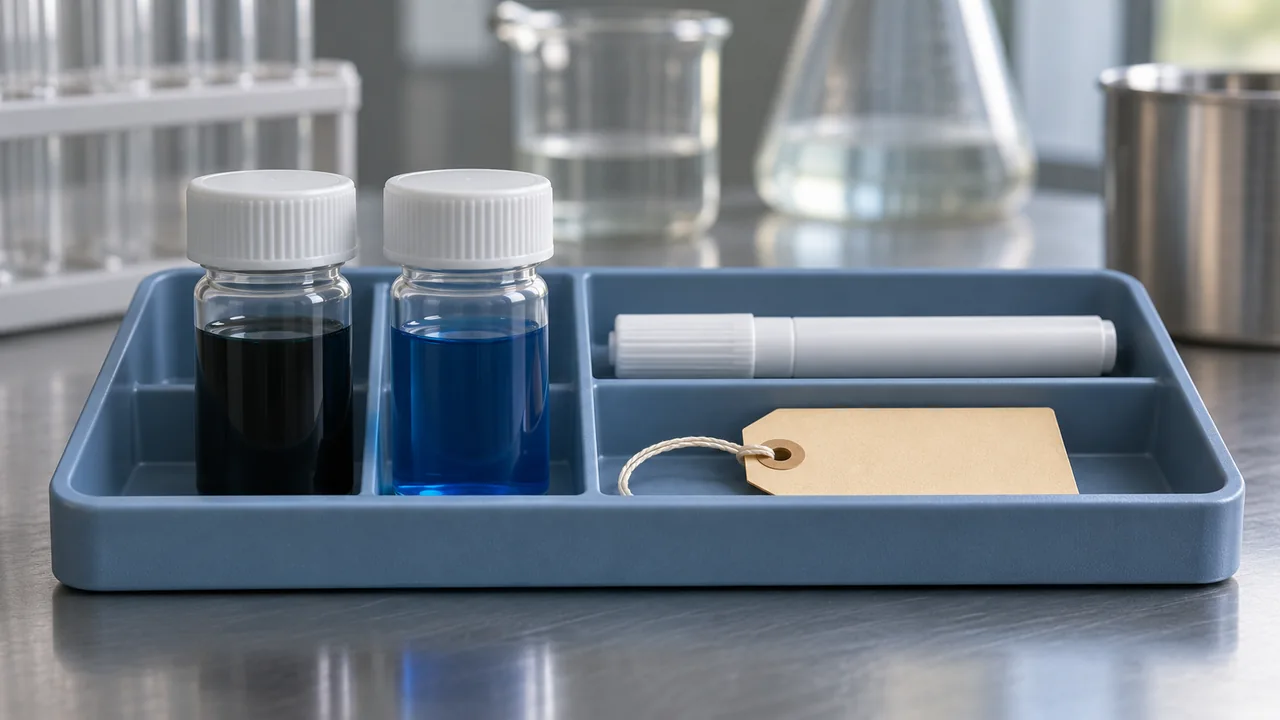
- Master Ink Formula TRA + Batch Consistency Linkage: No legitimate pen factory runs a brand-new SGS or Intertek toxicological review on every single production run. ASTM D-4236 evaluations cover the master ink formulation and color library (valid up to 5 years unless raw materials change). During mass production at ZH Stationery, each bulk shipment links back to that master evaluation through a signed Declaration of Formula Consistency, retained batch lot codes, and a matching 16-section GHS SDS—verified during incoming pigment and AQL release checks (see our 12-point marker pen factory audit checklist).
- Adult Self-Submission vs. Amazon Direct Validation (TIC) for Children’s Kits: For adult-only art markers, sellers typically upload the complete third-party PDF, six-sided retail packaging photos, and SKU/model linkage directly inside Seller Central. However, for children’s toys and toy-like kids’ art/drawing sets, Amazon rolled out mandatory annual Direct Validation beginning late 2025: sellers can no longer self-upload PDF test reports and must instead route existing reports or production samples through an Amazon-approved TIC (Testing, Inspection, and Certification) provider, which verifies compliance and transmits results directly to Amazon.
- Realistic Limits of Cross-Reference Letters: Factory master reports normally list the factory’s applicant name, factory model codes, and neutral white-box sample photos rather than your private-label brand name or Amazon ASIN. While a signed Model-to-SKU / ASIN Cross-Reference Letter may work for some adult-category reviews, Amazon compliance reviewers and TIC verifiers frequently reject cross-applicant mismatches when the retail box artwork differs from the tested sample photos. Plan ahead: either budget a lab report transfer / applicant update once your branded retail box is finalized, or submit final branded production units directly through your chosen TIC for children’s listings.
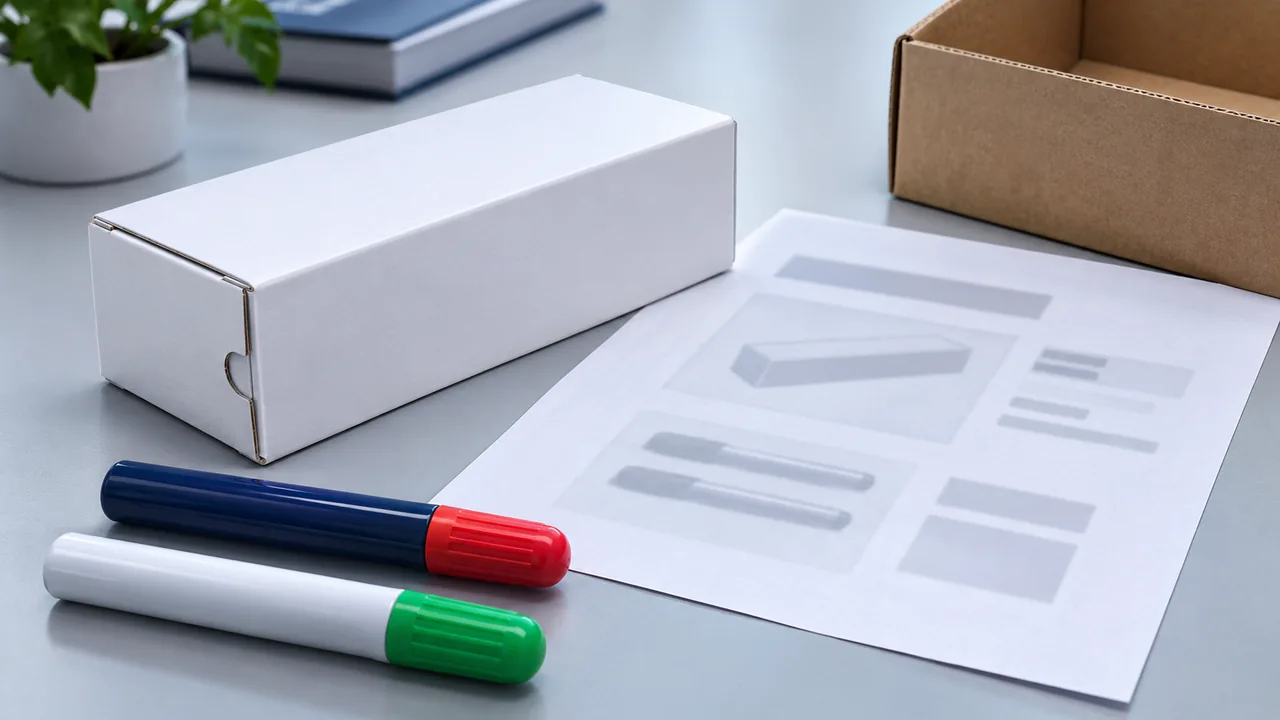
Before palletizing and container loading, our export team also audits printed retail boxes and master cartons to verify that the exact conformance statement, permanent lot tracking code, and importer record match the compliance packet submitted to Amazon, TIC verifiers, or retail QA portals.
Frequently Asked Questions
Can a factory issue its own ASTM D-4236 certificate on company letterhead?
No. Under LHAMA (16 CFR 1500.14(b)(8)), chronic-hazard evaluations must be signed by a qualified toxicologist—and Amazon US and major retail compliance teams reject manufacturer self-declarations outright. Always request the complete multi-page third-party report issued through an accredited laboratory or ACMI rather than a one-page factory letter.
Does an ASTM D-4236 report for acrylic markers also cover alcohol markers or metallic shades?
No. Because TRA evaluations audit exact chemical composition, a water-based acrylic pigment report never covers ethanol- or isopropanol-based alcohol dye markers (see our acrylic vs. alcohol markers OEM comparison). Likewise, adding metallic aluminum-flake, fluorescent, or glitter shades outside the evaluated pigment master library requires a supplemental toxicological review.
Do adult-positioned acrylic paint markers still require ASTM D-4236 compliance in the US?
Yes. LHAMA applies to all art materials sold in the United States regardless of user age, including professional and adult hobby acrylic markers. What changes for adult-only art supplies is that they generally avoid the additional CPSIA, ASTM F963-23, CPC, and Amazon Direct Validation (TIC) children’s testing stack required for items marketed to ages 12 and under.
What triggers mandatory ASTM D-4236 re-evaluation before the 5-year statutory limit?
Any material change to the ink formulation invalidates the previous TRA immediately—most commonly switching pigment suppliers, modifying the acrylic resin binder, substituting an isothiazolinone preservative or biocide (such as MIT, CMIT, or BIT), changing anti-drying co-solvents, or adding new specialty shades. Reputable OEM factories enforce raw-material change control so buyers are notified before any formulation update affects active compliance files.
What happens if Amazon rejects an ASTM D-4236 submission, and how do you handle listing reinstatement?
Amazon suppresses the ASIN until acceptable verification is completed, and the compliance appeal and listing reinstatement process typically takes 5 to 15 business days (longer during Q4 peak). For adult art listings, prepare the unedited multi-page third-party PDF, six-sided photos showing printed ASTM D-4236 wording and tracking codes, and—if applicant or packaging artwork differs from the factory report—an updated or transferred lab report rather than relying solely on a cross-reference letter. For children’s art kits subject to Amazon Direct Validation, initiate verification through an Amazon-approved TIC provider directly inside Seller Central.
Request Factory Compliance Files & OEM Acrylic Marker Samples
Scaling a US private-label or retail acrylic paint marker program? At ZH Stationery (ISO 9001:2015 and amfori BSCI A-rated in Tonglu, Hangzhou), custom OEM orders anchor on our dual production floor—whichever is higher: approximately 50,000 total pens or 2,000 custom printed boxes (for example, ~2,100 sets of 24-color packs or ~4,200 sets of 12-color packs)—supported by master-library ASTM D-4236 / LHAMA, EN71-3, ASTM F963-23, and CPSIA testing coordination (including TIC-ready sample packets for children’s listings). Review our factory certifications, explore our 7 OEM cost-cutting decisions, or request current compliance reference sheets and physical samples below.