
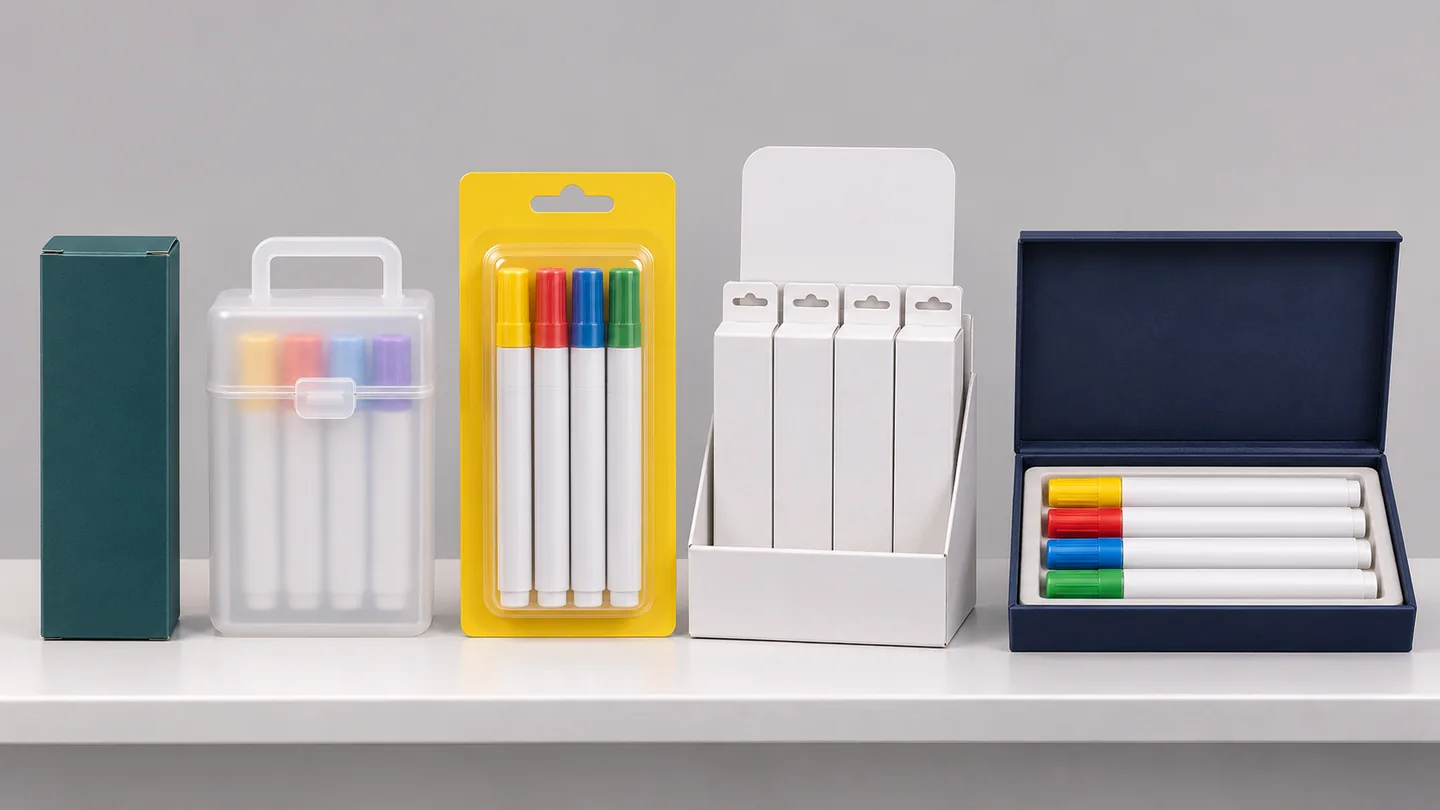
Packaging for acrylic paint markers is not a cosmetic afterthought—it governs your per-unit FOB cost, 20GP/40HQ container fill rate, Amazon FBA compliance, and ink shelf stability in transit. Choose the wrong structure and freight or pigment-settling defects can erase your product margin before the first reorder.
This factory-floor guide compares the five core B2B acrylic marker packaging formats on an apples-to-apples 24-color standard single-tip acrylic marker baseline (Ø 11 × 140 mm, 15 g/pen, 360 g markers per set), separates incompatible formats such as 6–12 color pegboard blister cards and single-pen countertop displays, aligns every MOQ with our 50,000-pen custom OEM policy, and covers the acrylic-specific engineering rules most generic packaging articles miss.
Quick Answer: Channel Match
- Amazon FBA volume launches (12–36 colors): Choose a 350 gsm folding color box with a PET/RPET or molded-pulp tray. It delivers the lowest landed freight (0.90 CBM per 1,000 24-color sets) and passes ISTA 6 drop tests inside a 5-ply master carton without paying luxury gift-box premiums.
- Amazon & D2C mid-to-high color counts (36–72+ colors): Choose a transparent PP carry case with handle or a tiered canvas/Oxford zipper pouch. Both keep markers horizontal, organize dozens of shades cleanly, and justify $24–$49 retail tiers.
- Big-box & craft chain pegboards (6–12 colors only): Use a PET/RPET blister card for tamper resistance and peg density—only with cotton-core/stable ink formulas suited to vertical hanging.
- Independent art & stationery counters: Use a knock-down (flat-packed) PDQ countertop display box holding 24–36 open-stock markers, ideally with angled or horizontal trays to minimize pigment settling.
- Premium gifting & seasonal Q4 SKUs ($35–$60+): Reserve 1,200–1,600 gsm magnetic rigid gift boxes with EVA/paper inserts for high-margin gift sets that can easily absorb 2.4× the ocean freight volume of a folding color box.
In This Guide
- 3 Acrylic Ink Packaging Rules
- Format 1: Folding Color Box
- Format 2: PP Case & Zipper Pouch
- Format 3: PET/RPET Blister Card
- Format 4: Countertop Display Box (PDQ)
- Format 5: Magnetic Rigid Gift Box
- Head-to-Head: 24-Color Comparison
- Packaging MOQ & 50,000-Pen Policy
- Compliance, Artwork & RFQ Brief
- FAQs
3 Acrylic Ink Packaging Rules
Unlike dye-based watercolor pens or ballpoint pens, water-based acrylic paint markers carry dense titanium dioxide and opaque pigment particles suspended in emulsion. Three real-world factory constraints should govern your packaging decision before graphic design starts:
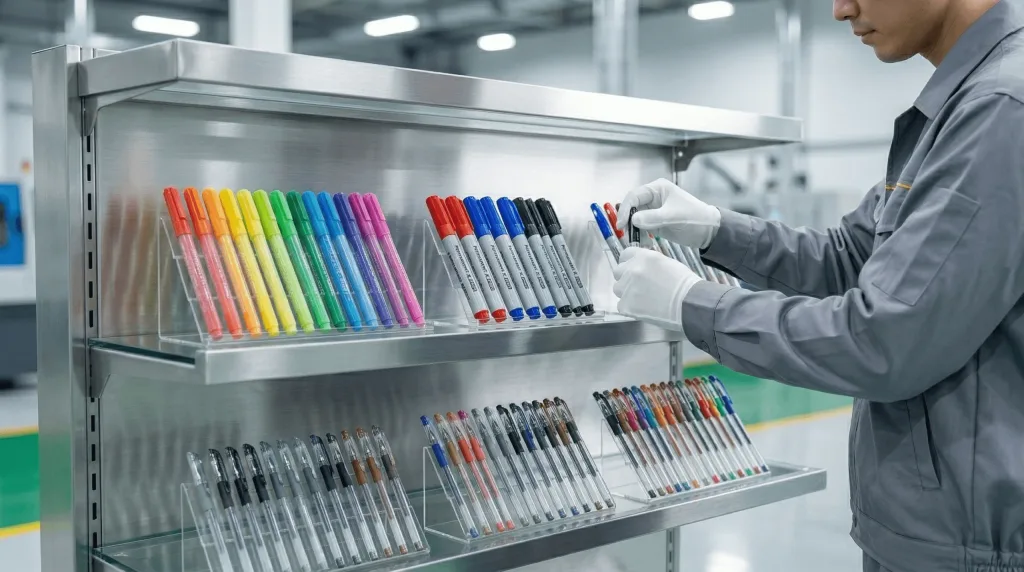
- Horizontal storage is critical for valve-press and direct-liquid acrylic ink: Storing acrylic markers upright for months on retail pegs or vertical countertop stands lets heavy pigments settle to the bottom (causing watery first strokes) or collect inside the cap (causing nib flooding when opened). For 24–72 color sets, prioritize flat-lying trays, horizontal PP carry cases, or lie-flat zipper pouches, and print “Store Horizontally” on both retail boxes and master cartons.
- PET/RPET and paperboard are replacing PVC across US and EU retail: Major European chains and North American retailers increasingly restrict PVC blisters and mixed-material laminates. Under the upcoming EU PPWR 2026 packaging rules, mono-material PET or 30%–100% RPET trays, FSC-certified paperboard dividers, and recyclable mono-PP carry cases protect you from retailer rejections and higher EPR fees.
- Tray fit controls transit damage more than outer box thickness: Loose markers rattle inside oversized boxes, loosening caps and drying out nibs before customers even open the set. A properly recessed PET tray or die-cut paper cradle inside a 350 gsm folding box consistently outperforms a heavier box with loose foam.
Format 1: Folding Color Box
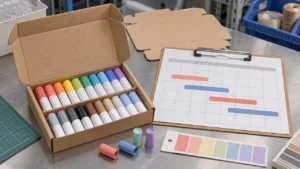
The 350 gsm folding color box with a tiered PET/RPET or paperboard inner tray is the workhorse of private-label marker programs from 12 to 60 colors. It keeps markers flat, maximizes print real estate for color charts, multi-surface icons, and compliance marks (ASTM D-4236, EN71, CE), and packs tighter into export cartons than any other format.
- 24-color packaging cost: Approximately $0.45–$0.65 per set (box + two 12-pen inner trays + matte/gloss lamination) at 2,000–5,000 set runs; spot UV or foil stamping adds $0.03–$0.06.
- 24-color shipping footprint: Retail box 14.8 × 13.8 × 3.4 cm (95 g packaging tare; 455 g total set weight). Packs 36 sets per 5-ply master carton (47 × 30 × 23 cm, 17.3 kg GW, 0.0324 CBM) = 0.90 CBM per 1,000 sets and 31,104 sets per 20GP.
- Best for: Amazon FBA high-turnover SKUs, stationery wholesalers, school & craft distributors, and price-competitive retail launches.
Format 2: PP Case & Zipper Pouch
Once an acrylic marker line scales to 24, 36, 48, 60, or 72 colors on Amazon or specialty retail, shoppers want reusable storage—not a paper box that tears after two weeks. Two reusable formats dominate high-count e-commerce listings today:
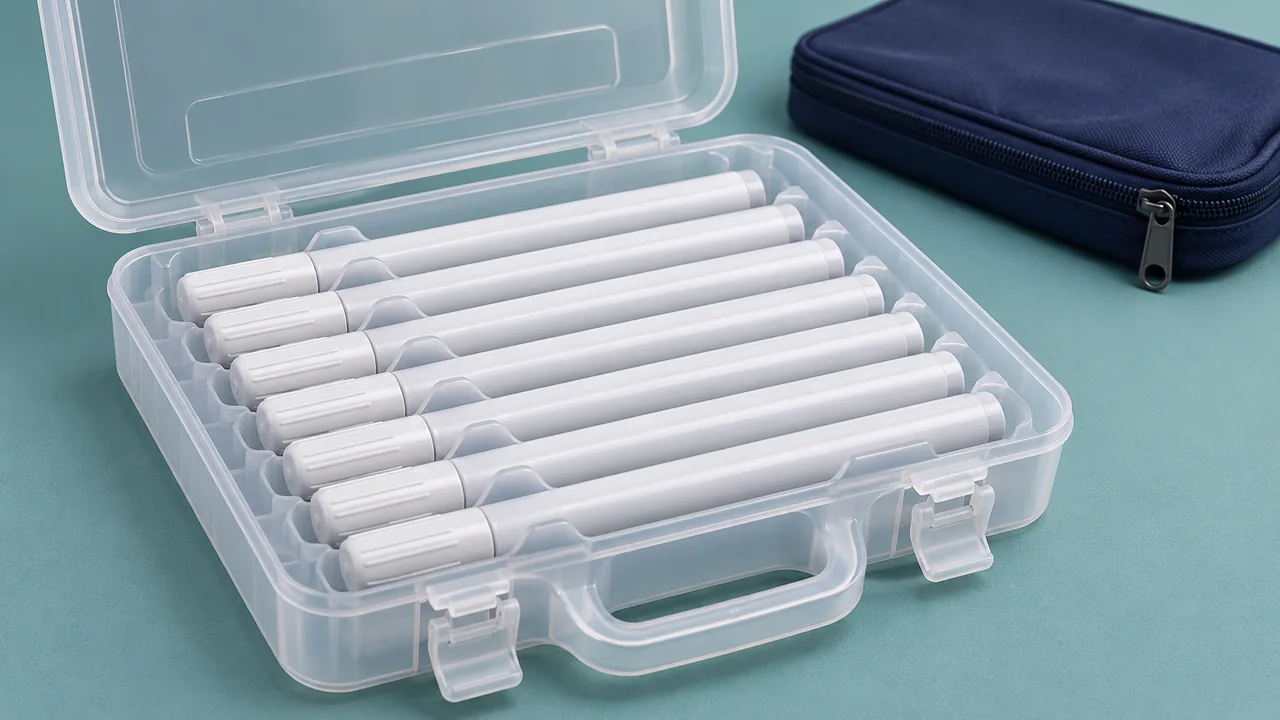
- Transparent Rigid PP Carry Case (with snap latches & handle): Lets buyers see true barrel colors through moisture-resistant polypropylene while a printed paper insert card carries branding and barcodes. At 24 colors, packaging adds $0.75–$1.15/set (175 g tare), requiring 1.87 CBM per 1,000 sets (+108% vs. color box) and fitting 14,940 sets per 20GP. Existing factory stock molds avoid tooling fees; bespoke shapes run $300–$800.
- Canvas / Oxford Zipper Carry Pouch (with structured base & dividers): The top-selling format for 48–72+ color artist sets and dual-tip collections. Packaging runs $0.95–$1.45/set at 24 colors (140 g tare) with custom woven label or screen-printed logo, requiring 1.78 CBM per 1,000 sets (+98% vs. color box) and fitting 15,720 sets per 20GP.
- Quality tip: Pair transparent PP cases with shrink-wrap or tamper-evident seals for FBA so latches never pop open on parcel conveyors. For zipper pouches, specify an internal PE stiffening board or segmented tray so markers stay horizontal rather than shifting loose in transit.
Format 3: PET/RPET Blister Card
Blister cards pair a 350–400 gsm C1S printed backer card (with a Euroslot hang tab) with a thermoformed 0.3–0.4 mm PET or RPET blister. Big-box retailers such as Walmart, Target, and craft chains favor blister cards for pegboard density and visible tamper resistance.
- Why blister cards are NOT more cube-efficient than folding boxes: A common sourcing myth claims blister cards ship more units per container because they look “flat.” In reality, a 12-color blister card needs wide card margins and a hang tab (roughly 25.0 × 19.0 × 1.8 cm = 855 cm³)—more than double the 368 cm³ envelope of a 12-color folding box (14.8 × 13.8 × 1.8 cm). Packed 40 cards per export carton (54 × 41 × 26 cm, 0.0576 CBM) to protect blister domes from crushing, 12-color blister cards require ~1.44 CBM per 1,000 cards—fitting roughly 19,440 cards per 20GP versus 59,616 12-color folding boxes.
- Cost & acrylic ink caveat: Expect $0.28–$0.48 per card for 6–12 color sets plus $200–$500 for a custom blister mold. Because pegboard cards hang vertically, restrict blister cards to smaller 6–12 color cotton-core acrylic sets and print clear shake-before-use instructions on the backer.
Format 4: Countertop Display Box (PDQ)
A countertop display box (PDQ tray) is a merchandising fixture holding 24 to 36 open-stock single markers—not a multi-color consumer retail set—so its unit economics must be evaluated per display rather than mixed into a set comparison table.
- Cost & shipping trade-off: A printed corrugated PDQ holding 24–36 single markers costs roughly $0.65–$1.10 per display (350 gsm card laminated to E-flute board). Shipping displays pre-assembled wastes 35%–45% of carton volume around the header card; specify knock-down (flat-packed) headers or nested inner packs whenever destination staff can fold the header in seconds.
- Acrylic ink tip: For valve-press acrylic markers sold individually at independent art shops, choose stepped horizontal or shallow-angled tray slots over vertical grid tubes so testers and shelf stock stay ready to write without heavy sedimentation.
Format 5: Magnetic Rigid Gift Box
Rigid setup boxes built from 1,200–1,600 gsm greyboard wrapped in textured or laminated art paper—paired with a magnetic flap and precision die-cut EVA foam or molded paper tray—position a marker line as a $35–$60+ gift item for Q4 holidays, boutique retail, and corporate art kits.
- 24-color packaging cost & labor: Expect $1.50–$2.60 per set (rigid shell + magnetic closure + custom die-cut EVA or rigid paper tray, plus $200–$400 tray die tooling). Because rigid boxes are hand-assembled and hand-loaded rather than run on automated cartoning lines, packing labor is 4–6× higher than a folding color box.
- 24-color shipping footprint: Rigid walls and foam cannot nest. A 24-color magnetic gift box (~22.5 × 17.5 × 4.2 cm, 265 g packaging tare, 625 g total set weight) packs 20 sets per master carton (48 × 38 × 24 cm, 13.6 kg GW, 0.0438 CBM) = 2.19 CBM per 1,000 sets (+143% vs. color box), fitting 12,780 sets per 20GP. Always verify that your retail price margin absorbs ~2.4× the ocean freight per set.
Head-to-Head: 24-Color Comparison
To eliminate spec-switching errors, the main table below holds the product 100% constant: 24 standard single-tip acrylic markers (Ø 11 × 140 mm, 360 g markers/set), matching the carton math in our Marker Set Carton Size & CBM Guide. Blister cards (6–12 color pegboard SKUs) and PDQ displays (24–36 single-pen fixtures) are noted separately below.
| 24-Color Set Format | Est. Pkg Cost / Set | Pkg Tare / Set | CBM / 1,000 Sets | 20GP Floor-Load (28 CBM) | Best Channel |
|---|---|---|---|---|---|
| Folding Color Box (350 gsm + tray) | $0.45–$0.65 | 95 g | 0.90 CBM (Baseline) | 31,104 sets (864 ctns) | Amazon FBA volume, wholesale |
| Canvas / Oxford Zipper Pouch | $0.95–$1.45 | 140 g | 1.78 CBM (+98%) | 15,720 sets (524 ctns) | 36–72 color Amazon & artist D2C |
| Transparent PP Carry Case (handle) | $0.75–$1.15 | 175 g | 1.87 CBM (+108%) | 14,940 sets (498 ctns) | 24–60 color Amazon & craft retail |
| Magnetic Rigid Gift Box (EVA tray) | $1.50–$2.60 | 265 g | 2.19 CBM (+143%) | 12,780 sets (639 ctns) | $35–$60+ gifting & boutique |
Separate Channel Formats (Not 24-Color Retail Sets): PET/RPET Blister Cards (6–12 colors) run $0.28–$0.48/card and fit ~19,440 12-color cards per 20GP (~1.44 CBM/1,000 cards) for big-box pegboards. PDQ Countertop Display Boxes (holding 24–36 single open-stock markers) run $0.65–$1.10/display and should ship flat-packed whenever store assembly is acceptable.
Packaging MOQ & 50,000-Pen Policy
A common source of confusion in B2B quoting is mixing up packaging-supplier MOQ (the minimum print or mold run for boxes) with factory pen-production MOQ. At ZH Stationery, custom OEM/ODM orders start at 50,000 total pens per order (counted across individual pens produced, not 50,000 per color). As shown below, converting 50,000 pens into sets naturally aligns with real-world packaging minimums:
| Target Set Size | Sets at 50,000-Pen OEM MOQ | Natural Packaging Alignment | Launch LCL Footprint (Color Box) |
|---|---|---|---|
| 12-color set | 4,176 sets (58 ctns) | Exceeds offset color box (2,000+) & blister card (3,000+) print minimums | 1.96 CBM · 1,038.2 kg |
| 24-color set | 2,088–2,100 sets (58–70 ctns) | Matches offset color box, stock PP case & zipper pouch MOQ (~2,000 sets) | 1.88 CBM (color box) / 3.93 CBM (PP case) |
| 36-color set | 1,392 sets (58 ctns) | Matches rigid gift box & stock PP case / zipper pouch minimums (1,000+) | 1.92 CBM · 1,003.4 kg |
| 48-color set | 1,060 sets (53 ctns) | Matches hand-assembled magnetic gift box & display MOQ (1,000+ sets) | 1.95 CBM · 1,012.3 kg |
| 60-color set | 848 sets (53 ctns) | Best paired with stock PP case/zipper pouch + printed sleeve or digital print | 1.95 CBM · 1,012.3 kg |
Need to test below 50,000 pens first? Standard ZH Stationery stock marker models can be sampled in smaller trial quantities, or you can combine multiple color counts (for example, 12 + 24 + 48 color SKUs using the same barrel and ink system) under a single 50,000-pen production run. See our MOQ negotiation and multi-SKU planning guide for practical ways to structure a first launch.
Compliance, Artwork & RFQ Brief
Packaging artwork runs in parallel with marker production and typically requires 15–25 days after dieline and proof sign-off. Locking technical files early prevents packaging from becoming the shipping bottleneck.
Mandatory Artwork & Barcode Checklist
- Print-ready vector files: Supply Adobe Illustrator (.ai) or print-ready PDF placed on the factory dieline with 3 mm bleed, outlined fonts, and Pantone (PMS) spot codes for brand colors alongside CMYK process artwork.
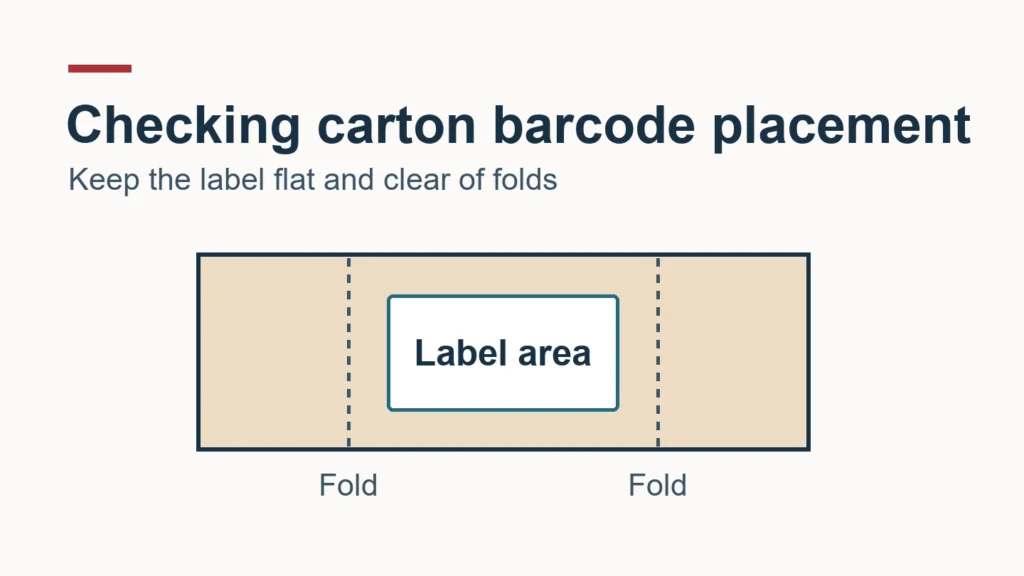
- Scannable barcodes (UPC / EAN / FNSKU): Place black bars on a flat, uncoated white quiet zone—never over curved plastic corners or glossy foil—and request a pre-production barcode scan verification photo to avoid Walmart or Amazon intake chargebacks.
- Market-specific safety & recycling marks: Include ASTM D-4236 conformance and age grading for US retail, CE / EN71 marks and mono-material recycling symbols (e.g., PAP 21, PET 01, PP 05) for Europe, plus clear “Store Horizontally” care icons.
6 Specs to Send in Your Packaging RFQ
- Barrel & tip type: Single-tip bullet/brush or dual-tip barrel, diameter (mm), length (mm), and ink system (cotton-core vs. valve-press/direct-liquid).
- Color counts & SKU mix: Target set sizes (e.g., 12 / 24 / 36 / 48 / 60 colors) and whether multiple SKUs will share one 50,000-pen production run.
- Sales channel & drop-test target: Amazon FBA (ISTA 6), big-box pegboard, art-store counter, or direct-to-consumer gifting.
- Preferred packaging structure & material rule: Folding color box, PP carry case, zipper pouch, PET/RPET blister, PDQ, or rigid gift box—noting any PVC-free or FSC requirement.
- Destination market compliance: US (ASTM D-4236 / CPSIA), EU/UK (EN71 / REACH / PPWR), and required language panels.
- Target freight mode: LCL sea, 20GP/40HQ FCL, or air/express split, so we engineer the retail box and 5-ply master carton together for maximum container fill and FBA weight compliance.
FAQs
Which acrylic marker packaging format is best for Amazon FBA?
For standard 12–36 color volume SKUs, a 350 gsm folding color box with a snug PET/RPET or paperboard tray delivers the lowest landed freight (0.90 CBM per 1,000 24-color sets) and reliable transit protection inside 5-ply FBA cartons. For 36–72+ color artist sets, a transparent PP carry case or tiered Oxford zipper pouch wins higher retail pricing and repeat storage utility.
Why should acrylic paint markers be packaged horizontally instead of upright?
Water-based acrylic paint ink uses dense suspended pigments. Long-term vertical storage—common with pegboard blister cards or upright countertop tubes—causes heavy pigments to settle at the bottom or flood the cap end. Flat-lying trays, horizontal PP cases, and lie-flat zipper pouches protect ink consistency and cut customer defect returns.
Do blister cards really fit more units in a 20GP container than color boxes?
No. A 12-color blister card needs wide hang-tab margins (roughly 25 × 19 × 1.8 cm = 855 cm³), more than double the 368 cm³ footprint of a 12-color folding color box (14.8 × 13.8 × 1.8 cm). Packed safely against crushing, 12-color blister cards fit roughly 19,440 cards per 20GP versus 59,616 12-color folding boxes.
What is the MOQ for custom acrylic marker packaging at ZH Stationery?
Custom OEM/ODM production starts at 50,000 total pens per order across all colors and sets—roughly 4,176 sets for 12-color packs, 2,088 sets for 24-color packs, or 1,060 sets for 48-color packs. Those set quantities naturally satisfy offset color box (2,000+), PP case/zipper pouch (1,000–2,000+), and rigid gift box (1,000+) packaging minimums.
Should I specify PET/RPET instead of PVC for marker trays and blisters?
Yes. North American and European retailers increasingly phase out PVC due to recyclability restrictions and EU PPWR compliance. Specifying mono-material PET, 30%–100% RPET, FSC paperboard trays, or mono-PP carry cases avoids retailer rejection and future-proofs your SKU.
How much extra ocean freight does a PP carry case or rigid gift box add?
On the exact same 24-color standard acrylic marker set, switching from a folding color box (0.90 CBM/1,000 sets) to a zipper pouch adds 98% shipping volume (1.78 CBM), a transparent PP carry case adds 108% (1.87 CBM), and a magnetic rigid gift box adds 143% (2.19 CBM)—reducing 20GP capacity from 31,104 sets down to 12,780–15,720 sets.
Next Step: Compare Real Samples
The best acrylic marker packaging format is not the one that looks richest in a studio render—it is the one that keeps pigments stable horizontally, meets your channel’s display and compliance rules, and preserves unit margin after ocean freight and FBA fees. If you are launching a new private-label line, test a folding color box alongside a PP carry case or zipper pouch so you can compare exact FOB pricing, carton CBM, and physical sample unboxing side by side.
Share your target color counts, sales channel, and preferred format with our acrylic marker OEM team via the contact page to receive structural dielines, packaging samples, and a full landed-cost comparison.
Next step for freight planning: Calculate master carton dimensions, gross weight, FBA caps, and 20GP/40HQ loads in our Carton Size & CBM Guide for Marker Sets (12–60 Colors).
OEM/ODM MOQ Policy: Custom OEM/ODM programs start at 50,000 total pens per order (counted across total individual pens produced—for example, 4,176 sets of 12 colors, 2,088 sets of 24 colors, or 1,060 sets of 48 colors). Standard stock models are available in smaller trial quantities for market validation.