
Reviewed by: ZH Stationery Quality Assurance & Production Team (8 Workshops · Tonglu, Hangzhou — ISO 9001:2015 & amfori BSCI ‘A’)
A generic 25-point factory checklist wastes time because it treats a marker plant like any plastic-molding vendor. A clean showroom, an ISO wall plaque, and one hand-picked sample tell you almost nothing about whether bulk shipments will arrive with dried-out nibs, leaking alcohol barrels, or off-shade ink six months from now.
Built from the exact audit gates our eight workshops in Tonglu, Hangzhou pass for international retail chains and private-label importers, this 12-check marker pen factory audit standard replaces vague advice with marker-specific pass/fail engineering metrics—plus a fast 45-minute live video screening track for leaner brands that do not fly a QA team to China.
Quick Answer: Two-Track Marker Factory Audit (45-Min Video vs. Full On-Site)
Match audit depth to your order risk instead of forcing an enterprise QA manual onto a first private-label launch:
| Audit Track | Best Fit Buyer | Time Required | Must-Verify Marker Factory Proof |
|---|---|---|---|
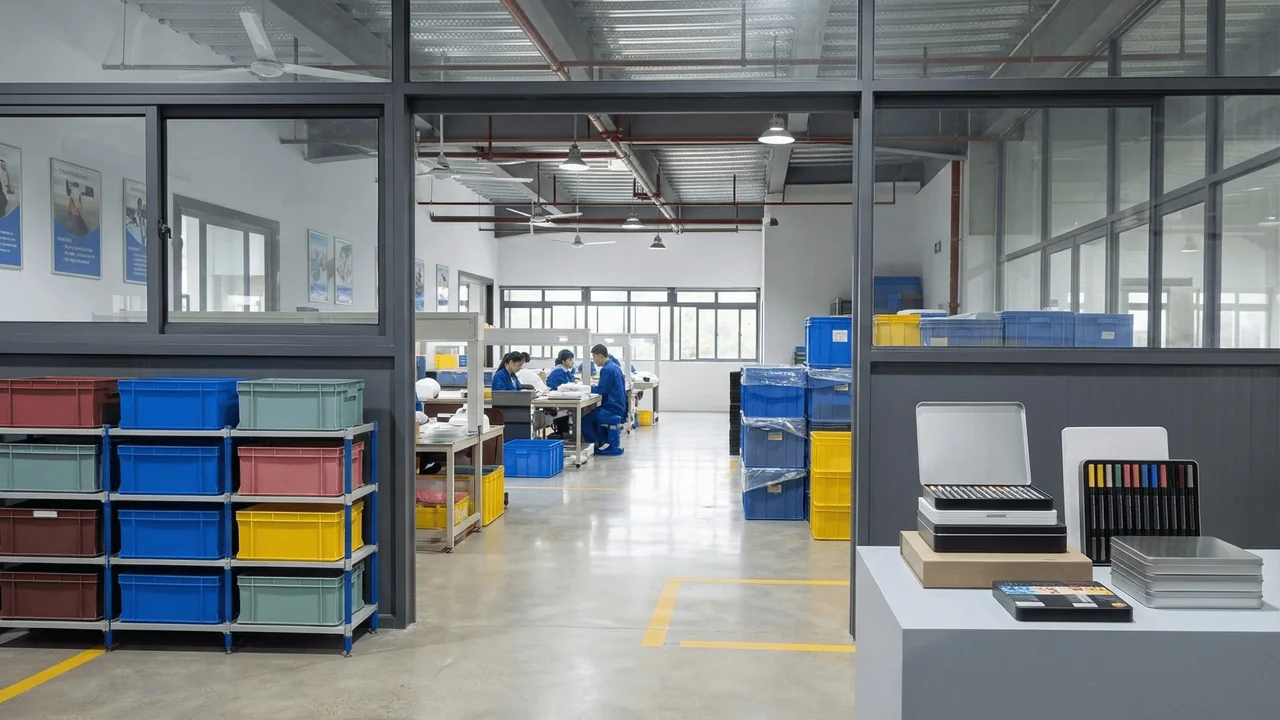
| Track A: 45-Minute Live Video Screen | Amazon FBA brands, DTC launchers & regional distributors (entry OEM programs) | 45–60 minutes on unedited video call | Walk unedited from lobby sign to injection presses, ink/retained-sample lab, vacuum leak chamber, and export cartons with live lot codes; match business license to bank beneficiary. |
| Track B: Full On-Site or SGS / QIMA Audit | National retail chains, licensed programs & 100,000+ pen OEM contracts | 1 full working day + pre-audit document review | Execute all 12 quantitative gates below: subcontractor mapping, dry-core blank fill-weight checks, -0.02 to -0.04 MPa vacuum leak testing, 45–50°C aging logs, ISO 2859-1 AQL release, and a live carton-to-ink traceability drill. |
Quick Links
- Stage 1 (Checks 1–3): Legal Entity, Real Workshops & Subcontractor Scope
- Stage 2 (Checks 4–6): Ink Chemistry, Dry-Core Weighing & Cap-Seal Lab Metrics
- Stage 3 (Checks 7–9): In-Process Patrols, ISO 2859-1 AQL & Compliance Files
- Stage 4 (Checks 10–12): Lot Traceability Drill, Carton Checks & Stop-Order Red Flags
- How ZH Stationery Opens Our Tonglu Plant to Buyer Audits & Pre-Audit Dossier
- Frequently Asked Questions
Stage 1 (Checks 1–3): Legal Entity, Real Workshops & Subcontractor Scope
Before inspecting a single marker nib, verify that the company quoting your RFQ actually owns the machinery producing your order. Many sourcing failures start when a trading intermediary presents a partner factory’s showroom and certificates while quietly switching production to a cheaper sub-plant after deposit (see our dedicated breakdown on how to distinguish a real pen manufacturer from a trading company in China).
| Check # | Audit Focus | What to Inspect (On-Site or Live Video) | Pass Criteria vs. Immediate Red Flag |
|---|---|---|---|
| 1 | Legal Identity & Bank Match | Cross-check Chinese business license (Unified Social Credit Code), export entity, proforma invoice beneficiary, and third-party lab report holder. | Pass: Exact legal match (e.g., Tonglu Zhenghua Stationery Co., Ltd.) or documented factory-to-exporter link. Red Flag: Personal or unrelated offshore bank account with evasive answers. |
| 2 | In-House vs. Outsourced Process Map | Walk the active production floor to confirm which steps happen under one roof: barrel/cap molding, ink compounding & color matching, automated assembly, barrel printing, and packing. | Pass: Clear disclosure of specialist purchased parts (precision nibs or fiber reservoirs) backed by incoming IQC logs. Red Flag: Claiming “100% in-house” while unable to show running presses or filling lines. |
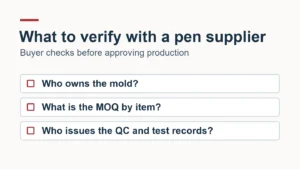
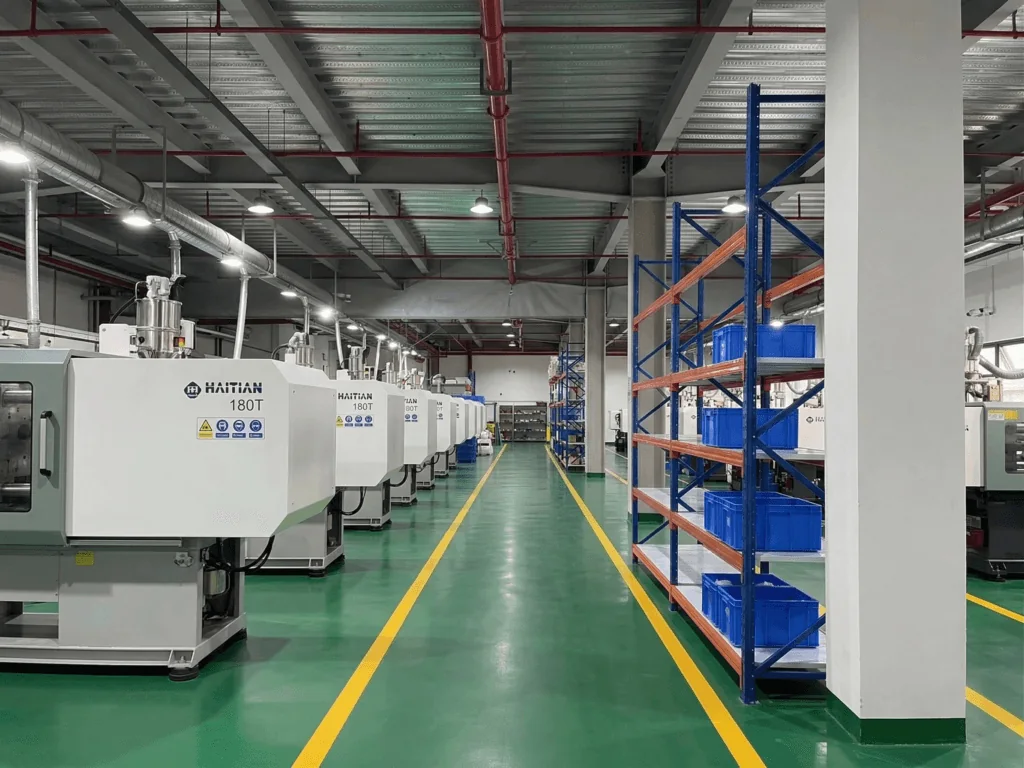
| 3 | SKU-Level Capacity & Mold Ownership | Inspect active injection press tonnage, cavity counts (16–32 cavities for commercial barrels), shift logs, and mold storage racks. | Pass: Verifiable line output matched to your specific pen structure and delivery window. Red Flag: Quoting generic monthly volume with zero line-level scheduling proof. |
Stage 2 (Checks 4–6): Ink Chemistry, Dry-Core Weighing & Cap-Seal Lab Metrics
This stage separates genuine marker manufacturers from generic assemblers. Over 80% of retail returns on acrylic paint markers, alcohol illustration markers, and multi-color pen sets trace back to four physical variables: airtight cap-seal integrity, ink fill-weight accuracy, pigment dispersion stability, and nib-to-ink capillary matching. Verify these three quantitative gates directly inside the ink and QC lab:
Check 4: Ink Formula Batch Control, 48°C Settling & D65 Color Repeatability
- What to Verify: Formula batch tickets, filtration records, 48°C accelerated settling & shake-recovery checks for heavy TiO₂ acrylic pigments, and standardized D65 daylight booth drawdowns compared against signed golden swatches (backed by calibrated L/C/H coordinates across our 1,238-color ink library).
- Why Generic Plants Fail: Matching ink shades by eye under workshop fluorescent lights causes visible batch-to-batch color drift between launch orders and reorders.
Check 5: Dry-Core Blank Ink Fill-Weight (0.01 g Scale) & Nib/Valve Calibration
- What to Verify: In-line dry/wet core weighing—or destructive wet-core extraction minus matched unfilled dry-core blanks on a calibrated 0.01 g analytical scale—plus valve actuation-force checks on pump-action acrylic markers and side-angle flex recovery tests on flexible nylon brush tips.
- Why Generic Plants Fail: Weighing a fully assembled marker masks ink under-filling because plastic barrel and cap weight tolerances easily exceed ±0.3 g.
Check 6: -0.02 to -0.04 MPa Vacuum Leak Test, Cap Pull Force & 45–50°C Aging
- What to Verify: A -0.02 to -0.04 MPa negative-pressure vacuum leak test (10 minutes) on alcohol markers to simulate air-freight cabin pressure drops, cap pull-off force gauges (10–18 N), and 7–14 day 45–50°C horizontal thermal-aging retention logs verifying airtight inner-cap sealing against dry-out.
- Why Generic Plants Fail: Skipping vacuum and 45–50°C cap-seal aging leads directly to ink burping in air cargo and dried-out nibs after ocean transit.
Stage 3 (Checks 7–9): In-Process Patrols, ISO 2859-1 AQL & Compliance Files
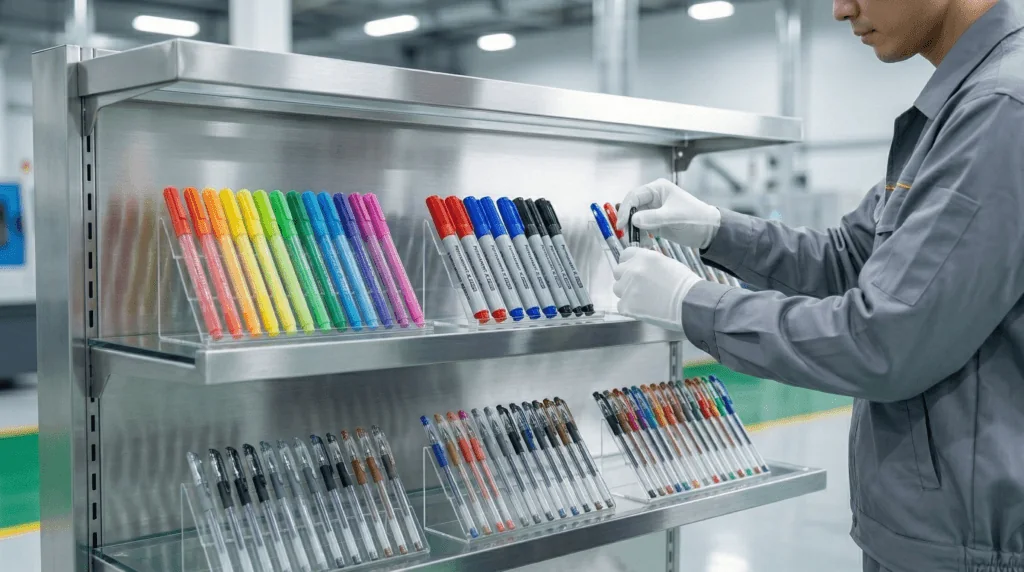
Final inspection alone cannot catch defects buried inside sealed 60-color gift sets. Audit how operators stop defective runs mid-shift, how final lots are sampled under ISO 2859-1, and whether regulatory reports actually belong to the ink inside your barrels.
| Check # | Quality System Gate | Concrete Evidence to Pull During Audit | ZH Factory Standard Benchmark |
|---|---|---|---|
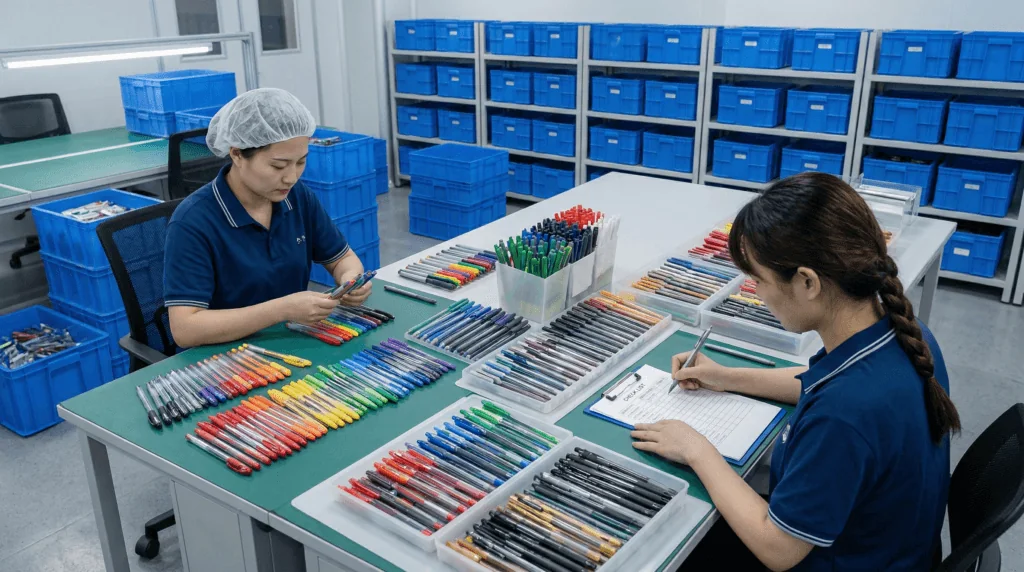
| 7 | First-Piece Sign-Off & Patrol Plan | Ask a line operator (not sales) to show the signed golden sample, defect limits, red-tag quarantine bin, and line-clearance sheet after color changeover. | Signed first-piece approval before every shift; locked quarantine bins so rejected units cannot re-enter packing without QA sign-off. |
| 8 | ISO 2859-1 Final AQL & Defect Tiers | Verify written defect criteria (Critical = leak/sharp/wrong warning; Major = dry nib, off-shade, loose cap, bad barcode; Minor = light scuff) plus calibration stickers. | ISO 2859-1 General Inspection Level II: Critical 0 / Major 1.5 / Minor 4.0 for retail private-label sets (Major 2.5 for promotional lines). |
| 9 | Formula-Matched Safety Reports | Confirm certificates match the legal factory entity, exact ink series, and market: U.S. CPSC / LHAMA & ASTM D-4236 (report verification guide), EU EN71-3, CPSIA / CPC, and 16-section SDS/MSDS. | Pre-validated standard ink platforms backed by ISO/IEC 17025 lab reports plus facility ISO 9001:2015 & amfori BSCI ‘A’ audits (view certifications). |
Stage 4 (Checks 10–12): Lot Traceability Drill, Carton Checks & Stop-Order Red Flags
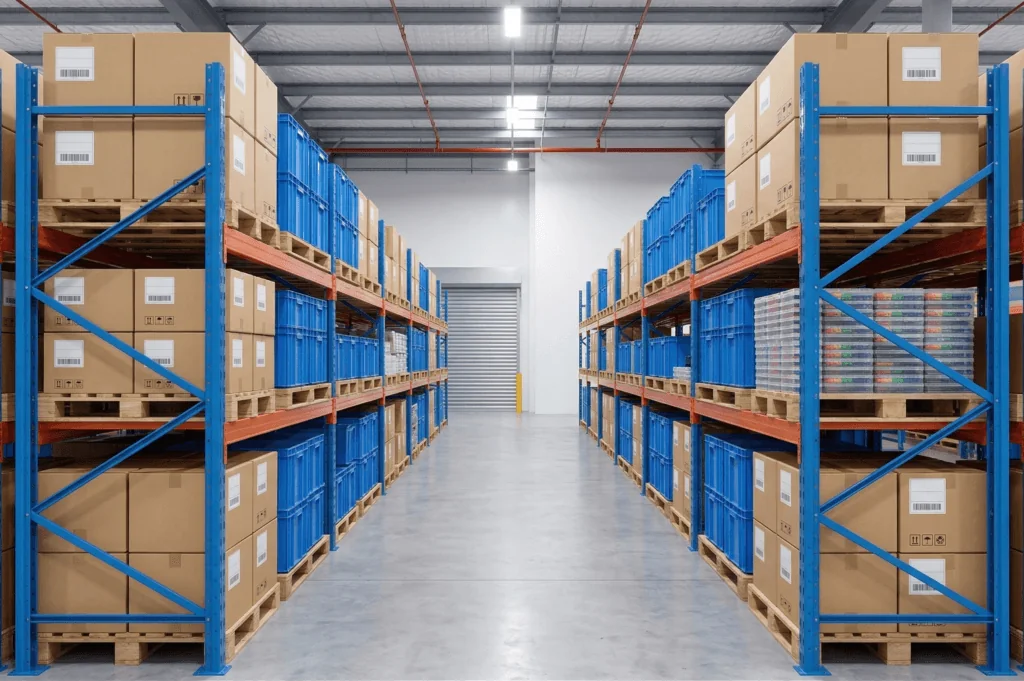
The fastest way to expose paper-only quality management is a live 15-minute traceability test in the finished-goods warehouse. Point to one sealed export carton at random and walk through these final three gates:
Check 10: 15-Minute Two-Way Lot Traceability Drill (Carton to Raw Ink)
- Live Drill: Select one sealed carton on a finished pallet and ask QA to trace its lot code backward to the exact ink batch ticket, nib lot, barrel/cap molding date, and signed AQL release sheet—then reverse-trace one raw ink batch forward to every finished carton that used it.
- Pass Requirement: Complete forward and backward traceability retrieved within 15–30 minutes, backed by archived retained finished pens and wet-ink reference bottles.
Check 11: Export Carton Orientation, Barcode Scans & Cold-Chain Marks
- Live Check: Verify horizontal packing orientation for dual-tip alcohol and acrylic sets (preventing single-end capillary pooling), inner-tray drop resilience, live ASIN/UPC barcode scans, winter freeze warnings (acrylic ink <0°C), and measured master-carton gross weight vs. quoted packing list.
- Pass Requirement: Zero discrepancy between the signed packaging specification, barcode scans, and actual palletized export cartons.
Check 12: Subcontractor Change Control & Closed-Loop CAPA
- Live Check: Pull one historical defect or customer complaint file to verify containment, root-cause investigation, corrective action, and updated work instructions—plus a written change-control clause forbidding unauthorized nib, pigment, or sub-supplier swaps after golden sample approval.
- Pass Requirement: Documented closed-loop CAPA with effectiveness verification on subsequent production lots, and zero unapproved component or formula substitutions permitted without buyer sign-off.
Global Stop-Order Red Flags (Hold Deposit Until Resolved)
Summary Veto Gates Across Stages 1–4 — Pause Your Deposit Immediately If Any Apply:
- Unexplained mismatch between business license, bank beneficiary, and third-party lab report applicant.
- Refusal to disclose outsourced ink compounding, molding, or printing—or blocking unedited live video of running production lines.
- No calibrated 0.01 g analytical scale, vacuum leak chamber, or retained-sample rack on site when quoting alcohol or acrylic paint markers.
- Rejected pens stored loose beside active packing tables without red-tag quarantine controls.
- Safety or toxicology certificates belonging to a different ink chemistry, older revision, or unrelated manufacturer.
How ZH Stationery Opens Our Tonglu Plant to Remote & On-Site Audits
We publish these exact 12 engineering gates because we run them daily across our 10,000+ sqm, 8-workshop facility in Tonglu, Hangzhou (established in 2000; explore our virtual factory tour). Whether you send an SGS/QIMA inspector ahead of a container launch or qualify us over a 45-minute live video walkthrough, our QA team welcomes unscripted inspections across injection molding, ink color matching, vacuum leak testing, and AQL carton staging.
Transparent Order Minimums (Two Independent Factory Floors — Whichever Is Higher): Custom OEM/ODM production at ZH Stationery is governed by two separate thresholds so buyers can plan exact volumes with zero math surprises:
- Total Pen Production Floor (~50,000 total pens per order): Covers automated filling, barrel printing, and collation setup—meaning a 12-color set starts at roughly 4,000–4,200 sets (~48,000–50,400 pens) and a 24-color set starts at 2,000 sets (48,000 pens) when drawing from our 1,238-color standard ink library.
- Custom Printed Packaging Floor (typically 2,000 custom boxes/cases per SKU): On larger 48- to 168-color sets, printing 2,000 bespoke retail boxes or zippered cases brings total pen volume to 96,000–336,000 pens. Brands testing smaller initial launches on 60–168 color sets can lower set count closer to the ~50,000-pen floor by pairing neutral/stock carry cases with custom sleeve labels or woven patches (see full BOM tiers in our custom marker pen sets OEM guide). Standard stock markers are also available in small trial quantities for blind lab testing prior to audit.
Skip the Guesswork: Request Our Pre-Audit Dossier or Book a Live Video Tour
Not ready to send an RFQ yet? Start your supplier due diligence with zero sales pressure. We send qualified sourcing teams our verified Pre-Audit Dossier within 24 hours:
- Current ISO 9001:2015 & amfori BSCI ‘A’ audit certificates + Chinese business license
- Redacted ISO 2859-1 AQL inspection record & lab equipment calibration list
- Fillable 12-Check Marker Factory Audit Scorecard for your on-site or SGS/QIMA team
Request Pre-Audit Dossier & Scorecard Book a 45-Min Live Video Walkthrough
Frequently Asked Questions
How long should a marker pen factory audit take?
A focused on-site or SGS/QIMA audit for a single-site marker factory typically takes one full working day, preceded by remote document verification of licenses, BSCI/ISO certificates, and lab reports. For smaller private-label buyers screening a supplier before sampling, a structured 45-minute unedited live video walkthrough covers legal identity, active molding and filling lines, lab testing gear, and warehouse lot codes.
Is ISO 9001 certification alone enough to approve a marker pen factory?
No. ISO 9001:2015 confirms that a documented quality management system exists, but it does not guarantee marker-specific controls. Buyers still need hands-on verification of dry-core ink weighing, -0.02 to -0.04 MPa vacuum leak testing, 45–50°C cap-seal aging logs, D65 shade matching, and formula-matched ASTM D-4236 or EN71-3 safety reports.
What is the single most revealing marker-specific test during a factory audit?
Combining a live 15-minute finished-carton traceability drill with physical verification of in-house dry-core blank weighing (0.01 g scale), a negative-pressure vacuum leak chamber, and a 45–50°C thermal-aging retention rack immediately separates true marker manufacturers from trading intermediaries or low-control assemblers.
What ISO 2859-1 AQL levels are standard for OEM marker pen inspections?
Most retail chains, Amazon FBA brands, and private-label importers specify ISO 2859-1 (or ANSI/ASQ Z1.4) under General Inspection Level II with acceptance limits of Critical: 0, Major: 1.5, and Minor: 4.0 (while basic promotional pens sometimes allow Major: 2.5). Written defect definitions for dry nibs, cap pull-off force, and shade drift must be signed alongside your golden sample.
Should buyers audit subcontractors for nibs, reservoirs, or packaging?
You do not need to visit every component vendor personally, but the marker factory must prove incoming quality control (IQC) over every safety- or performance-critical purchased part—especially polyester/nylon nibs, fiber reservoirs, valves, pigments, and printed retail cartons—with lot traceability and strict approval rules before switching any sub-supplier.
Can a 45-minute remote video audit replace an on-site visit?
A live, unedited video walkthrough is highly effective for initial supplier screening, verifying real molding and assembly workshops, and checking calibration stickers before ordering samples. For first-time 100,000+ pen retail programs or custom steel tooling launches, pair remote screening with an on-site pre-shipment AQL inspection by your QA team or an accredited agency such as SGS, QIMA, or Bureau Veritas.