

Reviewed by: ZH Stationery Engineering & QA Team (Tonglu Zhenghua Stationery Co., Ltd. · 200 Chenshan Road, Tonglu, Hangzhou)
Quick Answer: Our 7 Tonglu Factory OEM Engineering Standards
Manufacturing private-label glitter markers is a particle-suspension and fluid-delivery challenge—not just adding shimmer to standard paint. Across our eight workshops in Tonglu, Hangzhou (ZH Stationery), we mass-produce three dedicated OEM glitter platforms: our Glitter Acrylic Marker, our Duo-Color Glitter Acrylic Marker, and our high-opacity Super Glitter Acrylic Paint Marker range.
Here are the seven core engineering checkpoints and factory reference ranges our Tonglu ink and QA teams use to qualify OEM glitter marker orders (with exact production tolerances locked on your signed pre-production golden samples):
| # | OEM Engineering Check | ZH Tonglu Factory Reference Standard | Defect Prevented |
|---|---|---|---|
| 1 | Glitter Material & Particle Size | 10–40 µm mica/fluorphlogopite (direct-liquid brush); 50–150 µm flakes (valve-press nibs) | Clogged nibs & dull metallic finish |
| 2 | Nib Porosity & Valve Aperture | Open-pore 2.0–4.0 mm bonded polyester valve nibs + dual stainless/glass balls, or direct-liquid nylon brush | Clear binder streaks & jammed valves |
| 3 | Shear-Thinning Viscosity | Reference 8–15 mPa·s (direct-liquid) / 15–25 mPa·s (valve-press) measured via Brookfield LV, 25°C, Spindle #1/#2 @ 60 rpm | Hard-caking vs. sluggish ink starvation |
| 4 | Dry Time & Surface Adhesion | 10–30 s touch-dry on paper; 1–3 min on glass/ceramic; 24 h full cure (sealer needed for washable non-porous wear) | Smearing & false permanence returns |
| 5 | Anti-Settling & AQL Release | 48–50°C for 7–14 days during golden-sample qualification (15–20 s shake recovery) + same-day D65 & valve AQL checks | Settled barrels after ocean transit |
| 6 | US/EU Safety & EU 2023/2055 | ASTM D-4236 / LHAMA, EN71-3, CPSIA / CPC, Non-DG SDS, plus polymer-glitter-free inorganic mica/fluorphlogopite pigments | EU microplastics holds & FBA takedowns |
| 7 | Dual-Gate MOQ & Packaging | 2,000 sets min. per box artwork + ~48,000–50,000 pens order volume (2,000 sets for 24–36 colors; 3,000–4,200 sets for 12 colors) | Under-batched quotes & crushed trays |
Quick Links
- Checks 1 & 2: Particle Size (10–150 µm) Matched to Nib Porosity & Valve Aperture
- Checks 3 & 4: Viscosity Test Conditions, Cure Times & Substrate Adhesion
- Check 5: 50°C Anti-Settling Qualification & Same-Day Pre-Shipment AQL QC
- Check 6: ASTM D-4236, EN71-3 & EU 2023/2055 Polymer-Glitter-Free Pigments
- Check 7: Packaging Formats, Pen-Count vs. Set-Count MOQ & Lead Time
- Frequently Asked Questions
Checks 1 & 2: Particle Size (10–150 µm) Matched to Nib Porosity & Valve Aperture
Most glitter marker failures occur when bold decorative flakes are forced through a fine-pore acrylic nib. A dispersion that sparkles in a mixing tank will bridge and clog within ten strokes if flake diameter exceeds the nib pore channel or valve aperture. Below are the four sparkle architectures engineered in our Tonglu plant (compare hardware mechanics in our valve-press marker technology and valve-press vs. fiber tip guide):
| Glitter Architecture | Particle Spec & EU 2023/2055 Status | Matched Nib & Valve Hardware | Best Commercial Fit |
|---|---|---|---|
| Fine Pearlescent Shimmer | 10–40 µm coated natural mica or synthetic fluorphlogopite (polymer-glitter-free) | Direct-liquid regulator + 1–5 mm flexible nylon brush (cap-off instant write) | Journaling, brush lettering & kids craft kits |
| High-Luster Mineral Glitter | 40–100 µm coarse synthetic fluorphlogopite platelets (polymer-glitter-free; EU + US flagship) | 2.0–3.0 mm open-pore polyester valve nib + dual mixing balls | Rock painting, dark cardstock, wood signs & holiday DIY |
| Chunky PET Super-Sparkle | 50–150 µm (~100–250 mesh) metallized PET flakes (synthetic polymer; non-EU / regional scope) | Wide-aperture valve stem + 3.0–4.0 mm high-porosity nib + dual stainless balls | Bold US craft chains, poster signage & gift sets |
| Duo-Color Metallic Outline | 15–35 µm metallic/mica core + dye halo (polymer-glitter-free mineral option) | Calibrated 2.0 mm bullet valve nib (ZH Duo-Color Glitter) | Greeting cards, scrapbooking & teen gift packs |

Checks 3 & 4: Viscosity Test Conditions, Cure Times & Substrate Adhesion
Check 3 — Shear-thinning rheology with defined test conditions: Because thixotropic glitter suspensions exhibit different apparent viscosities under rest versus high-shear writing, quoting a single viscosity number without measurement conditions is meaningless for QA engineers. As an in-house baseline measured on a Brookfield LV rotational viscometer at 25°C (Spindle #1 or #2 at 60 rpm), our direct-liquid shimmer formulas typically target 8–15 mPa·s while our higher-suspension valve-press glitter formulas target 15–25 mPa·s—with exact low-shear/high-shear targets calibrated per flake loading and confirmed on your golden-sample specification sheet.
Check 4 — Drying windows and honest substrate claims: On porous substrates (black cardstock, raw wood, matte stone, and canvas), water-based acrylic glitter ink reaches touch-dry in 10–30 seconds and anchors mechanically into surface pores. On non-porous glass, glazed ceramic, smooth plastic, or metal, touch-dry takes 1–3 minutes depending on coat thickness and humidity, with full polymer film cure taking 24 hours. Because cured waterborne acrylics can still scratch off slick glass or dishwasher-washed mugs, never print blanket “permanent on all surfaces” claims—specify clear acrylic varnish sealing or low-heat curing where wash durability is required.

Check 5: 50°C Anti-Settling Qualification & Same-Day Pre-Shipment AQL QC
A freshly filled glitter sample writes effortlessly on day one; real field complaints emerge two months later after warm ocean transit. To protect shelf life without stalling our 25–30 day bulk lead time, ZH Stationery separates multi-day qualification aging from same-day pre-shipment AQL batch release:
- 48–50°C Accelerated Settling Qualification (Golden Sample & Retained Batch Tracking): During pre-production qualification and new pigment-lot intake, filled samples undergo 7–14 days at 48–50°C in horizontal and upright orientations to confirm 15–20 second shake-back re-suspension with zero hard-caking around the mixing balls. Matched retained samples from each bulk lot are logged in our retention room in parallel so finished containers ship on schedule.
- Valve Actuation & Cap Seal Verification (Every Shipment Release): Same-day AQL sampling checks spring-valve actuation force and concentric cap pull-off force (reference 10–18 N, confirmed per barrel mold) to prevent both dry tips and priming floods.
- D65 Black/White Card Drawdowns (Every Shipment Release): Production lots are drawn down on black and white opacity cards under D65 daylight and compared against signed golden samples for base hue (from our 1,238-color Ink Color Management library) and sparkle uniformity.
- Winter Freeze-Thaw Transit Controls (Q4/Q1 Shipments): Because water-based acrylic emulsions break down permanently below 0°C, winter shipments bound for North America or Northern Europe use cold-transit warning cartons and optional thermal liners (see winter freight cost math in our acrylic vs. alcohol B2B sourcing guide).
Check 6: ASTM D-4236, EN71-3 & EU 2023/2055 Polymer-Glitter-Free Pigments
Glitter marker compliance spans both art-material toxicology and European microplastics rules. Manufacturing inside our ISO 9001:2015 certified and amfori BSCI-audited (TÜV Rheinland Monitoring ID 26-0412887) Tonglu plant (view all certificates and factory tour) gives importers verifiable documentation:
- United States & Canada: Supported by third-party ASTM D-4236 / LHAMA chronic hazard evaluations (ASTM D-4236 report guide), CPSIA / CPC documentation for children’s kits, and updated 16-section Non-DG SDS/MSDS. Because waterborne acrylic glitter inks contain no flammable solvents, shipments clear air express, ocean freight, and Amazon FBA standard receiving without Hazmat volume limits.
- European Union & UK (EU REACH 2023/2055 Precision): Under EU Commission Regulation (EU) 2023/2055, waterborne acrylic binder resins form a continuous polymer film upon drying (a distinct regulatory pathway from solid microplastic particles), whereas intentionally added PET plastic glitter flakes face strict restriction. For EU retail programs, we supply polymer-glitter-free inorganic mineral pigments (synthetic fluorphlogopite or natural mica) backed by full pigment composition data, EN71-3 migration testing, and REACH / SVHC compliance.

Check 7: Packaging Formats, Pen-Count vs. Set-Count MOQ & Lead Time
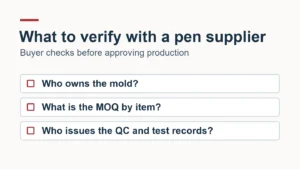
In honest OEM manufacturing, minimum order quantity is governed by two parallel gates: (1) total pen / per-shade filling batch volume (typically ~48,000–50,000 total pens per order and at least 2,000 pens per shade for economic glitter dispersion mixing), and (2) custom packaging conversion minimums (starting at 2,000 sets per printed box artwork). That is why a 24- or 36-color set clears both gates at 2,000 sets (48,000–72,000 pens), while a smaller 12-color retail pack typically starts at 3,000–4,200 sets (36,000–50,400 pens) unless two 12-color assortments share the same barrel mold and ink batch (compare carton CBM math in our packaging options guide and 7 OEM cost-cutting decisions guide).
| OEM Program & Packaging Format | Realistic Factory MOQ (Sets & Total Pens) | Tooling & Setup Cost | Bulk Lead Time |
|---|---|---|---|
| 24–36 Color Set (Public Mold + Folding Color Box or Zippered Carry Bag) | 2,000 sets per box artwork (48,000–72,000 pens total; 2,000 pcs/shade) | $0 barrel mold; $200–$600 die-cut & PET tray setup | 25–30 days after sample sign-off |
| 12–18 Color Set (Public Mold + Folding Color Box / PP Case / Blister) | 3,000–4,200 sets (36,000–50,400 pens total), or 2,000 sets per SKU when combining 2 themes on shared stock shades | $0 stock PP case mold (or $200–$700 die-cut / blister mold) | 25–30 days |
| Custom-Printed Metal Tin Box or Bespoke Custom-Mixed Glitter Shade | 3,000–5,000 sets | $0 existing tin size (or $3,000–$8,000 new tin stamping die) | 30–40 days |
| Proprietary Custom Barrel & Cap Steel Mold (Full ODM) | 5,000+ sets (100,000+ pens) | $15,000–$35,000+ multi-cavity hot-runner steel mold | 45–60 days tooling + 25–30 days bulk |
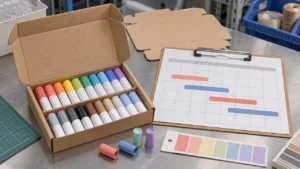
Every retail pack should store barrels horizontally to keep mineral flakes evenly distributed along the barrel and include a concise 3-icon usage strip (Shake 15s → Press to Prime → Recap Tightly). For a wider look at China’s export workshops, read our China paint marker manufacturers export guide.
Frequently Asked Questions
How Do Synthetic Fluorphlogopite and Natural Mica Address the EU 2023/2055 Microplastics Restriction?
EU Commission Regulation 2023/2055 targets intentionally added synthetic polymer microparticles such as conventional PET plastic glitter flakes. While waterborne acrylic binder resins form a continuous polymer film upon drying (a distinct regulatory category under the regulation), replacing PET plastic flakes with inorganic mineral pigments—coated synthetic fluorphlogopite or natural mica—delivers high-luster sparkle with polymer-glitter-free pigments suited for European retail compliance reviews.
Should a Private-Label Glitter Marker Line Use Valve-Press Tips or Direct-Liquid Nylon Brush Tips?
Choose valve-press bullet or chisel tips (2.0–4.0 mm open-pore bonded polyester) when your priority is larger 50–150 µm sparkle flakes and opaque coverage on rocks, wood, or dark cardstock. Choose direct-liquid nylon brush tips paired with finer 10–40 µm mineral pearlescent pigments when targeting journalers, card makers, and kids craft kits who expect immediate cap-off writing without pumping a spring valve.
Why Do Some Glitter Markers Write Clear Binder First, and How Does ZH Stationery Prevent It?
Clear binder streaks appear when dense glitter flakes compact at the bottom of the barrel and the suspension system cannot hold particles evenly—or when a single lightweight ball fails to break up sediment. We match shear-thinning viscosity (monitored by Brookfield LV rotational viscometer at 25°C) to the chosen nib porosity, install dual glass or stainless-steel mixing balls, and verify 15–20 second shake-back uniformity during pre-production sample qualification.
Why Does a 12-Color Glitter Set Require More Boxes Than a 36-Color Set to Meet Factory MOQ?
Glitter ink mixing and automated filling lines require a minimum economic pen volume—typically 48,000–50,000 total pens per production order (and at least 2,000 pens per individual shade)—alongside a 2,000-box minimum for custom offset color boxes. A 24- or 36-color set naturally meets both thresholds at 2,000 sets (48,000–72,000 pens), whereas a 12-color set typically runs at 3,000–4,200 sets (36,000–50,400 pens) unless two 12-color themes share the same public mold and ink batch.
What Pre-Production Evidence Should Buyers Sign Off Before Releasing Bulk Glitter Marker Production?
Never authorize mass production from one freshly filled wet stroke. Lock signed pre-production golden samples backed by dried drawdowns on white and black opacity cards under D65 daylight, confirmed ink and particle specifications (including mineral pigment CAS/composition for EU programs), verified cap-seal and valve opening checks, and an updated 16-section non-DG SDS. Multi-day 48–50°C thermal settling observation can be scheduled as part of your pre-production QA sign-off window.
Request ZH Stationery Glitter Marker Samples & Factory Quote
Ready to evaluate our polymer-glitter-free mica shimmer brushes or high-sparkle valve-press glitter paint markers on your target substrates? Use the Get a Free Quote form on this page—or contact our Tonglu engineering team via our direct contact page and browse our Glitter Acrylic Marker and Super Glitter range. Share your target market (US/EU), set size, packaging format, and planned order quantity, and we will prepare physical test samples, dried color swatches, current Non-DG SDS documentation, and an itemized FOB quote.