
Знаете ли вы, что повседневные школьные и офисные принадлежности иногда могут содержать вредные химические вещества? Поэтому тестирование на формальдегид в письменных принадлежностях важно для безопасности.
В руководстве ВОЗ 2010 года по качеству воздуха в помещениях для отдельных загрязнителей указан формальдегид. Они касаются воздействия в воздухе помещений. Они не устанавливают универсального предельного значения для письменных принадлежностей. При тестировании продукции следует указывать отобранную часть, применимый стандарт на продукцию и использованный метод испытаний.
Для защиты покупателей и поддержания сильного бренда необходимы надежные услуги по тестированию.

Важность тестирования на формальдегид в канцелярских товарах и стандарты
Для обеспечения безопасности покупателей национальные и международные организации установили строгие правила в отношении вредных компонентов в письменных принадлежностях.
Для ученических товаров, входящих в его область применения, GB 21027-2020 является китайским стандартом на продукцию, который следует проверять. Его требования зависят от изделия и его части. Отдельно подтверждайте требования рынка назначения. Отчет по китайскому стандарту сам по себе не подтверждает соответствие для каждого экспортного рынка.
Проводя испытания по этим стандартам, производители демонстрируют свою работу по экологичному, безопасному и высококачественному производству.
Лабораторный метод: спектрофотометрия с ацетилацетоном
В официальном описании GB/T 32606-2016 метод определения формальдегида указан как спектрофотометрия с ацетилацетоном. Попросите лабораторию указать редакцию метода. Убедитесь, что этапы отбора проб и экстракции соответствуют испытуемой части.
Основной принцип:
Метод с ацетилацетоном позволяет получить окрашенный продукт реакции. Лаборатория сравнивает его оптическую плотность с калибровочными растворами. Лаборатория должна соблюдать указанные условия подготовки реагентов, экстракции, реакции и измерения. Этот обзор не является полным стандартом. Он также не является лабораторной процедурой.
Что проверять в лабораторном отчете
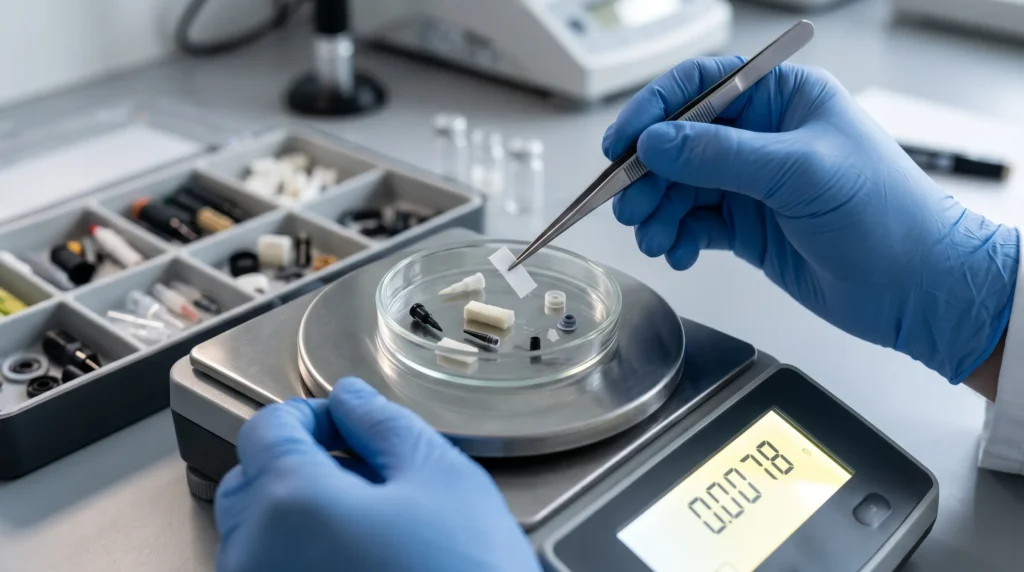
Используйте эти четыре пункта для проверки отчета вместе с лабораторией. Полный метод испытания устанавливает массу образца, условия экстракции, объемы реагентов, время реакции и диапазон калибровки. Не выводите их из общей статьи о закупках.
1. Подготовка образца
Укажите модель, деталь и материал отобранного образца. Спросите, как деталь была подготовлена и экстрагирована в соответствии с указанным методом. Подтвердите, что в отчете указан именно этот образец, а не другой продукт или партия.
2. Цветная реакция
Проверьте, что лаборатория следовала указанному методу при подготовке реагентов, проведении реакции и измерении оптической плотности. Попросите разъяснений, если в отчете не указан метод или описана измененная процедура.
3. Создание калибровочной кривой
Спросите, как были установлены диапазон калибровки и холостая проба метода. Спросите, попадал ли результат образца в проверенный диапазон измерений. Применяемый метод, а не общая статья, устанавливает уровни калибровки.
4. Считывание результатов
Прочитайте указанное значение с его единицами измерения, пределом обнаружения или количественного определения и применимым пределом допустимости. Значение ниже предела отчетности следует читать как указано. Не называйте это доказательством отсутствия формальдегида.
Итоговая формула расчета
Выражение ниже показывает изменение единиц только тогда, когда c уже скорректировано на холостую пробу и учтено дополнительное разбавление. Полный метод и расчеты лаборатории определяют окончательный результат. Это выражение не является полной процедурой GB/T 32606.
x = (c × f) / m
- x = Количество свободного формальдегида в образце (мг/кг)
- c = Концентрация, скорректированная на холостую пробу, с учетом любого дополнительного разбавления (мкг/мл)
- f = Объем, до которого была разбавлена жидкость образца (мл)
- m = Точная масса исходного образца (г)
Проверьте холостую пробу метода, коэффициенты разбавления и единицы отчетности вместе с лабораторией. Одна только коррекция холостой пробы не означает, что итоговое значение является точным.
Надежное тестирование для вашего спокойствия
Обеспечение безопасности продукции — это не только требование закона. Это забота о ваших клиентах.
Выбирайте лабораторию, чья действующая область аккредитации покрывает необходимый метод. Проверяйте непосредственно организацию, выдавшую отчёт, наименование образца и область аккредитации. Данная статья не устанавливает текущие полномочия или область аккредитации какой-либо упомянутой лаборатории.
Для маркеров и других пишущих принадлежностей протокол испытаний фиксирует образец, метод и результаты. Сравните эти результаты с применимыми требованиями к продукции. Аккредитация не означает, что каждая непроверенная модель, деталь или партия не содержит вредных компонентов.
Связанное руководство: Как читать отчет об испытаниях по стандарту ASTM D-4236 для акриловых маркеров.
Связанные материалы
- За пределами “Нетоксично”: скрытая правда о пищевых чернилах для детских маркеров
- Стандарты качества цветных карандашей и будущие тенденции: что вам нужно знать
- руководство по съедобным маркерам
- руководство по классическому материалу для доски
- Руководство по чернилам для маркеров сухого стирания
- Руководство по удалению следов маркера для сухого стирания
- Удаление перманентного маркера с пластика
Why Formaldehyde Still Appears in Stationery
Formaldehyde is not added to markers on purpose. It arrives as a residual from three sources: adhesives in packaging, preservatives in water-based ink, and finishes on wooden or paper components. In each case the amount is small, but the regulatory limit is also small, and the test measures what is present rather than what was intended.
The adhesive route is the most common. Casein and urea-formaldehyde glues are cheap and strong, which is why they still appear in some cartons and laminated boards. A marker itself may pass while the display box it ships in does not.
The ink route matters for water-based formulas. Some preservative systems release formaldehyde slowly as they break down, which is why a freshly mixed batch can pass and a batch tested after six months in a warehouse can fail. That is not a manufacturing defect in the usual sense; it is a formulation choice with a time dimension.
How the Acetylacetone Method Works
GB/T 32606-2016 specifies acetylacetone spectrophotometry as the formaldehyde test method. The procedure runs in four stages.
Extraction. The sample is placed in water at a controlled temperature for a set period. Formaldehyde migrates into the water. The extraction time and temperature are specified, and changing either one changes the result.
Reaction. Acetylacetone reagent is added. In the presence of ammonium acetate, formaldehyde reacts to form a yellow compound, 3,5-diacetyl-1,4-dihydrolutidine. The reaction needs a fixed time and temperature to complete.
Measurement. The solution is read in a spectrophotometer at 412 nanometers. Absorbance is proportional to formaldehyde concentration within the calibrated range.
Calculation. Concentration is derived from the calibration curve, corrected for the blank, and converted to milligrams per kilogram of sample.
The formula only works when the blank is properly corrected and any additional dilution is counted. A report that quotes a number without stating the method edition, the extraction conditions, and the blank value is not reproducible.
Reading a Report: What the Numbers Mean
Three numbers matter on a formaldehyde report: the result, the limit, and the detection limit.
The result should be expressed in mg/kg with the measurement uncertainty stated. A result of 15 mg/kg with an uncertainty of plus or minus 3 is a different statement from 15 mg/kg with no uncertainty given.
The limit depends on the destination market and the product category. Textile and wood components have their own limits under separate standards; stationery is often assessed against the general consumer goods framework. Confirm which limit applies before comparing a result to a pass threshold.
The detection limit tells you whether the test could actually see a failure. A method with a detection limit of 20 mg/kg cannot demonstrate compliance with a 16 mg/kg limit, no matter what the result says.
Sampling and Extraction: Where Tests Go Wrong
Most false passes and false failures trace to sampling, not to the instrument.
The sample must represent the batch. A single marker taken from the top of a carton is not a batch sample. The correct approach is to composite material from several units, because formaldehyde distribution within a production run is not uniform.
The extraction conditions must match the method. Water temperature, extraction time, and the ratio of sample mass to water volume all affect the result. A lab that shortens the extraction to save time will report a lower number than the method intends.
The tested part must be the part that matters. For a marker, that means the barrel, the cap, the ink, and the packaging assessed separately, because each has a different risk profile and a different limit may apply.
Часто задаваемые вопросы
Does passing a formaldehyde test mean the product is safe? No. It means formaldehyde is below the applicable limit for that test method. Other substances are covered by other tests.
How often should formaldehyde be retested? At minimum once per production batch, and again whenever the ink supplier, adhesive supplier, or packaging supplier changes.
Can a factory self-test? It can screen internally, but the report that goes to a retailer should come from an accredited third-party lab with the method edition stated.
What happens if a batch fails? The batch should be held, the source identified — ink, adhesive, or packaging — and the affected lots traced. Retesting the same sample rarely changes the result.
Where Formaldehyde Comes From in the Supply Chain
The test measures what is present, not what was intended. Three upstream sources account for most failures.
Adhesive suppliers. Casein and urea-formaldehyde glues remain cheap and strong, which is why they still appear in laminated boards and some cartons. A marker can pass while the display box it ships in does not. Ask for the adhesive declaration separately from the ink declaration.
Preservative systems in water-based ink. Certain preservatives release formaldehyde as they break down. A freshly mixed batch passes; the same batch tested after six months in a warm warehouse may not. This is a formulation choice with a time dimension, and it is the most common cause of a late failure.
Wood and paper components. Pencil barrels, wooden display stands, and some paper stocks carry residual formaldehyde from processing. These are usually low, but they add to the total when the test composites multiple materials.
The practical implication: test the finished product as it ships, not the individual components in isolation. A composite sample catches the additive effect that single-component testing misses.
Setting a Retest Cadence That Actually Catches Drift
Most programs retest once per production batch, which is not enough to catch a slow drift.
A supplier can change an adhesive vendor, a preservative concentration, or a packaging source without announcing it, and the change shows up three batches later as a failed test. The cadence that catches this has three triggers.
Per batch. A basic screening test on every production run. This is a factory-side control, not a third-party report.
Per quarter. A full third-party report on the current production. This catches drift before it becomes a retailer issue.
Per change. Any change to ink supplier, adhesive supplier, packaging supplier, or formulation triggers an immediate retest regardless of the quarterly schedule. This is the trigger most programs omit, and it is the one that catches the failures that matter.
Put the change trigger in the purchase order, not in a side agreement. A clause that requires notification before any material substitution is enforceable; a verbal understanding is not.