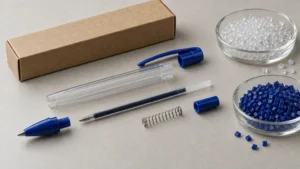

Czy wiesz, że codzienne artykuły szkolne i biurowe mogą czasem zawierać szkodliwe substancje chemiczne? Dlatego badanie formaldehydu w produktach piśmienniczych ma znaczenie dla bezpieczeństwa.
Wytyczne WHO z 2010 r. dotyczące jakości powietrza wewnętrznego dla wybranych zanieczyszczeń obejmują formaldehyd. Dotyczą one narażenia w powietrzu wewnętrznym. Nie ustalają uniwersalnego limitu dopuszczalnego dla produktów piśmienniczych. Badanie produktu powinno wskazywać badaną część, obowiązującą normę produktową oraz zastosowaną metodę badawczą.
Aby chronić nabywców i utrzymać silną markę, niezbędne są wiarygodne usługi badawcze.
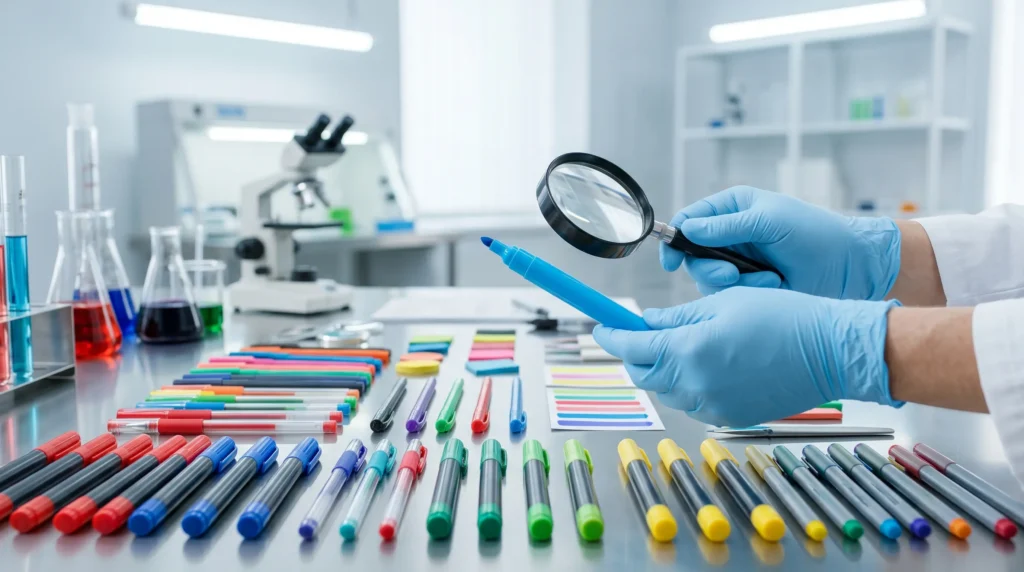
Znaczenie testowania formaldehydu w artykułach papierniczych i normy
Aby zapewnić bezpieczeństwo nabywcom, krajowe i międzynarodowe organizacje ustanowiły surowe przepisy dotyczące szkodliwych składników w produktach piśmienniczych.
Dla artykułów szkolnych objętych jej zakresem, GB 21027-2020 jest chińską normą produktową, którą należy sprawdzić. Jej wymagania zależą od artykułu i części. Wymagania rynku docelowego należy potwierdzić oddzielnie. Sam raport zgodny z chińską normą nie świadczy o zgodności dla każdego rynku eksportowego.
Badając zgodnie z tymi normami, producenci wykazują swoje zaangażowanie w ekologiczną, bezpieczną i wysokiej jakości produkcję.
Metoda laboratoryjna: spektrofotometria z acetyloacetonem
Oficjalny wykaz dla GB/T 32606-2016 określa metodę badania formaldehydu jako spektrofotometrię z acetyloacetonem. Należy poprosić laboratorium o podanie wersji metody. Należy potwierdzić, że etapy pobierania próbek i ekstrakcji odpowiadają badanej części.
Podstawowa zasada:
Metoda z acetyloacetonem tworzy barwny produkt reakcji. Laboratorium porównuje jego absorbancję z roztworami kalibracyjnymi. Laboratorium musi przestrzegać określonych warunków przygotowania odczynników, ekstrakcji, reakcji i pomiaru. Ten przegląd nie jest pełną normą. Nie jest również procedurą laboratoryjną.
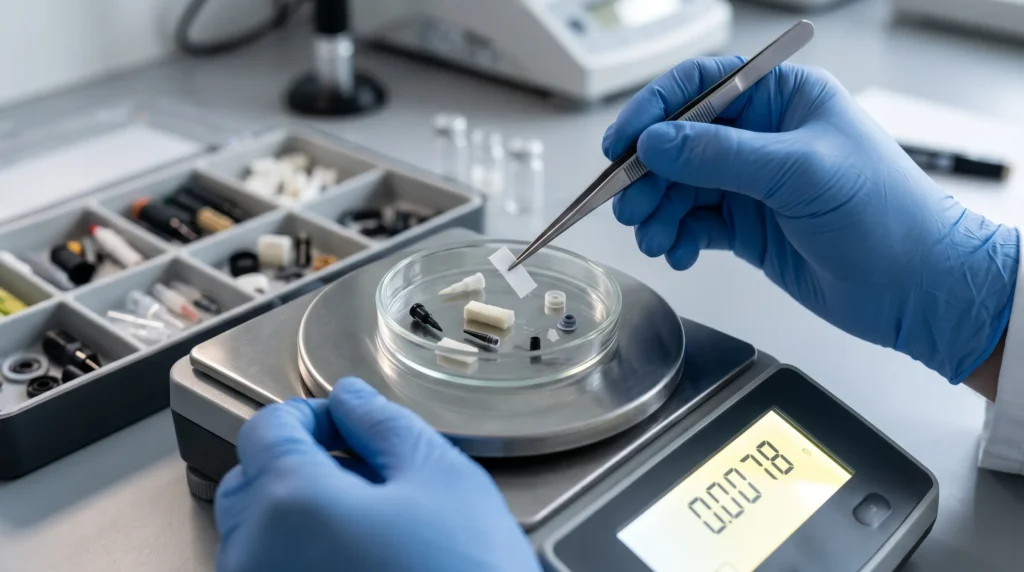
Co sprawdzić w raporcie laboratoryjnym
Skorzystaj z tych czterech punktów, aby przejrzeć raport z laboratorium. Pełna metoda badawcza określa masę próbki, warunki ekstrakcji, objętości odczynników, czas reakcji i zakres kalibracji. Nie należy ich wywnioskować z ogólnego artykułu o zaopatrzeniu.
1. Przygotowanie próbki
Podaj badany model, część i materiał. Zapytaj, w jaki sposób część została przygotowana i poddana ekstrakcji zgodnie z cytowaną metodą. Potwierdź, że raport dotyczy próbki, a nie innego produktu lub partii.
2. Reakcja barwna
Sprawdź, czy laboratorium postępowało zgodnie z cytowaną metodą w zakresie przygotowania odczynników, reakcji i odczytu absorbancji. Poproś o wyjaśnienie, jeśli raport nie podaje metody lub opisuje zmienioną procedurę.
3. Tworzenie krzywej wzorcowej
Zapytaj, w jaki sposób ustalono zakres kalibracji i ślepą próbę metody. Zapytaj, czy wynik próbki mieścił się w sprawdzonym zakresie pomiarowym. Obowiązująca metoda, a nie ogólny artykuł, określa poziomy kalibracji.
4. Odczyt wyników
Odczytaj podaną wartość z jednostkami, granicą wykrywalności lub oznaczalności oraz obowiązującym limitem dopuszczalnym. Wartość poniżej granicy oznaczalności należy odczytać jako podaną. Nie traktuj tego jako dowodu, że formaldehyd nie występuje.
Ostateczny wzór obliczeniowy
Poniższe wyrażenie pokazuje zmianę jednostki tylko wtedy, gdy c jest już skorygowane o ślepą próbę i uwzględniono dodatkowe rozcieńczenie. Pełna metoda i obliczenia laboratoryjne decydują o podanym wyniku. To wyrażenie nie jest pełną procedurą GB/T 32606.
x = (c × f) / m
- x = Ilość wolnego formaldehydu w próbce (mg/kg)
- c = Stężenie skorygowane o ślepą próbę, z uwzględnieniem dodatkowego rozcieńczenia (μg/mL)
- f = Objętość, do której rozcieńczono płyn próbki (mL)
- m = Dokładna masa oryginalnej próbki (g)
Sprawdź ślepą próbę metody, współczynniki rozcieńczenia i jednostki raportowania z laboratorium. Sama korekta ślepej próby nie oznacza, że suma jest dokładna.
Zaufane testowanie dla Twojego spokoju ducha
Utrzymanie bezpieczeństwa produktów to nie tylko kwestia prawa. Chodzi o ochronę klientów.
Wybierz laboratorium, którego aktualny zakres akredytacji obejmuje potrzebną metodę. Sprawdź bezpośrednio wystawcę raportu, nazwę próbki i zakres. Ten artykuł nie określa aktualnych uprawnień ani zakresu żadnego wymienionego laboratorium.
W przypadku markerów i innych produktów piśmienniczych raport z badań zawiera próbkę, metodę i wyniki. Porównaj te wyniki z obowiązującymi wymaganiami produktowymi. Akredytacja nie oznacza, że każdy nieprzebadany model, część lub partia jest wolna od szkodliwych składników.
Powiązany przewodnik: Jak czytać raport z testu ASTM D-4236 dla markerów akrylowych.
Powiązane artykuły
- Poza “nietoksycznością”: ukryta prawda o spożywczym tuszu do markerów dla dzieci
- Normy jakości ołówków kolorowych i przyszłe trendy: Co musisz wiedzieć
- Przewodnik po pisakach jadalnych
- Przewodnik po klasycznych materiałach tablicowych
- Przewodnik po tuszu do markerów suchościeralnych
- Przewodnik usuwania plam z markerów suchościeralnych
- Usuwanie markerów permanentnych z plastiku
Why Formaldehyde Still Appears in Stationery
Formaldehyde is not added to markers on purpose. It arrives as a residual from three sources: adhesives in packaging, preservatives in water-based ink, and finishes on wooden or paper components. In each case the amount is small, but the regulatory limit is also small, and the test measures what is present rather than what was intended.
The adhesive route is the most common. Casein and urea-formaldehyde glues are cheap and strong, which is why they still appear in some cartons and laminated boards. A marker itself may pass while the display box it ships in does not.
The ink route matters for water-based formulas. Some preservative systems release formaldehyde slowly as they break down, which is why a freshly mixed batch can pass and a batch tested after six months in a warehouse can fail. That is not a manufacturing defect in the usual sense; it is a formulation choice with a time dimension.
How the Acetylacetone Method Works
GB/T 32606-2016 specifies acetylacetone spectrophotometry as the formaldehyde test method. The procedure runs in four stages.
Extraction. The sample is placed in water at a controlled temperature for a set period. Formaldehyde migrates into the water. The extraction time and temperature are specified, and changing either one changes the result.
Reaction. Acetylacetone reagent is added. In the presence of ammonium acetate, formaldehyde reacts to form a yellow compound, 3,5-diacetyl-1,4-dihydrolutidine. The reaction needs a fixed time and temperature to complete.
Measurement. The solution is read in a spectrophotometer at 412 nanometers. Absorbance is proportional to formaldehyde concentration within the calibrated range.
Calculation. Concentration is derived from the calibration curve, corrected for the blank, and converted to milligrams per kilogram of sample.
The formula only works when the blank is properly corrected and any additional dilution is counted. A report that quotes a number without stating the method edition, the extraction conditions, and the blank value is not reproducible.
Reading a Report: What the Numbers Mean
Three numbers matter on a formaldehyde report: the result, the limit, and the detection limit.
The result should be expressed in mg/kg with the measurement uncertainty stated. A result of 15 mg/kg with an uncertainty of plus or minus 3 is a different statement from 15 mg/kg with no uncertainty given.
The limit depends on the destination market and the product category. Textile and wood components have their own limits under separate standards; stationery is often assessed against the general consumer goods framework. Confirm which limit applies before comparing a result to a pass threshold.
The detection limit tells you whether the test could actually see a failure. A method with a detection limit of 20 mg/kg cannot demonstrate compliance with a 16 mg/kg limit, no matter what the result says.
Sampling and Extraction: Where Tests Go Wrong
Most false passes and false failures trace to sampling, not to the instrument.
The sample must represent the batch. A single marker taken from the top of a carton is not a batch sample. The correct approach is to composite material from several units, because formaldehyde distribution within a production run is not uniform.
The extraction conditions must match the method. Water temperature, extraction time, and the ratio of sample mass to water volume all affect the result. A lab that shortens the extraction to save time will report a lower number than the method intends.
The tested part must be the part that matters. For a marker, that means the barrel, the cap, the ink, and the packaging assessed separately, because each has a different risk profile and a different limit may apply.
Często zadawane pytania
Does passing a formaldehyde test mean the product is safe? No. It means formaldehyde is below the applicable limit for that test method. Other substances are covered by other tests.
How often should formaldehyde be retested? At minimum once per production batch, and again whenever the ink supplier, adhesive supplier, or packaging supplier changes.
Can a factory self-test? It can screen internally, but the report that goes to a retailer should come from an accredited third-party lab with the method edition stated.
What happens if a batch fails? The batch should be held, the source identified — ink, adhesive, or packaging — and the affected lots traced. Retesting the same sample rarely changes the result.
Where Formaldehyde Comes From in the Supply Chain
The test measures what is present, not what was intended. Three upstream sources account for most failures.
Adhesive suppliers. Casein and urea-formaldehyde glues remain cheap and strong, which is why they still appear in laminated boards and some cartons. A marker can pass while the display box it ships in does not. Ask for the adhesive declaration separately from the ink declaration.
Preservative systems in water-based ink. Certain preservatives release formaldehyde as they break down. A freshly mixed batch passes; the same batch tested after six months in a warm warehouse may not. This is a formulation choice with a time dimension, and it is the most common cause of a late failure.
Wood and paper components. Pencil barrels, wooden display stands, and some paper stocks carry residual formaldehyde from processing. These are usually low, but they add to the total when the test composites multiple materials.
The practical implication: test the finished product as it ships, not the individual components in isolation. A composite sample catches the additive effect that single-component testing misses.
Setting a Retest Cadence That Actually Catches Drift
Most programs retest once per production batch, which is not enough to catch a slow drift.
A supplier can change an adhesive vendor, a preservative concentration, or a packaging source without announcing it, and the change shows up three batches later as a failed test. The cadence that catches this has three triggers.
Per batch. A basic screening test on every production run. This is a factory-side control, not a third-party report.
Per quarter. A full third-party report on the current production. This catches drift before it becomes a retailer issue.
Per change. Any change to ink supplier, adhesive supplier, packaging supplier, or formulation triggers an immediate retest regardless of the quarterly schedule. This is the trigger most programs omit, and it is the one that catches the failures that matter.
Put the change trigger in the purchase order, not in a side agreement. A clause that requires notification before any material substitution is enforceable; a verbal understanding is not.