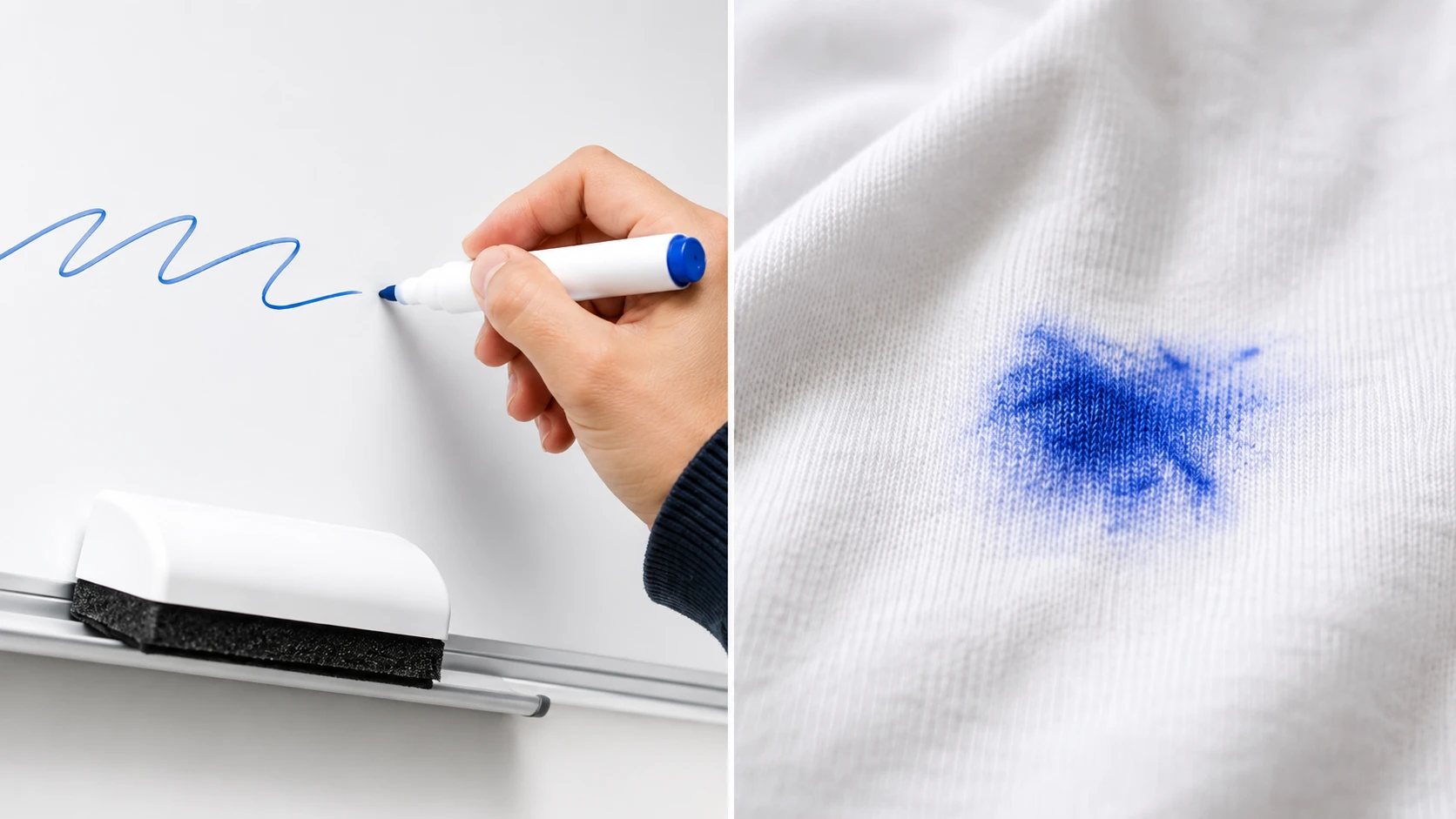
Every teacher has a story about a dry erase marker ruining a shirt. Every office manager has fielded complaints about whiteboard ink that will not wash out of a blouse. These are not random events. They are predictable results of ink mixing choices made at the factory, long before the marker reaches a classroom or conference room.
For B2B buyers sourcing whiteboard markers, dry erase ink chemistry is not just science. It is the line between repeat orders and return requests. When you know why some formulas stain fabric and others wash out, you can ask suppliers better questions. You move past catalog text and price sheets.
This article breaks down the four parts of dry erase ink. It explains the mixing tradeoff that sets stain behavior. It also gives B2B buyers a practical method to judge whiteboard marker quality before a bulk order.
Spis treści
Szybka odpowiedź: Dlaczego markery suchościeralne plamią ubrania?
Oto podstawowa chemia w czterech punktach:
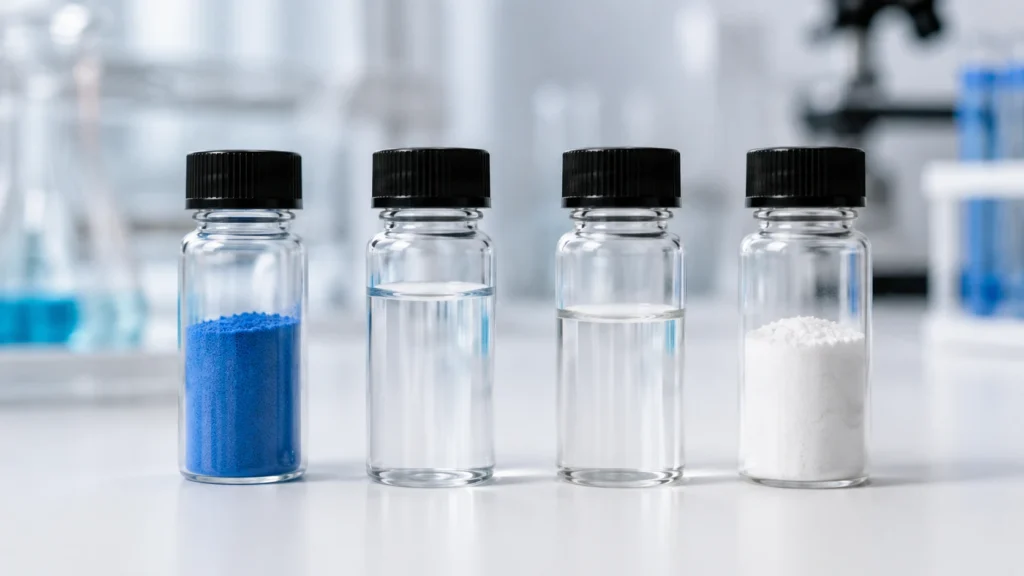
- Tusz suchościeralny zawiera trzy aktywne składniki: pigment (kolor), rozpuszczalnik alkoholowy (utrzymuje tusz w stanie płynnym, odparowuje przy kontakcie) oraz środek uwalniający na bazie silikonowo-polimerowej (zapobiega wiązaniu tuszu z powierzchnią tablicy).
- The release agent only works on non-porous surfaces. On a smooth whiteboard, the silicone forms a slippery film that lets you wipe the pigment away. On fabric) cotton, polyester, or blends (the porous fibers absorb the pigment-carrying solvent before the release agent can do its job.
- Cząsteczki pigmentu są sprawcą plam. Gdy rozpuszczalnik alkoholowy odparuje wewnątrz włókien tkaniny, cząsteczki pigmentu zostają fizycznie uwięzione w strukturze włókna. Detergenty na bazie wody nie mogą do nich dotrzeć, ponieważ powłoka środka uwalniającego jest odporna na wodę.
- Dye-based and dyeblocker-enhanced formulas wash out more easily. Some manufacturers use polymeric dyes instead of pigments, or add anionic dyeblocker compounds that prevent the colorant from bonding to fabric receptor sites) making the ink machine-washable.
These factors help brand owners and buying teams set sharper sourcing and QC standards before bulk production.
Jak skład tuszu do tablic suchościeralnych wpływa na reklamacje klientów
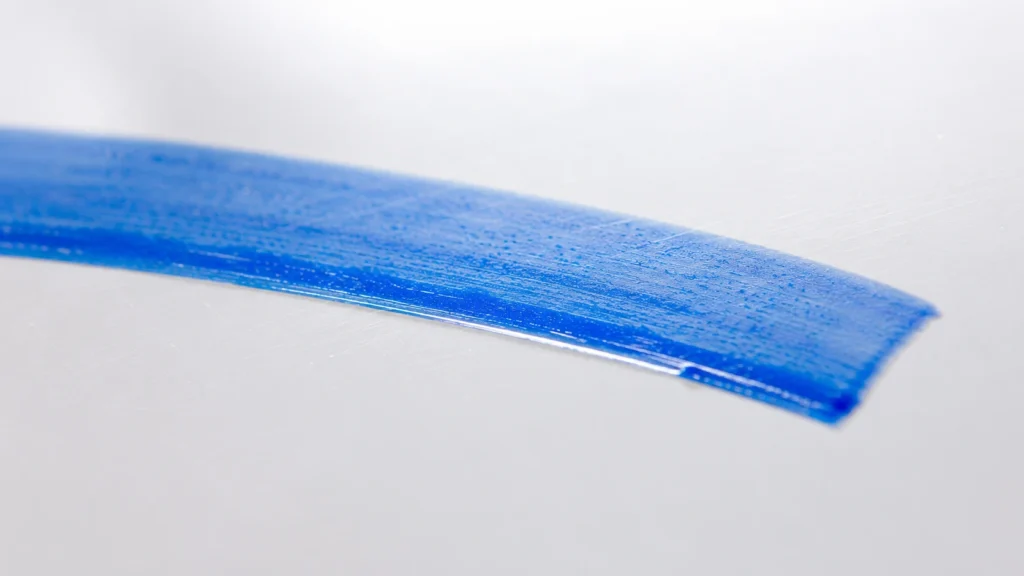
Every whiteboard marker complaint traces back to a mixing choice. Ghosting on the board. Staining on clothes. Drying out in storage. Here is how the four parts of dry erase ink create the complaints your customers feel:
| Składnik tuszu | Co robi | Typowa skarga przy słabej formulacji | Wskaźnik jakości na poziomie fabryki |
| Pigment lub barwnik (substancja barwiąca) | Zapewnia kolor; stężenie zależy od rzeczywistej receptury atramentu. | Tusz trwale plami odzież (pigment uwięziony we włóknach tkaniny); kolory na tablicy wyglądają na wyblakłe lub pasiaste | Rozkład wielkości cząstek pigmentu; odczyty spektrofotometru koloru dla każdej partii; testy zmywalności z tkaniny na bawełnie i mieszankach bawełniano-poliestrowych |
| Rozpuszczalnik alkoholowy | Utrzymuje tusz w stanie płynnym w pojemniku; odparowuje w ciągu 2–3 sekund na powierzchni tablicy | Marker szybko wysycha (zbyt dużo lotnego rozpuszczalnika); tusz pozostaje zbyt długo mokry (zbyt mało rozpuszczalnika lub niewłaściwy typ) | Testowanie szybkości parowania rozpuszczalnika; testowanie czasu bez skuwki (minimum 2 godziny ekspozycji); weryfikacja czystości rozpuszczalnika dla każdej partii |
| Środek uwalniający (polimer silikonowy) | Pomaga w uwalnianiu wyschniętego śladu z kompatybilnej tablicy; rodzaj i stężenie zależą od receptury. | Tusz pozostawia cienie lub osad na tablicy (niewystarczająca ilość środka uwalniającego); tusz rozmazuje się zamiast czyścić się czysto | Weryfikacja stężenia środka uwalniającego; testowanie ścieralności po 24-godzinnym czasie utrwalania na standardowej powierzchni tablicy |
| Żywica wiążąca | Tworzy warstwę utrzymującą pigment na powierzchni pisania; rozpuszczalna w wodzie w wysokiej jakości formulacjach | Ink permanently bonds to board surface (wrong resin type (acrylic instead of water-soluble); ink flakes off before erasing (insufficient resin) | Testowanie rozpuszczalności żywicy; testowanie tworzenia warstwy; pomiar stosunku przyczepności do uwalniania |
The Royal Society of Chemistry notes the key split between dry erase and permanent markers. The polymer choice is what differs. Permanent markers use acrylic, which bonds to the surface once dry. Dry erase markers use silicone, which makes a non-bonding film. But that silicone film only stops bonding on smooth, non-porous surfaces. On fabric, the solvent carries pigment deep into the fibers. The release agent cannot step in there.
Kompromis w formulacji: Atrament suchościeralny na bazie pigmentu vs. barwnika
This is where B2B buyers need to see a production tradeoff that most end users never notice.
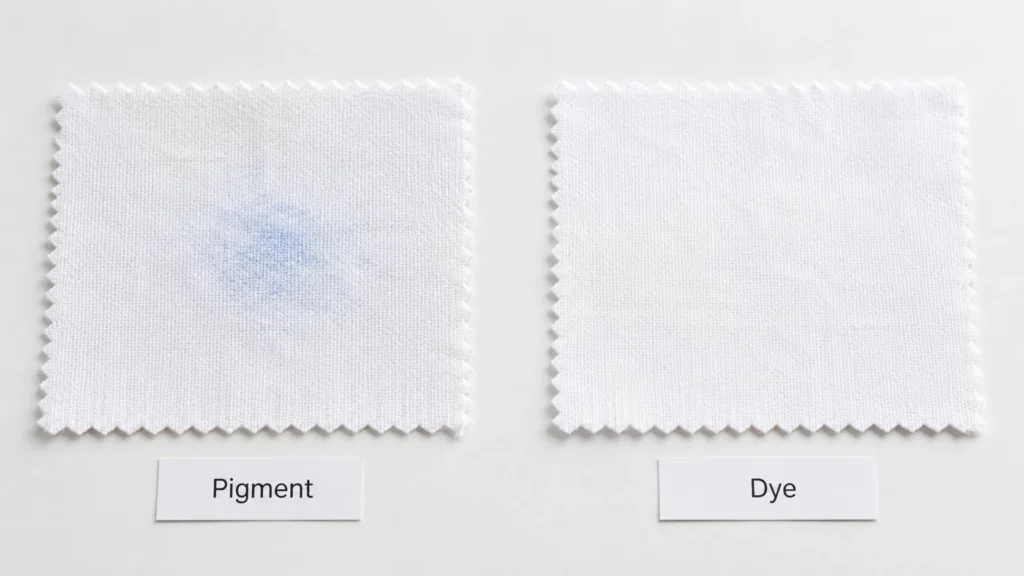
Most commercial dry erase markers use pigment-based ink. Pigments are solid color bits held in the solvent. They give strong, bright color. They resist fading under office lights. They keep line look steady on the board. But those same bits are why whiteboard markers stain clothes. When the alcohol solvent dries inside cotton or polyester fibers, the pigment bits stay trapped in the fiber. They are too big to dissolve and too deep to rinse out with water.
The other path is dye-based ink. The colorant dissolves at the molecule level instead of floating as solid bits. Patent specs for washable dry erase mixes describe polymeric dyes. These colorants stay water-soluble after the solvent dries. So the ink can come out in a normal wash cycle. The tradeoff: dye inks may look a bit less rich on the board. They can also fade faster under long UV light.
Patent documents describe possible ways to improve washability. Some add agents that change how the colorant touches a surface. A patent example is not proof that a store marker uses that formula or gets that result. Ask for wash tests on the real fabrics instead. Do not copy a patent range onto every dry-erase ink.
For B2B buyers, the real question is which mix your market needs. A school supply distributor selling to K-12 classes may pick washability over color strength. Teachers and parents forgive a lighter ink if it does not ruin a uniform. An office wholesaler may pick board performance and bright color. Adults are less likely to get ink on clothes. They are more likely to complain about ghosting and weak erase.
A factory with in-house ink R&D can help buyers work this tradeoff. ZH STATIONERY runs such a lab. It can make samples with different pigment-to-dye ratios. It can test them against the end-user cases that matter for your market.
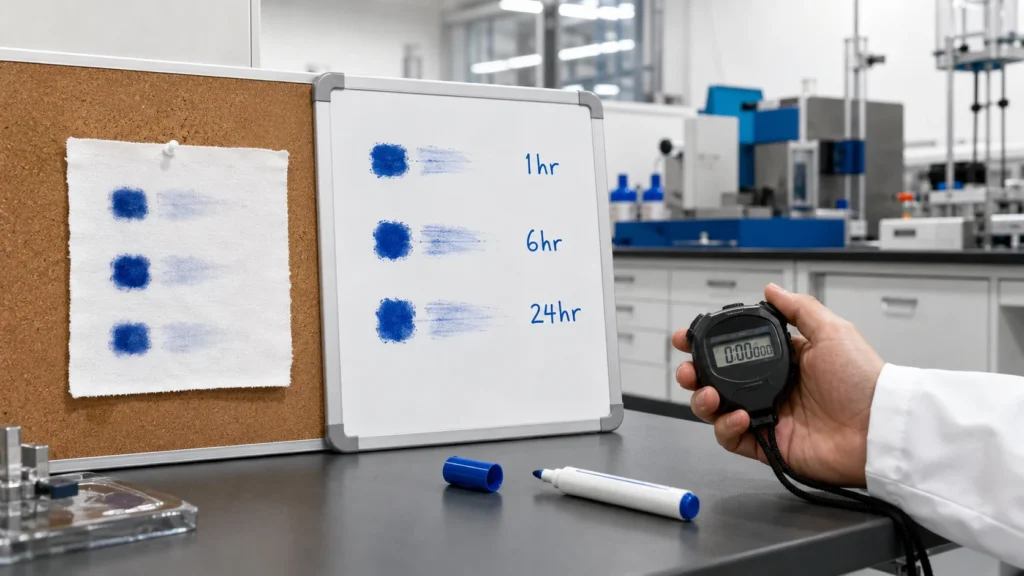
Co powinni przetestować nabywcy B2B przed zamówieniem markerów suchościeralnych
Catalog text and spec sheets will not show real-world performance. Here are the four tests that reveal mix quality:
- Ścieralność z tablicy po czasie utrwalania. Write on a standard whiteboard surface and let the ink sit for 24 hours before erasing. A quality formulation should wipe away cleanly with no ghosting or shadow residue. Ghosting indicates insufficient release agent or the wrong resin type (problems that will generate customer complaints from offices and schools that leave writing on boards overnight.
- Zmywalność z tkaniny na bawełnie i mieszankach bawełniano-poliestrowych. Apply ink to both 100% cotton and 50/50 poly-cotton swatches, let dry for one hour, then run through a cold-water laundry cycle. A dye-based or dyeblocker-enhanced formulation should come out clean or nearly clean. A standard pigment-based formulation will leave visible staining) which may be acceptable for adult office markets but not for school products.
- Czas bez skuwki. Remove the cap and leave the marker exposed to open air for two hours, then test writing performance. The marker should write immediately without skipping. Cap-off failure is the most common complaint for all marker types and is driven by solvent volatility and cap-seal design (both of which the factory should control with batch-level testing.
- Spójność koloru między partiami. Poproś o odczyty spektrofotometru z trzech oddzielnych partii produkcyjnych. Delta-E między partiami powinna być poniżej 1,5 dla produktu klasy profesjonalnej. Dryf koloru między zamówieniami to czerwona flaga wskazująca na niespójne źródło pigmentu lub kontrolę formulacji.
A factory that handles 2,000+ new SKUs a year needs strong test gear. Add 100% inline automated checks before packing and strict AQL sampling for shipment. ZH STATIONERY runs this across a 10000+ sqm plant with 8 workshops. The question to ask is not do you test quality. Ask: can you show batch-level test data for the SKU I am ordering?
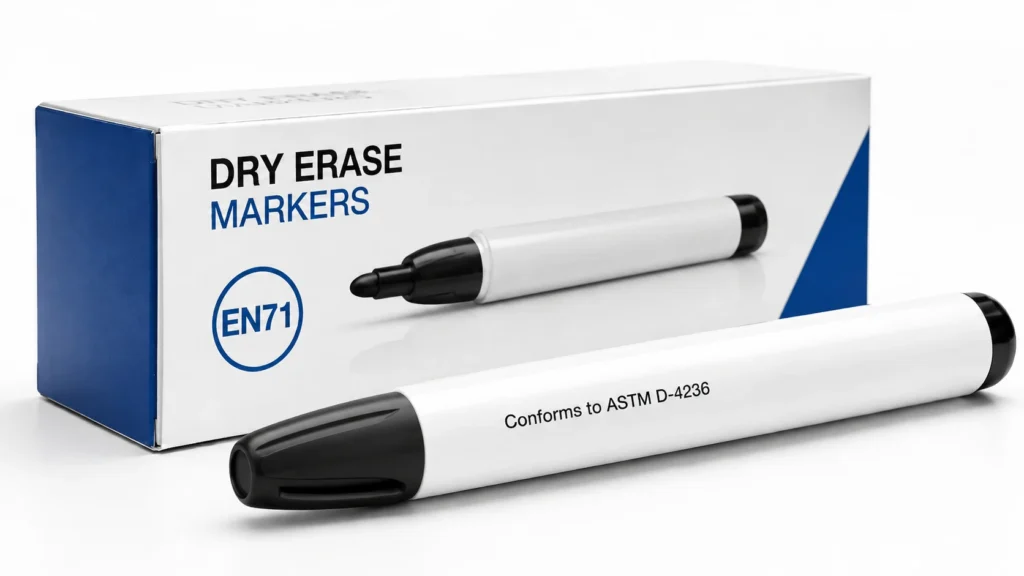
Certyfikaty i bezpieczeństwo: Warstwa zgodności dla markerów suchościeralnych
Dry erase markers sit under the same safety rules as all art and writing products in the US and EU. For school and children's products, the bar is higher.
The US CPSC says all art materials must pass a toxicology review under LHAMA. They must carry the Conforms to ASTM D-4236 line. Whiteboard markers sold to children under 12 face more rules. Third-party testing for lead and phthalates must come from a CPSC-accredited lab. A Children's Product Certificate is also needed.
In the EU, whiteboard markers classed as toys must meet EN71. EN71-3 covers heavy metal migration. The alcohol solvents in dry erase ink, like isopropanol and ethanol, are usually safer than the old ketone solvents such as MEK. Every part still must be written down and tested.
Dla nabywców B2B praktyczne kroki są następujące:
- Poproś o aktualne, opatrzone datą raporty z testów EN71 i ASTM D-4236, które konkretnie odnoszą się do zamawianego SKU markera suchościeralnego.
- Potwierdź, że laboratorium testujące jest akredytowane zgodnie z normą ISO 17025.
- Sprawdź, czy wszystkie składniki tuszu są udokumentowane w karcie charakterystyki (MSDS) do celów odprawy celnej.
- W przypadku produktów do kanałów szkolnych potwierdź dostępność certyfikatu produktu dziecięcego CPSIA.
ZH STATIONERY keeps EN71 and ASTM D-4236 certified options. Batch-level test documents tie to real production runs.
Często zadawane pytania
Dlaczego markery suchościeralne plamią ubrania, skoro tak łatwo ścierają się z tablic?
The silicone release agent in dry erase ink only works on non-porous surfaces. On a smooth board, it makes a slick film that stops pigment bonding. A dry cloth lifts the whole ink film off. On fabric, the surface is porous. The alcohol carries pigment deep into the fibers before the release agent can build its shield. Once the solvent dries, the pigment bits are trapped. Water alone cannot get them out.
Jaka jest różnica między tuszem suchościeralnym na bazie pigmentu a tuszem na bazie barwnika?
Pigment ink uses solid color bits in the solvent. It gives strong color and resists fading. The bits also get trapped in fabric and cause lasting stains. Dye ink dissolves the colorant at the molecule level. It can wash out in a normal cycle. The tradeoff: dye mixes may look less rich on the board and fade faster in UV light. Some makers blend both to balance color and washability.
Czy markery suchościeralne “o niskim zapachu” są bezpieczniejsze lub wyższej jakości niż standardowe?
Low-odor mixes usually swap strong solvents for gentler ones. Ethanol instead of isopropanol is one example. This cuts the smell. It does not change stain or board behavior. The real quality sign is not the low-odor label. It is the solvent chemistry and whether the release agent level is enough for clean erase. A low-odor marker with too little release agent will ghost, no matter how nice it smells.
Jak mogę przetestować jakość markerów suchościeralnych przed złożeniem zamówienia hurtowego?
Run four tests. First, board erase after 24-hour set time, with no ghosting left. Second, fabric wash on cotton and poly-cotton blends, cold water, one hour after ink contact. Third, cap-off writing after two hours of air. Fourth, batch-to-batch color steadiness using a spectrophotometer. A factory that shows this data from production QC records proves real control. Data from one hand-built sample does not.
Jakie certyfikaty są wymagane dla markerów suchościeralnych na rynkach szkolnych w USA i Europie?
All dry erase markers sold in the US need ASTM D-4236 under LHAMA. Products for children under 12 also need CPSIA third-party testing and a Children's Product Certificate. In the EU, EN71-3 applies to products classed as toys. Always ask for current, dated test reports from ISO 17025 labs. The reports must name your exact SKU. A factory with batch-level compliance data, like ZH STATIONERY, sends these with the order.
Co sprawia, że marker suchościeralny jest “zmywalny” z perspektywy produkcyjnej?
Washability comes from mixing choices, not claims. Three paths exist. Polymeric dyes dissolve at the molecule level and wash out. Dyeblocker agents stop colorants from bonding to fabric fibers. Or blend pigments with water-soluble binder resins that let go during a wash. If a supplier says washable, ask which path they used. Ask for fabric wash data. A spoken promise is not enough.
If you are sourcing dry erase markers for school programs, office retail, or private-label lines, contact ZH STATIONERY. Talk about ink mixing options. Ask for wash test samples. Review whiteboard marker specs for your target market.
Powiązany przewodnik: Kontrola jakości pisaków markerowych.
Powiązany przewodnik: Jak używać markerów akrylowych na tkaninie i sprawić, by wzór był trwały.
Powiązane artykuły
- Usuwanie plam po markerach suchościeralnych: Co każdy nabywca B2B powinien wiedzieć o zmywalności tuszu
- Raport dotyczący pozyskiwania markerów suchościeralnych na mokro 2026: Przewodnik dla nabywców B2B
- Markery suchościeralne na mokro a inne rodzaje piór: Strategia zaopatrzenia B2B na rok 2026
- Jak Usunąć Marker Permanentny z Tablicy Suchościeralnej: 3 Sposoby Bez Chemii
- Klasyczny materiał tablicowy: Główne komponenty i ekologiczne aktualizacje
- Usuwanie markerów permanentnych z plastiku
- użycie markera permanentnego na płytach CD