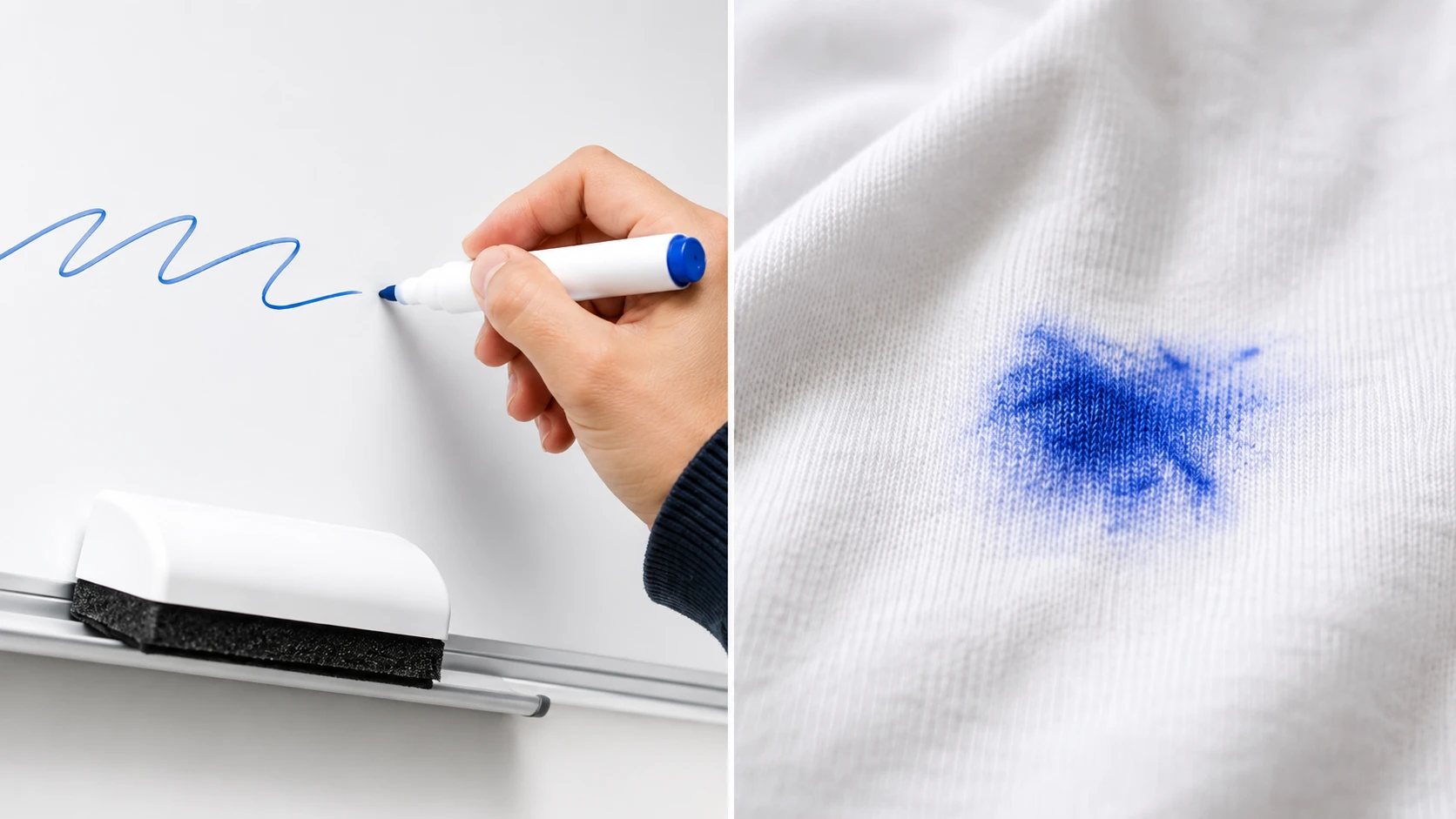
Every teacher has a story about a dry erase marker ruining a shirt. Every office manager has fielded complaints about whiteboard ink that will not wash out of a blouse. These are not random events. They are predictable results of ink mixing choices made at the factory, long before the marker reaches a classroom or conference room.
For B2B buyers sourcing whiteboard markers, dry erase ink chemistry is not just science. It is the line between repeat orders and return requests. When you know why some formulas stain fabric and others wash out, you can ask suppliers better questions. You move past catalog text and price sheets.
This article breaks down the four parts of dry erase ink. It explains the mixing tradeoff that sets stain behavior. It also gives B2B buyers a practical method to judge whiteboard marker quality before a bulk order.
Índice
Resposta Rápida: Por que os Marcadores para Quadro Branco Mancham Roupas?
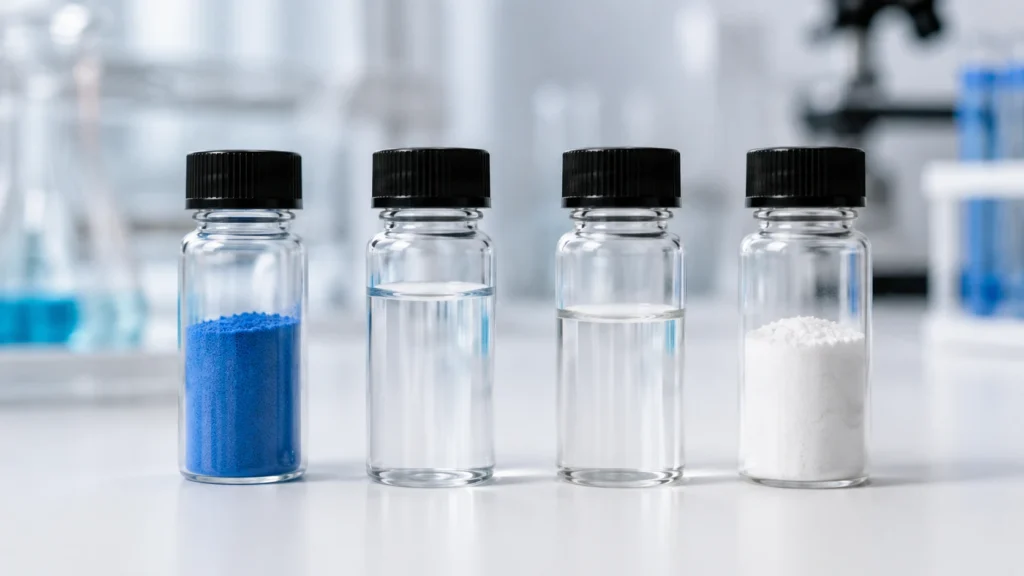
Aqui está a química central em quatro pontos:
- A tinta de marcador de quadro branco contém três ingredientes ativos: pigmento (cor), um solvente álcool (mantém a tinta líquida, evapora ao contato) e um agente de liberação de polímero de silicone (impede que a tinta se fixe na superfície do quadro branco).
- The release agent only works on non-porous surfaces. On a smooth whiteboard, the silicone forms a slippery film that lets you wipe the pigment away. On fabric) cotton, polyester, or blends (the porous fibers absorb the pigment-carrying solvent before the release agent can do its job.
- As partículas de pigmento são as culpadas pelas manchas. Uma vez que o solvente álcool evapora dentro das fibras do tecido, as partículas de pigmento ficam fisicamente presas na estrutura da fibra. Detergentes à base de água não conseguem alcançá-las porque o revestimento do agente de liberação resiste à água.
- Dye-based and dyeblocker-enhanced formulas wash out more easily. Some manufacturers use polymeric dyes instead of pigments, or add anionic dyeblocker compounds that prevent the colorant from bonding to fabric receptor sites) making the ink machine-washable.
These factors help brand owners and buying teams set sharper sourcing and QC standards before bulk production.
Como a Formulação da Tinta para Quadro Branco Determina Reclamações de Clientes
Every whiteboard marker complaint traces back to a mixing choice. Ghosting on the board. Staining on clothes. Drying out in storage. Here is how the four parts of dry erase ink create the complaints your customers feel:
| Componente da Tinta | O Que Faz | Reclamação Comum Quando Mal Formulado | Métrica de Qualidade em Nível de Fábrica |
| Pigmento ou corante (colorante) | Fornece cor; a concentração depende da formulação real da tinta. | A tinta mancha a roupa permanentemente (pigmento preso nas fibras do tecido); as cores parecem desbotadas ou irregulares no quadro | Distribuição do tamanho das partículas do pigmento; leituras de espectrofotômetro de cor por lote; teste de lavabilidade em tecido de algodão e misturas de algodão-poliéster |
| Solvente álcool | Mantém a tinta líquida no tubo; evapora em 2–3 segundos na superfície do quadro | O marcador seca rapidamente (muito solvente volátil); a tinta parece molhada por muito tempo (pouco solvente, ou tipo de solvente errado) | Teste de taxa de evaporação do solvente; teste de tempo sem tampa (exposição mínima de 2 horas); verificação da pureza do solvente por lote |
| Agente de liberação (polímero de silicone) | Ajuda a marca seca a se soltar de um quadro compatível; o tipo e a concentração dependem da formulação. | A tinta cria fantasmas ou deixa resíduos no quadro (agente de liberação insuficiente); a tinta borra em vez de apagar limpo | Verificação da concentração do agente de liberação; teste de apagabilidade após 24 horas de secagem em superfície padrão de quadro branco |
| Resina aglutinante | Forma um filme que segura o pigmento na superfície de escrita; solúvel em água em formulações de qualidade | Ink permanently bonds to board surface (wrong resin type (acrylic instead of water-soluble); ink flakes off before erasing (insufficient resin) | Teste de solubilidade da resina; teste de formação de filme; medição da relação adesão-liberação |
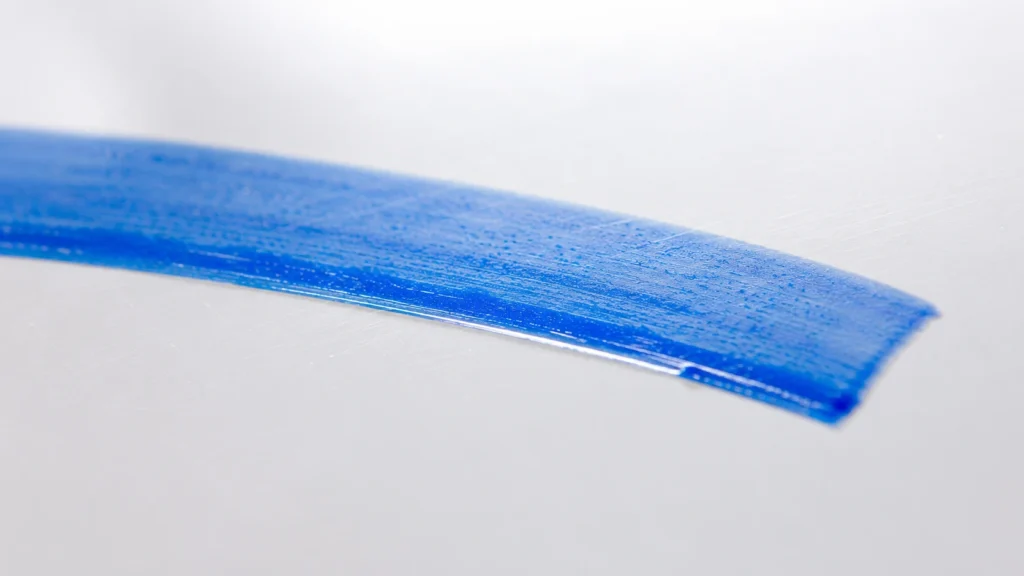
The Royal Society of Chemistry notes the key split between dry erase and permanent markers. The polymer choice is what differs. Permanent markers use acrylic, which bonds to the surface once dry. Dry erase markers use silicone, which makes a non-bonding film. But that silicone film only stops bonding on smooth, non-porous surfaces. On fabric, the solvent carries pigment deep into the fibers. The release agent cannot step in there.
O Tradeoff na Formulação: Tinta para Quadro Branco à Base de Pigmento vs. Corante
This is where B2B buyers need to see a production tradeoff that most end users never notice.
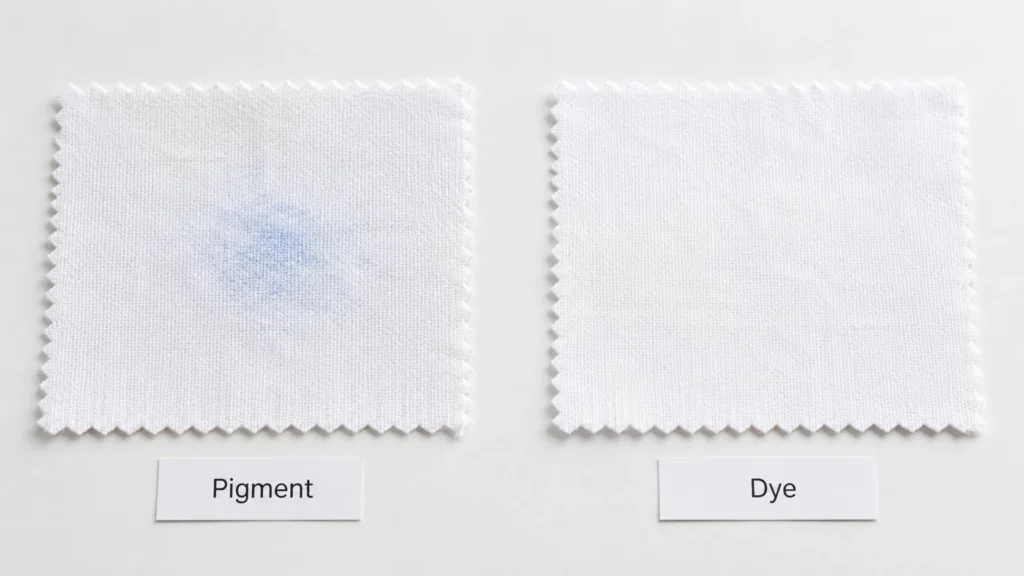
Most commercial dry erase markers use pigment-based ink. Pigments are solid color bits held in the solvent. They give strong, bright color. They resist fading under office lights. They keep line look steady on the board. But those same bits are why whiteboard markers stain clothes. When the alcohol solvent dries inside cotton or polyester fibers, the pigment bits stay trapped in the fiber. They are too big to dissolve and too deep to rinse out with water.
The other path is dye-based ink. The colorant dissolves at the molecule level instead of floating as solid bits. Patent specs for washable dry erase mixes describe polymeric dyes. These colorants stay water-soluble after the solvent dries. So the ink can come out in a normal wash cycle. The tradeoff: dye inks may look a bit less rich on the board. They can also fade faster under long UV light.
Patent documents describe possible ways to improve washability. Some add agents that change how the colorant touches a surface. A patent example is not proof that a store marker uses that formula or gets that result. Ask for wash tests on the real fabrics instead. Do not copy a patent range onto every dry-erase ink.
For B2B buyers, the real question is which mix your market needs. A school supply distributor selling to K-12 classes may pick washability over color strength. Teachers and parents forgive a lighter ink if it does not ruin a uniform. An office wholesaler may pick board performance and bright color. Adults are less likely to get ink on clothes. They are more likely to complain about ghosting and weak erase.
A factory with in-house ink R&D can help buyers work this tradeoff. ZH STATIONERY runs such a lab. It can make samples with different pigment-to-dye ratios. It can test them against the end-user cases that matter for your market.
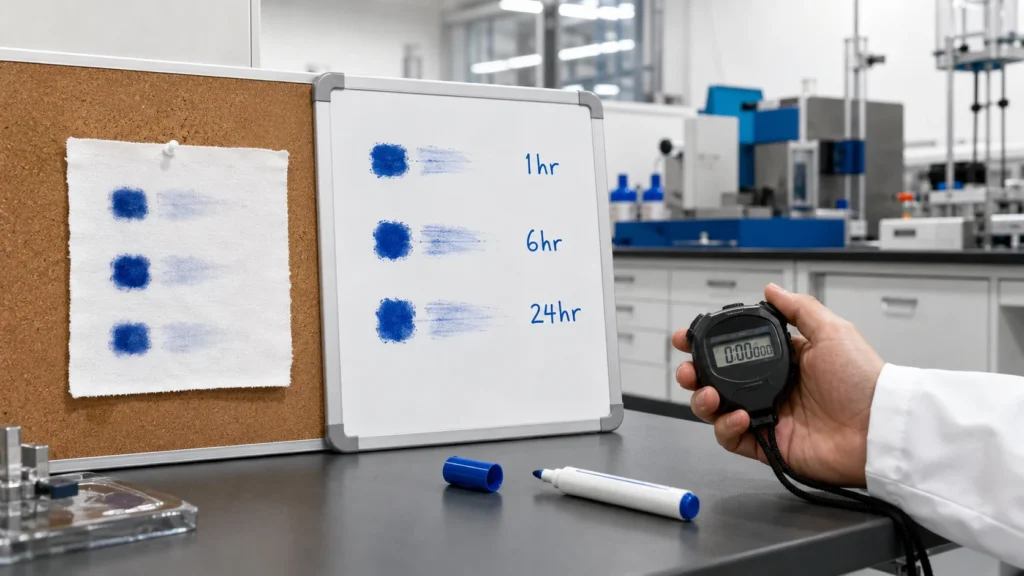
O que os compradores B2B devem testar antes de encomendar marcadores para quadro branco
Catalog text and spec sheets will not show real-world performance. Here are the four tests that reveal mix quality:
- Escreva em uma superfície padrão de quadro branco e deixe a tinta secar por 24 horas antes de apagar. Uma formulação de qualidade deve limpar completamente, sem fantasmas ou resíduos de sombra. Fantasmas indicam agente de liberação insuficiente ou tipo de resina errado — problemas que gerarão reclamações de clientes de escritórios e escolas que deixam escritas nos quadros durante a noite. Write on a standard whiteboard surface and let the ink sit for 24 hours before erasing. A quality formulation should wipe away cleanly with no ghosting or shadow residue. Ghosting indicates insufficient release agent or the wrong resin type (problems that will generate customer complaints from offices and schools that leave writing on boards overnight.
- Aplique tinta em amostras de algodão 100% e mistura 50/50 algodão-poliéster, deixe secar por uma hora e, em seguida, execute um ciclo de lavagem com água fria. Uma formulação à base de corante ou com bloqueador de corante deve sair limpa ou quase limpa. Uma formulação padrão à base de pigmento deixará manchas visíveis — o que pode ser aceitável para mercados de escritório adulto, mas não para produtos escolares. Apply ink to both 100% cotton and 50/50 poly-cotton swatches, let dry for one hour, then run through a cold-water laundry cycle. A dye-based or dyeblocker-enhanced formulation should come out clean or nearly clean. A standard pigment-based formulation will leave visible staining) which may be acceptable for adult office markets but not for school products.
- Remova a tampa e deixe o marcador exposto ao ar livre por duas horas, depois teste o desempenho da escrita. O marcador deve escrever imediatamente sem falhas. A falha no tempo sem tampa é a reclamação mais comum para todos os tipos de marcadores e é impulsionada pela volatilidade do solvente e pelo design da vedação da tampa — ambos os quais a fábrica deve controlar com testes em nível de lote. Remove the cap and leave the marker exposed to open air for two hours, then test writing performance. The marker should write immediately without skipping. Cap-off failure is the most common complaint for all marker types and is driven by solvent volatility and cap-seal design (both of which the factory should control with batch-level testing.
- Solicite leituras de espectrofotômetro de três lotes de produção separados. O delta-E entre os lotes deve ser inferior a 1,5 para um produto de nível profissional. A deriva de cor entre pedidos é um sinal de alerta para fornecimento inconsistente de pigmento ou controle de formulação. Uma fábrica que processa mais de 2.000 novos SKUs por ano com inspeção visual e funcional de 100% antes da embalagem — como a ZH STATIONERY faz em suas instalações automatizadas de 4.000 m² — tem a infraestrutura de teste para gerar essa documentação. A pergunta a fazer aos fornecedores não é "você testa a qualidade?" mas "você pode me mostrar os dados de teste em nível de lote para o SKU específico que estou pedindo?".
A factory that handles 2,000+ new SKUs a year needs strong test gear. Add 100% inline automated checks before packing and strict AQL sampling for shipment. ZH STATIONERY runs this across a 10000+ sqm plant with 8 workshops. The question to ask is not do you test quality. Ask: can you show batch-level test data for the SKU I am ordering?
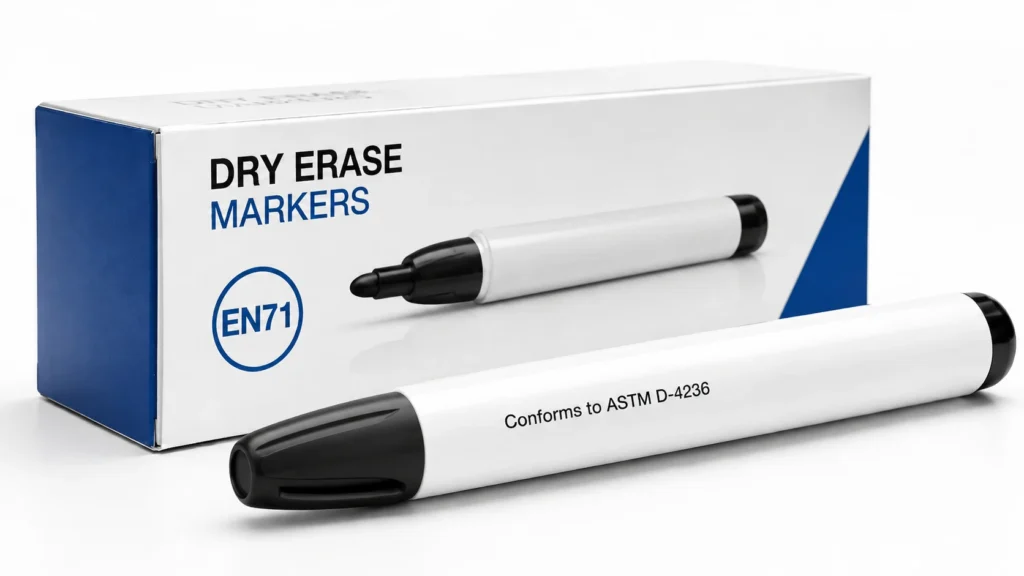
Certificações e Segurança: A Camada de Conformidade para Marcadores de Quadro Branco
Dry erase markers sit under the same safety rules as all art and writing products in the US and EU. For school and children's products, the bar is higher.
The US CPSC says all art materials must pass a toxicology review under LHAMA. They must carry the Conforms to ASTM D-4236 line. Whiteboard markers sold to children under 12 face more rules. Third-party testing for lead and phthalates must come from a CPSC-accredited lab. A Children's Product Certificate is also needed.
In the EU, whiteboard markers classed as toys must meet EN71. EN71-3 covers heavy metal migration. The alcohol solvents in dry erase ink, like isopropanol and ethanol, are usually safer than the old ketone solvents such as MEK. Every part still must be written down and tested.
Para compradores B2B, as etapas práticas são:
- Solicitar relatórios de teste atuais e datados da EN71 e ASTM D-4236 que façam referência específica ao SKU de apagamento a seco que você está encomendando.
- Confirmar que o laboratório de teste é acreditado pela ISO 17025.
- Verificar se todos os ingredientes da tinta estão documentados em uma FISPQ para desembaraço aduaneiro.
- Para produtos do canal escolar, confirmar a disponibilidade do Certificado de Produto Infantil da CPSIA.
ZH STATIONERY keeps EN71 and ASTM D-4236 certified options. Batch-level test documents tie to real production runs.
Perguntas Frequentes
Por que os marcadores para quadro branco mancham roupas, se são tão facilmente removidos do quadro?
The silicone release agent in dry erase ink only works on non-porous surfaces. On a smooth board, it makes a slick film that stops pigment bonding. A dry cloth lifts the whole ink film off. On fabric, the surface is porous. The alcohol carries pigment deep into the fibers before the release agent can build its shield. Once the solvent dries, the pigment bits are trapped. Water alone cannot get them out.
Qual é a diferença entre a tinta para quadro branco à base de pigmento e à base de corante?
Pigment ink uses solid color bits in the solvent. It gives strong color and resists fading. The bits also get trapped in fabric and cause lasting stains. Dye ink dissolves the colorant at the molecule level. It can wash out in a normal cycle. The tradeoff: dye mixes may look less rich on the board and fade faster in UV light. Some makers blend both to balance color and washability.
Os Marcadores de Quadro Branco “Baixo Odor” São Mais Seguros Ou De Maior Qualidade Que Os Padrão?
Low-odor mixes usually swap strong solvents for gentler ones. Ethanol instead of isopropanol is one example. This cuts the smell. It does not change stain or board behavior. The real quality sign is not the low-odor label. It is the solvent chemistry and whether the release agent level is enough for clean erase. A low-odor marker with too little release agent will ghost, no matter how nice it smells.
Como posso testar a qualidade dos marcadores para quadro branco antes de fazer um pedido em grande quantidade?
Run four tests. First, board erase after 24-hour set time, with no ghosting left. Second, fabric wash on cotton and poly-cotton blends, cold water, one hour after ink contact. Third, cap-off writing after two hours of air. Fourth, batch-to-batch color steadiness using a spectrophotometer. A factory that shows this data from production QC records proves real control. Data from one hand-built sample does not.
Quais Certificações os Marcadores para Quadro Branco Precisam para os Mercados Escolares dos EUA e da Europa?
All dry erase markers sold in the US need ASTM D-4236 under LHAMA. Products for children under 12 also need CPSIA third-party testing and a Children's Product Certificate. In the EU, EN71-3 applies to products classed as toys. Always ask for current, dated test reports from ISO 17025 labs. The reports must name your exact SKU. A factory with batch-level compliance data, like ZH STATIONERY, sends these with the order.
O Que Torna Um Marcador de Quadro Branco “Lavável” Do Ponto de Vista da Fabricação?
Washability comes from mixing choices, not claims. Three paths exist. Polymeric dyes dissolve at the molecule level and wash out. Dyeblocker agents stop colorants from bonding to fabric fibers. Or blend pigments with water-soluble binder resins that let go during a wash. If a supplier says washable, ask which path they used. Ask for fabric wash data. A spoken promise is not enough.
If you are sourcing dry erase markers for school programs, office retail, or private-label lines, contact ZH STATIONERY. Talk about ink mixing options. Ask for wash test samples. Review whiteboard marker specs for your target market.
Guia relacionado: Controle de Qualidade de Caneta Marcadora.
Guia relacionado: Como Usar Marcadores de Tinta Acrílica em Tecido e Fazer o Design Durar.
Leitura relacionada
- Remoção de Manchas de Marcador para Quadro Branco: O Que Todo Comprador B2B Deve Saber Sobre a Lavabilidade da Tinta
- Relatório de Fornecimento de Marcadores Apagáveis a Úmido 2026: Guia do Comprador B2B
- Marcadores Apagáveis a Úmido vs. Outros Tipos de Canetas: Uma Estratégia de Sourcing B2B para 2026
- Como Remover Marcas de Sharpie de Quadro Branco: 3 Truques Sem Químicos
- Material Clássico de Quadro Negro: Componentes Principais e Atualizações Ecológicas
- remoção de marcador permanente de plástico
- uso de marcador permanente em CDs