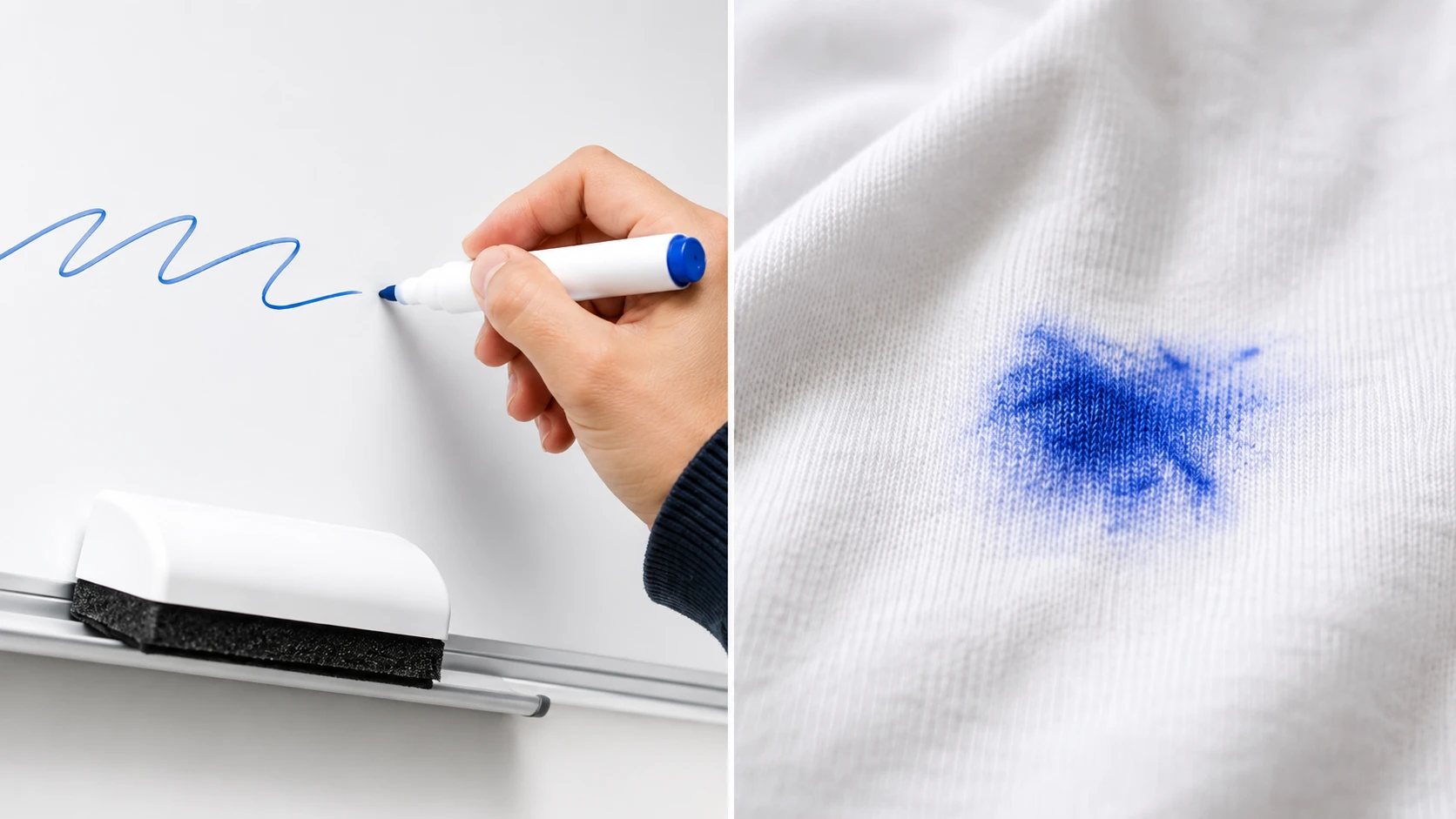
Every teacher has a story about a dry erase marker ruining a shirt. Every office manager has fielded complaints about whiteboard ink that will not wash out of a blouse. These are not random events. They are predictable results of ink mixing choices made at the factory, long before the marker reaches a classroom or conference room.
For B2B buyers sourcing whiteboard markers, dry erase ink chemistry is not just science. It is the line between repeat orders and return requests. When you know why some formulas stain fabric and others wash out, you can ask suppliers better questions. You move past catalog text and price sheets.
This article breaks down the four parts of dry erase ink. It explains the mixing tradeoff that sets stain behavior. It also gives B2B buyers a practical method to judge whiteboard marker quality before a bulk order.
Tabla de Contenidos
Respuesta rápida: ¿Por qué los marcadores de borrado en seco manchan la ropa?
Aquí está la química central en cuatro puntos:
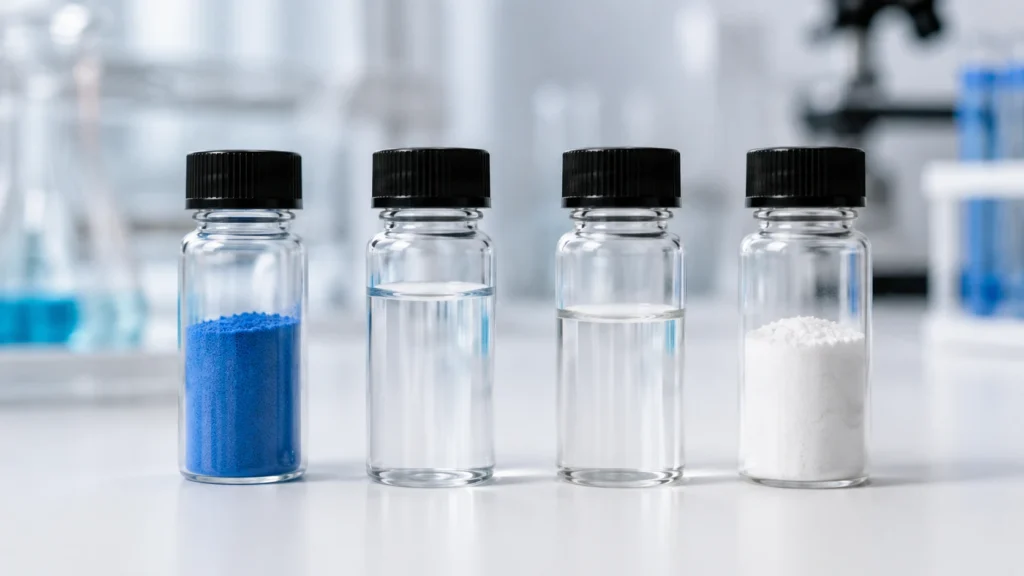
- La tinta de borrado en seco contiene tres ingredientes activos: pigmento (color), un solvente de alcohol (mantiene la tinta líquida, se evapora al contacto) y un agente de liberación de polímero de silicona (evita que la tinta se adhiera a la superficie de la pizarra blanca).
- The release agent only works on non-porous surfaces. On a smooth whiteboard, the silicone forms a slippery film that lets you wipe the pigment away. On fabric) cotton, polyester, or blends (the porous fibers absorb the pigment-carrying solvent before the release agent can do its job.
- Las partículas de pigmento son las culpables de las manchas. Una vez que el solvente de alcohol se evapora dentro de las fibras de la tela, las partículas de pigmento quedan físicamente atrapadas en la estructura de la fibra. Los detergentes a base de agua no pueden alcanzarlas porque el recubrimiento del agente de liberación resiste el agua.
- Dye-based and dyeblocker-enhanced formulas wash out more easily. Some manufacturers use polymeric dyes instead of pigments, or add anionic dyeblocker compounds that prevent the colorant from bonding to fabric receptor sites) making the ink machine-washable.
These factors help brand owners and buying teams set sharper sourcing and QC standards before bulk production.
Cómo la formulación de la tinta borrable en seco determina las quejas de los clientes
Every whiteboard marker complaint traces back to a mixing choice. Ghosting on the board. Staining on clothes. Drying out in storage. Here is how the four parts of dry erase ink create the complaints your customers feel:
| Componente de la tinta | Qué hace | Queja común cuando se formula mal | Métrica de calidad a nivel de fábrica |
| Pigmento o colorante (colorante) | Proporciona color; la concentración depende de la formulación real de la tinta. | La tinta mancha la ropa permanentemente (pigmento atrapado en fibras de la tela); los colores se ven descoloridos o con rayas en la pizarra | Distribución del tamaño de partícula del pigmento; lecturas del espectrofotómetro de color por lote; pruebas de lavabilidad en tela de algodón y mezclas de algodón-poliéster |
| Solvente de alcohol | Mantiene la tinta líquida en el barril; se evapora en 2–3 segundos en la superficie de la pizarra | El marcador se seca rápidamente (demasiado solvente volátil); la tinta se siente húmeda por mucho tiempo (poco solvente o tipo de solvente incorrecto) | Pruebas de tasa de evaporación del solvente; pruebas de tiempo sin tapa (exposición mínima de 2 horas); verificación de pureza del solvente por lote |
| Agente de liberación (polímero de silicona) | Ayuda a que la marca seca se desprenda de una pizarra compatible; el tipo y la concentración dependen de la formulación. | La tinta deja fantasmas o residuos en la pizarra (agente de liberación insuficiente); la tinta se mancha en lugar de borrarse limpiamente | Verificación de la concentración del agente de liberación; pruebas de borrabilidad después de 24 horas de fijación en una superficie de pizarra blanca estándar |
| Resina aglutinante | Forma una película que mantiene el pigmento en la superficie de escritura; soluble en agua en formulaciones de calidad | Ink permanently bonds to board surface (wrong resin type (acrylic instead of water-soluble); ink flakes off before erasing (insufficient resin) | Pruebas de solubilidad de la resina; pruebas de formación de película; medición de la relación adhesión-liberación |
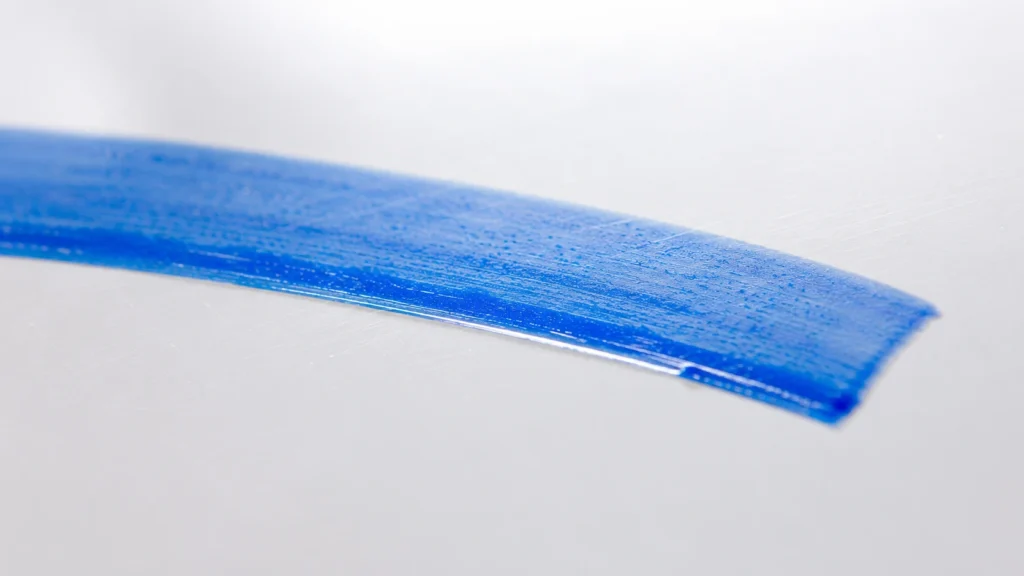
The Royal Society of Chemistry notes the key split between dry erase and permanent markers. The polymer choice is what differs. Permanent markers use acrylic, which bonds to the surface once dry. Dry erase markers use silicone, which makes a non-bonding film. But that silicone film only stops bonding on smooth, non-porous surfaces. On fabric, the solvent carries pigment deep into the fibers. The release agent cannot step in there.
La Compensación en la Formulación: Tinta Borrable en Seco a Base de Pigmento vs. Tinte
This is where B2B buyers need to see a production tradeoff that most end users never notice.
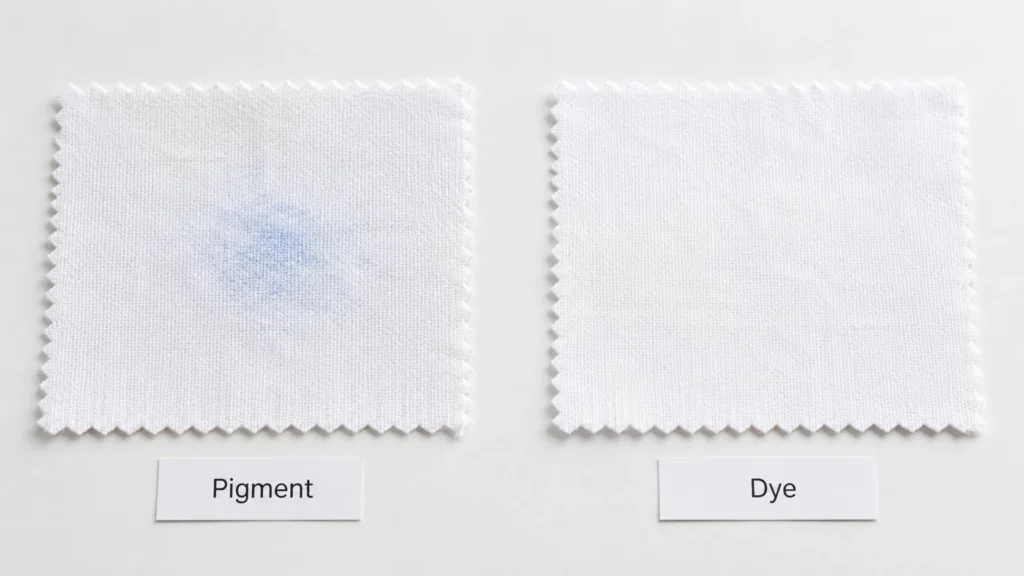
Most commercial dry erase markers use pigment-based ink. Pigments are solid color bits held in the solvent. They give strong, bright color. They resist fading under office lights. They keep line look steady on the board. But those same bits are why whiteboard markers stain clothes. When the alcohol solvent dries inside cotton or polyester fibers, the pigment bits stay trapped in the fiber. They are too big to dissolve and too deep to rinse out with water.
The other path is dye-based ink. The colorant dissolves at the molecule level instead of floating as solid bits. Patent specs for washable dry erase mixes describe polymeric dyes. These colorants stay water-soluble after the solvent dries. So the ink can come out in a normal wash cycle. The tradeoff: dye inks may look a bit less rich on the board. They can also fade faster under long UV light.
Patent documents describe possible ways to improve washability. Some add agents that change how the colorant touches a surface. A patent example is not proof that a store marker uses that formula or gets that result. Ask for wash tests on the real fabrics instead. Do not copy a patent range onto every dry-erase ink.
For B2B buyers, the real question is which mix your market needs. A school supply distributor selling to K-12 classes may pick washability over color strength. Teachers and parents forgive a lighter ink if it does not ruin a uniform. An office wholesaler may pick board performance and bright color. Adults are less likely to get ink on clothes. They are more likely to complain about ghosting and weak erase.
A factory with in-house ink R&D can help buyers work this tradeoff. ZH STATIONERY runs such a lab. It can make samples with different pigment-to-dye ratios. It can test them against the end-user cases that matter for your market.
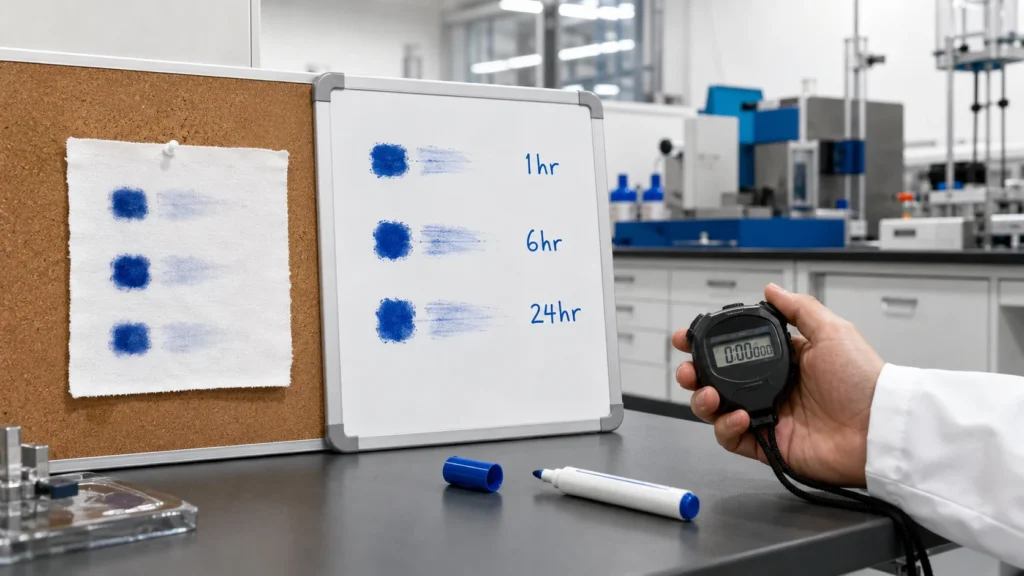
Lo que los compradores B2B deberían probar antes de pedir marcadores de borrado en seco
Catalog text and spec sheets will not show real-world performance. Here are the four tests that reveal mix quality:
- Borrabilidad en la pizarra después del tiempo de fijación. Write on a standard whiteboard surface and let the ink sit for 24 hours before erasing. A quality formulation should wipe away cleanly with no ghosting or shadow residue. Ghosting indicates insufficient release agent or the wrong resin type (problems that will generate customer complaints from offices and schools that leave writing on boards overnight.
- Lavabilidad en tela de algodón y mezclas de algodón-poliéster. Apply ink to both 100% cotton and 50/50 poly-cotton swatches, let dry for one hour, then run through a cold-water laundry cycle. A dye-based or dyeblocker-enhanced formulation should come out clean or nearly clean. A standard pigment-based formulation will leave visible staining) which may be acceptable for adult office markets but not for school products.
- Tiempo sin tapa. Remove the cap and leave the marker exposed to open air for two hours, then test writing performance. The marker should write immediately without skipping. Cap-off failure is the most common complaint for all marker types and is driven by solvent volatility and cap-seal design (both of which the factory should control with batch-level testing.
- Consistencia de color entre lotes. Solicite lecturas del espectrofotómetro de tres lotes de producción separados. El delta-E entre lotes debe ser inferior a 1.5 para un producto de grado profesional. La deriva de color entre pedidos es una señal de alerta de un suministro de pigmento inconsistente o un control de formulación deficiente.
A factory that handles 2,000+ new SKUs a year needs strong test gear. Add 100% inline automated checks before packing and strict AQL sampling for shipment. ZH STATIONERY runs this across a 10000+ sqm plant with 8 workshops. The question to ask is not do you test quality. Ask: can you show batch-level test data for the SKU I am ordering?
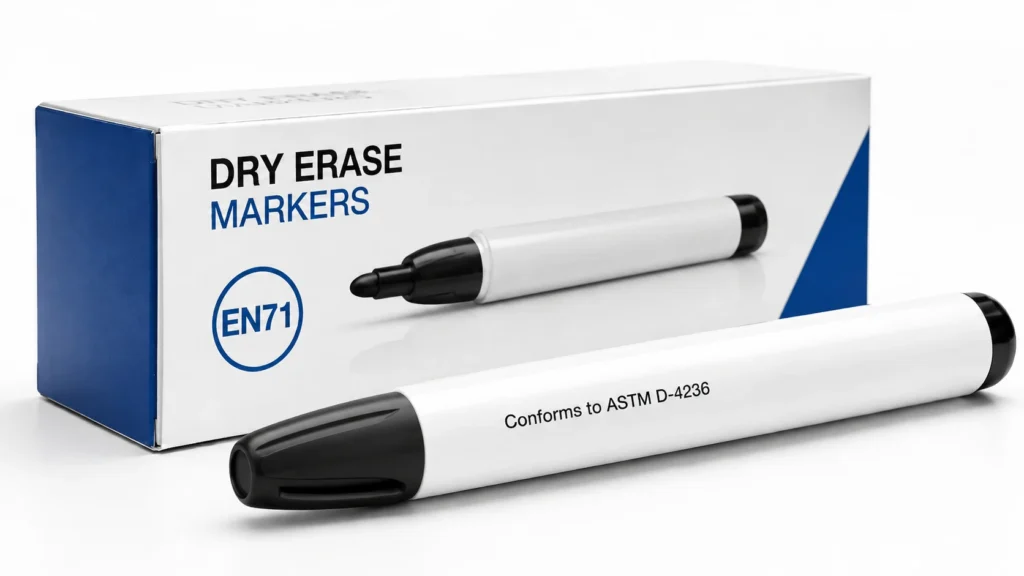
Certificaciones y Seguridad: La Capa de Cumplimiento para Marcadores de Borrado en Seco
Dry erase markers sit under the same safety rules as all art and writing products in the US and EU. For school and children's products, the bar is higher.
The US CPSC says all art materials must pass a toxicology review under LHAMA. They must carry the Conforms to ASTM D-4236 line. Whiteboard markers sold to children under 12 face more rules. Third-party testing for lead and phthalates must come from a CPSC-accredited lab. A Children's Product Certificate is also needed.
In the EU, whiteboard markers classed as toys must meet EN71. EN71-3 covers heavy metal migration. The alcohol solvents in dry erase ink, like isopropanol and ethanol, are usually safer than the old ketone solvents such as MEK. Every part still must be written down and tested.
Para los compradores B2B, los pasos prácticos son:
- Solicitar informes de prueba actualizados y fechados de EN71 y ASTM D-4236 que hagan referencia específica al SKU de borrado en seco que está solicitando.
- Confirmar que el laboratorio de pruebas esté acreditado según ISO 17025.
- Verificar que todos los ingredientes de la tinta estén documentados en una MSDS para el despacho de aduanas.
- Para productos del canal escolar, confirmar la disponibilidad del Certificado de Producto Infantil CPSIA.
ZH STATIONERY keeps EN71 and ASTM D-4236 certified options. Batch-level test documents tie to real production runs.
Preguntas Frecuentes
¿Por qué los marcadores de borrado en seco manchan la ropa si se borran tan fácilmente de las pizarras blancas?
The silicone release agent in dry erase ink only works on non-porous surfaces. On a smooth board, it makes a slick film that stops pigment bonding. A dry cloth lifts the whole ink film off. On fabric, the surface is porous. The alcohol carries pigment deep into the fibers before the release agent can build its shield. Once the solvent dries, the pigment bits are trapped. Water alone cannot get them out.
¿Cuál es la diferencia entre la tinta borrable en seco a base de pigmento y la tinta borrable en seco a base de colorante?
Pigment ink uses solid color bits in the solvent. It gives strong color and resists fading. The bits also get trapped in fabric and cause lasting stains. Dye ink dissolves the colorant at the molecule level. It can wash out in a normal cycle. The tradeoff: dye mixes may look less rich on the board and fade faster in UV light. Some makers blend both to balance color and washability.
¿Son los marcadores de borrado en seco “de bajo olor” más seguros o de mayor calidad que los estándar?
Low-odor mixes usually swap strong solvents for gentler ones. Ethanol instead of isopropanol is one example. This cuts the smell. It does not change stain or board behavior. The real quality sign is not the low-odor label. It is the solvent chemistry and whether the release agent level is enough for clean erase. A low-odor marker with too little release agent will ghost, no matter how nice it smells.
¿Cómo puedo probar la calidad de los marcadores de borrado en seco antes de realizar un pedido al por mayor?
Run four tests. First, board erase after 24-hour set time, with no ghosting left. Second, fabric wash on cotton and poly-cotton blends, cold water, one hour after ink contact. Third, cap-off writing after two hours of air. Fourth, batch-to-batch color steadiness using a spectrophotometer. A factory that shows this data from production QC records proves real control. Data from one hand-built sample does not.
¿Qué Certificaciones Necesitan los Marcadores de Pizarra Blanca para los Mercados Escolares de EE. UU. y Europa?
All dry erase markers sold in the US need ASTM D-4236 under LHAMA. Products for children under 12 also need CPSIA third-party testing and a Children's Product Certificate. In the EU, EN71-3 applies to products classed as toys. Always ask for current, dated test reports from ISO 17025 labs. The reports must name your exact SKU. A factory with batch-level compliance data, like ZH STATIONERY, sends these with the order.
¿Qué hace que un marcador de borrado en seco sea “lavable” desde una perspectiva de fabricación?
Washability comes from mixing choices, not claims. Three paths exist. Polymeric dyes dissolve at the molecule level and wash out. Dyeblocker agents stop colorants from bonding to fabric fibers. Or blend pigments with water-soluble binder resins that let go during a wash. If a supplier says washable, ask which path they used. Ask for fabric wash data. A spoken promise is not enough.
If you are sourcing dry erase markers for school programs, office retail, or private-label lines, contact ZH STATIONERY. Talk about ink mixing options. Ask for wash test samples. Review whiteboard marker specs for your target market.
Guía relacionada: Control de calidad de marcadores.
Guía relacionada: Cómo usar rotuladores de pintura acrílica sobre tela y lograr que el diseño perdure.
Lecturas relacionadas
- Eliminación de manchas de marcadores de borrado en seco: Lo que todo comprador B2B debe saber sobre la lavabilidad de la tinta
- Informe de Abastecimiento de Marcadores de Borrado en Húmedo 2026: Guía para Compradores B2B
- Marcadores de borrado en húmedo frente a otros tipos de bolígrafos: una estrategia de abastecimiento B2B para 2026
- Cómo Quitar Sharpie de una Pizarra Blanca: 3 Trucos Sin Químicos
- Material Clásico de Pizarra: Componentes Esenciales y Actualizaciones Ecológicas
- Eliminación de rotulador permanente de plástico
- uso de rotulador permanente en CD