

В ZH STATIONERY мы уверены, что хороший цветной карандаш — это больше, чем дерево и пигмент. Это инструмент для творчества, который должен быть высокопроизводительным и безопасным. Поскольку рынок движется к товарам профессионального уровня, знание стандартов качества является ключом к выбору правильного поставщика. Смотрите нашу главную страницу для полного ассортимента.

1. Важные стандарты для цветных карандашей
Чтобы наши клиенты получали лучшее, мы следуем строгим международным правилам. Эти требования делятся на две группы. Как они работают — физические. Насколько они безопасны — безопасность.
- Физические стандарты (качество и производительность):
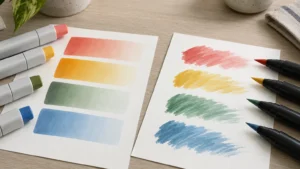
- QB/T 4435: Это ключевое правило для водорастворимых цветных карандашей. Оно проверяет, как карандаш ведет себя при смешивании с водой.
- JIS S 6006 (Япония): Этот стандарт маркирует карандаши как мягкие, средние или твердые. Он также проверяет прочность грифеля и устойчивость цветов к выцветанию (светостойкость).
- Стандарты безопасности (здоровье и окружающая среда):
- GB 21027: Базовое правило безопасности для школьных принадлежностей, с акцентом на пределы содержания тяжелых металлов.
- Европейские требования к игрушкам: EN 71-3 регулирует миграцию определённых элементов. Пределы зависят от элемента и категории материала игрушки; универсального предела содержания свинца 2 ppm для каждого компонента карандаша не существует. Попросите лабораторию указать исследуемый материал, применимую категорию, метод и предел. Отдельно рассмотрите другие применимые химические требования.
- REACH: Проверьте применимые ограничения на вещества и информационные обязанности для материалов и целевого рынка. Заявление REACH не означает, что продукт вообще не содержит опасных веществ. Уточните, какие ограничения и вещества покрывает предоставленная документация.
Для заказа ZH Stationery запросите файлы для конкретного карандаша, формулы и рынка. Подтвердите модель, примечания к образцам, дату отчета и применимые правила, прежде чем делать заявления об упаковке. Не предполагайте, что один отчет покрывает все продукты в ассортименте.
2. Будущее индустрии цветных карандашей
Отрасль меняется. В некоторых регионах меньше детей. Люди по-прежнему тратят больше на высококачественные художественные принадлежности. Вот главные тенденции:
- Профессиональное качество: Художники и любители теперь хотят более качественные цвета, которые не выцветают. Это означает, что карандаши “профессионального уровня” становятся самым популярным выбором.
- Новые технологии: Мы используем новые материалы и более умные способы производства, чтобы сделать карандаши более гладкими и прочными.
- От количества к качеству: Китай больше не просто производит “много карандашей”. Теперь мы делаем лучшие карандаши. ZH STATIONERY гордится тем, что возглавляет эти изменения, переходя от простого производства к созданию высококлассных брендов.
Часто задаваемые вопросы (FAQ)
В1: Безопасны ли цветные карандаши ZH STATIONERY для детей? О: Да. Наши карандаши соответствуют строгим требованиям, таким как EN 71-3 и REACH. Они не содержат вредных тяжелых металлов и токсичных химикатов, что делает их безопасными для студентов и художников.
В2: В чем разница между карандашами ученического и профессионального уровня? О: Карандаши профессионального уровня имеют лучшую светостойкость, поэтому цвета не выцветают, и более высокое качество пигмента. Они также соответствуют более строгим физическим требованиям, таким как JIS S 6006 для прочности грифеля.
В3: Экспортирует ли ZH STATIONERY на европейский рынок? О: Да. Вся наша продукция соответствует европейским правилам, включая регистрацию REACH для товаров на химической основе, поступающих в ЕС. Свяжитесь с нашим отделом продаж чтобы обсудить ваши потребности в импорте.
В4: Почему светостойкость важна для цветных карандашей? О: Она показывает, как долго цвет остается ярким под воздействием света. Высококачественные карандаши от ZH STATIONERY используют передовые пигменты, поэтому ваши работы сохраняются годами без выцветания.
Связанное руководство: Для соответствующего планирования соответствия требованиям см. Рынок элитных корпоративных ручек.
Связанные материалы
- Полное руководство по цветным карандашам: типы, применение и рыночные тенденции
- Как делают цветные карандаши? Секрет грифеля
- Руководство по испытанию канцелярских изделий на свободный формальдегид
- Руководство по детским художественным материалам
- Руководство по арт-терапии и снятию стресса
- Руководство по безопасности детских маркеров OEM
- Руководство по чернилам для пищевых маркеров
The Standards That Actually Apply to Colored Pencils
Colored pencils sit at an awkward intersection. They are art materials, school supplies, and sometimes toys, depending on how they are packaged and who they are sold to. That overlap means more than one standard applies, and buyers who assume a single certificate covers everything usually discover the gap at the customs stage.
For the U.S. market, art materials fall under LHAMA and carry an ASTM D-4236 conformance statement on the pack. The statement reflects a toxicological review by a qualified professional, not a factory self-declaration. For Europe, EN71-3 covers heavy metal migration from the material, and EN71-9 covers organic chemical compounds. A pencil sold as a toy also needs EN71-1 for mechanical safety and EN71-2 for flammability.
For children under 12 in the U.S., CPSIA applies, which means lead and phthalate testing plus a Children’s Product Certificate. That is a separate document from ASTM D-4236 and is not interchangeable with it.
Lightfastness and the Blue Wool Scale
Fading is the most common complaint about colored pencils and the hardest property to test in a factory. The industry measures it with the Blue Wool Scale, a set of eight wool swatches that fade at known rates under controlled light exposure. A pencil rated 8 barely shifts after extended UV exposure; one rated 4 or below visibly fades within weeks on a sunny shelf.
Organic pigments, especially the azo family, produce brilliant color but fade faster. Titanium dioxide and iron oxide pigments are far more stable but limited in hue. That is why a premium pencil set mixes both families, and why the price difference between an artist-grade set and a student-grade set is often just the pigment category the manufacturer chose.
Buyers should ask for a lightfastness report by color, not a single number for the whole set. A 48-color set where 40 colors rate 7 or above and 8 colors rate 4 is not a 48-color artist set; it is a hybrid, and the retail claim should reflect that.
Core Composition and Break Resistance
A colored pencil core is pigment, binder, wax, and filler pressed and baked at a temperature well below what graphite pencils endure. Pigments decompose at high heat, so color cores are fired at lower temperatures and hardened with binders instead of kiln sintering. That is why color cores are naturally softer than graphite cores.
Softer cores break more easily. The failure usually happens in transit, not in use, and it shows up as a rattle when the pencil is shaken. Break resistance depends on three variables: the binder ratio, the core diameter relative to the barrel bore, and the glue line between core and wood.
Ask for a drop test on a full carton, not on a single pencil. A 30-centimeter drop onto a hard floor, repeated three times, is a reasonable baseline. Then open the carton and check for rattling, because a broken core inside an intact barrel is invisible until the customer sharpens it.
Barrel Wood and Sharpening Behavior
The wood matters more than most buyers expect. Basswood and cedar sharpen cleanly and hold the core without splitting. Low-grade wood with inconsistent grain tears during sharpening, and a torn edge is what customers photograph for a one-star review.
Ask the supplier which species they use and whether the slats are kiln-dried to a consistent moisture content. Wood that arrives at 12 percent moisture and dries to 6 percent in a warehouse will shrink around the core, and a shrunken barrel cracks at the ferrule end.
Also check the paint and lacquer on the barrel. A barrel painted with cheap lacquer chips at the sharpening edge and leaves flakes in the sharpener, which is a complaint that has nothing to do with the pigment quality.
What to Ask For in a Test Report
A useful report names the SKU, the production batch, the test method, the laboratory, and the date. It does not name only the factory. A certificate that covers “colored pencils” as a category is not evidence that the specific batch in your order was tested.
Ask for the heavy metal migration result by element, not just a pass or fail. Lead, cadmium, mercury, and chromium VI each have their own limit under EN71-3, and a report that aggregates them hides which element was close to the threshold.
Ask whether the lab is accredited to ISO/IEC 17025 for the specific test method. An accredited lab can be audited; a factory’s internal lab cannot, even when the equipment is identical.
Часто задаваемые вопросы
Do colored pencils need EN71 if they are sold as art supplies? If the product could reasonably be used by children, most EU retailers will require EN71-3 at minimum. Products explicitly marketed as toys need the full EN71 set.
What is a good lightfastness rating for a retail set? For an artist-grade claim, most colors should rate 7 or 8 on the Blue Wool Scale. Student sets commonly sit at 4 to 6, which is acceptable if the pack does not claim archival performance.
Can you supply CPSIA documentation? Yes. For children’s products we provide lead and phthalate test results from an accredited lab, plus the Children’s Product Certificate.
What is the MOQ for a custom colored pencil set? Stock bodies with custom packaging typically start at 3,000 to 5,000 sets. A custom barrel color or a new tin format raises the floor because of the tooling and print setup involved.

Case Study: Why Two Suppliers Quote Differently
Two factories quote the same 48-color set with a 22 percent price gap. Neither is wrong. The difference usually sits in three places.
Pigment grade. One uses a mix of organic and inorganic pigments balanced for lightfastness; the other uses cheaper organics across the full range. The second set looks identical out of the box and fades differently after six months on a sunny shelf.
Core binder ratio. A higher binder fraction resists breakage but costs more. The lower quote often carries a core that survives normal use but fails a drop test on a full carton.
Barrel wood. Basswood and cedar sharpen cleanly. A lower-grade species with inconsistent grain tears during sharpening, which becomes a review complaint that has nothing to do with the pigment.
Ask both suppliers for the same three data points before comparing price: lightfastness by color, drop-test result on a carton, and wood species.
Часто задаваемые вопросы
Do colored pencils expire? The pigment does not, but the binder can dry out over several years, making the core crumble when sharpened. Storage below 30 degrees Celsius and away from direct sun extends usable life considerably.
Is a tin box better than a cardboard box? A tin protects the pencils from impact and moisture, which matters for a set that will sit on a shelf. A cardboard box costs less and ships lighter. The choice is a channel decision, not a quality decision.
Can the same set be sold in both EU and US markets? Yes, if the testing covers both regimes. EN71-3 and ASTM D-4236 are different tests with different documentation; a set approved for one market is not automatically approved for the other.
A set that passes all five checks on a production sample is ready for a purchase order. A set that passes four is a negotiation, not a rejection.