

At ZH STATIONERY, we believe a great colored pencil is more than wood and pigment. It is a tool for creativity that must be high-performing and safe. As the market moves toward pro-grade goods, knowing quality standards is the key to picking the right supplier. See our home page for the full range.

1. Important Standards for Colored Pencils
To make sure our customers get the best, we follow strict international rules. These bars split into two groups. How they work, physical. How safe they are, safety.
- Physical Standards (Quality & Performance):
- QB/T 4435: This is a key rule for water-soluble colored pencils. It checks how the pencil performs when mixed with water.
- JIS S 6006 (Japan): This standard labels pencils as soft, medium, or hard. It also tests how strong the lead is and how well the colors stay bright over time (lightfastness).
- Safety Standards (Health & Environment):
- GB 21027: A basic safety rule for student supplies, focusing on heavy metal limits.
- European toy requirements: EN 71-3 addresses migration of specified elements. Limits depend on the element and toy-material category; there is no universal 2 ppm lead limit for every pencil component. Ask the laboratory to identify the sampled material, applicable category, method and limit. Review other applicable chemical requirements separately.
- REACH: Check applicable substance restrictions and information duties for the materials and intended market. A REACH statement does not mean that a product contains no hazardous substances whatsoever. Ask which restrictions and substances the supplied documentation covers.
For a ZH Stationery order, ask for the files for the exact pencil, formula, and market. Confirm the model, sample notes, report date, and rules that apply before passing pack claims. Do not assume one report covers every product in the range.
2. The Future of the Colored Pencil Industry
The industry is changing. Some regions have fewer children. People still spend more on high-quality art supplies. Here are the top trends:
- Professional Quality: Artists and hobbyists now want better colors that don’t fade. This means “Professional Grade” pencils are becoming the most popular choice.
- New Technology: We are using new materials and smarter manufacturing ways to make pencils smoother and stronger.
- From Quantity to Quality: China is no longer just making “lots of pencils.” We are now making the best pencils. ZH STATIONERY is proud to lead this change, moving from simple manufacturing to high-end brand creation.
Frequently Asked Questions (FAQ)
Q1: Are ZH STATIONERY colored pencils safe for children? A: Yes. Our pencils meet strict bars like EN 71-3 and REACH. They are free from harmful heavy metals and toxic chemicals, making them safe for students and artists.
Q2: What is the difference between student-grade and professional-grade pencils? A: Pro-grade pencils have better lightfastness, so colors do not fade, and higher pigment quality. They also follow stricter physical bars like JIS S 6006 for lead strength.
Q3: Does ZH STATIONERY export to the European market? A: Yes. All our products meet European rules, including REACH registration for chemical-based goods entering the EU. Contact our sales team to discuss your import needs.
Q4: Why is lightfastness important for colored pencils? A: It measures how long a color stays bright under light. High-quality pencils from ZH STATIONERY use advanced pigments so your art lasts for years without fading.
Related guide: For related compliance planning, see Luxury Corporate Pen Market.
Related Reading
- The Ultimate Guide to Colored Pencils: Types, Uses, and Market Trends
- How Are Color Pencils Made? The Secret Behind the Lead
- The Ultimate Guide to Free Formaldehyde Testing in Stationery
- kids art materials guide
- art therapy and stress relief guide
- children's marker OEM safety guide
- food-grade marker ink guide
The Standards That Actually Apply to Colored Pencils
Colored pencils sit at an awkward intersection. They are art materials, school supplies, and sometimes toys, depending on how they are packaged and who they are sold to. That overlap means more than one standard applies, and buyers who assume a single certificate covers everything usually discover the gap at the customs stage.
For the U.S. market, art materials fall under LHAMA and carry an ASTM D-4236 conformance statement on the pack. The statement reflects a toxicological review by a qualified professional, not a factory self-declaration. For Europe, EN71-3 covers heavy metal migration from the material, and EN71-9 covers organic chemical compounds. A pencil sold as a toy also needs EN71-1 for mechanical safety and EN71-2 for flammability.
For children under 12 in the U.S., CPSIA applies, which means lead and phthalate testing plus a Children’s Product Certificate. That is a separate document from ASTM D-4236 and is not interchangeable with it.
Lightfastness and the Blue Wool Scale
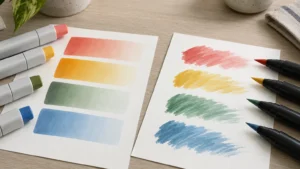
Fading is the most common complaint about colored pencils and the hardest property to test in a factory. The industry measures it with the Blue Wool Scale, a set of eight wool swatches that fade at known rates under controlled light exposure. A pencil rated 8 barely shifts after extended UV exposure; one rated 4 or below visibly fades within weeks on a sunny shelf.
Organic pigments, especially the azo family, produce brilliant color but fade faster. Titanium dioxide and iron oxide pigments are far more stable but limited in hue. That is why a premium pencil set mixes both families, and why the price difference between an artist-grade set and a student-grade set is often just the pigment category the manufacturer chose.
Buyers should ask for a lightfastness report by color, not a single number for the whole set. A 48-color set where 40 colors rate 7 or above and 8 colors rate 4 is not a 48-color artist set; it is a hybrid, and the retail claim should reflect that.
Core Composition and Break Resistance
A colored pencil core is pigment, binder, wax, and filler pressed and baked at a temperature well below what graphite pencils endure. Pigments decompose at high heat, so color cores are fired at lower temperatures and hardened with binders instead of kiln sintering. That is why color cores are naturally softer than graphite cores.
Softer cores break more easily. The failure usually happens in transit, not in use, and it shows up as a rattle when the pencil is shaken. Break resistance depends on three variables: the binder ratio, the core diameter relative to the barrel bore, and the glue line between core and wood.
Ask for a drop test on a full carton, not on a single pencil. A 30-centimeter drop onto a hard floor, repeated three times, is a reasonable baseline. Then open the carton and check for rattling, because a broken core inside an intact barrel is invisible until the customer sharpens it.
Barrel Wood and Sharpening Behavior
The wood matters more than most buyers expect. Basswood and cedar sharpen cleanly and hold the core without splitting. Low-grade wood with inconsistent grain tears during sharpening, and a torn edge is what customers photograph for a one-star review.
Ask the supplier which species they use and whether the slats are kiln-dried to a consistent moisture content. Wood that arrives at 12 percent moisture and dries to 6 percent in a warehouse will shrink around the core, and a shrunken barrel cracks at the ferrule end.
Also check the paint and lacquer on the barrel. A barrel painted with cheap lacquer chips at the sharpening edge and leaves flakes in the sharpener, which is a complaint that has nothing to do with the pigment quality.
What to Ask For in a Test Report
A useful report names the SKU, the production batch, the test method, the laboratory, and the date. It does not name only the factory. A certificate that covers “colored pencils” as a category is not evidence that the specific batch in your order was tested.
Ask for the heavy metal migration result by element, not just a pass or fail. Lead, cadmium, mercury, and chromium VI each have their own limit under EN71-3, and a report that aggregates them hides which element was close to the threshold.
Ask whether the lab is accredited to ISO/IEC 17025 for the specific test method. An accredited lab can be audited; a factory’s internal lab cannot, even when the equipment is identical.
Frequently Asked Questions
Do colored pencils need EN71 if they are sold as art supplies? If the product could reasonably be used by children, most EU retailers will require EN71-3 at minimum. Products explicitly marketed as toys need the full EN71 set.
What is a good lightfastness rating for a retail set? For an artist-grade claim, most colors should rate 7 or 8 on the Blue Wool Scale. Student sets commonly sit at 4 to 6, which is acceptable if the pack does not claim archival performance.
Can you supply CPSIA documentation? Yes. For children’s products we provide lead and phthalate test results from an accredited lab, plus the Children’s Product Certificate.
What is the MOQ for a custom colored pencil set? Stock bodies with custom packaging typically start at 3,000 to 5,000 sets. A custom barrel color or a new tin format raises the floor because of the tooling and print setup involved.

Case Study: Why Two Suppliers Quote Differently
Two factories quote the same 48-color set with a 22 percent price gap. Neither is wrong. The difference usually sits in three places.
Pigment grade. One uses a mix of organic and inorganic pigments balanced for lightfastness; the other uses cheaper organics across the full range. The second set looks identical out of the box and fades differently after six months on a sunny shelf.
Core binder ratio. A higher binder fraction resists breakage but costs more. The lower quote often carries a core that survives normal use but fails a drop test on a full carton.
Barrel wood. Basswood and cedar sharpen cleanly. A lower-grade species with inconsistent grain tears during sharpening, which becomes a review complaint that has nothing to do with the pigment.
Ask both suppliers for the same three data points before comparing price: lightfastness by color, drop-test result on a carton, and wood species.
Frequently Asked Questions
Do colored pencils expire? The pigment does not, but the binder can dry out over several years, making the core crumble when sharpened. Storage below 30 degrees Celsius and away from direct sun extends usable life considerably.
Is a tin box better than a cardboard box? A tin protects the pencils from impact and moisture, which matters for a set that will sit on a shelf. A cardboard box costs less and ships lighter. The choice is a channel decision, not a quality decision.
Can the same set be sold in both EU and US markets? Yes, if the testing covers both regimes. EN71-3 and ASTM D-4236 are different tests with different documentation; a set approved for one market is not automatically approved for the other.
A set that passes all five checks on a production sample is ready for a purchase order. A set that passes four is a negotiation, not a rejection.