
Bạn có biết rằng đồ dùng học tập và văn phòng hàng ngày đôi khi có thể ẩn chứa hóa chất độc hại? Đó là lý do tại sao việc kiểm tra formaldehyde trong các sản phẩm viết lại quan trọng đối với an toàn.
Hướng dẫn không khí trong nhà của WHO 2010 cho các chất ô nhiễm được chọn bao gồm formaldehyde. Chúng bao gồm phơi nhiễm trong không khí trong nhà. Chúng không đặt ra một giới hạn đạt chuẩn phổ quát cho các sản phẩm viết. Việc kiểm tra sản phẩm nên nêu rõ bộ phận được lấy mẫu, tiêu chuẩn sản phẩm áp dụng và phương pháp kiểm tra được sử dụng.
Để bảo vệ người mua và giữ vững tên thương hiệu, dịch vụ kiểm nghiệm đáng tin cậy là điều thiết yếu.

Tầm quan trọng của việc kiểm định formaldehyde trong văn phòng phẩm và tiêu chuẩn
Để giữ an toàn cho người mua, các tổ chức quốc gia và quốc tế đã đặt ra các quy tắc nghiêm ngặt đối với các thành phần có hại trong sản phẩm viết.
Đối với các mặt hàng dành cho học sinh trong phạm vi của nó, GB 21027-2020 là tiêu chuẩn sản phẩm Trung Quốc cần kiểm tra. Các yêu cầu của nó phụ thuộc vào mặt hàng và bộ phận. Xác nhận nhu cầu của thị trường đích một cách riêng biệt. Một báo cáo theo tiêu chuẩn Trung Quốc một mình không cho thấy sự phù hợp cho mọi thị trường xuất khẩu.
Bằng cách kiểm nghiệm theo các tiêu chuẩn này, nhà sản xuất thể hiện nỗ lực về sản xuất xanh, an toàn và chất lượng cao.
Phương pháp phòng thí nghiệm: Quang phổ hấp thụ Acetylacetone
Danh mục chính thức của GB/T 32606-2016 ghi phương pháp thử formaldehyde là quang phổ acetylacetone. Hãy yêu cầu phòng thí nghiệm nêu rõ phiên bản phương pháp. Xác nhận rằng các bước lấy mẫu và chiết của họ phù hợp với chi tiết được thử.
Nguyên lý cơ bản:
Phương pháp acetylacetone tạo ra một sản phẩm phản ứng có màu. Phòng thí nghiệm so sánh độ hấp thụ của nó với các dung dịch đã hiệu chuẩn. Phòng thí nghiệm phải tuân theo các điều kiện chuẩn bị thuốc thử, chiết xuất, phản ứng và đo lường đã nêu. Tổng quan này không phải là tiêu chuẩn đầy đủ. Nó cũng không phải là một quy trình phòng thí nghiệm.
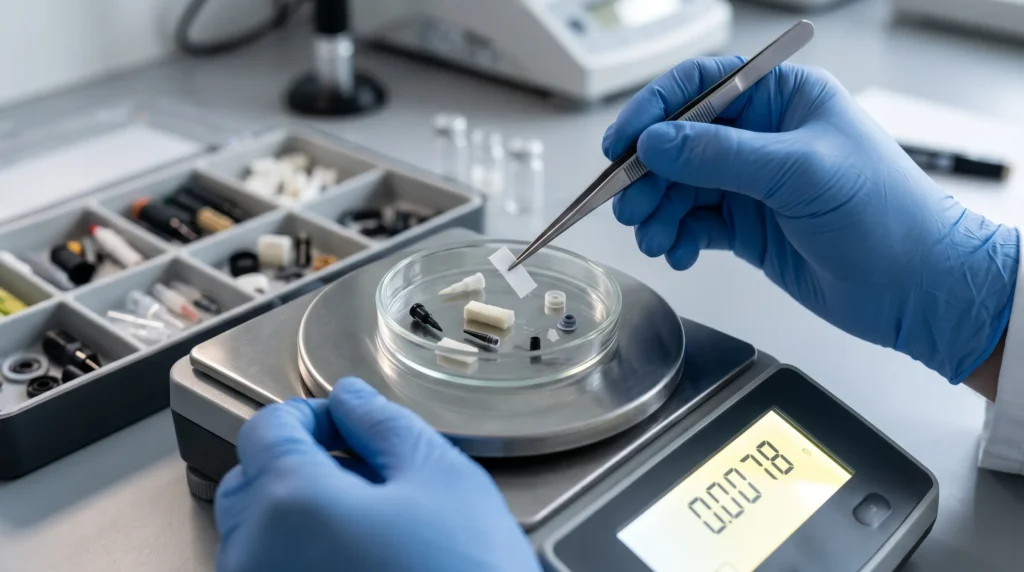
Những điều cần kiểm tra trong báo cáo phòng thí nghiệm
Sử dụng bốn điểm này để xem xét báo cáo với phòng thí nghiệm. Phương pháp kiểm tra đầy đủ đặt ra khối lượng mẫu, điều kiện chiết xuất, thể tích thuốc thử, thời gian phản ứng và phạm vi hiệu chuẩn. Không suy ra những điều đó từ một bài viết tìm nguồn chung chung.
1. Chuẩn bị mẫu
Nêu rõ mẫu, bộ phận và vật liệu được lấy mẫu. Hỏi cách bộ phận được chuẩn bị và chiết xuất theo phương pháp được trích dẫn. Xác nhận rằng báo cáo nêu rõ mẫu, không phải một sản phẩm hoặc lô khác.
2. Phản ứng màu
Kiểm tra rằng phòng thí nghiệm đã tuân theo phương pháp được trích dẫn cho việc chuẩn bị thuốc thử, phản ứng và đọc độ hấp thụ. Yêu cầu làm rõ nếu báo cáo không nêu rõ phương pháp hoặc mô tả một quy trình đã thay đổi.
3. Tạo đường chuẩn
Hỏi cách phạm vi hiệu chuẩn và mẫu trắng phương pháp được thiết lập. Hỏi liệu kết quả mẫu có nằm trong phạm vi đo đã kiểm tra không. Phương pháp áp dụng, không phải một bài viết chung chung, đặt ra các mức hiệu chuẩn.
4. Đọc kết quả
Đọc giá trị được báo cáo cùng với đơn vị, giới hạn phát hiện hoặc định lượng và giới hạn đạt áp dụng. Một giá trị dưới giới hạn báo cáo nên được đọc là đã báo cáo. Đừng gọi đó là bằng chứng rằng không có formaldehyde.
Công thức tính toán cuối cùng
Biểu thức dưới đây chỉ cho thấy sự thay đổi đơn vị khi c đã được hiệu chỉnh mẫu trắng và độ pha loãng thêm đã được tính. Phương pháp đầy đủ và cách tính của phòng thí nghiệm quyết định kết quả báo cáo. Biểu thức này không phải toàn bộ quy trình GB/T 32606.
x = (c × f) / m
- x = Lượng formaldehyde tự do trong mẫu (mg/kg)
- c = Nồng độ đã hiệu chỉnh mẫu trắng, với mọi độ pha loãng bổ sung đã được tính đến (μg/mL)
- f = Thể tích dung dịch mẫu được pha loãng tới (mL)
- m = Khối lượng chính xác của mẫu ban đầu (g)
Kiểm tra mẫu trắng phương pháp, hệ số pha loãng và đơn vị báo cáo với phòng thí nghiệm. Chỉ sửa mẫu trắng không có nghĩa là tổng số là chính xác.
Kiểm nghiệm đáng tin cậy vì sự an tâm của bạn
Giữ sản phẩm an toàn không chỉ là vấn đề pháp lý. Đó là bảo vệ khách hàng của bạn.
Chọn một phòng thí nghiệm có phạm vi công nhận hiện tại bao gồm phương pháp cần thiết. Kiểm tra trực tiếp người phát hành báo cáo, tên mẫu và phạm vi. Bài viết này không đặt ra thông tin xác thực hiện tại hoặc phạm vi của bất kỳ phòng thí nghiệm được nêu tên nào.
Đối với bút đánh dấu và các sản phẩm viết khác, một báo cáo kiểm tra ghi lại mẫu, phương pháp và kết quả. So sánh những kết quả đó với nhu cầu sản phẩm áp dụng. Công nhận không có nghĩa là mọi mẫu, bộ phận hoặc lô chưa được kiểm tra đều không có các bộ phận có hại.
Hướng dẫn liên quan: Cách đọc báo cáo thử nghiệm ASTM D-4236 cho bút lông acrylic.
Bài đọc liên quan
Why Formaldehyde Still Appears in Stationery
Formaldehyde is not added to markers on purpose. It arrives as a residual from three sources: adhesives in packaging, preservatives in water-based ink, and finishes on wooden or paper components. In each case the amount is small, but the regulatory limit is also small, and the test measures what is present rather than what was intended.
The adhesive route is the most common. Casein and urea-formaldehyde glues are cheap and strong, which is why they still appear in some cartons and laminated boards. A marker itself may pass while the display box it ships in does not.
The ink route matters for water-based formulas. Some preservative systems release formaldehyde slowly as they break down, which is why a freshly mixed batch can pass and a batch tested after six months in a warehouse can fail. That is not a manufacturing defect in the usual sense; it is a formulation choice with a time dimension.
How the Acetylacetone Method Works
GB/T 32606-2016 specifies acetylacetone spectrophotometry as the formaldehyde test method. The procedure runs in four stages.
Extraction. The sample is placed in water at a controlled temperature for a set period. Formaldehyde migrates into the water. The extraction time and temperature are specified, and changing either one changes the result.
Reaction. Acetylacetone reagent is added. In the presence of ammonium acetate, formaldehyde reacts to form a yellow compound, 3,5-diacetyl-1,4-dihydrolutidine. The reaction needs a fixed time and temperature to complete.
Measurement. The solution is read in a spectrophotometer at 412 nanometers. Absorbance is proportional to formaldehyde concentration within the calibrated range.
Calculation. Concentration is derived from the calibration curve, corrected for the blank, and converted to milligrams per kilogram of sample.
The formula only works when the blank is properly corrected and any additional dilution is counted. A report that quotes a number without stating the method edition, the extraction conditions, and the blank value is not reproducible.
Reading a Report: What the Numbers Mean
Three numbers matter on a formaldehyde report: the result, the limit, and the detection limit.
The result should be expressed in mg/kg with the measurement uncertainty stated. A result of 15 mg/kg with an uncertainty of plus or minus 3 is a different statement from 15 mg/kg with no uncertainty given.
The limit depends on the destination market and the product category. Textile and wood components have their own limits under separate standards; stationery is often assessed against the general consumer goods framework. Confirm which limit applies before comparing a result to a pass threshold.
The detection limit tells you whether the test could actually see a failure. A method with a detection limit of 20 mg/kg cannot demonstrate compliance with a 16 mg/kg limit, no matter what the result says.
Sampling and Extraction: Where Tests Go Wrong
Most false passes and false failures trace to sampling, not to the instrument.
The sample must represent the batch. A single marker taken from the top of a carton is not a batch sample. The correct approach is to composite material from several units, because formaldehyde distribution within a production run is not uniform.
The extraction conditions must match the method. Water temperature, extraction time, and the ratio of sample mass to water volume all affect the result. A lab that shortens the extraction to save time will report a lower number than the method intends.
The tested part must be the part that matters. For a marker, that means the barrel, the cap, the ink, and the packaging assessed separately, because each has a different risk profile and a different limit may apply.
Câu hỏi thường gặp
Does passing a formaldehyde test mean the product is safe? No. It means formaldehyde is below the applicable limit for that test method. Other substances are covered by other tests.
How often should formaldehyde be retested? At minimum once per production batch, and again whenever the ink supplier, adhesive supplier, or packaging supplier changes.
Can a factory self-test? It can screen internally, but the report that goes to a retailer should come from an accredited third-party lab with the method edition stated.
What happens if a batch fails? The batch should be held, the source identified — ink, adhesive, or packaging — and the affected lots traced. Retesting the same sample rarely changes the result.
Where Formaldehyde Comes From in the Supply Chain
The test measures what is present, not what was intended. Three upstream sources account for most failures.
Adhesive suppliers. Casein and urea-formaldehyde glues remain cheap and strong, which is why they still appear in laminated boards and some cartons. A marker can pass while the display box it ships in does not. Ask for the adhesive declaration separately from the ink declaration.
Preservative systems in water-based ink. Certain preservatives release formaldehyde as they break down. A freshly mixed batch passes; the same batch tested after six months in a warm warehouse may not. This is a formulation choice with a time dimension, and it is the most common cause of a late failure.
Wood and paper components. Pencil barrels, wooden display stands, and some paper stocks carry residual formaldehyde from processing. These are usually low, but they add to the total when the test composites multiple materials.
The practical implication: test the finished product as it ships, not the individual components in isolation. A composite sample catches the additive effect that single-component testing misses.
Setting a Retest Cadence That Actually Catches Drift
Most programs retest once per production batch, which is not enough to catch a slow drift.
A supplier can change an adhesive vendor, a preservative concentration, or a packaging source without announcing it, and the change shows up three batches later as a failed test. The cadence that catches this has three triggers.
Per batch. A basic screening test on every production run. This is a factory-side control, not a third-party report.
Per quarter. A full third-party report on the current production. This catches drift before it becomes a retailer issue.
Per change. Any change to ink supplier, adhesive supplier, packaging supplier, or formulation triggers an immediate retest regardless of the quarterly schedule. This is the trigger most programs omit, and it is the one that catches the failures that matter.
Put the change trigger in the purchase order, not in a side agreement. A clause that requires notification before any material substitution is enforceable; a verbal understanding is not.