

Tại ZH STATIONERY, chúng tôi tin rằng một cây bút chì màu tốt không chỉ là gỗ và bột màu. Đó là công cụ sáng tạo cần hiệu suất cao và an toàn. Khi thị trường chuyển sang hàng chuyên nghiệp, việc hiểu rõ tiêu chuẩn chất lượng là chìa khóa để chọn đúng nhà cung cấp. Xem trang chủ để biết đầy đủ các dòng sản phẩm.

1. Các Tiêu Chuẩn Quan Trọng Đối Với Bút Chì Màu
Để đảm bảo khách hàng nhận được sản phẩm tốt nhất, chúng tôi tuân thủ nghiêm ngặt các quy định quốc tế. Các tiêu chuẩn này chia thành hai nhóm: về vật lý và về an toàn.
- Tiêu chuẩn vật lý (Chất lượng & Hiệu suất):
- QB/T 4435: Đây là quy định quan trọng đối với bút chì màu tan trong nước. Nó kiểm tra hiệu suất của bút chì khi trộn với nước.
- JIS S 6006 (Nhật Bản): Tiêu chuẩn này phân loại bút chì thành loại mềm, trung bình hoặc cứng. Tiêu chuẩn cũng kiểm tra độ bền của ruột chì và độ bền màu theo thời gian (độ bền ánh sáng).
- Tiêu chuẩn an toàn (Sức khỏe & Môi trường):
- GB 21027: Quy tắc an toàn cơ bản cho đồ dùng học sinh, tập trung vào giới hạn kim loại nặng.
- Yêu cầu đồ chơi châu Âu: EN 71-3 đề cập đến sự di chuyển của các nguyên tố quy định. Giới hạn phụ thuộc vào nguyên tố và loại vật liệu đồ chơi; không có giới hạn chì 2 ppm chung cho mọi thành phần bút chì. Yêu cầu phòng thí nghiệm xác định vật liệu được lấy mẫu, loại áp dụng, phương pháp và giới hạn. Xem xét riêng các yêu cầu hóa học áp dụng khác.
- REACH: Kiểm tra các hạn chế chất áp dụng và nghĩa vụ thông tin đối với vật liệu và thị trường dự kiến. Một tuyên bố REACH không có nghĩa là sản phẩm không chứa bất kỳ chất nguy hại nào. Hỏi rõ tài liệu được cung cấp bao gồm những hạn chế và chất nào.
Đối với đơn hàng ZH Stationery, hãy yêu cầu hồ sơ cho đúng loại bút chì, công thức và thị trường. Xác nhận model, ghi chú mẫu, ngày báo cáo và quy định áp dụng trước khi đưa ra tuyên bố về bao bì. Đừng cho rằng một báo cáo áp dụng cho mọi sản phẩm trong dòng.
2. Tương lai của Ngành Bút Chì Màu
Ngành đang thay đổi. Một số khu vực có ít trẻ em hơn. Người tiêu dùng vẫn chi nhiều hơn cho đồ dùng nghệ thuật chất lượng cao. Dưới đây là các xu hướng hàng đầu:
- Chất lượng chuyên nghiệp: Các nghệ sĩ và người đam mê hiện muốn màu sắc tốt hơn, không phai. Điều này có nghĩa là bút chì “Cấp chuyên nghiệp” đang trở thành lựa chọn phổ biến nhất.
- Công nghệ mới: Chúng tôi đang sử dụng vật liệu mới và phương pháp sản xuất thông minh hơn để làm cho bút chì mượt mà và bền hơn.
- Từ số lượng đến chất lượng: Trung Quốc không còn chỉ sản xuất “thật nhiều bút chì”. Chúng tôi hiện đang sản xuất tốt nhất . ZH STATIONERY tự hào dẫn đầu sự thay đổi này, chuyển từ sản xuất đơn thuần sang sáng tạo thương hiệu cao cấp.
Câu Hỏi Thường Gặp (FAQ)
Q1: Bút chì màu ZH STATIONERY có an toàn cho trẻ em không? A: Có. Bút chì của chúng tôi đáp ứng các tiêu chuẩn nghiêm ngặt như EN 71-3 và REACH. Chúng không chứa kim loại nặng độc hại và hóa chất độc, an toàn cho học sinh và họa sĩ.
Q2: Sự khác biệt giữa bút chì cấp học sinh và cấp chuyên nghiệp là gì? A: Bút chì cấp chuyên nghiệp có độ bền màu tốt hơn, màu không phai, và chất lượng bột màu cao hơn. Chúng cũng tuân thủ các tiêu chuẩn vật lý nghiêm ngặt hơn như JIS S 6006 về độ bền ruột chì.
Q3: ZH STATIONERY có xuất khẩu sang thị trường châu Âu không? A: Có. Tất cả sản phẩm của chúng tôi đáp ứng quy định châu Âu, bao gồm đăng ký REACH cho hàng hóa gốc hóa chất nhập vào EU. Liên hệ đội ngũ bán hàng của chúng tôi để trao đổi về nhu cầu nhập khẩu của bạn.
Q4: Tại sao độ bền màu lại quan trọng đối với bút chì màu? A: Nó đo thời gian màu giữ được độ tươi dưới ánh sáng. Bút chì chất lượng cao từ ZH STATIONERY sử dụng bột màu tiên tiến để tác phẩm của bạn bền lâu không phai.
Hướng dẫn liên quan: Để lập kế hoạch tuân thủ liên quan, xem Thị trường bút doanh nghiệp cao cấp.
Bài đọc liên quan
- Hướng dẫn tối ưu về bút chì màu: Các loại, công dụng và xu hướng thị trường
- Bút chì màu được sản xuất như thế nào? Bí mật đằng sau ruột bút
- Hướng dẫn kiểm nghiệm formaldehyde tự do trong đồ dùng văn phòng
- Hướng dẫn dụng cụ mỹ thuật cho trẻ em
- Hướng dẫn liệu pháp nghệ thuật và giảm căng thẳng
- hướng dẫn an toàn bút lông trẻ em OEM
- hướng dẫn mực bút dạ cấp thực phẩm
The Standards That Actually Apply to Colored Pencils
Colored pencils sit at an awkward intersection. They are art materials, school supplies, and sometimes toys, depending on how they are packaged and who they are sold to. That overlap means more than one standard applies, and buyers who assume a single certificate covers everything usually discover the gap at the customs stage.
For the U.S. market, art materials fall under LHAMA and carry an ASTM D-4236 conformance statement on the pack. The statement reflects a toxicological review by a qualified professional, not a factory self-declaration. For Europe, EN71-3 covers heavy metal migration from the material, and EN71-9 covers organic chemical compounds. A pencil sold as a toy also needs EN71-1 for mechanical safety and EN71-2 for flammability.
For children under 12 in the U.S., CPSIA applies, which means lead and phthalate testing plus a Children’s Product Certificate. That is a separate document from ASTM D-4236 and is not interchangeable with it.
Lightfastness and the Blue Wool Scale
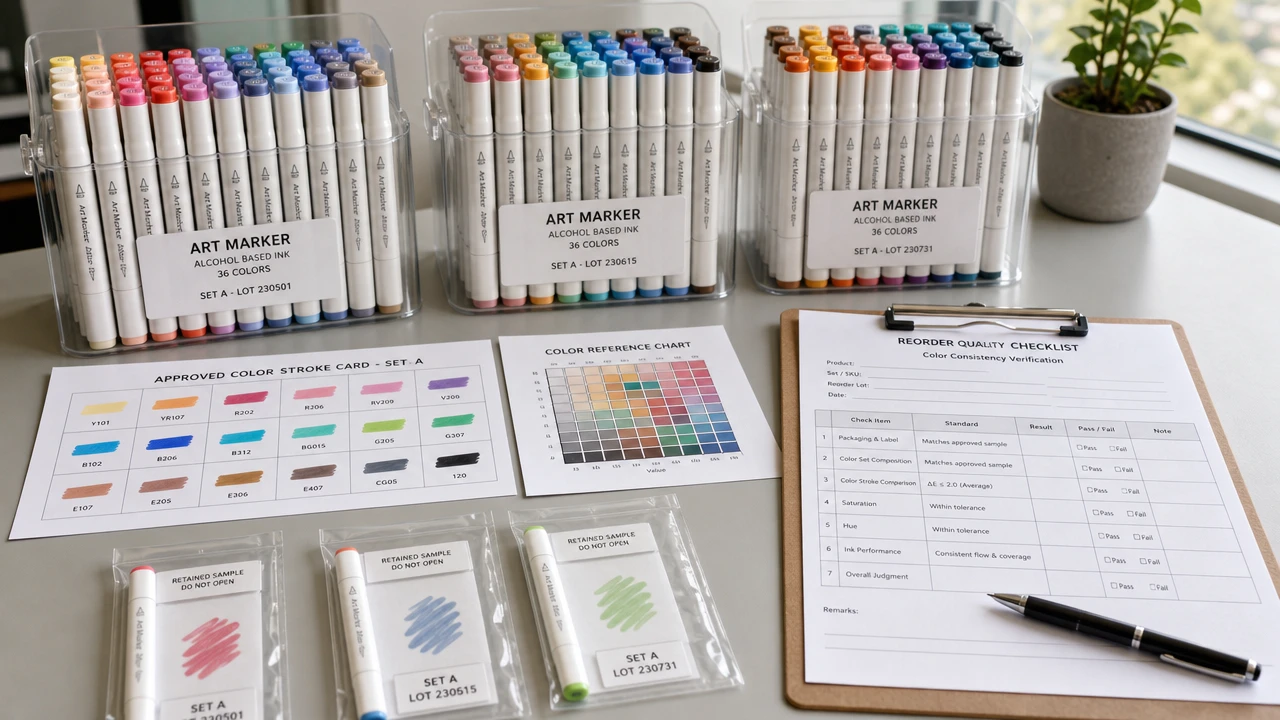
Fading is the most common complaint about colored pencils and the hardest property to test in a factory. The industry measures it with the Blue Wool Scale, a set of eight wool swatches that fade at known rates under controlled light exposure. A pencil rated 8 barely shifts after extended UV exposure; one rated 4 or below visibly fades within weeks on a sunny shelf.
Organic pigments, especially the azo family, produce brilliant color but fade faster. Titanium dioxide and iron oxide pigments are far more stable but limited in hue. That is why a premium pencil set mixes both families, and why the price difference between an artist-grade set and a student-grade set is often just the pigment category the manufacturer chose.
Buyers should ask for a lightfastness report by color, not a single number for the whole set. A 48-color set where 40 colors rate 7 or above and 8 colors rate 4 is not a 48-color artist set; it is a hybrid, and the retail claim should reflect that.
Core Composition and Break Resistance
A colored pencil core is pigment, binder, wax, and filler pressed and baked at a temperature well below what graphite pencils endure. Pigments decompose at high heat, so color cores are fired at lower temperatures and hardened with binders instead of kiln sintering. That is why color cores are naturally softer than graphite cores.
Softer cores break more easily. The failure usually happens in transit, not in use, and it shows up as a rattle when the pencil is shaken. Break resistance depends on three variables: the binder ratio, the core diameter relative to the barrel bore, and the glue line between core and wood.
Ask for a drop test on a full carton, not on a single pencil. A 30-centimeter drop onto a hard floor, repeated three times, is a reasonable baseline. Then open the carton and check for rattling, because a broken core inside an intact barrel is invisible until the customer sharpens it.
Barrel Wood and Sharpening Behavior
The wood matters more than most buyers expect. Basswood and cedar sharpen cleanly and hold the core without splitting. Low-grade wood with inconsistent grain tears during sharpening, and a torn edge is what customers photograph for a one-star review.
Ask the supplier which species they use and whether the slats are kiln-dried to a consistent moisture content. Wood that arrives at 12 percent moisture and dries to 6 percent in a warehouse will shrink around the core, and a shrunken barrel cracks at the ferrule end.
Also check the paint and lacquer on the barrel. A barrel painted with cheap lacquer chips at the sharpening edge and leaves flakes in the sharpener, which is a complaint that has nothing to do with the pigment quality.
What to Ask For in a Test Report
A useful report names the SKU, the production batch, the test method, the laboratory, and the date. It does not name only the factory. A certificate that covers “colored pencils” as a category is not evidence that the specific batch in your order was tested.
Ask for the heavy metal migration result by element, not just a pass or fail. Lead, cadmium, mercury, and chromium VI each have their own limit under EN71-3, and a report that aggregates them hides which element was close to the threshold.
Ask whether the lab is accredited to ISO/IEC 17025 for the specific test method. An accredited lab can be audited; a factory’s internal lab cannot, even when the equipment is identical.
Câu hỏi thường gặp
Do colored pencils need EN71 if they are sold as art supplies? If the product could reasonably be used by children, most EU retailers will require EN71-3 at minimum. Products explicitly marketed as toys need the full EN71 set.
What is a good lightfastness rating for a retail set? For an artist-grade claim, most colors should rate 7 or 8 on the Blue Wool Scale. Student sets commonly sit at 4 to 6, which is acceptable if the pack does not claim archival performance.
Can you supply CPSIA documentation? Yes. For children’s products we provide lead and phthalate test results from an accredited lab, plus the Children’s Product Certificate.
What is the MOQ for a custom colored pencil set? Stock bodies with custom packaging typically start at 3,000 to 5,000 sets. A custom barrel color or a new tin format raises the floor because of the tooling and print setup involved.
Case Study: Why Two Suppliers Quote Differently
Two factories quote the same 48-color set with a 22 percent price gap. Neither is wrong. The difference usually sits in three places.
Pigment grade. One uses a mix of organic and inorganic pigments balanced for lightfastness; the other uses cheaper organics across the full range. The second set looks identical out of the box and fades differently after six months on a sunny shelf.
Core binder ratio. A higher binder fraction resists breakage but costs more. The lower quote often carries a core that survives normal use but fails a drop test on a full carton.
Barrel wood. Basswood and cedar sharpen cleanly. A lower-grade species with inconsistent grain tears during sharpening, which becomes a review complaint that has nothing to do with the pigment.
Ask both suppliers for the same three data points before comparing price: lightfastness by color, drop-test result on a carton, and wood species.
Câu hỏi thường gặp
Do colored pencils expire? The pigment does not, but the binder can dry out over several years, making the core crumble when sharpened. Storage below 30 degrees Celsius and away from direct sun extends usable life considerably.
Is a tin box better than a cardboard box? A tin protects the pencils from impact and moisture, which matters for a set that will sit on a shelf. A cardboard box costs less and ships lighter. The choice is a channel decision, not a quality decision.
Can the same set be sold in both EU and US markets? Yes, if the testing covers both regimes. EN71-3 and ASTM D-4236 are different tests with different documentation; a set approved for one market is not automatically approved for the other.
A set that passes all five checks on a production sample is ready for a purchase order. A set that passes four is a negotiation, not a rejection.