Trong thị trường đồ dùng viết tùy chỉnh cho trẻ em, an toàn và dễ sử dụng là hai trụ cột của niềm tin thương hiệu. Khi tìm nhà cung cấp bút lông trẻ em OEM đáng tin cậy, hãy chọn sản phẩm công thái học và đạt tiêu chuẩn an toàn cao. Xương bàn tay trẻ 3-6 tuổi chưa phát triển hoàn thiện. Lực cầm và sức mạnh khác người lớn, theo kết quả trị liệu nhi khoa.
1. Điểm đau trong dụng cụ vẽ truyền thống cho trẻ em
Nhiều bút lông từ nhà sản xuất giá rẻ chỉ là bút người lớn thu nhỏ. Chúng thường quá mảnh gây mỏi tay. Cạnh ngòi hoặc nắp có thể sắc gây trầy xước. Các chi tiết nhỏ dễ rơi ra. Những lỗi này phá hỏng niềm vui vẽ và gây khiếu nại về an toàn, làm tổn hại thương hiệu của bạn.
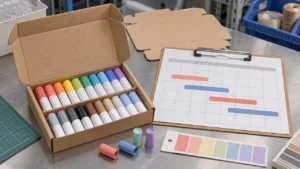
Ảnh thiết kế công nghiệp của một bộ bút lông chất lượng cao được thiết kế đặc biệt cho trẻ em, thể hiện thân bút tròn đầy đặn như viên sỏi không có góc nhọn, cũng như kết cấu chống trượt sinh học được đúc trên bề mặt.
2. Thiết kế công nghiệp cao cấp: Khái niệm “Cộng sinh tự nhiên”
Để giải quyết những điểm đau này, chúng tôi đã đưa ý tưởng về sự vừa vặn tự nhiên vào công việc sản phẩm và thiết kế khuôn. Khách hàng B2B nhận được giải pháp sản phẩm tốt hơn:
Tay cầm được thiết kế riêng cho bàn tay nhỏ: Thiết kế thân bút phải nhẹ nhưng đầy đặn. Chúng tôi tích hợp các họa tiết chống trượt mô phỏng sinh học trong quá trình ép phun để tăng ma sát và chống rơi, đảm bảo trẻ em không bị mỏi tay trong các buổi vẽ dài.
Hình dạng tròn trịa, thân thiện không có góc nhọn: Tổng thể bề ngoài loại bỏ mọi cạnh sắc, áp dụng hình dạng tròn trịa gợi nhớ đến viên sỏi. Điều này không chỉ bảo vệ trẻ về mặt vật lý mà còn mang lại cho sản phẩm sự gần gũi cao hơn về mặt tâm lý, tăng tỷ lệ chuyển đổi thị giác trên kệ bán lẻ.
Thiết kế nắp và nút bịt đầu: Xem xét khả năng giữ linh kiện và cấu trúc nắp trên sản phẩm hoàn thiện. ISO 11540 đề cập đến các loại nắp được thiết kế để giảm nguy cơ ngạt thở; tiêu chuẩn này không loại bỏ nguy cơ nghẹn. Yêu cầu bằng chứng cụ thể cho từng mẫu và đánh giá các bộ phận có thể tháo rời cũng như độ tuổi phù hợp trước khi đưa ra tuyên bố tuân thủ.
3. Nâng tầm thương hiệu của bạn với thiết kế vượt trội
Thiết kế tốt không chỉ là giảm thiểu rủi ro. Đó là nguồn giá trị thương hiệu. Vẻ ngoài sạch sẽ cùng kỹ thuật công thái học làm cho bút đánh dấu tùy chỉnh của bạn mạnh mẽ hơn trên thị trường.
Sản xuất tận gốc, chất lượng đảm bảo
Là nhà sản xuất dụng cụ viết chuyên dụng và nhà máy nguồn, chúng tôi vận hành toàn bộ chuỗi. Thiết kế công nghiệp, công việc khuôn mẫu và ép phun hàng loạt đều được thực hiện nội bộ. Chúng tôi tuân theo các quy tắc kích thước an toàn khi viết quốc tế để tạo ra các sản phẩm tùy chỉnh mới và an toàn.
Thực hiện bước tiếp theo cho thương hiệu của bạn: Liên hệ với chúng tôi ngay hôm nay để nhận danh mục sản phẩm và báo giá số lượng đặt hàng tối thiểu (MOQ) OEM!
Đơn hàng tối thiểu cho các chương trình OEM/ODM tùy chỉnh là 50.000 bút mỗi đơn hàng, tính theo tổng số bút riêng lẻ được sản xuất. Đối với hộp 12 màu, tương đương khoảng 4.200 bộ, không phải 50.000 mỗi màu. Các mẫu tiêu chuẩn có sẵn có thể được lấy mẫu với số lượng thử nghiệm nhỏ hơn.
The Regulatory Map for Children’s Markers
Selling a marker to a child is a different regulatory exercise than selling one to an adult. Four frameworks usually apply, and they do not overlap cleanly.
EN71 for Europe. Part 1 covers mechanical and physical properties, Part 2 covers flammability, Part 3 covers heavy metal migration, and Part 9 covers organic chemical compounds. A marker marketed as a toy needs all four; a marker sold as an art material for children needs at least Part 3, and most EU retailers will ask for Part 9 as well.
ASTM D-4236 and LHAMA for the U.S. Art materials carry a conformance statement backed by a toxicological review. That is a labeling requirement, not a product safety certification.
CPSIA for U.S. children’s products. Products designed for children under 12 need lead and phthalate testing plus a Children’s Product Certificate. This sits alongside ASTM D-4236, not instead of it.
REACH for the EU. SVHC screening applies to all products, not just children’s items. A marker can be fully EN71 compliant and still fail a REACH SVHC check on a specific additive.
Ergonomics: Grip Diameter and Age
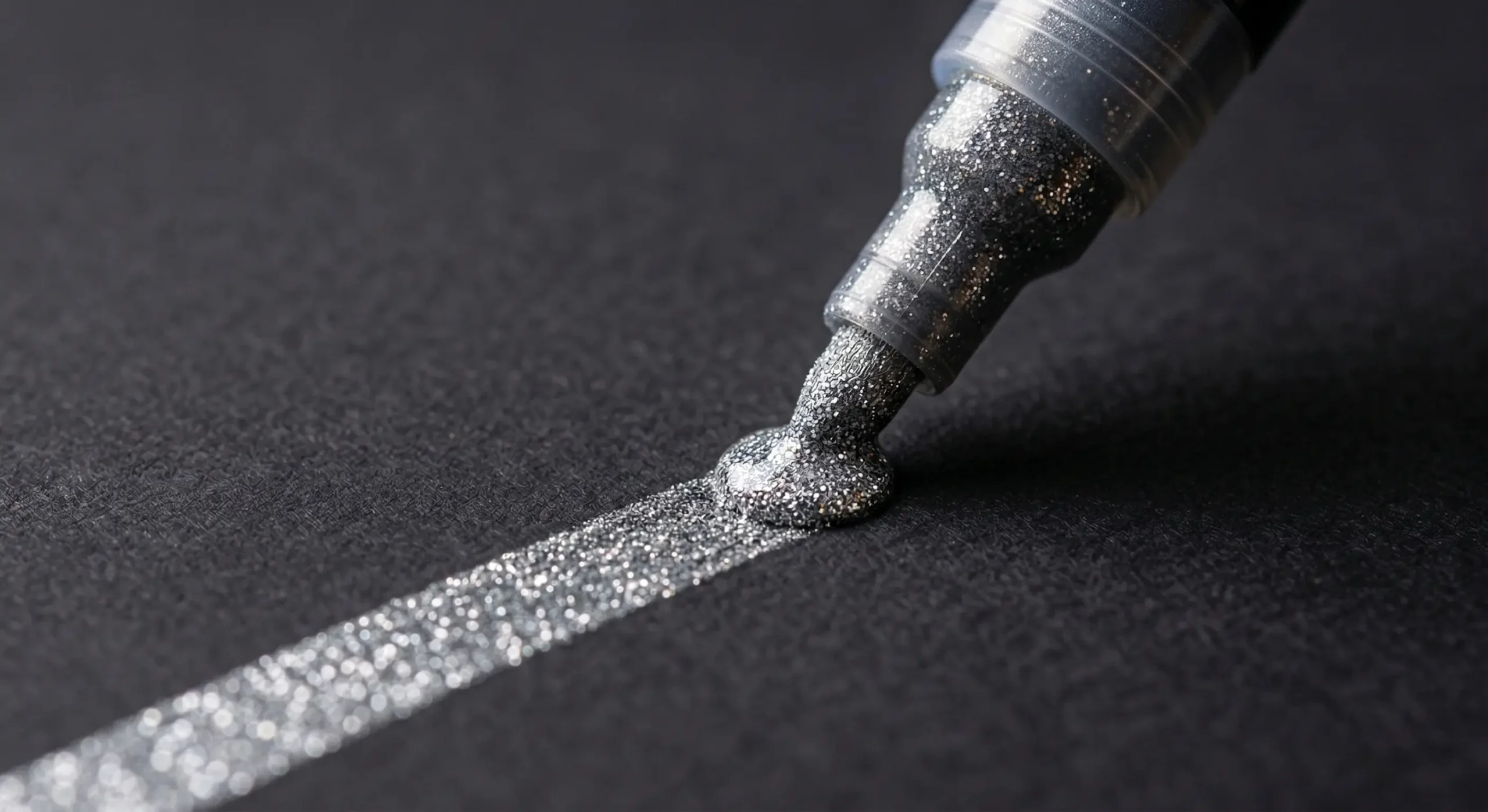
Macro close-up of a pen nib laying down an opaque line
The hand bones of a three to six year old are not fully formed. The grip is still developing, and a barrel sized for an adult hand forces an awkward hold that children compensate for by gripping harder, which tires the hand quickly and produces inconsistent strokes.
Three practical dimensions matter. Barrel diameter around 10 to 12 millimeters suits the preschool grip. A triangular or ergonomically contoured section helps position the fingers without instruction. Overall length should let the marker rest against the web of the hand without overbalancing.
Cap design matters as much as the barrel. A cap that needs significant force to remove will be chewed rather than pulled. A cap that releases too easily creates a choking risk. The working window is a pull force that a five-year-old can manage but a toddler cannot easily defeat.
Ink Safety: What “Non-Toxic” Actually Covers
The phrase “non-toxic” on a marker package is not a regulated claim in most markets. It usually means the manufacturer completed a toxicological review under ASTM D-4236 or an equivalent framework, and that no acute hazard was identified for the intended use.
What that review covers: acute toxicity, skin and eye irritation, sensitization, and chronic hazard labeling. What it does not cover: every possible contaminant, long-term low-dose exposure, or misuse such as drinking the ink.
For children’s markers, three ink properties deserve separate attention. First, preservative choice, because water-based ink supports microbial growth and the preservative has to be both effective and safe. Second, bittering agents, which are added to discourage ingestion and must not themselves be hazardous. Third, pH, because an acidic ink can corrode the valve or the nib over shelf life.
Ventilated Caps and the Choking Hazard Question
Custom animal pen mold development for childrens shapes
A ventilated cap has a small airway designed to allow breathing if the cap is inhaled. It is not a guarantee of safety, but it does extend the window for intervention, which is why many markets expect it on children’s writing instruments.
Two things to verify. First, the airway must be a real channel, not a decorative dimple. Second, the cap must still seal when closed, because a cap that vents and also leaks air will dry the marker out within weeks. That tradeoff is a design problem, and it is one of the places where cheap caps fail.
Ask for the cap pull-force data and the ventilation airflow measurement. Both should be on the test report, not just asserted in a sales conversation.
Câu hỏi thường gặp
Does a children’s marker need both EN71 and CPSIA? If it sells in both markets, yes. They are separate regimes and neither substitutes for the other.
Is “non-toxic” a certification? No. It is a claim that usually reflects an ASTM D-4236 toxicological review. Ask for the review documentation, not the phrase.
What barrel diameter suits a preschooler? Around 10 to 12 millimeters, with a contoured grip section if possible.
Can you supply ventilated caps? Yes, with pull-force and airflow data on the test report. The cap must also pass a closed-storage seal test.
What a Compliance File Should Contain
A compliance file is not a certificate. It is a set of documents that lets a retailer answer a question from a regulator within a day. Four items belong in it.
Test reports by SKU. Each report names the product, the batch, the test method, the laboratory, and the date. A report that covers “children’s markers” as a category does not prove that the batch in your order was tested.
The Children’s Product Certificate. Required for U.S. children’s products under CPSIA. It names the manufacturer, the testing lab, and the specific rule each test addresses.
Material declarations. A list of the substances in the ink and the barrel by function, with their regulatory status. A supplier that refuses to disclose this under NDA is declining to be checked.
Retained samples. One sealed set from the approved run, labelled with SKU, PO number, and production date. Without it, a reorder dispute becomes a conversation about memory.
Packaging Rules for Children’s Products
Packaging carries its own compliance burden. A blister card with a hang hole is treated differently from a sealed poly bag, and the difference shows up in choking-hazard rules and suffocation warnings.
Poly bags above a certain size must carry a suffocation warning in the destination language. Blister cards need the age grading printed in a specified size and position. Display boxes intended for floor standing need stability testing if they will hold product above a certain height.
Ask the supplier which packaging format they have already certified for the target market. A factory that has shipped the same format to EU retail has already worked through the labeling details; one that has not will learn them on your order.