Children’s Marker OEM Guide: Ergonomics & Safety for B2B Brands
맞춤형 어린이 필기 시장에서 안전과 사용 편의성은 브랜드 신뢰의 두 기둥입니다. 신뢰할 수 있는 어린이 마커 OEM을 찾을 때 인체공학적이고 높은 안전 기준에 맞게 제작된 제품을 선택하세요. 3~6세 어린이의 손뼈는 완전히 성장하지 않았습니다. 소아 치료 연구에 따르면 그들의 그립과 힘은 성인과 다릅니다.
1. 전통적인 아동용 그리기 도구의 문제점
저가 제조사의 많은 마커는 단순히 성인용 펜을 축소한 것입니다. 너무 얇아 손 피로를 유발하는 경우가 많습니다. 펜촉이나 캡 가장자리가 날카로워 긁힘을 유발할 수 있습니다. 작은 부품이 쉽게 떨어질 수 있습니다. 이러한 결함은 그림 그리기의 즐거움을 망치고 안전 관련 불만을 초래합니다. 이는 브랜드 명성에 해를 끼칩니다.
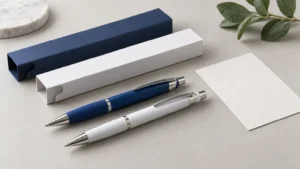
아동을 위해 특별히 설계된 고품질 마커 세트의 산업 디자인 사진으로, 날카로운 각이 없는 풍부한 자갈 모양의 둥근 몸체와 표면의 생체 모방형 미끄럼 방지 질감을 보여줍니다.
2. 프리미엄 산업 디자인: “자연 공생” 개념
이러한 문제점을 해결하기 위해 제품 개발과 금형 설계에 자연스러운 핏 개념을 도입했습니다. B2B 고객은 더 나은 제품 솔루션을 받을 수 있습니다:
작은 손에 맞춤화된 그립: 몸체 디자인은 가벼우면서도 충분히 볼륨감 있어야 합니다. 사출 성형 공정 중 생체 모방형 미끄럼 방지 질감을 적용하여 마찰력을 높이고 떨어뜨리는 것을 방지하며, 아이들이 긴 그림 그리기 시간 동안 손 피로를 느끼지 않도록 합니다.
날카로운 각이 없는 둥글고 친근한 형태: 전체 외관은 모든 날카로운 모서리를 제거하고 자갈을 연상시키는 둥근 형태를 채택합니다. 이는 물리적으로 아이를 보호할 뿐만 아니라 심리적으로 제품에 더 높은 친근감을 부여하여 소매 진열대에서 시각적 전환율을 높입니다.
The minimum order for custom OEM/ODM programs is 50,000 pens per order, counted by total individual pens produced. For a 12-color pack, that equals roughly 4,200 sets, not 50,000 of each color. Standard stock models can be sampled at smaller trial sizes.
The Regulatory Map for Children’s Markers
Selling a marker to a child is a different regulatory exercise than selling one to an adult. Four frameworks usually apply, and they do not overlap cleanly.
EN71 for Europe. Part 1 covers mechanical and physical properties, Part 2 covers flammability, Part 3 covers heavy metal migration, and Part 9 covers organic chemical compounds. A marker marketed as a toy needs all four; a marker sold as an art material for children needs at least Part 3, and most EU retailers will ask for Part 9 as well.
ASTM D-4236 and LHAMA for the U.S. Art materials carry a conformance statement backed by a toxicological review. That is a labeling requirement, not a product safety certification.
CPSIA for U.S. children’s products. Products designed for children under 12 need lead and phthalate testing plus a Children’s Product Certificate. This sits alongside ASTM D-4236, not instead of it.
REACH for the EU. SVHC screening applies to all products, not just children’s items. A marker can be fully EN71 compliant and still fail a REACH SVHC check on a specific additive.
Ergonomics: Grip Diameter and Age
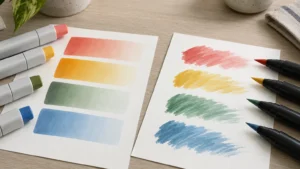
Macro close-up of a pen nib laying down an opaque line
The hand bones of a three to six year old are not fully formed. The grip is still developing, and a barrel sized for an adult hand forces an awkward hold that children compensate for by gripping harder, which tires the hand quickly and produces inconsistent strokes.
Three practical dimensions matter. Barrel diameter around 10 to 12 millimeters suits the preschool grip. A triangular or ergonomically contoured section helps position the fingers without instruction. Overall length should let the marker rest against the web of the hand without overbalancing.
Cap design matters as much as the barrel. A cap that needs significant force to remove will be chewed rather than pulled. A cap that releases too easily creates a choking risk. The working window is a pull force that a five-year-old can manage but a toddler cannot easily defeat.
Ink Safety: What “Non-Toxic” Actually Covers
The phrase “non-toxic” on a marker package is not a regulated claim in most markets. It usually means the manufacturer completed a toxicological review under ASTM D-4236 or an equivalent framework, and that no acute hazard was identified for the intended use.
What that review covers: acute toxicity, skin and eye irritation, sensitization, and chronic hazard labeling. What it does not cover: every possible contaminant, long-term low-dose exposure, or misuse such as drinking the ink.
For children’s markers, three ink properties deserve separate attention. First, preservative choice, because water-based ink supports microbial growth and the preservative has to be both effective and safe. Second, bittering agents, which are added to discourage ingestion and must not themselves be hazardous. Third, pH, because an acidic ink can corrode the valve or the nib over shelf life.
Ventilated Caps and the Choking Hazard Question
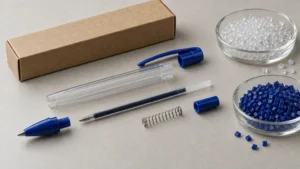
Custom animal pen mold development for childrens shapes
A ventilated cap has a small airway designed to allow breathing if the cap is inhaled. It is not a guarantee of safety, but it does extend the window for intervention, which is why many markets expect it on children’s writing instruments.
Two things to verify. First, the airway must be a real channel, not a decorative dimple. Second, the cap must still seal when closed, because a cap that vents and also leaks air will dry the marker out within weeks. That tradeoff is a design problem, and it is one of the places where cheap caps fail.
Ask for the cap pull-force data and the ventilation airflow measurement. Both should be on the test report, not just asserted in a sales conversation.
자주 묻는 질문
Does a children’s marker need both EN71 and CPSIA? If it sells in both markets, yes. They are separate regimes and neither substitutes for the other.
Is “non-toxic” a certification? No. It is a claim that usually reflects an ASTM D-4236 toxicological review. Ask for the review documentation, not the phrase.
What barrel diameter suits a preschooler? Around 10 to 12 millimeters, with a contoured grip section if possible.
Can you supply ventilated caps? Yes, with pull-force and airflow data on the test report. The cap must also pass a closed-storage seal test.
What a Compliance File Should Contain
A compliance file is not a certificate. It is a set of documents that lets a retailer answer a question from a regulator within a day. Four items belong in it.
Test reports by SKU. Each report names the product, the batch, the test method, the laboratory, and the date. A report that covers “children’s markers” as a category does not prove that the batch in your order was tested.
The Children’s Product Certificate. Required for U.S. children’s products under CPSIA. It names the manufacturer, the testing lab, and the specific rule each test addresses.
Material declarations. A list of the substances in the ink and the barrel by function, with their regulatory status. A supplier that refuses to disclose this under NDA is declining to be checked.
Retained samples. One sealed set from the approved run, labelled with SKU, PO number, and production date. Without it, a reorder dispute becomes a conversation about memory.
Packaging Rules for Children’s Products
Packaging carries its own compliance burden. A blister card with a hang hole is treated differently from a sealed poly bag, and the difference shows up in choking-hazard rules and suffocation warnings.
Poly bags above a certain size must carry a suffocation warning in the destination language. Blister cards need the age grading printed in a specified size and position. Display boxes intended for floor standing need stability testing if they will hold product above a certain height.
Ask the supplier which packaging format they have already certified for the target market. A factory that has shipped the same format to EU retail has already worked through the labeling details; one that has not will learn them on your order.