
Sapevi che i materiali scolastici e da ufficio di uso quotidiano possono talvolta nascondere sostanze chimiche nocive? Ecco perché i test sulla formaldeide nei prodotti per la scrittura sono importanti per la sicurezza.
Le linee guida WHO 2010 sull'aria indoor per gli inquinanti selezionati includono la formaldeide. Coprono l'esposizione nell'aria indoor. Non stabiliscono un limite di superamento universale per i prodotti per la scrittura. I test di prodotto dovrebbero indicare la parte campionata, lo standard di prodotto applicabile e il metodo di test utilizzato.
To protect buyers and keep a strong brand name, reliable testing services are essential.

L'Importanza dei Test sulla Formaldeide nella Cancelleria e le Normative
Per mantenere sicuri gli acquirenti, gruppi nazionali e internazionali hanno stabilito regole rigorose per le parti nocive nei prodotti di scrittura.
Per gli articoli per studenti nel suo ambito, GB 21027-2020 è lo standard di prodotto cinese da verificare. I suoi requisiti dipendono dall'articolo e dalla parte. Conferma separatamente i requisiti del mercato di destinazione. Un rapporto conforme allo standard cinese da solo non dimostra la conformità per ogni mercato di esportazione.
By testing to these standards, makers show their work on green, safe, high-quality production.
Il metodo di laboratorio: spettrofotometria con acetilacetone
The official listing for GB/T 32606-2016 names the formaldehyde test method as acetylacetone spectrophotometry. Ask the lab to state the method edition. Confirm that its sampling and extraction steps fit the tested part.
Il Principio di Base:
Il metodo all'acetilacetone produce un prodotto di reazione colorato. Il laboratorio confronta la sua assorbanza con soluzioni calibrate. Il laboratorio deve seguire le condizioni indicate di preparazione dei reagenti, estrazione, reazione e misurazione. Questa panoramica non è lo standard completo. Non è nemmeno una procedura di laboratorio.
Cosa verificare nel rapporto di laboratorio
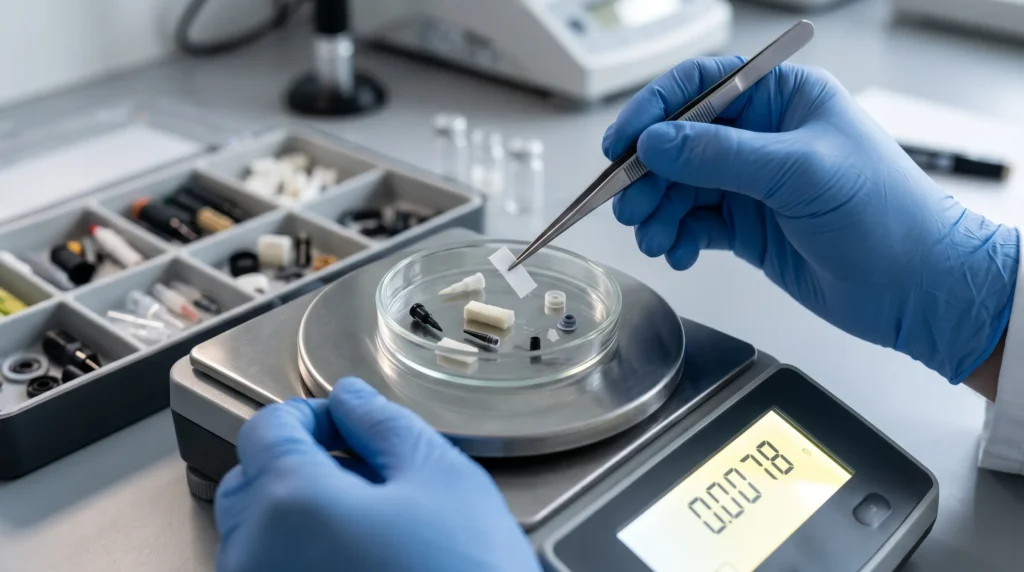
Usa questi quattro punti per rivedere il rapporto con il laboratorio. Il metodo di test completo stabilisce massa del campione, condizioni di estrazione, volumi dei reagenti, tempo di reazione e intervallo di calibrazione. Non dedurli da un articolo generico sull'approvvigionamento.
1. Preparazione del Campione
Indica il modello, la parte e il materiale campionati. Chiedi come la parte è stata preparata ed estratta secondo il metodo citato. Conferma che il rapporto indichi il campione, non un prodotto o lotto diverso.
2. La Reazione del Colore
Verifica che il laboratorio abbia seguito il metodo citato per la preparazione dei reagenti, la reazione e la lettura dell'assorbanza. Chiedi chiarimenti se il rapporto non indica il metodo o descrive una procedura modificata.
3. Creazione della Curva Standard
Chiedi come sono stati impostati l'intervallo di calibrazione e il bianco del metodo. Chiedi se il risultato del campione rientrava nell'intervallo di misurazione verificato. Il metodo applicabile, non un articolo generico, stabilisce i livelli di calibrazione.
4. Lettura dei Risultati
Leggi il valore riportato con le sue unità, il limite di rilevamento o quantificazione e il limite di conformità applicabile. Un valore inferiore a un limite di rilevamento dovrebbe essere letto come riportato. Non chiamarlo prova che non esista formaldeide.
Formula di Calcolo Finale
The expression below shows a unit change only when c is already blank-corrected and extra dilution is counted. The full method and the lab's math rule the reported result. This expression is not the full GB/T 32606 procedure.
x = (c × f) / m
- x = La quantità di formaldeide libera nel campione (mg/kg)
- c = Concentrazione corretta per il bianco, con qualsiasi diluizione aggiuntiva considerata (μg/mL)
- f = Il volume a cui è stato diluito il liquido del campione (mL)
- m = La massa esatta del campione originale (g)
Verifica con il laboratorio il bianco del metodo, i fattori di diluizione e le unità di rendicontazione. Una sola correzione del bianco non significa che il totale sia esatto.
Test Affidabili per la Vostra Tranquillità
Keeping products safe is not just about the law. It is about protecting your customers.
Scegli un laboratorio il cui attuale ambito di accreditamento copra il metodo necessario. Verifica direttamente l'emittente del rapporto, il nome del campione e l'ambito. Questo articolo non stabilisce le credenziali o l'ambito attuali di alcun laboratorio nominato.
Per pennarelli e altri prodotti per la scrittura, un rapporto di test registra il campione, il metodo e i risultati. Confronta quei risultati con i requisiti di prodotto applicabili. L'accreditamento non significa che ogni modello, parte o lotto non testato sia privo di parti nocive.
Guida correlata: Come Leggere un Rapporto di Prova ASTM D-4236 per i Pennarelli Acrilici.
Letture correlate
- Oltre “Non Tossico”: La Verità Nascosta sull'Inchiostro per Pennarelli di Grado Alimentare per Bambini
- Standard di Qualità per Matite Colorate e Tendenze Future: Cosa Devi Sapere
- guida per pennarelli commestibili
- Guida ai materiali per lavagne classiche
- Guida all'inchiostro dei pennarelli cancellabili a secco
- Guida alla rimozione delle macchie di pennarelli cancellabili a secco
- Rimozione di pennarelli indelebili dalla plastica
Why Formaldehyde Still Appears in Stationery
Formaldehyde is not added to markers on purpose. It arrives as a residual from three sources: adhesives in packaging, preservatives in water-based ink, and finishes on wooden or paper components. In each case the amount is small, but the regulatory limit is also small, and the test measures what is present rather than what was intended.
The adhesive route is the most common. Casein and urea-formaldehyde glues are cheap and strong, which is why they still appear in some cartons and laminated boards. A marker itself may pass while the display box it ships in does not.
The ink route matters for water-based formulas. Some preservative systems release formaldehyde slowly as they break down, which is why a freshly mixed batch can pass and a batch tested after six months in a warehouse can fail. That is not a manufacturing defect in the usual sense; it is a formulation choice with a time dimension.
How the Acetylacetone Method Works
GB/T 32606-2016 specifies acetylacetone spectrophotometry as the formaldehyde test method. The procedure runs in four stages.
Extraction. The sample is placed in water at a controlled temperature for a set period. Formaldehyde migrates into the water. The extraction time and temperature are specified, and changing either one changes the result.
Reaction. Acetylacetone reagent is added. In the presence of ammonium acetate, formaldehyde reacts to form a yellow compound, 3,5-diacetyl-1,4-dihydrolutidine. The reaction needs a fixed time and temperature to complete.
Measurement. The solution is read in a spectrophotometer at 412 nanometers. Absorbance is proportional to formaldehyde concentration within the calibrated range.
Calculation. Concentration is derived from the calibration curve, corrected for the blank, and converted to milligrams per kilogram of sample.
The formula only works when the blank is properly corrected and any additional dilution is counted. A report that quotes a number without stating the method edition, the extraction conditions, and the blank value is not reproducible.
Reading a Report: What the Numbers Mean
Three numbers matter on a formaldehyde report: the result, the limit, and the detection limit.
The result should be expressed in mg/kg with the measurement uncertainty stated. A result of 15 mg/kg with an uncertainty of plus or minus 3 is a different statement from 15 mg/kg with no uncertainty given.
The limit depends on the destination market and the product category. Textile and wood components have their own limits under separate standards; stationery is often assessed against the general consumer goods framework. Confirm which limit applies before comparing a result to a pass threshold.
The detection limit tells you whether the test could actually see a failure. A method with a detection limit of 20 mg/kg cannot demonstrate compliance with a 16 mg/kg limit, no matter what the result says.
Sampling and Extraction: Where Tests Go Wrong
Most false passes and false failures trace to sampling, not to the instrument.
The sample must represent the batch. A single marker taken from the top of a carton is not a batch sample. The correct approach is to composite material from several units, because formaldehyde distribution within a production run is not uniform.
The extraction conditions must match the method. Water temperature, extraction time, and the ratio of sample mass to water volume all affect the result. A lab that shortens the extraction to save time will report a lower number than the method intends.
The tested part must be the part that matters. For a marker, that means the barrel, the cap, the ink, and the packaging assessed separately, because each has a different risk profile and a different limit may apply.
Domande Frequenti
Does passing a formaldehyde test mean the product is safe? No. It means formaldehyde is below the applicable limit for that test method. Other substances are covered by other tests.
How often should formaldehyde be retested? At minimum once per production batch, and again whenever the ink supplier, adhesive supplier, or packaging supplier changes.
Can a factory self-test? It can screen internally, but the report that goes to a retailer should come from an accredited third-party lab with the method edition stated.
What happens if a batch fails? The batch should be held, the source identified — ink, adhesive, or packaging — and the affected lots traced. Retesting the same sample rarely changes the result.
Where Formaldehyde Comes From in the Supply Chain
The test measures what is present, not what was intended. Three upstream sources account for most failures.
Adhesive suppliers. Casein and urea-formaldehyde glues remain cheap and strong, which is why they still appear in laminated boards and some cartons. A marker can pass while the display box it ships in does not. Ask for the adhesive declaration separately from the ink declaration.
Preservative systems in water-based ink. Certain preservatives release formaldehyde as they break down. A freshly mixed batch passes; the same batch tested after six months in a warm warehouse may not. This is a formulation choice with a time dimension, and it is the most common cause of a late failure.
Wood and paper components. Pencil barrels, wooden display stands, and some paper stocks carry residual formaldehyde from processing. These are usually low, but they add to the total when the test composites multiple materials.
The practical implication: test the finished product as it ships, not the individual components in isolation. A composite sample catches the additive effect that single-component testing misses.
Setting a Retest Cadence That Actually Catches Drift
Most programs retest once per production batch, which is not enough to catch a slow drift.
A supplier can change an adhesive vendor, a preservative concentration, or a packaging source without announcing it, and the change shows up three batches later as a failed test. The cadence that catches this has three triggers.
Per batch. A basic screening test on every production run. This is a factory-side control, not a third-party report.
Per quarter. A full third-party report on the current production. This catches drift before it becomes a retailer issue.
Per change. Any change to ink supplier, adhesive supplier, packaging supplier, or formulation triggers an immediate retest regardless of the quarterly schedule. This is the trigger most programs omit, and it is the one that catches the failures that matter.
Put the change trigger in the purchase order, not in a side agreement. A clause that requires notification before any material substitution is enforceable; a verbal understanding is not.