Customer complaints about dry markers should not turn into a blame game between distributor, retailer, service team, and factory. A dry marker may come from cap leaks, poor prime, storage heat, long shelf time, damaged packing, or a real production flaw. A color gap may come from ink batch drift, paper, light, dry time, or an unapproved reorder change.
This article gives importers, private-label brands, Amazon sellers, and stationery distributors a working flow for dry marker or color gap complaints before they choose replacements or ask the supplier for fixes.
Quick Answer
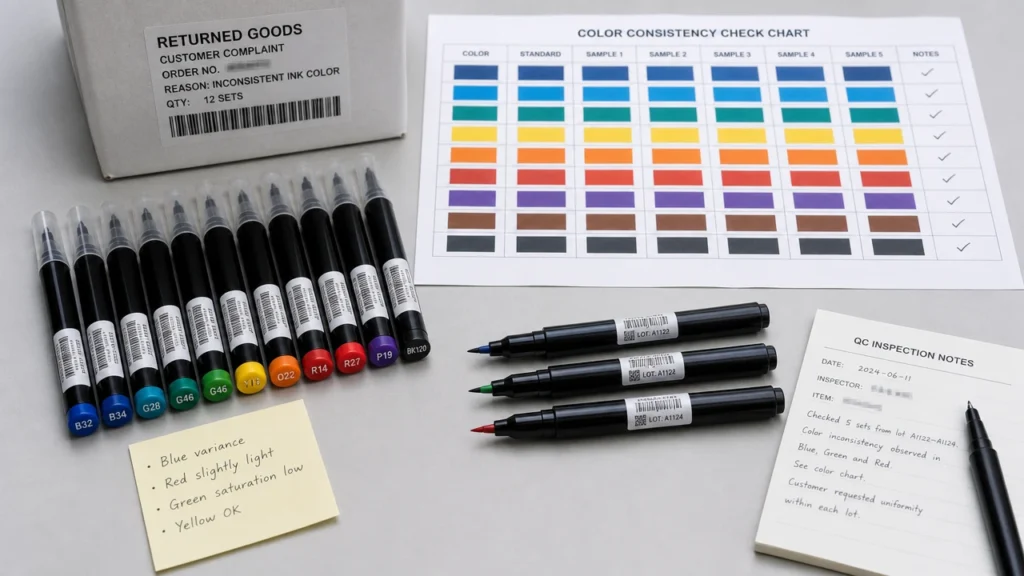
Handle marker complaints in seven steps. Split the complaint type. Collect proof. Find the lot. Compare retained samples. Review storage and shipping conditions. Reply to the customer with a clear fix. Then ask the supplier for fixes based on facts. Do not treat every dry marker as a factory flaw. Do not treat every color gap as acceptable drift.
Quick Links
- Quick Answer
- Separate Complaint Types
- Collect Evidence
- Trace the Lot
- Compare Retained Samples
- Check Storage and Shipping
- Customer Response
- Supplier CAPA
- Complaint Report Template
- Ask Better Supplier Questions
- FAQs
Separate Complaint Types Before You Decide the Remedy
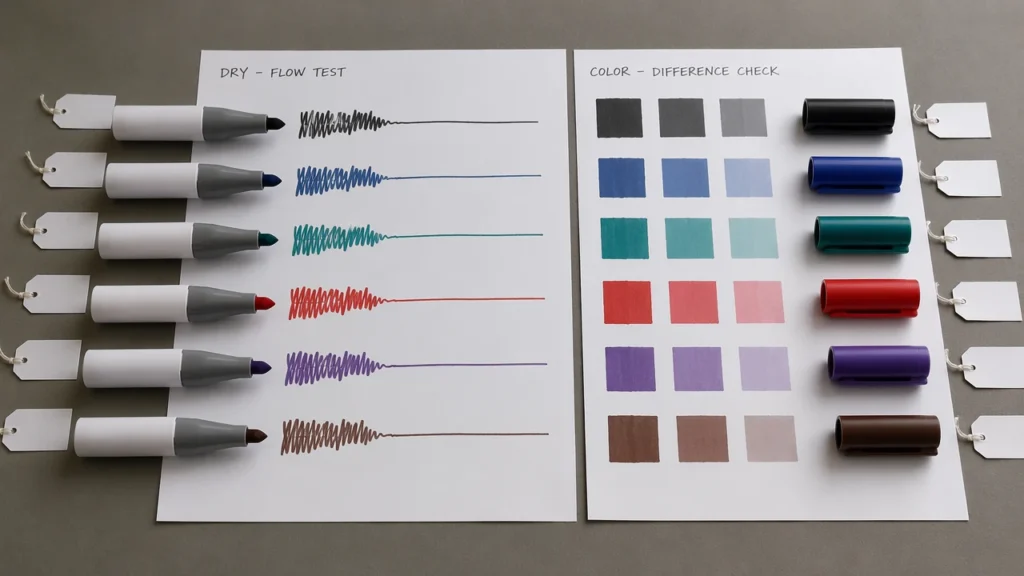
The first mistake is mixing dry-out and color complaints into one quality issue. They often need different proof. Dry markers are about ink delivery, cap seal, reservoir state, tip state, and storage. Color differences require checks of the formulation, color standard, substrate, drying time, lighting and batch comparison.
| Complaint Type | What It Usually Means | First Evidence to Request |
|---|---|---|
| Dry on arrival | The marker does not write when opened or after normal priming | Video of opening, priming attempt, cap condition, lot code, and pack photo |
| Writes then dries quickly | Cap seal, tip damage, storage heat, or formulation may be involved | Use timeline, storage location, cap photo, writing sample, and affected quantity |
| One color is weak | Ink saturation, nib feeding, pigment load, or paper can affect the result | Color number, writing sample, paper type, and comparison with another set |
| Whole set looks different | Batch change, lighting, packaging color card, or display condition may be involved | Lot code, retained sample comparison, color chart, and photo under neutral light |
| Reorder color does not match | The new batch may not match the approved sample or previous retained sample | Old and new lot codes, approved color standard, and side by side dry swatches |
For a deeper production view, the marker pen quality control and dried-out markers guide explains cap seal, ink flow, and check points. For reorder issues, use the keeping marker colors consistent article as a partner checklist.
Collect Evidence Before Blaming the Batch
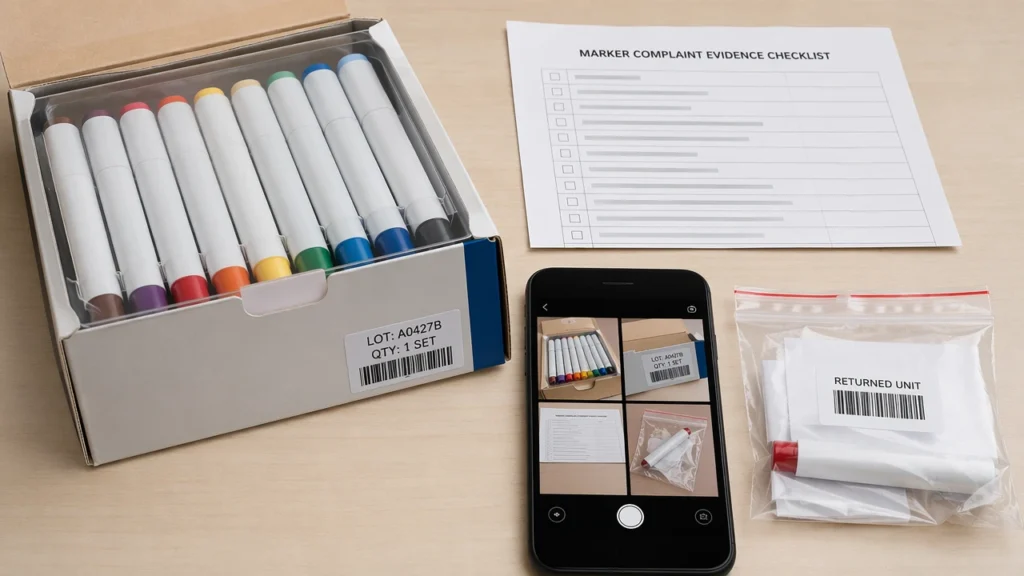
Service teams want to solve the complaint fast. That is fair. A quick refund without proof does not help the buyer find the root cause. Ask for enough detail to judge the case without making the customer do factory-level tests.
- Order number, SKU, color set, and purchase date.
- Lot code, date code, carton mark, barcode, or any label that links the unit to a shipment.
- Photos of the full set, damaged packaging, cap position, tip condition, and affected colors.
- A short video showing normal priming or writing on plain paper.
- How many units are affected out of the units sold or inspected.
- Where the goods were stored before sale and whether heat, freezing, sunlight, or crushed cartons were possible.
For SKUs sold through retail or online channels, product codes matter. GS1 US explains that a GTIN names a trade item. A barcode does not name the production lot by itself. Buyers should also keep lot codes or carton marks in the complaint file.
Trace the Lot and Find the Complaint Pattern
One complaint can be a user-use issue. Ten from the same lot, color, pack, or warehouse are a pattern. The buyer should tie each case to a shipment, carton, production date, and channel. Then decide whether to replace a few units, hold stock, or ask for a factory look.
| Pattern | Likely Direction | Buyer Action |
|---|---|---|
| Same color across many sets | Color-specific ink, nib, or filling issue | Compare affected color with retained samples and ask supplier for batch records |
| Same lot across several customers | Production or shipment condition may be involved | Hold remaining stock from the lot until inspection is complete |
| Only one warehouse or region | Storage, temperature, or handling may be involved | Review warehouse logs, carton damage, and transit route |
| Only online channel returns | Customer expectation, listing photo, or packing damage may be involved | Check product photos, replacement policy, and packaging protection |
| Reorder mismatch | Approved standard or formula control may have drifted | Compare old lot, new lot, and signed color standard |
Buyers sourcing different marker types can review the marker range and the dual tip acrylic versus single tip guide. Tip count and cap count change the number of possible fail points. Complaint tracing should fit the product design.
Compare Retained Samples Under Controlled Conditions
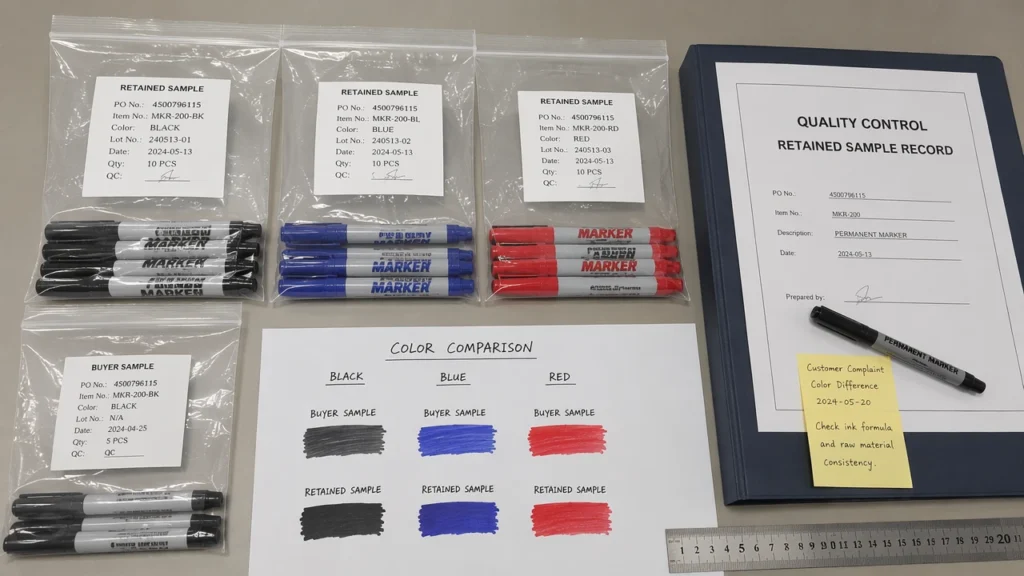
A kept sample is the buyer's best guard against guessing. Keep one approved sample on the buyer side and one on the supplier side. For color disputes, compare the affected samples with kept samples on the same paper, after the same dry time, under neutral light. For dry-out complaints, check cap fit, nib state, weight gap if it is available, and whether normal prime restores flow.
If the case involves acrylic or valve markers, check prime performance with care. The valve press marker technology page explains why ink flow depends on the tie between valve, reservoir, nib, and user prime.
Check Storage, Shipping, and Retail Handling
Markers are small goods. Their performance can still be affected by storage and shipping. Heat, long time near sunlight, crushed caps, loose retail packing, or warehouse aging can turn a good lot into a complaint problem.
For packing test context, the official ASTM D4332 page covers conditioning containers, packages, or packing parts before testing. That does not mean every shipment needs a lab transit test. It is a useful note that heat and wetness can change packing parts and test results.
Packing format can add or cut risk. Review acrylic marker packing options and the carton size, gross weight, and CBM guide when complaints point to crushed boxes, loose trays, warehouse marks, or carton damage.
Reply to the Customer Without Overpromising
A good customer reply is calm, specific, and fast. It should note the issue, ask for missing proof, explain the next step, and give a real fix when the case is sound. Avoid heavy language that makes the customer feel blamed.
| Situation | Suggested Response Direction | What Not to Say |
|---|---|---|
| Single dry marker | Ask for photo or video, offer replacement if policy allows, record lot details | All markers were tested, so this cannot happen |
| Multiple dry markers in one set | Replace the set, request affected unit return if needed, check remaining stock | You must have stored it incorrectly |
| Color looks different from listing | Ask for photo under neutral light and compare listing image, packaging chart, and retained sample | Screen color is always your problem |
| Reorder mismatch | Compare old and new lot samples and pause repeat shipment if the difference is material | Small variation is normal without checking |
Request Supplier CAPA Based on Facts
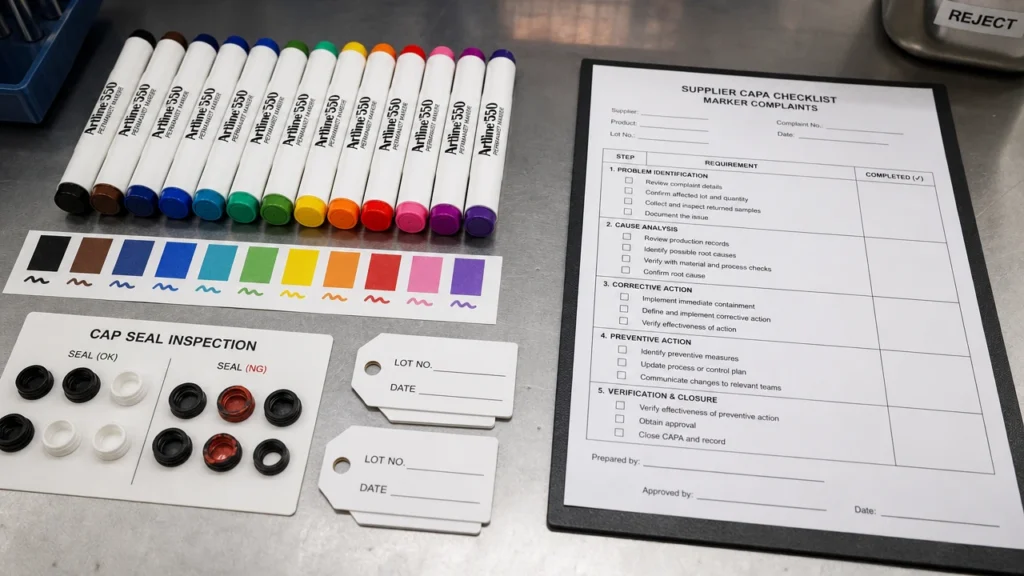
Supplier fixes should match the proof. Do not ask for a broad sorry report. Ask for a root-cause review, affected scope, hold action, fix, stop step, and how the next shipment will be checked.
For Dry Marker Complaints
- Ask the supplier to review cap seal data, nib fitting, filling volume, reservoir saturation, and packing pressure.
- Ask whether the issue is limited to a color, lot, tip type, or packaging format.
- Request retained-sample comparison and photos or videos of internal checks.
- Agree on replacement, credit, sorting, or next-order prevention only after scope is clear.
For Color Difference Complaints
- Ask for comparison against the approved color standard and previous lot sample.
- Use the same paper, dry time, and viewing condition when comparing swatches.
- Check whether pigment, dye, ink base, nib, or paper instructions changed between orders.
- If color control is critical, define Delta E or visual tolerance before the next PO rather than after the complaint.
For paper review, use ZH Stationery's certifications page and the ASTM D-4236 report guide. The US CPSC art materials guidance says art products carry marking duties under LHAMA and ASTM D-4236. The official ASTM D4236 page also makes clear that the standard covers chronic health hazard marking. It is not a promise that a marker will never dry out.
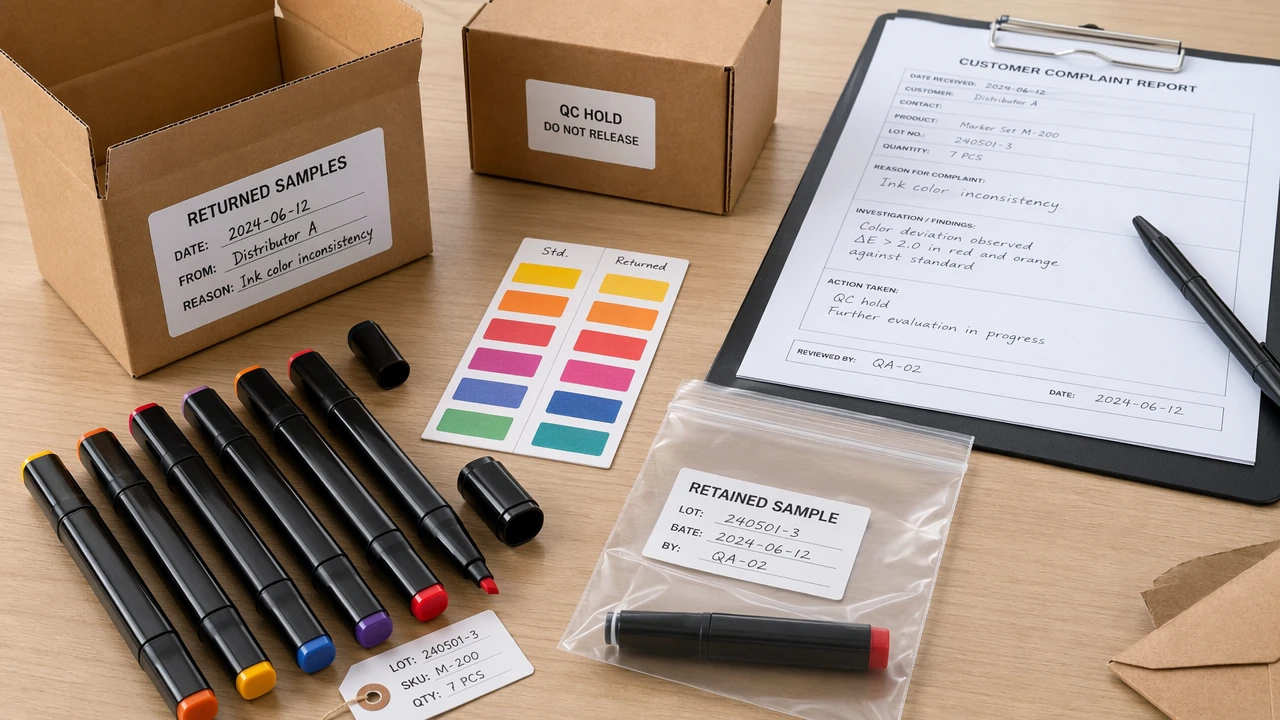
Complaint Report Template
Use one report format for both buyer and supplier. A short, full complaint report saves more time than a long email thread.
| Field | What to Record |
|---|---|
| Buyer and channel | Distributor, retailer, Amazon, direct retail, school supply, or other channel |
| SKU and product type | Set size, marker type, tip type, ink system, packaging format, and barcode or GTIN |
| Lot information | Production date, lot code, carton mark, shipment date, and warehouse location |
| Complaint description | Dry marker, weak flow, color difference, cap problem, packaging damage, or mixed issue |
| Evidence | Photos, video, writing sample, customer message, returned unit, and retained sample comparison |
| Affected scope | Units sold, units inspected, complaints received, affected colors, and affected cartons |
| Temporary action | Replacement, refund, inventory hold, sorting, or additional inspection |
| Supplier action | Root cause, containment, corrective action, prevention method, and next shipment check |
Ask Better Supplier Questions
Complaint questions should force a useful answer. If the supplier only says the next order will be better, the buyer still has no control method.
| Question | A Useful Supplier Answer Should Include |
|---|---|
| Which lot, color, or component is most likely involved? | A clear scope based on lot code, color number, nib, cap, ink batch, package, or shipment record |
| What retained samples did you compare? | Photos, comparison method, sample date, and whether the factory sample matches the buyer sample |
| How did you test the affected complaint type? | Dry-out checks for cap seal and ink flow, or color checks using the same substrate and dry time |
| What stock should the buyer hold or sort? | Specific lot, carton range, color, channel, or warehouse location, not a vague suggestion |
| What corrective action will change the next order? | A process change, inspection point, material control, packaging change, or approval step |
| What proof will you send before replacement production? | Inspection photos, sample results, updated specification, signed golden sample, or shipment sample |
FAQs
These FAQs match the practical complaint questions marker distributors and private-label buyers usually ask.
What should I ask customers to send when markers are dry?
Ask for the order number, SKU, lot code or carton mark, photos of the set and caps, a short video of normal prime or writing, and the count of affected markers. If you can, keep the returned unit for compare with kept samples.
How do I know if a color gap is a factory issue or a viewing issue?
Compare the affected sample with the passed kept sample on the same paper, after the same dry time, under neutral light. If the gap stays visible across repeat checks and matches one lot or color, ask the supplier to review batch records and color control.
Should I replace stock before the factory checks samples?
For a sound customer case, a replacement may be the right service call. For stock-level action, wait until you know the affected lot, color, carton range, or warehouse spot. Otherwise you may replace too much stock or miss the real problem.
What kept samples should a distributor hold?
Keep the passed pre-production sample, one mass production sample from each shipment, packing samples, color swatches, and carton mark photos. Mark each sample with SKU, PO, lot, date, and supplier name.
Can ASTM D-4236 prove markers will not dry out?
No. ASTM D-4236 covers chronic health hazard marking for art products. It helps compliance review. Dry-out cases need product quality checks like cap seal, ink flow, nib fit, fill state, storage, and kept sample compare.
What should a supplier fix action include?
It should include root cause, affected scope, short-term hold, fix, stop step, proof from kept samples or tests, and the check method for the next shipment.
Conclusion
Dry markers and color gaps are not the same complaint. They should not be looked at with the same checklist. The buyer needs enough proof to guard customers, enough tracking to guard stock, and enough supplier detail to stop the same issue in the next shipment.
If your team is preparing a new marker order or reviewing a complaint pattern, send ZH Stationery the SKU, set size, ink type, tip type, packing format, target market, affected lot details, and available proof. You can also review the factory tour and who we are pages before talking about a marker QC flow.
Related guide: Acrylic Paint Markers vs Alcohol Markers.