A buyer can place the same marker order twice and still get colors that feel slightly off on the shelf. To keep marker colors consistent across reorders, the repeat order needs more than same as last time in an email. It needs a steady color standard, the same check way, and a supplier who can trace what changed from one batch to the next.
This matters most for private-label sets, school programs, retail refills, and color-count adds. If a 24-color set from January looks different from the June set, the buyer has a brand problem even when every marker writes. ZH buyers can start from the marker product range and build the color file around the exact SKU, ink system, nib, packing, and channel.
Quick Answer
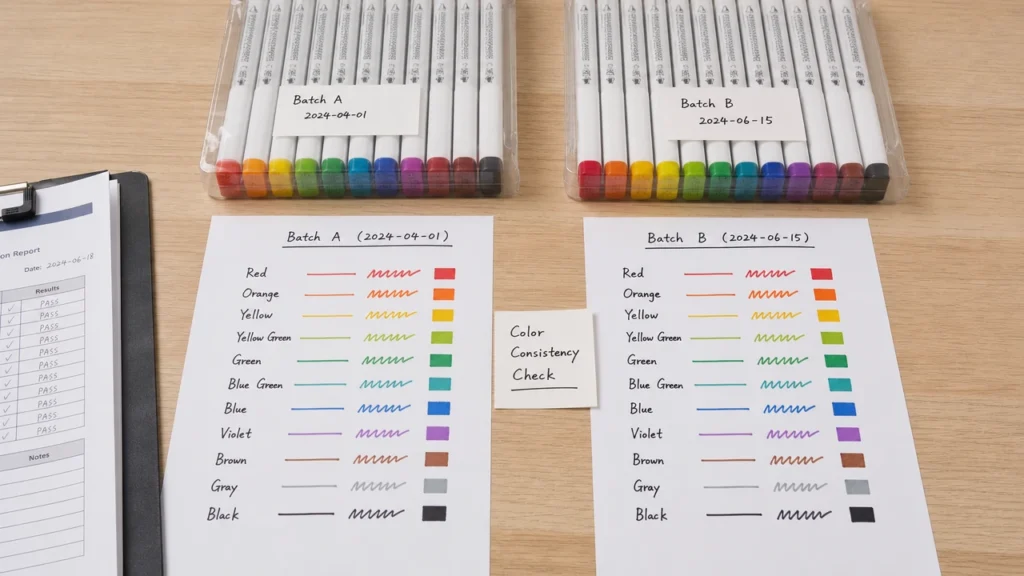
The best way to keep marker colors consistent across reorders is to pass a physical master sample, define how color is checked, ask the supplier to keep kept samples, and ask for a reorder sample before mass production when the program matters. A digital color code alone is too weak. Marker ink changes with paper, dry time, nib flow, pigment lot, and light.
Quick Links
- Quick Answer
- Why Marker Colors Drift Between Reorders
- Set a Color Standard Before the First PO
- Use a Reorder Color Control Sheet
- Check the Whole Writing System
- Control Light and Viewing Conditions
- Ask for Retained Samples and Batch Records
- Build Color Tolerance Into the RFQ
- Approve Reorder Samples Before Mass Production
- Ask Better Supplier Questions
- FAQs
Why Marker Colors Drift Between Reorders
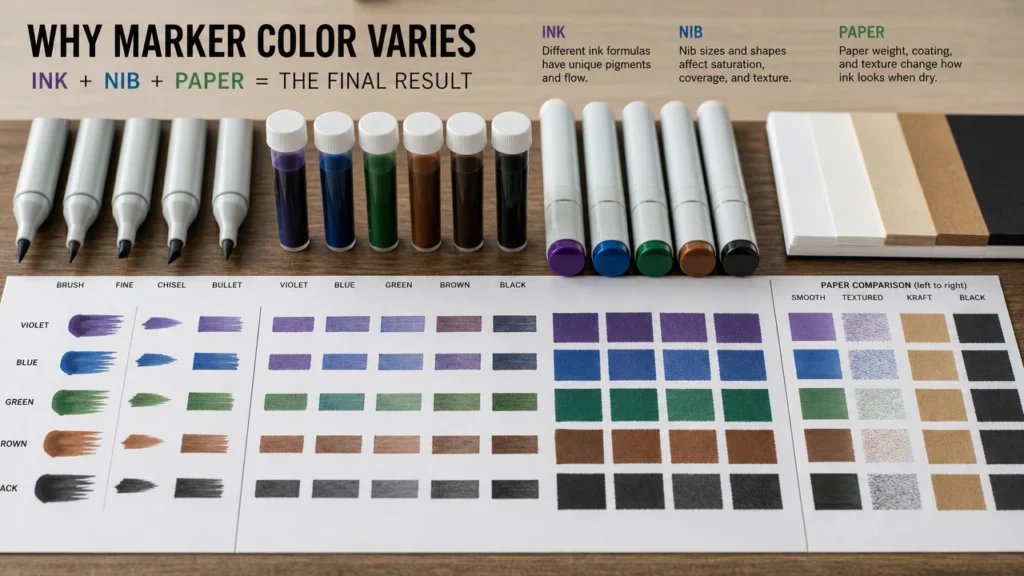
Color drift usually starts with small changes no one logs. A dye supplier changes lot. A nib takes more ink than the last nib. A card used for checking is swapped for a brighter one. The cap seal changes dry act in storage. None of these looks big alone. The finished set can still look less matched beside the first shipment.
The risk is higher when buyers pass colors from a screen, a printed art file, or a catalog photo. Marker color is a writing result, not a flat graphic color. Check the ink after it is written, dried, and compared on the same material the buyer will likely use.
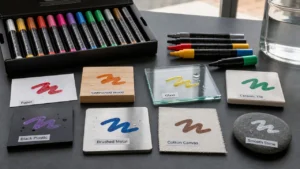
For acrylic paint markers, face act is key. A color that looks strong on white card may look different on a black board, canvas, stone, or plastic. Buyers building acrylic ranges can tie color pass to product details on the custom acrylic markers maker checklist. For watercolor goods, compare wet and dry strokes. Dilution and paper absorb change the look. The watercolor marker sourcing guide is a useful next read.
Set a Color Standard Before the First PO
Reorder control starts before the first production order. The first passed shipment should make the base for every later order. If the buyer waits until the second order to set the color bar, both sides end up arguing from memory.
Use a Physical Master Sample
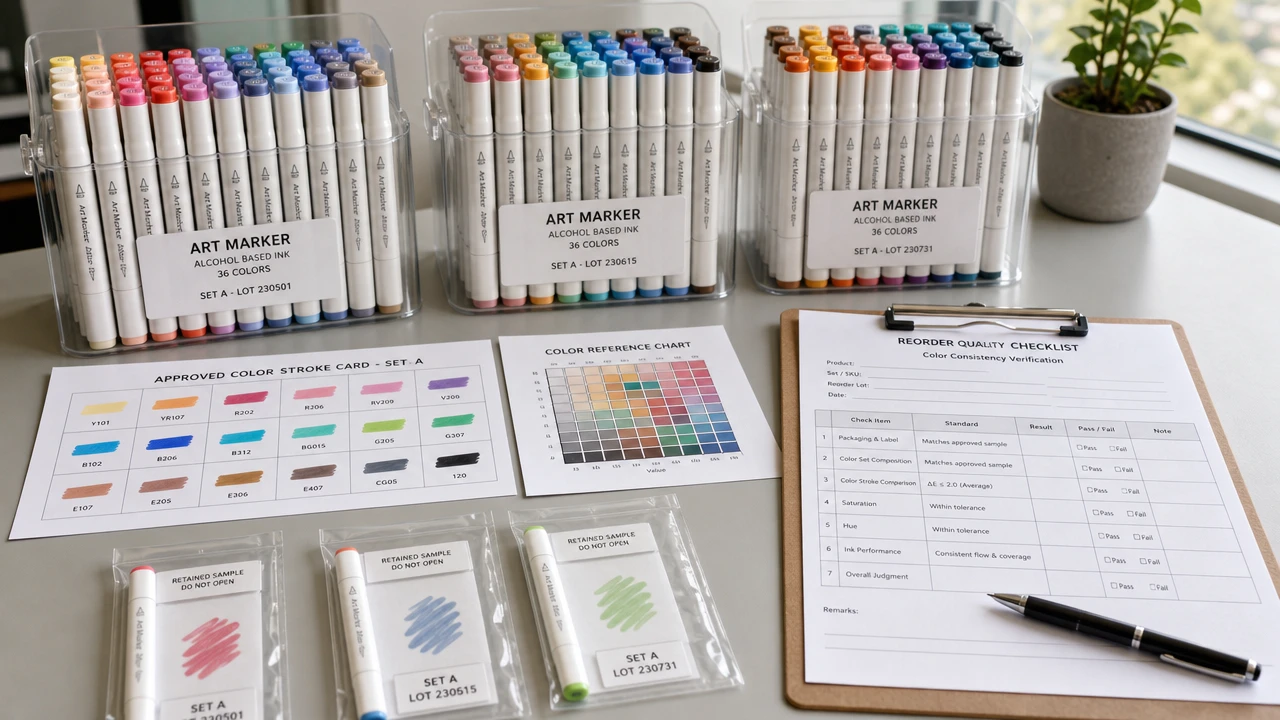
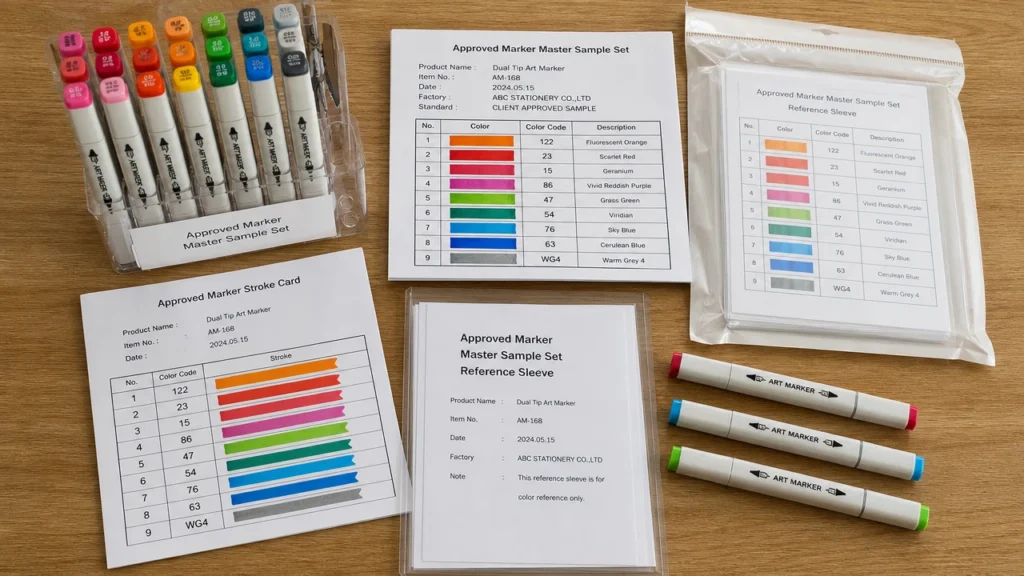
A master sample should hold real marker strokes, not only the barrel color or printed pack color. Keep one passed set with the buyer. Ask the factory to keep one sealed kept set. Label both with item number, color codes, PO number, pass date, and the check material.
Pair Color Codes With Real Strokes
Pantone, RGB, CMYK, or LAB values can help a supplier see the target. The passed marker stroke decides final acceptance. A red cap, a red printed label, and a red ink stroke are three separate color problems. Treat them apart in the pass file.
Record the Surface and Drying Time
A buyer should set the paper or face used for checking and the dry time before compare. Five minutes, thirty minutes, and 24 hours can give different calls, based on the ink system. If the product is a retail art set, check the material that matches the claim on the pack.
Use a Reorder Color Control Sheet
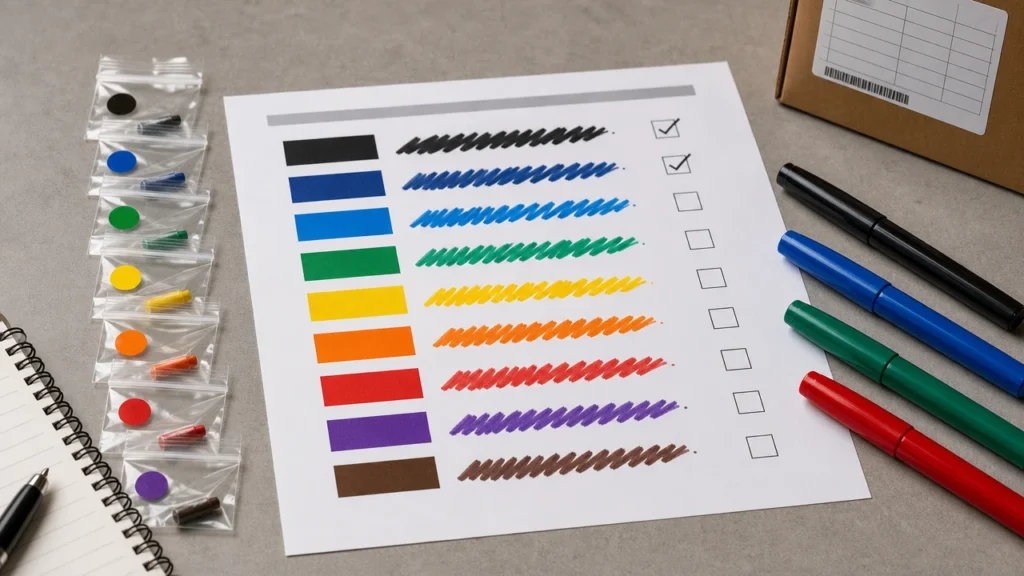
A reorder color sheet keeps the talk practical. It tells the factory what must stay, what can change with pass, and what proof should return before production starts.
| Field | What to Record | Why It Matters |
|---|---|---|
| SKU and set size | Item number, 12/24/36/48/60 color set, packaging version | Prevents the supplier from matching the wrong range |
| Approved color reference | Master sample ID, color code list, approval date | Creates one source of truth for reorder comparison |
| Checking substrate | Paper, card, plastic, canvas, or other target surface | Controls the surface effect on the visible color |
| Drying time | Time before visual or instrument check | Keeps wet and dry comparisons separate |
| Tolerance method | Visual approval, Delta E target, or both | Makes acceptance less subjective |
| Retained samples | Buyer sample and factory sample storage requirements | Supports dispute checks and future reorders |
| Batch record | Ink lot, nib lot, barrel version, packing date | Makes later color drift easier to trace |
This sheet does not need to be complex. It needs to be used every time. A clean RFQ and pass file also helps the factory quote without guessing, especially when the same buyer grows from one marker range into several lines.
Check the Whole Writing System
Marker color is made by a system. Ink. Tip. Valve or reservoir. Barrel seal. Paper. User pressure. A supplier may match the ink in a lab cup, then lose the target after the ink moves through the nib. That is why reorder pass should compare finished markers, not only ink samples.
| Part to Check | Reorder Risk | Buyer Action |
|---|---|---|
| Ink formula | Pigment or dye lot can shift hue, strength, or transparency | Ask whether the same approved formula and supplier lot are used |
| Nib or tip | Different fibers can change flow rate and stroke saturation | Approve the finished marker stroke, not a loose ink swatch |
| Cap and barrel seal | Evaporation can make stored markers write darker or weaker | Check writing after normal storage and shipping conditions |
| Packaging color | Printed color cards may not match the ink result | Separate package artwork approval from ink stroke approval |
| Paper or test surface | Brightness and coating change perceived color | Use the same checking surface for every reorder |
This is also where the buyer should split act from color. A marker can match color and still fail flow, dry, odor, leak, or cap-off act. For wider supplier checks, tie this reorder flow to the questions in the ASTM D-4236 report guide and the dual tip acrylic marker guide.
Control Light and Viewing Conditions
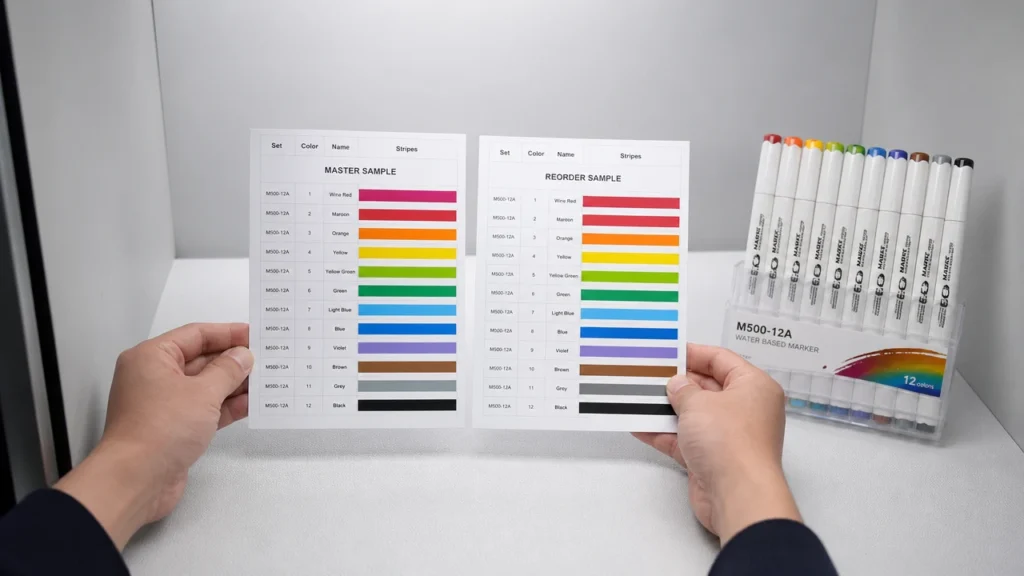
Two samples can look close in one room and wrong in another. That is why pro color checks control light, view angle, background, and sample spot. ISO 3668:2017 covers visual compare of paint color in a booth with set light sources. Marker ink is not always paint film. The buyer lesson holds. Set the view state before judging color.
For instrument checks, ASTM D2244 covers color tolerance and difference from measured points. The CIEDE2000 formula is often used for a more perceptual number. Buyers do not need a lab project for every order. They should not mix visual pass, phone photos, and supplier screenshots as if they were the same proof.
Without a light booth or color tool, the next best step is discipline. Same paper. Same light. Same dry time. Same background. Side-by-side compare with the master. A simple way used every time beats a technical way used once and lost.
Ask for Retained Samples and Batch Records
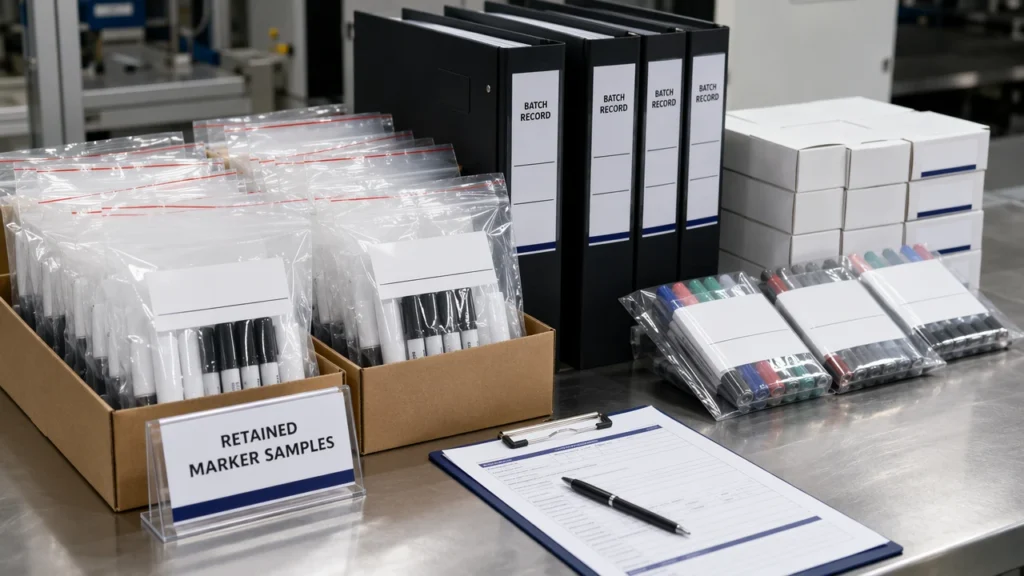
Kept samples guard both sides. The buyer can compare the new shipment with the agreed base. The supplier can show whether the new batch followed the same file. Without kept samples, reorder fights turn into opinion.
Ask the supplier to keep a sealed set from the passed run and another from each mass batch. The label should hold SKU, PO, production date, ink lot, nib lot, pack version, and inspector name or QC stamp. Do not ask for secret formula details unless the trade link supports that level. Batch trace is enough for most sourcing calls.
This also helps packing and logistics. If the buyer changes the card, tray, insert, or carton storage state, the writing result can shift with wet, rub, or pressure in transit. Tie packing plans to the acrylic marker packaging guide and the carton size, gross weight, and CBM guide.
Build Color Tolerance Into the RFQ
A reorder RFQ should tell the supplier how close the color must be and how the buyer will decide. Same color as last order is not a tolerance. It is a wish.
| RFQ Wording | Better Version | Why It Helps |
|---|---|---|
| Same as before | Match approved master sample MS-2026-05 under agreed checking method | Names the actual reference |
| Pantone red | Target Pantone number plus approved dried marker stroke on white card | Avoids treating a color book as the final product |
| Color must be perfect | Visual approval required, no obvious hue shift beside retained sample | Creates a practical inspection rule |
| Supplier to confirm quality | Supplier to send reorder sample photos, stroke cards, and retained sample label before mass production | Defines the evidence needed before approval |
| Use old packaging | Use packaging version PKG-02 and confirm printed color card version | Prevents packaging color drift from being confused with ink drift |
For high-value programs, ask whether the supplier can report a Delta E value and which formula, tool, light, and base they used. Do not compare numbers from different ways as if they are the same. For normal wholesale sets, a well-run visual bar may be enough.
Approve Reorder Samples Before Mass Production
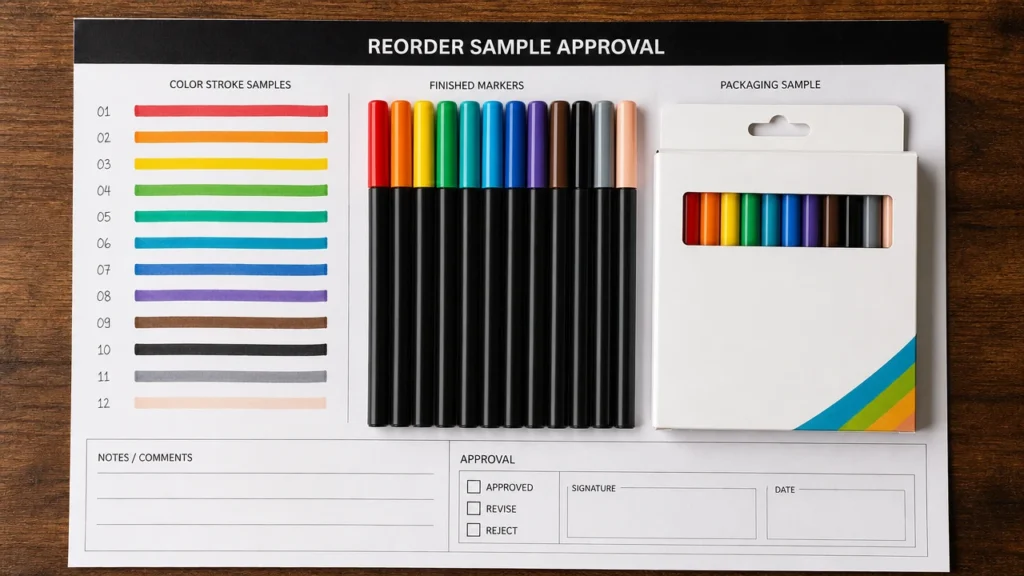
A reorder sample should not restart the whole product flow. It should confirm the production team still works from the right file. Keep it lean. One sample set. One stroke card. One pack sample if pack color matters. One batch label record.
- Ask for the reorder sample before bulk ink filling or final assembly.
- Compare the sample beside the buyer-held master sample, not beside a computer screen.
- Check the light colors and weak colors first because drift is easier to notice there.
- Write on the same paper or surface used for original approval.
- Record approval comments in the PO file so the next reorder has a trail.
If the buyer changes set size, channel, or pack format at the same time, treat the order as a controlled update, not a simple reorder. A 12-color school set, a 48-color art set, and a private-label retail box can use different pass rules. Buyers can also compare set-size plans against the separate 12 vs 24 vs 36 vs 48 vs 60 set guide after it is confirmed public.
Ask Better Supplier Questions
The strongest supplier questions ask for proof, not comfort. Use these before a repeat order becomes urgent.
| Question | A Useful Supplier Answer Should Include |
|---|---|
| Which master sample are you using for this reorder? | A sample ID, order reference, approval date, and storage condition |
| Has the ink formula, pigment or dye supplier, nib, barrel, or cap seal changed? | A direct yes or no answer, plus the reason for any change and whether a new approval sample is needed |
| Can you keep retained samples from this reorder? | The number of retained sets, storage period, label method, and access process if a dispute appears |
| How will you check color before mass production? | Substrate, drying time, light condition, visual or instrumental method, and who signs off |
| What happens if one color is outside tolerance? | A correction process, resampling timeline, and whether the whole set or only that color is affected |
| Can packaging artwork colors be approved separately from ink colors? | A clear separation between printed packaging color, barrel/cap color, and actual ink stroke color |
These questions also show whether the factory thinks like a repeat-order partner or a one-time quote source. If the supplier cannot name the kept sample or batch record, slow down before a large reorder.
What to Send the Supplier Before the Reorder
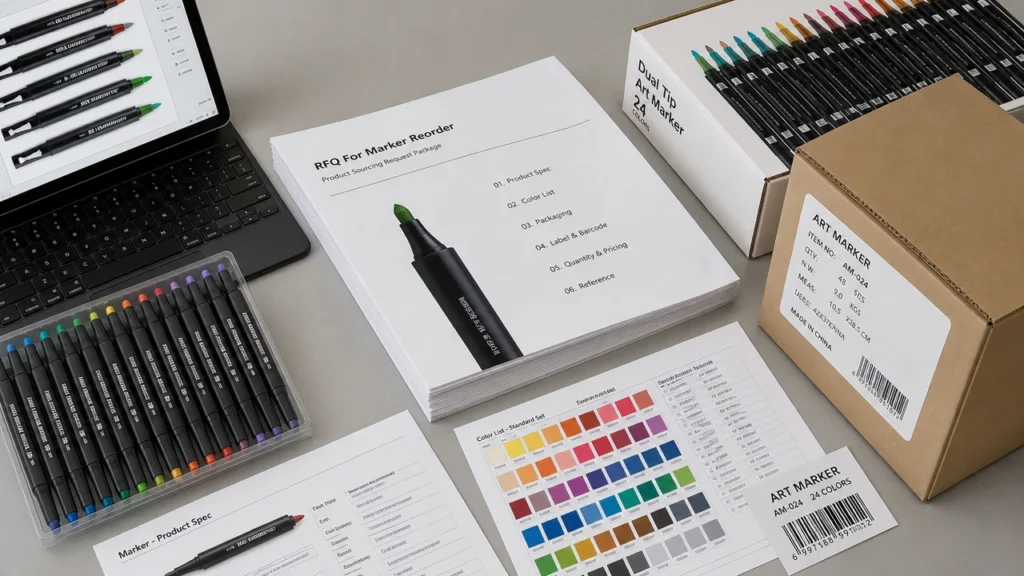
A tidy reorder file saves time. Send the supplier the PO from the passed order, SKU list, color code list, master sample basis, set size, pack version, target market, and any complaint notes from the last run. For Amazon, retail, or distributor programs, add barcode, carton, and label needs in the same file, not after production starts.
For a new custom marker program, ZH Stationery can review the target color list, pack plan, market channel, and reorder hopes before sampling. Share the color file, planned face, set size, yearly volume, and destination country through the company page or the product inquiry route.
FAQs
These FAQs match the sourcing questions buyers raise when repeat orders need steady colors.
Why do marker colors change between reorders?
Colors can change when ink batch, pigment or dye lot, nib material, barrel seal, pass paper, dry time, or view light shifts. A repeat order should compare the new sample with the passed master, not only a digital file or old PO.
Is a Pantone number enough for custom marker color matching?
A Pantone number helps talk. It is not enough for marker ink. The same target can look different after drying on coated paper, plain paper, board, plastic, or canvas. Pass real marker strokes on the planned use material.
Should every reorder have a new pre-production sample?
For retail programs, private-label sets, and long-gap repeats, yes. A small sample catches formula, nib, pack, and batch-label changes before mass run. For steady frequent orders, buyers can agree on a shorter pass if kept samples and batch records are clear.
What color tolerance should buyers use for marker reorders?
There is no universal number for every marker, color, and face. Buyers can set a practical visual bar, an instrument bar like Delta E, or both. Agree it before production. Check it under the same view states each time.
How should passed marker color samples be stored?
Keep them in sealed sleeves or boxes, away from sun, wet, heat, and dust. Label with SKU, color code, order, pass date, base, and supplier batch info. Swap aging bases when they fade or stop matching.
Can color consistency be checked without a lab tool?
Yes. A controlled visual check can stop many problems. Use the same paper, stroke count, dry time, light, and compare way. For high-value retail programs, a colorimeter adds a clear record. The visual pass still matters.
What should a reorder RFQ include for color control?
The passed master base, color code list, check base, tolerance way, kept sample ask, batch record ask, pack color needs, pass timeline, and the person for final sign-off.
Conclusion
Color consistency across marker reorders comes from habits, not luck. Pass a real master sample. Set the check way. Keep samples. Make every reorder go back to the same file. When buyer and supplier share one bar, a repeat order becomes a controlled process, not a fresh talk.
If you are preparing a private-label reorder, send ZH Stationery the passed color list, current pack file, set size, last PO base, and destination market. The team can help review which color points should be confirmed before production.
Related guide: Dual Tip Markers Explained.
Related Reading
The minimum order for custom OEM/ODM programs is 50,000 pens per order, counted by total individual pens produced. For a 12-color pack, that equals roughly 4,200 sets, not 50,000 of each color. Standard stock models can be sampled at smaller trial sizes.