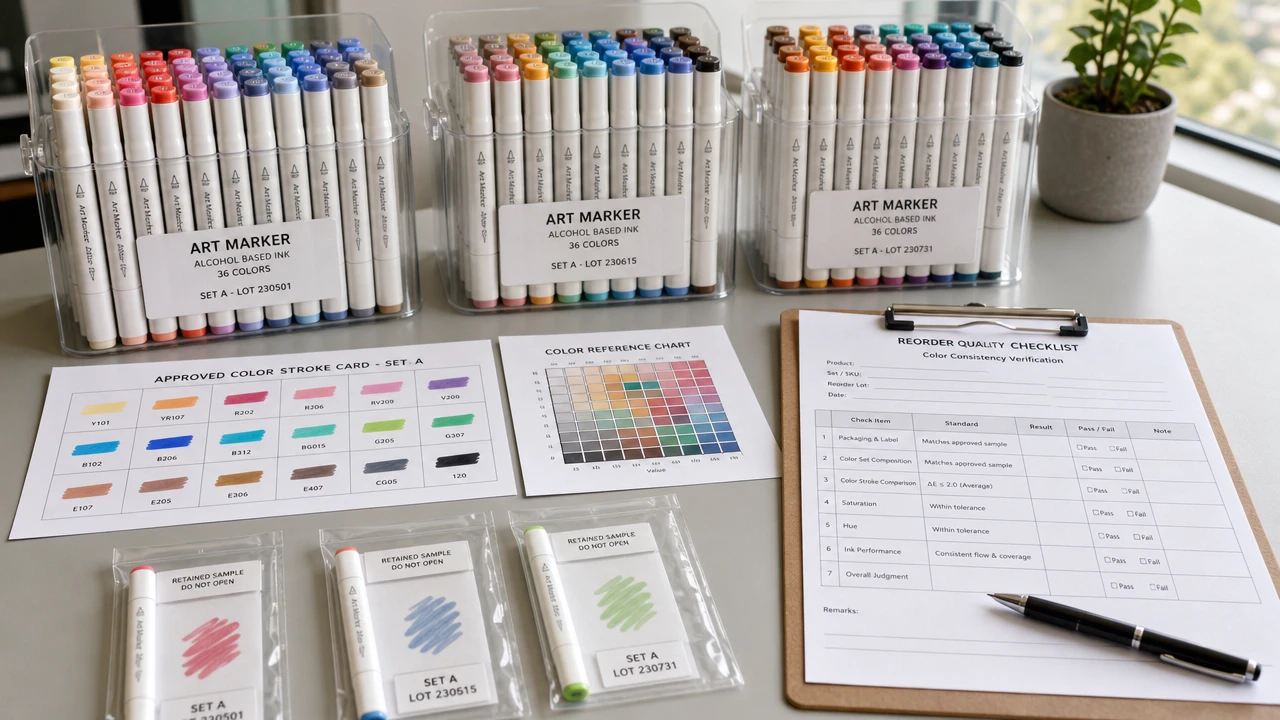
A buyer can place the same marker order twice and still get colors that feel slightly off on the shelf. To keep marker colors consistent across reorders, the repeat order needs more than same as last time in an email. It needs a steady color standard, the same check way, and a supplier who can trace what changed from one batch to the next.
This matters most for private-label sets, school programs, retail refills, and color-count adds. If a 24-color set from January looks different from the June set, the buyer has a brand problem even when every marker writes. ZH buyers can start from the ассортимент маркеров and build the color file around the exact SKU, ink system, nib, packing, and channel.
Быстрый ответ
The best way to keep marker colors consistent across reorders is to pass a physical master sample, define how color is checked, ask the supplier to keep kept samples, and ask for a reorder sample before mass production when the program matters. A digital color code alone is too weak. Marker ink changes with paper, dry time, nib flow, pigment lot, and light.
Быстрые ссылки
- Быстрый ответ
- Почему цвета маркеров отклоняются между повторными заказами
- Установите цветовой стандарт до первого заказа
- Используйте лист контроля цвета для повторных заказов
- Проверяйте всю систему письма
- Контролируйте освещение и условия просмотра
- Запросите контрольные образцы и записи партий
- Заложите цветовые допуски в RFQ
- Утверждайте образцы повторного заказа перед массовым производством
- Задавайте поставщику более правильные вопросы
- Часто задаваемые вопросы (FAQ)
Почему цвета маркеров отклоняются между повторными заказами
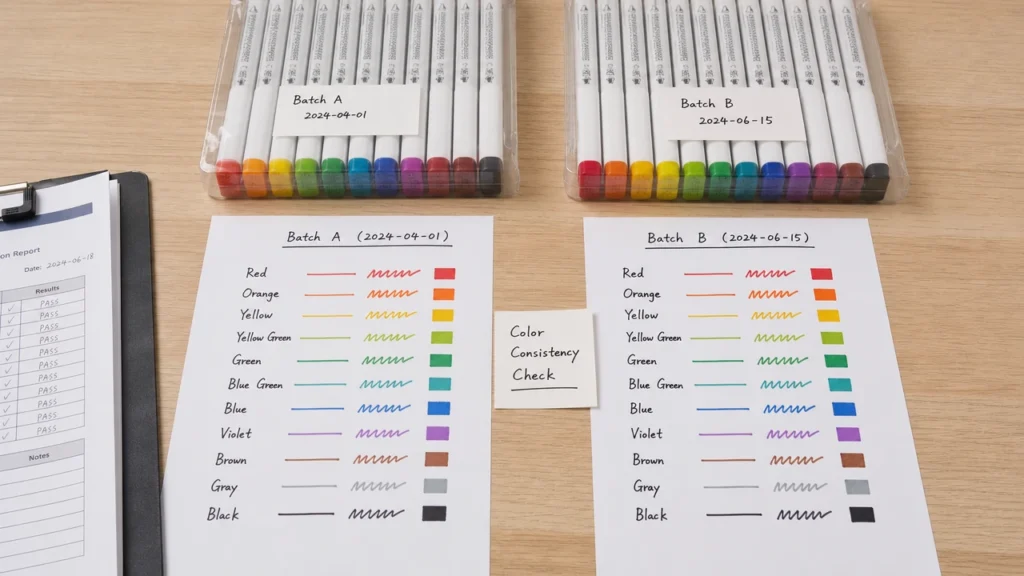
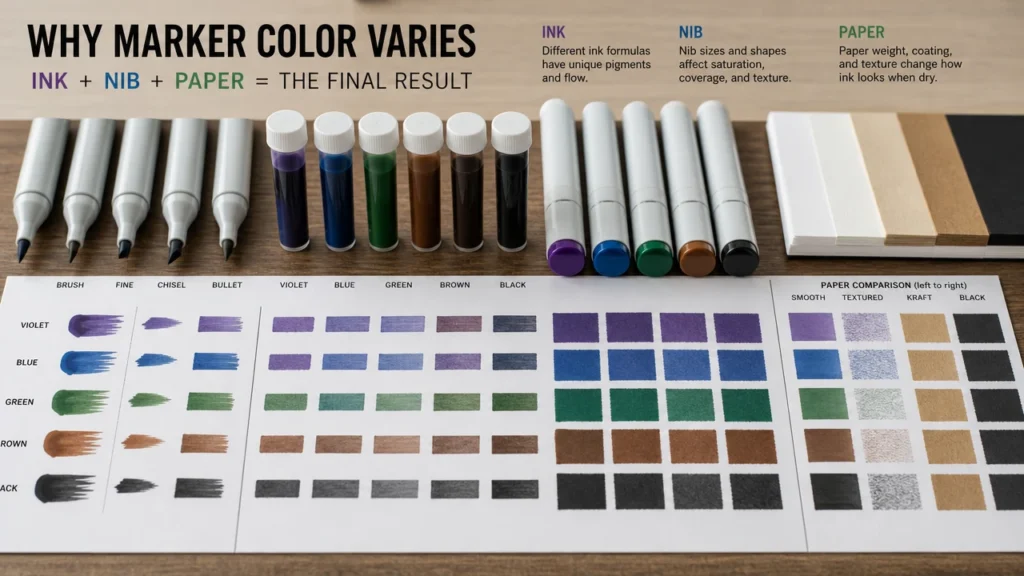
Color drift usually starts with small changes no one logs. A dye supplier changes lot. A nib takes more ink than the last nib. A card used for checking is swapped for a brighter one. The cap seal changes dry act in storage. None of these looks big alone. The finished set can still look less matched beside the first shipment.
The risk is higher when buyers pass colors from a screen, a printed art file, or a catalog photo. Marker color is a writing result, not a flat graphic color. Check the ink after it is written, dried, and compared on the same material the buyer will likely use.
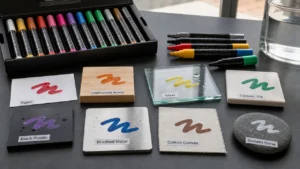
For acrylic paint markers, face act is key. A color that looks strong on white card may look different on a black board, canvas, stone, or plastic. Buyers building acrylic ranges can tie color pass to product details on the custom acrylic markers maker checklist. For watercolor goods, compare wet and dry strokes. Dilution and paper absorb change the look. The руководство по закупке акварельных маркеров is a useful next read.
Установите цветовой стандарт до первого заказа
Reorder control starts before the first production order. The first passed shipment should make the base for every later order. If the buyer waits until the second order to set the color bar, both sides end up arguing from memory.
Используйте физический эталонный образец
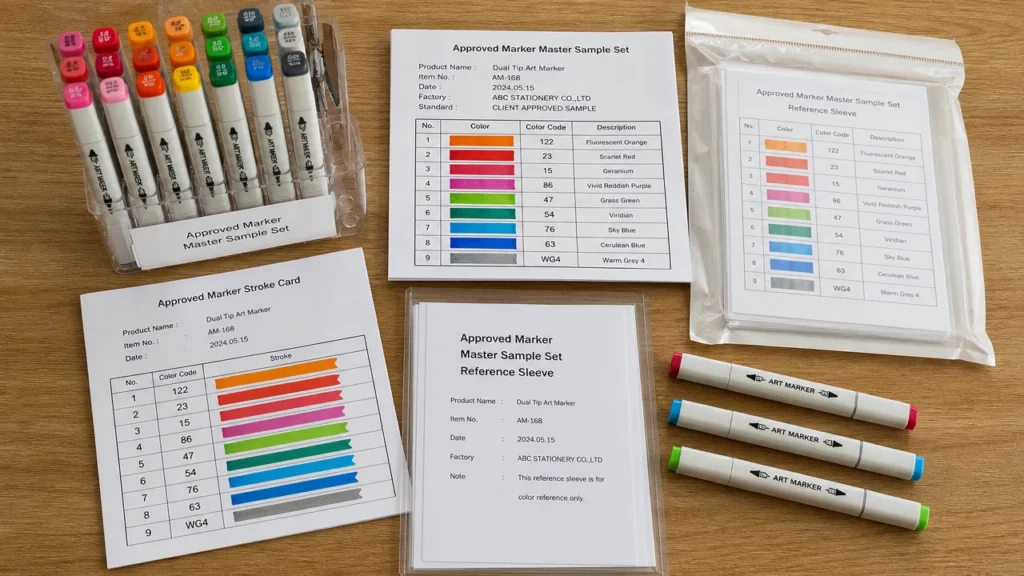
A master sample should hold real marker strokes, not only the barrel color or printed pack color. Keep one passed set with the buyer. Ask the factory to keep one sealed kept set. Label both with item number, color codes, PO number, pass date, and the check material.
Сопоставляйте коды цветов с реальными штрихами
Pantone, RGB, CMYK, or LAB values can help a supplier see the target. The passed marker stroke decides final acceptance. A red cap, a red printed label, and a red ink stroke are three separate color problems. Treat them apart in the pass file.
Фиксируйте поверхность и время высыхания
A buyer should set the paper or face used for checking and the dry time before compare. Five minutes, thirty minutes, and 24 hours can give different calls, based on the ink system. If the product is a retail art set, check the material that matches the claim on the pack.
Используйте лист контроля цвета для повторных заказов
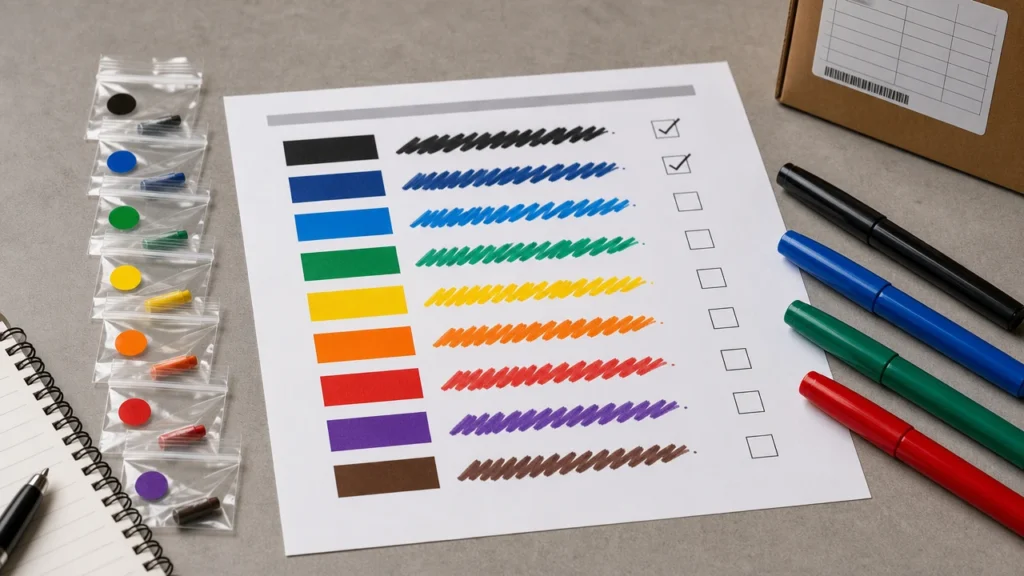
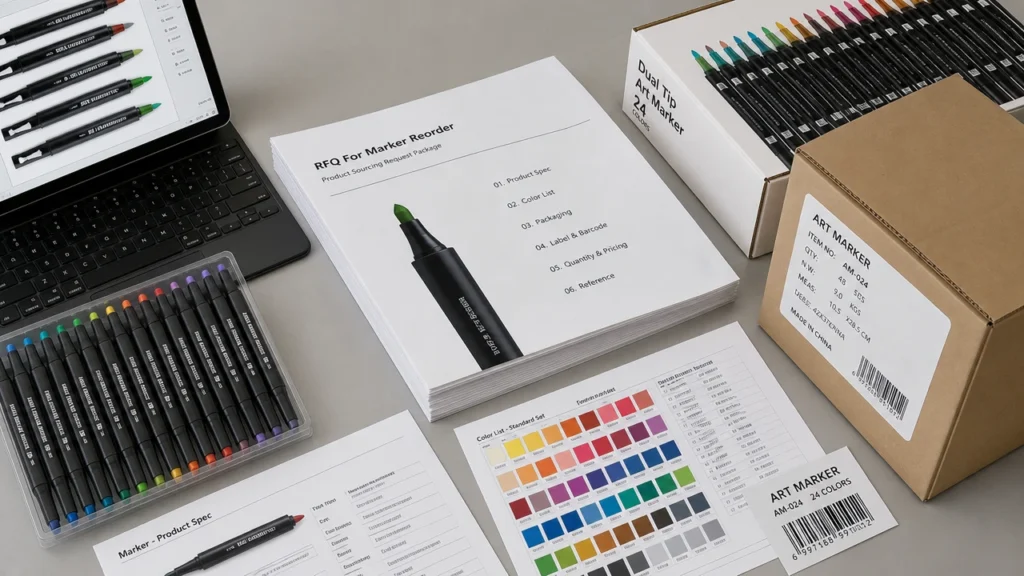
A reorder color sheet keeps the talk practical. It tells the factory what must stay, what can change with pass, and what proof should return before production starts.
| Поле | Что записывать | Почему это важно |
|---|---|---|
| SKU и размер набора | Номер позиции, набор из 12/24/36/48/60 цветов, версия упаковки | Предотвращает подбор поставщиком не той линейки |
| Утверждённый цветовой эталон | ID эталонного образца, список кодов цветов, дата утверждения | Создаёт единый источник истины для сравнения при повторных заказах |
| Материал для проверки | Бумага, картон, пластик, холст или другая целевая поверхность | Контролирует влияние поверхности на видимый цвет |
| Время высыхания | Время до визуальной или инструментальной проверки | Разделяет сравнения влажных и сухих штрихов |
| Метод допусков | Визуальное утверждение, целевое значение Delta E или оба | Делает приёмку менее субъективной |
| Хранимые образцы | Требования к хранению образцов покупателя и фабрики | Поддерживает проверку споров и будущие повторные заказы |
| Запись партии | Партия чернил, партия наконечников, версия корпуса, дата упаковки | Упрощает отслеживание будущих отклонений цвета |
This sheet does not need to be complex. It needs to be used every time. A clean RFQ and pass file also helps the factory quote without guessing, especially when the same buyer grows from one marker range into several lines.
Проверяйте всю систему письма
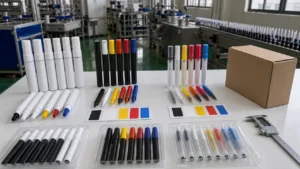
Marker color is made by a system. Ink. Tip. Valve or reservoir. Barrel seal. Paper. User pressure. A supplier may match the ink in a lab cup, then lose the target after the ink moves through the nib. That is why reorder pass should compare finished markers, not only ink samples.
| Проверяемая часть | Риск при повторном заказе | Действие покупателя |
|---|---|---|
| Формула чернил | Партия пигмента или красителя может изменить оттенок, интенсивность или прозрачность | Уточните, используется ли та же утверждённая формула и партия поставщика |
| Наконечник или кончик | Разные волокна могут изменить скорость подачи и насыщенность штриха | Утверждайте штрих готового маркера, а не отдельный образец чернил |
| Колпачок и уплотнение корпуса | Испарение может сделать хранящиеся маркеры темнее или слабее при письме | Проверяйте письмо после нормальных условий хранения и транспортировки |
| Цвет упаковки | Печатные цветовые карточки могут не совпадать с результатом чернил | Раздельное утверждение макета упаковки и утверждения штриха чернил |
| Бумага или тестовая поверхность | Яркость и покрытие изменяют воспринимаемый цвет | Используйте одну и ту же контрольную поверхность для каждого повторного заказа |
This is also where the buyer should split act from color. A marker can match color and still fail flow, dry, odor, leak, or cap-off act. For wider supplier checks, tie this reorder flow to the questions in the ASTM D-4236 report guide и dual tip acrylic marker guide.
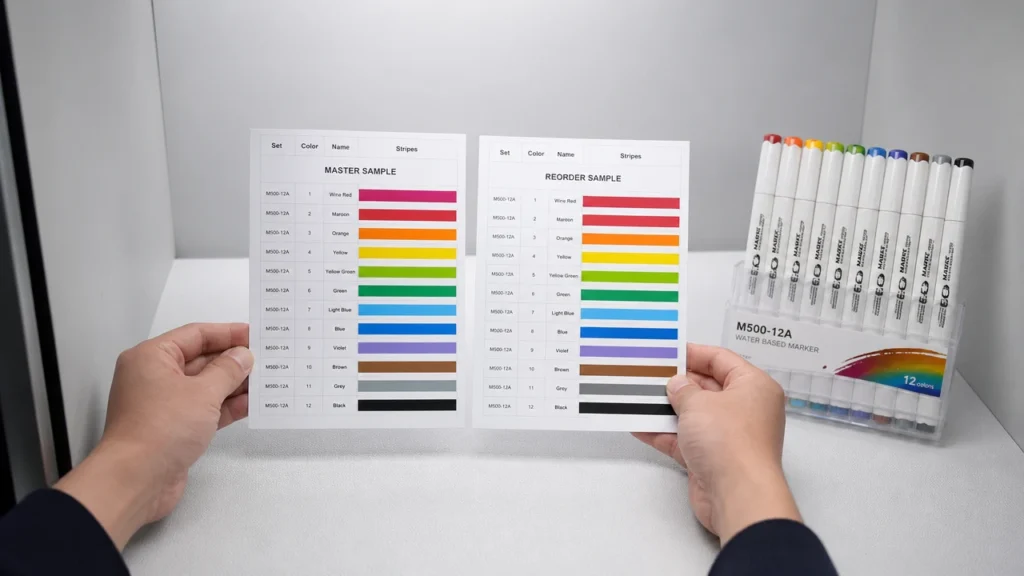
Контролируйте освещение и условия просмотра
Two samples can look close in one room and wrong in another. That is why pro color checks control light, view angle, background, and sample spot. ISO 3668:2017 covers visual compare of paint color in a booth with set light sources. Marker ink is not always paint film. The buyer lesson holds. Set the view state before judging color.
For instrument checks, ASTM D2244 covers color tolerance and difference from measured points. The CIEDE2000 formula is often used for a more perceptual number. Buyers do not need a lab project for every order. They should not mix visual pass, phone photos, and supplier screenshots as if they were the same proof.
Without a light booth or color tool, the next best step is discipline. Same paper. Same light. Same dry time. Same background. Side-by-side compare with the master. A simple way used every time beats a technical way used once and lost.
Запросите контрольные образцы и записи партий
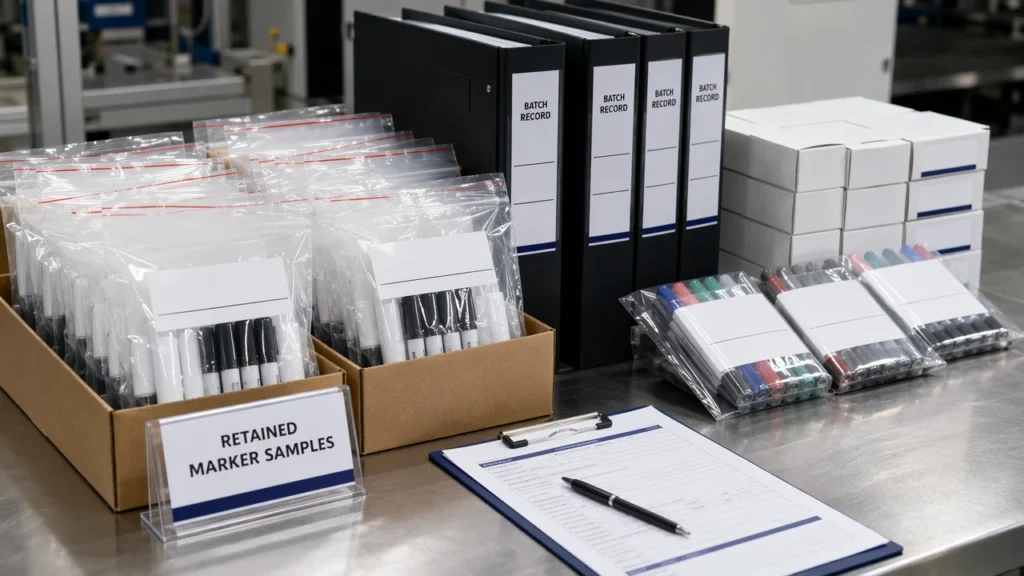
Kept samples guard both sides. The buyer can compare the new shipment with the agreed base. The supplier can show whether the new batch followed the same file. Without kept samples, reorder fights turn into opinion.
Ask the supplier to keep a sealed set from the passed run and another from each mass batch. The label should hold SKU, PO, production date, ink lot, nib lot, pack version, and inspector name or QC stamp. Do not ask for secret formula details unless the trade link supports that level. Batch trace is enough for most sourcing calls.
This also helps packing and logistics. If the buyer changes the card, tray, insert, or carton storage state, the writing result can shift with wet, rub, or pressure in transit. Tie packing plans to the руководством по упаковке акриловых маркеров и руководство по размеру коробки, весу брутто и CBM.
Заложите цветовые допуски в RFQ
A reorder RFQ should tell the supplier how close the color must be and how the buyer will decide. Same color as last order is not a tolerance. It is a wish.
| Формулировка запроса предложения | Улучшенная версия | Почему это помогает |
|---|---|---|
| Как раньше | Соответствие утверждённому эталонному образцу MS-2026-05 по согласованному методу проверки | Называет фактический эталон |
| Pantone красный | Целевое значение Pantone плюс утверждённый высохший штрих маркера на белой карточке | Избегает рассмотрения цветового веера как конечного продукта |
| Цвет должен быть идеальным | Требуется визуальное утверждение, отсутствие очевидного сдвига оттенка рядом с сохранённым образцом | Создаёт практическое правило инспекции |
| Поставщик должен подтвердить качество | Поставщик должен отправить фотографии образца повторного заказа, карточки штрихов и этикетку сохранённого образца до массового производства | Определяет доказательства, необходимые до утверждения |
| Использовать старую упаковку | Использовать версию упаковки PKG-02 и подтвердить версию печатной цветовой карточки | Предотвращает путаницу между изменением цвета упаковки и изменением чернил |
For high-value programs, ask whether the supplier can report a Delta E value and which formula, tool, light, and base they used. Do not compare numbers from different ways as if they are the same. For normal wholesale sets, a well-run visual bar may be enough.
Утверждайте образцы повторного заказа перед массовым производством
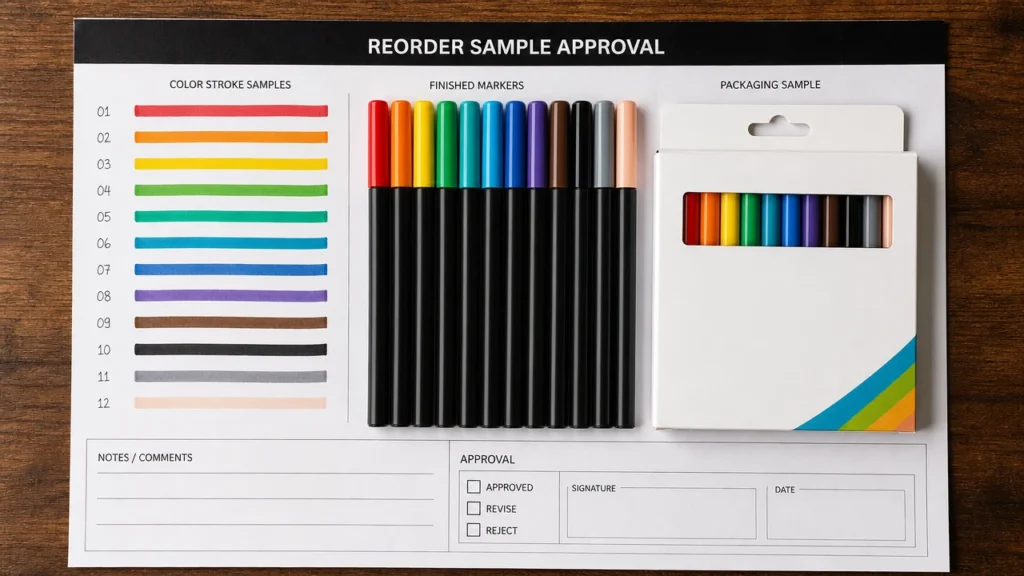
A reorder sample should not restart the whole product flow. It should confirm the production team still works from the right file. Keep it lean. One sample set. One stroke card. One pack sample if pack color matters. One batch label record.
- Запрашивайте образец повторного заказа до массовой заправки чернил или окончательной сборки.
- Сравнивайте образец рядом с эталонным образцом покупателя, а не с экраном компьютера.
- Сначала проверяйте светлые и слабые цвета, потому что сдвиг там заметнее.
- Пишите на той же бумаге или поверхности, которая использовалась при первоначальном утверждении.
- Записывайте комментарии об утверждении в файл заказа, чтобы у следующего повторного заказа была история.
If the buyer changes set size, channel, or pack format at the same time, treat the order as a controlled update, not a simple reorder. A 12-color school set, a 48-color art set, and a private-label retail box can use different pass rules. Buyers can also compare set-size plans against the separate 12 vs 24 vs 36 vs 48 vs 60 set guide after it is confirmed public.
Задавайте поставщику более правильные вопросы
The strongest supplier questions ask for proof, not comfort. Use these before a repeat order becomes urgent.
| Вопрос | Полезный ответ поставщика должен включать |
|---|---|
| Какой эталонный образец вы используете для этого повторного заказа? | Идентификатор образца, ссылка на заказ, дата утверждения и условия хранения |
| Изменились ли формула чернил, поставщик пигмента или красителя, стержень, корпус или уплотнение колпачка? | Прямой ответ «да» или «нет», а также причина любого изменения и необходимость нового утверждающего образца |
| Можете ли вы хранить сохранённые образцы из этого повторного заказа? | Количество сохранённых комплектов, срок хранения, метод маркировки и порядок доступа в случае спора |
| Как вы будете проверять цвет перед массовым производством? | Подложка, время высыхания, условия освещения, визуальный или инструментальный метод и кто подписывает |
| Что произойдёт, если один цвет выйдет за пределы допуска? | Процесс исправления, сроки повторной выборки и затрагивает ли это весь набор или только этот цвет |
| Можно ли утверждать цвета макета упаковки отдельно от цветов чернил? | Четкое различие между цветом печатной упаковки, цветом корпуса/колпачка и фактическим цветом чернильного штриха |
These questions also show whether the factory thinks like a repeat-order partner or a one-time quote source. If the supplier cannot name the kept sample or batch record, slow down before a large reorder.
Что отправить поставщику перед повторным заказом
A tidy reorder file saves time. Send the supplier the PO from the passed order, SKU list, color code list, master sample basis, set size, pack version, target market, and any complaint notes from the last run. For Amazon, retail, or distributor programs, add barcode, carton, and label needs in the same file, not after production starts.
For a new custom marker program, ZH Stationery can review the target color list, pack plan, market channel, and reorder hopes before sampling. Share the color file, planned face, set size, yearly volume, and destination country through the company page or the product inquiry route.
Часто задаваемые вопросы (FAQ)
These FAQs match the sourcing questions buyers raise when repeat orders need steady colors.
Почему цвета маркеров меняются между повторными заказами?
Colors can change when ink batch, pigment or dye lot, nib material, barrel seal, pass paper, dry time, or view light shifts. A repeat order should compare the new sample with the passed master, not only a digital file or old PO.
Достаточно ли номера Pantone для подбора индивидуального цвета маркера?
A Pantone number helps talk. It is not enough for marker ink. The same target can look different after drying on coated paper, plain paper, board, plastic, or canvas. Pass real marker strokes on the planned use material.
Должен ли каждый повторный заказ сопровождаться новым предпроизводственным образцом?
For retail programs, private-label sets, and long-gap repeats, yes. A small sample catches formula, nib, pack, and batch-label changes before mass run. For steady frequent orders, buyers can agree on a shorter pass if kept samples and batch records are clear.
Какой допуск по цвету следует использовать покупателям при повторных заказах маркеров?
There is no universal number for every marker, color, and face. Buyers can set a practical visual bar, an instrument bar like Delta E, or both. Agree it before production. Check it under the same view states each time.
How should passed marker color samples be stored?
Keep them in sealed sleeves or boxes, away from sun, wet, heat, and dust. Label with SKU, color code, order, pass date, base, and supplier batch info. Swap aging bases when they fade or stop matching.
Can color consistency be checked without a lab tool?
Yes. A controlled visual check can stop many problems. Use the same paper, stroke count, dry time, light, and compare way. For high-value retail programs, a colorimeter adds a clear record. The visual pass still matters.
Что должно включать в себя RFQ на повторный заказ для контроля цвета?
The passed master base, color code list, check base, tolerance way, kept sample ask, batch record ask, pack color needs, pass timeline, and the person for final sign-off.
Заключение
Color consistency across marker reorders comes from habits, not luck. Pass a real master sample. Set the check way. Keep samples. Make every reorder go back to the same file. When buyer and supplier share one bar, a repeat order becomes a controlled process, not a fresh talk.
If you are preparing a private-label reorder, send ZH Stationery the passed color list, current pack file, set size, last PO base, and destination market. The team can help review which color points should be confirmed before production.
Связанное руководство: Маркеры с двойным наконечником: объяснение.
Связанные материалы
- Качество акриловых чернил: 5 тестов, которые покупатели B2B должны провести перед заказом
- Наборы кастомных маркеров: руководство по цветам, наконечникам, упаковке и MOQ
- Как обрабатывать жалобы клиентов на высохшие маркеры или различия в цвете
- Руководство по наборам маркеров: 12 vs 24 vs 36 vs 48 vs 60 цветов
The minimum order for custom OEM/ODM programs is 50,000 pens per order, counted by total individual pens produced. For a 12-color pack, that equals roughly 4,200 sets, not 50,000 of each color. Standard stock models can be sampled at smaller trial sizes.