
Benvenuti nel cuore produttivo di ZH STATIONERY. In qualità di produttore leader di pennarelli personalizzati, sappiamo che gli acquirenti globali desiderano più dei prodotti standard.
Hanno bisogno di partner di fabbrica affidabili che possano garantire qualità costante, margini di crescita e soluzioni su misura OEM/ODM. Con sede a Tonglu, in Cina, il nostro stabilimento è progettato per soddisfare le specifiche esatte dei marchi di tutto il mondo.
Tonglu, in Cina, è conosciuta in tutto il mondo come la Capitale della produzione di penne. Nel corso degli anni, è diventata un enorme polo per la catena di fornitura globale della scrittura. Ora il mercato richiede una qualità superiore. Il vecchio stile economico e basilare non è più sufficiente. Gli acquirenti di oggi vogliono prodotti premium.
In qualità di fabbrica leader in questa rinomata regione, ZH STATIONERY si concentra interamente su pennarelli professionali di alta qualità. Uniamo la ricca storia produttiva di Tonglu con la tecnologia moderna per offrire un servizio di livello mondiale OEM e ODM ai marchi globali.
Ecco come stiamo cambiando il modo in cui vengono prodotti i pennarelli professionali.
1. Formule di inchiostro premium e punte di precisione
Molti pennarelli sul mercato sembrano uguali. La vera differenza è all'interno della penna. Artisti e designer professionisti hanno bisogno di inchiostro fluido e colori esatti.
Per far risaltare il tuo marchio, ZH STATIONERY investe concretamente nella tecnologia di base:
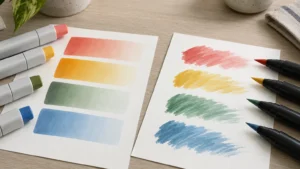
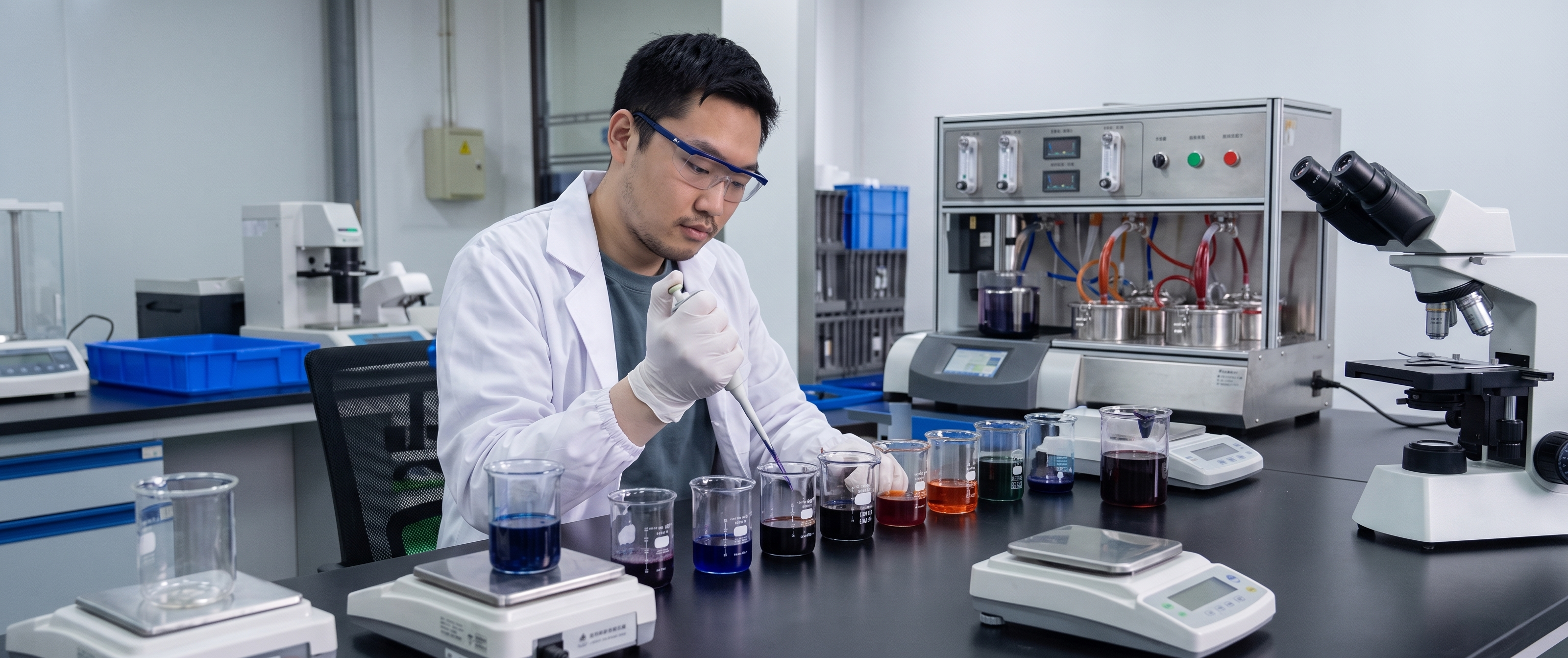
- Laboratorio avanzato per inchiostri: Sviluppiamo inchiostri a base alcolica e a base d'acqua di alta precisione. I nostri marcatori offrono colori brillanti e altamente saturi, sfumature omogenee e prestazioni durature.
- Punte di alta qualità: Che si tratti di una punta a scalpello larga per aree estese o di una punta a pennello morbida per i dettagli, utilizziamo solo i migliori componenti. Ciò garantisce un flusso d'inchiostro regolare senza perdite o secchezza.
2. Forte R&S per far crescere il vostro marchio
Grazie al forte sostegno e ai finanziamenti del governo locale di Tonglu, ZH STATIONERY dispone delle risorse per continuare a creare. Non produciamo solo penne standard. Costruiamo il futuro della scrittura.
Quando ci scegliete come partner di fabbrica, ottenete un fornitore in grado di trasformare rapidamente le vostre idee in prodotti. Volete un enorme set per artisti da 120 colori? Volete nuovi pennarelli acrilici? Volete fusti per pennarelli in bambù ecologico? Il nostro team R&S può realizzarlo rapidamente.
3. Concordare la proprietà del design e la riservatezza
Una delle maggiori preoccupazioni per gli acquirenti esteri è: la fabbrica copierà il mio design personalizzato?
In ZH STATIONERY, il vostro marchio è completamente al sicuro. Tonglu ha lanciato un rigoroso sistema di protezione della proprietà intellettuale per sostenere i veri creatori.
- Privacy completa: Firmiamo rigorosi NDA (Accordi di non divulgazione) con tutti i nostri clienti.
- Supporto legale locale: Grazie alle leggi accelerate sulla protezione dei brevetti nella nostra città, gli imitatori vengono rapidamente fermati.
- Innovazione senza preoccupazioni: Poiché i vostri design sono protetti sia dalle nostre regole aziendali che dalle leggi locali, potete collaborare con noi in tutta sicurezza per creare stampi unici per marcatori e imballaggi personalizzati che i vostri concorrenti non possono copiare.
Collaborate con una fabbrica di marcatori affidabile
Il mercato della scrittura sta passando da "Made in China" a "Intelligently Created in China". ZH STATIONERY è orgogliosa di guidare questo cambiamento nel settore dei pennarelli professionali.
State cercando un fornitore affidabile e di alta qualità di marcatori per aggiornare la vostra linea di prodotti?
Pronti a Elevare il Vostro Marchio di Cancelleria?
Il giusto partner di fabbrica è fondamentale per la vostra crescita. Siamo orgogliosi di essere il produttore preferito di pennarelli personalizzati per clienti in tutto il mondo. Offriamo prezzi equi senza compromettere la qualità. Che abbiate un design pronto per la produzione o abbiate bisogno di aiuto con la prototipazione digitale, il nostro team è qui. Contattateci oggi per parlare delle vostre esigenze OEM. Lasciate che diamo vita ai vostri progetti di pennarelli.
In qualità di fabbrica esperta a Tonglu, eseguiamo rigorosi controlli di qualità su ogni lotto prima della spedizione globale. Collaborare con noi significa una catena di fornitura stabile e ad alto rendimento per il successo a lungo termine del vostro marchio di scrittura.
Guida correlata: Come vengono realizzati i pennarelli a vernice.
Guida correlata: Per la pianificazione della conformità correlata, vedere Potenziare il Nostro Team: Benessere dei Dipendenti e Produzione Etica presso ZH STATIONERY.
What a Custom Marker Pen Manufacturer Actually Controls
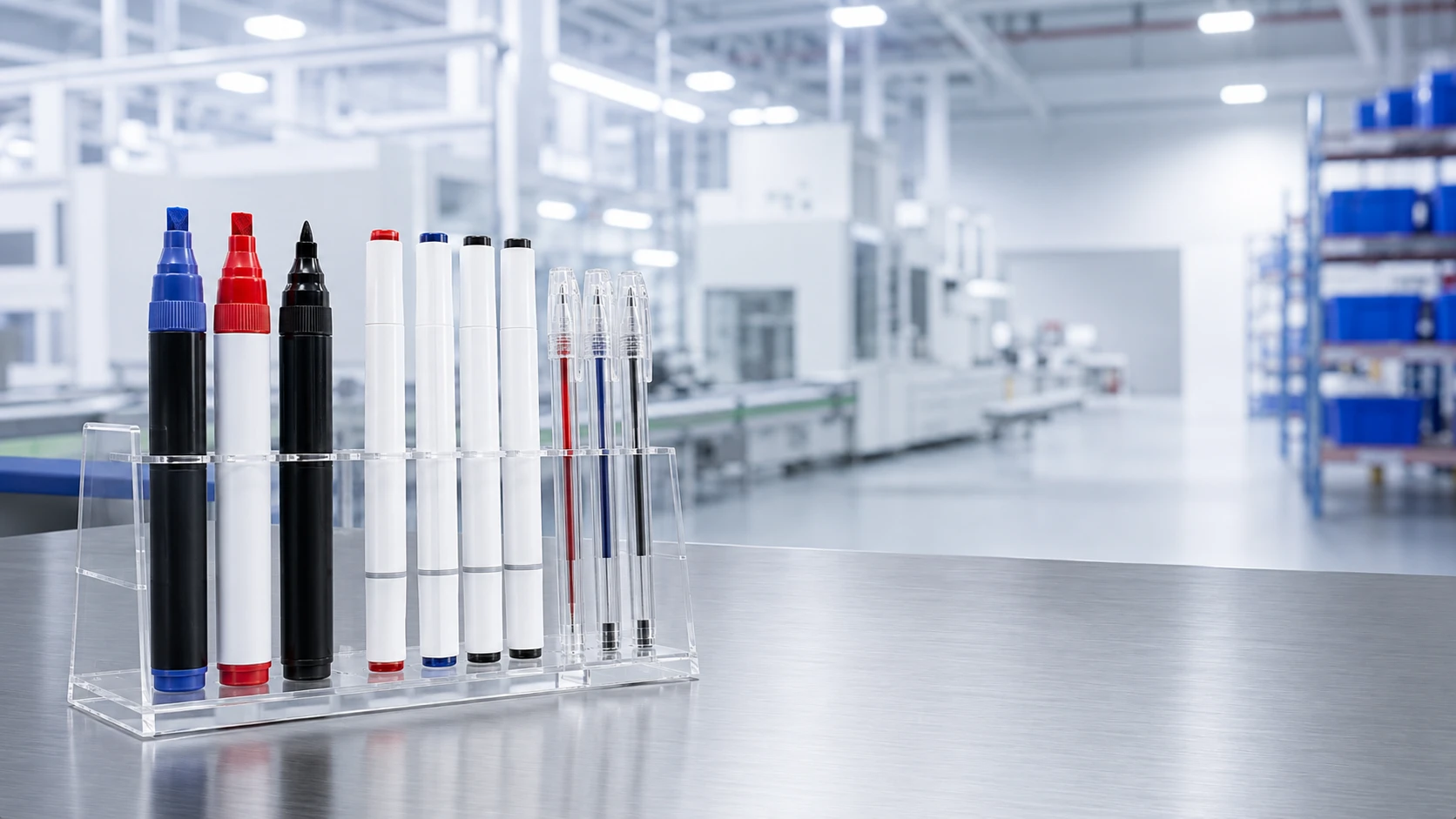
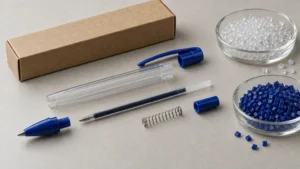
A marker looks simple from the outside. Inside, it is four subsystems that must work together: the ink, the nib, the barrel and cap, and the packaging. When a buyer evaluates a custom marker pen manufacturer, the useful question is not whether the factory can print a logo. It is which of those four subsystems the factory actually controls.
Ink is the hardest to control and the easiest to fake. A factory that buys pre-mixed ink from a third party inherits that supplier’s batch variation. A factory with its own ink lab can tune pigment load, viscosity, drying time, and lightfastness against a target surface. The difference shows up two months after delivery, when Batch 2 does not match Batch 1 on the shelf.
The nib decides how the marker feels in use. Fiber density, tip geometry, and the bond between fiber and binder determine whether a tip holds its shape through 500 strokes or turns mushy by stroke 50. Barrel and cap form a small sealed container. Their job is to stop the ink from evaporating, which is why cap seal should be tested with a closed-storage test, not a cap-off writing test.
Packaging is the fourth subsystem and the one most often treated as an afterthought. A retail card, blister, or display box changes freight volume, pallet configuration, and landed cost per unit. Buyers who approve packaging late usually pay for it twice: once in tooling, once in freight.
Ink Formulation: Where the Real Differentiation Lives

Most marker complaints trace back to ink, not to the pen body. The pigment-versus-dye choice sets the baseline. Pigment sits on the surface, gives opaque coverage, and resists UV fading. Dye dissolves into the carrier, blends smoothly, and produces brighter color at lower cost, but it fades faster and can wick into paper fibers unevenly.
For solvent-based markers, the carrier is usually alcohol with a small balance of wetting agents and release additives. For water-based markers, the carrier is water plus a humectant to slow drying in an uncapped tip. Both systems need a biocide package if the product will sit in a warehouse for months. Skipping that step is how a shipment arrives with mold in the reservoir.
Viscosity is the parameter buyers should ask about by number, not by feel. A difference of 200 cPs between batches is enough to change how a chisel tip lays down color. Factories with in-house ink capability can hold that window. Factories buying pre-mixed ink cannot, because they have no visibility into what changed upstream.
Ask for the ink batch record. A useful one lists pigment lot, carrier lot, viscosity reading, and the date the batch was mixed. If the supplier cannot produce that record for the SKU you are ordering, the batch consistency claim is not verifiable.
Nib Engineering and the Wear Test That Matters
The nib is the most-felt part of a marker and the least-specified in most purchase orders. Fiber density is the first number to pin down. Below 0.30 g/cm3, a tip collapses under repeated pressure and does not spring back. By the 50th stroke the fine end turns soft, and line precision drops off.
Geometry comes next. A bullet tip is predictable but flattens over time. A chisel tip gives three line widths from one nib but depends on a clean grind angle. A brush tip delivers organic variation but is the easiest to fray when the fiber-to-binder ratio is off.
Wear testing should run on the finished marker, not on a bare nib sample. Ask for a 100-meter writing trial on the intended substrate, with line width and color depth measured at the start and at the end. A tip that loses 15 percent of its line width over 100 meters is not ready for a retail program.
Cap retention and drop resistance belong in the same test plan. A cap that releases under a one-meter drop is a return waiting to happen, especially in school channels where bags get thrown around.
Quality Gates Before Shipment
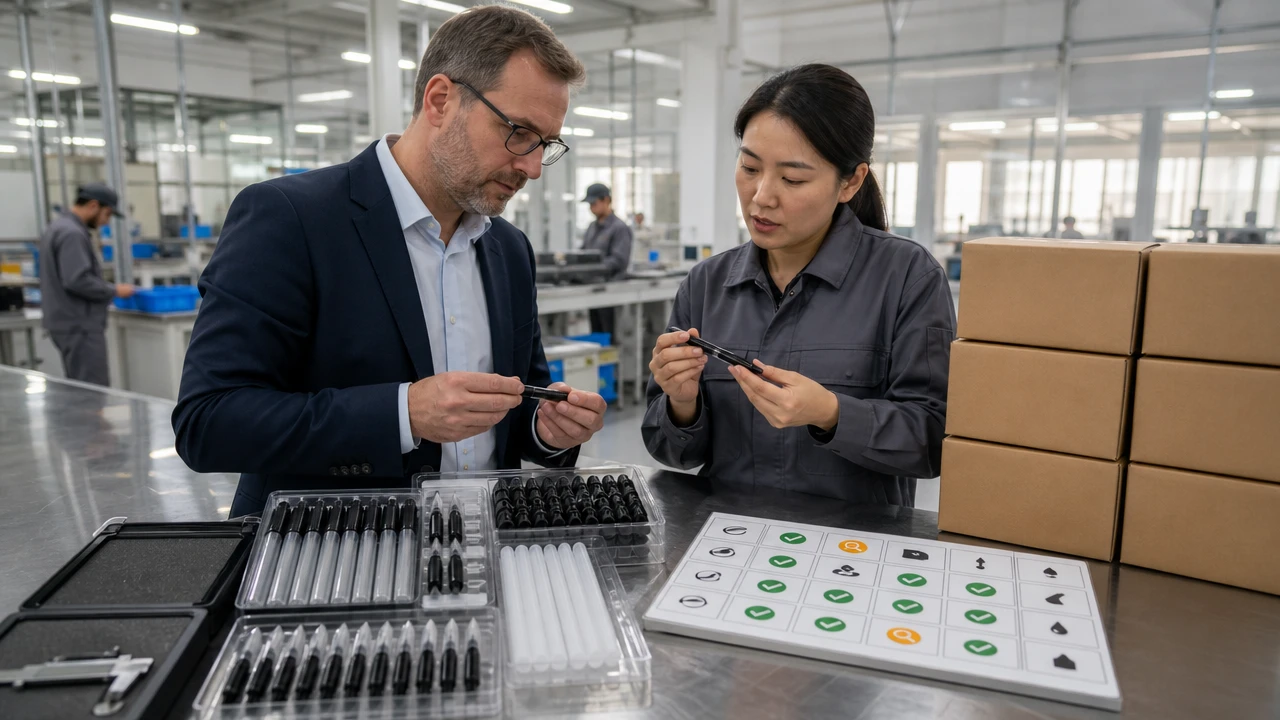
Three gates separate a manufacturing-focused supplier from a trading company. The first is inline inspection. A factory running 100 percent automated inspection checks fill weight, cap torque, and nib retention on every unit as it passes the station. That is a different claim from “we check samples.”
The second gate is statistical sampling on the finished lot. AQL levels should be written into the order: for most retail marker programs, Critical 0, Major 1.5, Minor 4.0 is a reasonable starting point. The buyer should confirm the defect definitions with the plant before production starts, not after a dispute.
The third gate is retained samples. One sealed set from the approved run, plus one from each mass-production batch, labeled with SKU, PO number, production date, ink lot, and nib lot. Without retained samples, a reorder dispute becomes a conversation about memory.
Documentation belongs alongside these gates. For the U.S. market, art materials need ASTM D-4236 conformance with a toxicology review behind it. For Europe, EN71-3 covers heavy metal migration and EN71-9 covers organic compounds. Reports should be current, dated, and name the SKU, not just the factory.
How to Brief a Custom Marker Factory

A brief that gets a usable answer contains seven items: marker type, ink system, tip construction, color count and reference numbers, packaging format, destination market, and forecast annual volume. Send the same brief to every candidate so the quotes are comparable.
Sampling comes next. Ask for a production-line sample rather than a hand-assembled prototype. Line samples represent bulk quality; hand-built samples represent what a technician can do with unlimited time. Test writing smoothness, color match across pens in the set, cap fit, and nib strength under pressure.
MOQ should be quoted by layer. A standard body with a printed logo typically starts lower than a custom mold program, because the tooling is already amortized. Ask separately for the MOQ on a stock body, a custom color, a custom mold, and a full retail set. A single headline MOQ number hides which layer is driving the cost.
Lead time follows the same logic. With existing molds, 25 to 35 days from sample approval is realistic. A new barrel or cap mold adds 15 to 25 days for design, machining, and trial runs. Third-party lab testing adds another 7 to 14 days depending on the lab queue.
Domande Frequenti
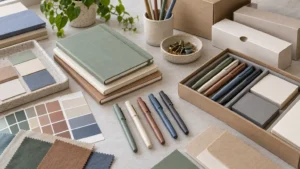
Can you match a specific Pantone color in the ink? Yes, with a caveat. Pantone gives the supplier a target, but the approved ink stroke on the intended substrate is what defines acceptance. A red cap, a red printed label, and a red ink stroke are three separate color problems and should be approved separately.
What is the minimum order for a custom marker program? It depends on the layer. Stock body plus logo starts lower than a new mold. For a fully custom OEM/ODM program, the floor is 50,000 pens per order counted by total individual pens produced; a 12-color pack equals roughly 4,200 sets, not 50,000 of each color.
How do you prevent dry-out during shipping? Cap seal is the first control, followed by fill weight and storage conditions. Ask for a closed-cap evaporation test and a storage trial at elevated temperature. A 50 C oven run for 7 to 14 days simulates a hot container crossing.
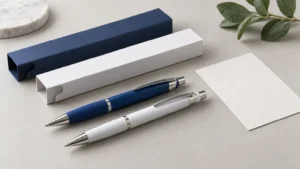
Can you supply private-label packaging? Yes. Blister cards, color boxes, display units, and gift boxes are all quotable. Send the retail channel and shelf requirements early, because packaging format changes freight volume and landed cost per unit more than most buyers expect.
Letture correlate
- Produzione di Pennarelli: Cosa i Compratori B2B Dovrebbero Sapere sui Processi di Fabbrica
- Le migliori 7 fabbriche di pennarelli in Cina per il 2026
- Incontra ZH STATIONERY alla 139ª Fiera di Canton: La Tua Fonte Affidabile per Pennarelli e Penne Gel Personalizzati
- Produzione di penne OEM ODM: Guida alle decisioni per l’acquirente
- Una Primavera Trionfante: ZH STATIONERY Brilla alla 139ª Fiera di Canton 2026
- I primi 5 produttori di penne in Cina: La guida definitiva all'approvvigionamento per il 2026
- Potenziare il Nostro Team: Benessere dei Dipendenti e Produzione Etica presso ZH STATIONERY
Tooling is usually the largest upfront line item in a custom program. Our pen mold factory and OEM tooling guide breaks down mold cost, cavity counts, and trial-run timelines.