

En el mundo acelerado de hoy, la arteterapia para aliviar el estrés se ha convertido en un método clave y creativo para apoyar la salud mental. La ansiedad y la depresión son riesgos silenciosos para la vida diaria. Por ello, el trabajo en salud mental sigue buscando formas nuevas y creativas de ayudar a las personas a sanar.
Una de las nuevas formas más efectivas es un método interdisciplinario de arteterapia. Une psicología, neurociencia y arte. Este método va más allá de la terapia de conversación tradicional. Las ilustraciones curativas son una herramienta probada. Ya sea que enfrente agotamiento o ansiedad, la arteterapia para el alivio del estrés funciona mediante tres movimientos poderosos. Crear espacios seguros. Construir eco emocional. Usar metáforas para guiar la mente.
1. Crear un Espacio Seguro a Través del Arte Visual
Aprendemos y sanamos mejor en el espacio adecuado. El conocimiento sin seguridad puede sentirse lejano y difícil de retener. Las ilustraciones curativas actúan como un puente. Llevan a los participantes a un lugar mental tranquilo. Una playa silenciosa. Un jardín floreciente. Una habitación acogedora. Eso los aleja del ruido diario y los ayuda a sentirse seguros.
La psicología ambiental muestra que un espacio cómodo y agradable puede reducir la ansiedad y aumentar los sentimientos positivos. Los colores suaves y las líneas fluidas en el arte crean un estado de ánimo tranquilo. Ayudan a las personas a abrirse al proceso de sanación.
Ejemplo del mundo real: En una clase de arteterapia para profesionales, el profesor colgó ilustraciones de la calma de la naturaleza alrededor de la sala. El arte mostraba un viento suave en un bosque de bambú. La luz del sol se movía a través de un arroyo brumoso. Los pájaros cantaban en las ramas.
La maestra pidió a los estudiantes cerrar los ojos, respirar profundo e imaginar caminar por esa escena. Un trabajador de finanzas que lidiaba con estrés prolongado dijo: Al principio, no podía calmarme. Pero al mirar el arte y escuchar la guía, sentí que estaba en el bosque de bambú. La tensión en mi cuerpo se desvaneció. Mi mente se aclaró. Como el arte estabilizó sus sentimientos, los estudiantes se unieron a la charla sobre el estrés con más facilidad.

2. Generar Resonancia Emocional para Sanar desde el Interior
Nuestras emociones y pensamientos están profundamente ligados. Las ilustraciones curativas usan imágenes para enviar mensajes emocionales específicos. Cuando el mensaje positivo en el arte coincide con lo que el espectador desea en silencio, crea eco emocional. Eso ayuda a la persona a ver sus propios sentimientos de una manera nueva.
La Teoría de la Autodeterminación dice que todos necesitamos conexión y capacidad. La arteterapia satisface esas necesidades haciendo que las personas se sientan vistas y sostenidas. Eso abre su poder natural para sanar.
Ejemplo del mundo real: En una clase sobre presión escolar, el profesor mostró una pieza titulada Superar la dificultad para crecer. La imagen mostraba a un estudiante enterrado bajo una montaña de libros. Desde la cima, se desplegaban alas blancas. Representaban la libertad ganada con esfuerzo.
Muchos estudiantes se conmovieron. Un estudiante que lidiaba con ansiedad por los estudios dijo: Esta imagen me hizo sentir que mi estrés finalmente era comprendido. Me dio esperanza. Si sigo adelante, puedo abrirme paso. El arte inició una conversación grupal. Los estudiantes dejaron de sentirse solos y comenzaron a buscar formas de afrontarlo.

3. Desbloquear el Subconsciente con Metáforas
Sigmund Freud, el fundador del psicoanálisis, creía que el subconsciente moldea fuertemente nuestros actos y sentimientos. A menudo, las luchas mentales provienen de conflictos ocultos o creencias erróneas en nuestro interior.
Las ilustraciones curativas están llenas de metáforas. Convierten ideas mentales abstractas en imágenes claras. Las nubes oscuras pueden representar la depresión. Una semilla que crece representa una nueva esperanza. Cuando miramos estas imágenes, el subconsciente capta los símbolos. Atraviesa nuestras barreras mentales e inicia un pensamiento profundo.
Además, Terapia cognitivo-conductual enseña que cambiar los pensamientos inútiles es clave para sanar. Las metáforas en la arteterapia dan un comienzo suave para ese cambio.
Ejemplo del mundo real: En un taller de emociones para adultos, el grupo estudió un pájaro encerrado en una jaula con una pesada cadena de hierro. El pájaro parecía triste. Afuera había un hermoso cielo azul y suaves nubes blancas. Justo al lado de la jaula, parcialmente oculta, había una llave.
Al principio, los adultos solo sintieron la trampa. Mientras hablaban, vieron que el pájaro era ellos. La cadena era su miedo innecesario. La llave, la respuesta a su problema, estaba a su lado todo el tiempo. La habían ignorado.
Un participante con ansiedad social dijo: Siempre pensé que el mundo exterior era peligroso, así que me escondí en mi jaula. Esta imagen me hizo ver que yo era quien se encerraba. Usando el cielo azul y la llave, este participante comenzó a intentar nuevos pasos sociales.
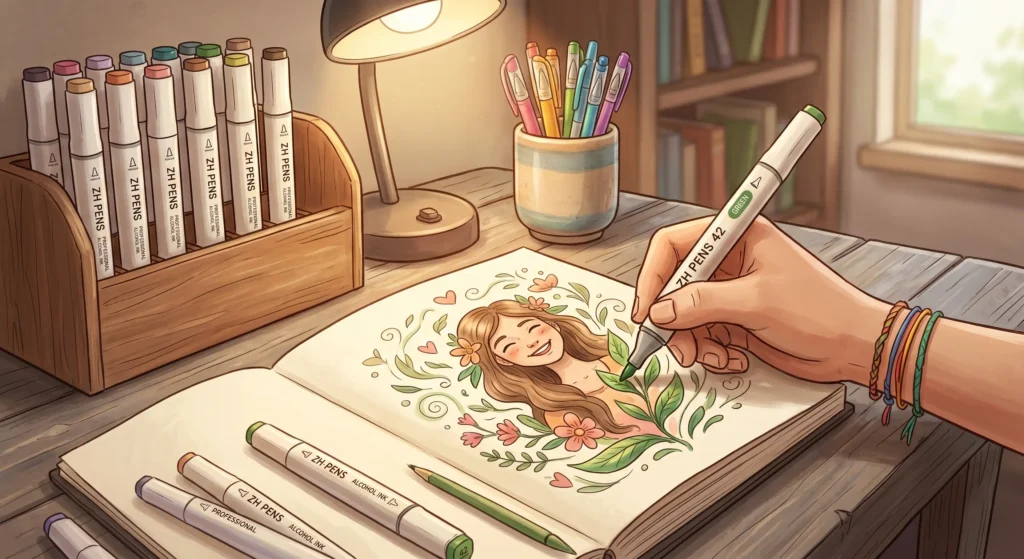
Hacer tus propias ilustraciones de sanación con marcadores profesionales también puede ser una forma fuerte de autocuidado.
Conclusión
Las ilustraciones curativas en la arteterapia interdisciplinaria muestran una promesa real. Construyen un espacio seguro. Provocan eco emocional. Usan metáforas para remodelar pensamientos difíciles. Estos tres movimientos funcionan juntos como un sistema de sanación.
A medida que la investigación crece, la arteterapia para aliviar el estrés se volverá aún más exacta y útil. Ayudará a más personas a salir de la oscuridad y entrar en una vida tranquila y positiva.
Guía relacionada: Para otra perspectiva sobre la capacidad de la fábrica y el control de procesos, consulte Una Primavera Triunfante: ZH STATIONERY Brilla en la 139ª Feria de Cantón 2026.
Lecturas relacionadas
- La guía definitiva de materiales artísticos para niños: Mejorando la percepción artística a través del juego interactivo
- 15 IDEAS DE COLOREO VERANIEGO CON BOLÍGRAFOS DE GEL
- Arte de Marcadores en TikTok: 5 Tendencias Virales que Puedes Crear con Solo 3 Rotuladores
- guía de seguridad del marcador infantil OEM
- Guía de tinta de marcadores de grado alimenticio
- Guía de pruebas de formaldehído en artículos de papelería
- Guía de bolígrafos y marcadores mini de papelería de bolsillo
Why Repetitive Mark-Making Calms the Nervous System
Coloring is a constrained task. The page sets the boundary, the color sets the variable, and nothing outside that frame needs attention for the next ten minutes. That constraint is the mechanism. When attention narrows to something concrete and low-stakes, the mind stops rehearsing the open loops that keep stress responses running.
The rhythm matters as much as the content. Filling an area with short, even strokes settles breathing into a slower pattern. Many people notice it around the third or fourth minute without being told to look for it. Long, continuous strokes have a different effect — more energizing, less settling — which is why fine liners and chisel tips produce different experiences even when the color is identical.
The third factor is low consequence. Nothing in a coloring page can be done wrong in a way that matters. That is rare in adult life, and the absence of consequence is itself restful.
Choosing Materials That Support the Process
Material choice changes the experience more than most beginners expect. Four variables are worth thinking about before buying a set.
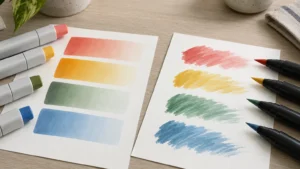
Tip type. Fine tips suit detail and small areas, which supports focused attention. Chisel tips cover large areas quickly, which suits a more rhythmic, less deliberate session. Brush tips sit between the two and are the most forgiving for people who have not drawn since school.
Ink system. Water-based markers are low-odor, easy to clean, and safe around children. Alcohol markers blend smoothly but carry a solvent smell that some people find distracting in a quiet room. Acrylic markers are opaque and work on dark paper, which opens up a different visual vocabulary.
Paper weight. Thin paper bleeds through and creates a second problem to manage. A 100 to 160 gsm stock absorbs enough ink to keep edges clean and lets the session stay about the session.
Color range. A 12-color set is enough to start. Larger sets introduce choice, and choice can become its own small stressor. Many people do better with a limited palette for the first few weeks.
Three Exercises You Can Start Today
Color field. Pick three colors that do not obviously belong together. Fill three horizontal bands across the page, letting the edges bleed slightly. Add simple line work over the top — a horizon, a few marks. The exercise takes about fifteen minutes and produces something that reads as intentional even when it was not planned.
One-color study. Use a single marker for the whole page. Work only with line weight and density. Filling space with more lines makes an area read darker; fewer lines make it lighter. The constraint removes color decisions and leaves only rhythm, which is often the more settling part.
Repeat pattern. Draw the same small shape across a grid. The repetition is the point. It occupies the part of attention that would otherwise drift, and the result is visually coherent regardless of drawing skill.
What Art Therapy Is Not
Art therapy as a clinical practice is delivered by a trained therapist within a treatment relationship. Coloring at home is not that, and it is worth being clear about the difference.
What a coloring session can do is provide a structured, low-demand activity that many people find settling. What it cannot do is diagnose, treat, or substitute for professional care. If stress is persistent, disruptive, or tied to a specific condition, a coloring page is not the intervention.
The honest framing is this: coloring is a accessible practice that supports attention and rhythm. It is not a cure, and presenting it as one does a disservice to the people who need actual clinical support.
Preguntas Frecuentes
How long should a session last? Ten to twenty minutes is enough for most people to notice a shift. Longer sessions are fine but the effect tends to plateau.
Do I need to be good at drawing? No. The exercises above are designed so that the result reads as intentional regardless of skill.
Are alcohol markers suitable for a quiet room? They carry a solvent odor. Water-based markers are usually a better fit for shared or small spaces.
What paper should I use? 100 to 160 gsm, single-sided if possible, to avoid bleed-through becoming a distraction.
Common Mistakes That Undo the Benefit
Three habits reliably cancel the settling effect of a coloring session.
Choosing the subject before sitting down. Deciding what to draw turns the session into a performance task. The exercises above work because the page has already decided for you. Pick the page in advance and let the session be only about color.
Working on a screen. Digital coloring removes the tactile feedback that does most of the work. The resistance of paper against a tip is part of why the activity settles attention; a stylus on glass does not produce the same effect for most people.
Checking the result against someone else’s. Comparison reopens the evaluation loop the activity was meant to close. The session works when the output is not being judged, including by you.
The practical version: pick the page the night before, use paper, and put the finished sheet somewhere without looking at it again that day.
Setting Up a Repeatable Ritual
The benefit comes from repetition more than duration. A fifteen-minute session four times a week does more than a single two-hour session, because the settling effect depends on the activity becoming familiar enough that it stops requiring decisions.
Three things make repetition easier. Keep the materials accessible rather than packed away. Use the same paper size each time so the scale of the task is predictable. And end the session at a natural stopping point rather than when time runs out, so the next session starts without a leftover task.
Most people who try coloring and abandon it do so because the setup cost exceeded the session length. Reducing friction matters more than extending the session.
Keep the paper and markers where you can see them. Visible materials get used; stored materials do not.