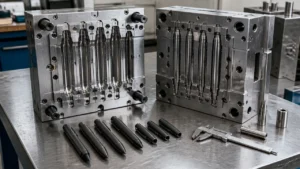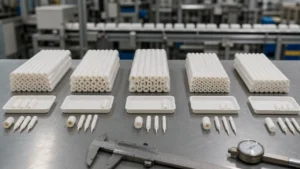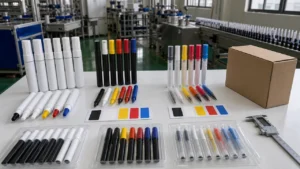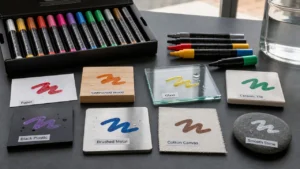
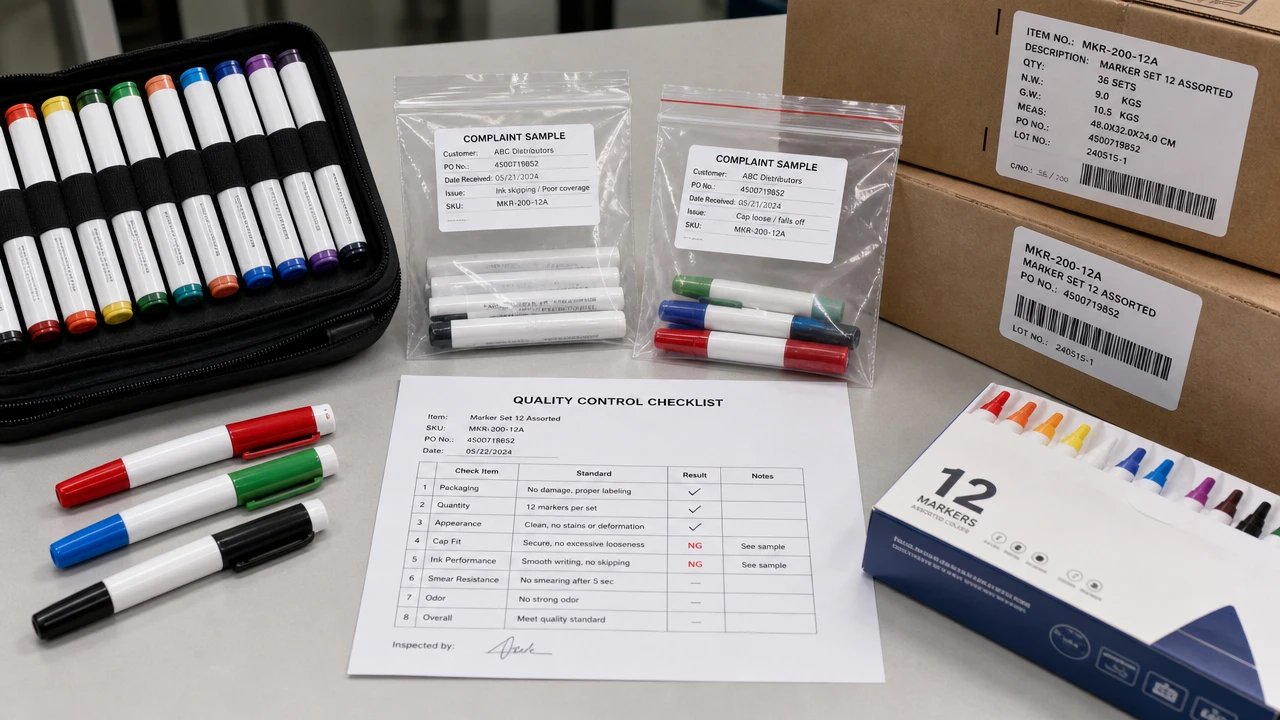
Marker dry-out complaints hurt a distributor because they usually show after the product has moved through the warehouse, channel, and shelf. In this anonymized case, ZH Stationery reviewed dry-out complaints for a distributor. We changed the control flow around cap seal, nib fit, storage risk, and reorder feedback.
This article does not name the buyer or print private complaint numbers. It shows the fix flow. Buyers can use the same method when sourcing markers, comparing a China manufacturer, or preparing an RFQ for private-label sets.
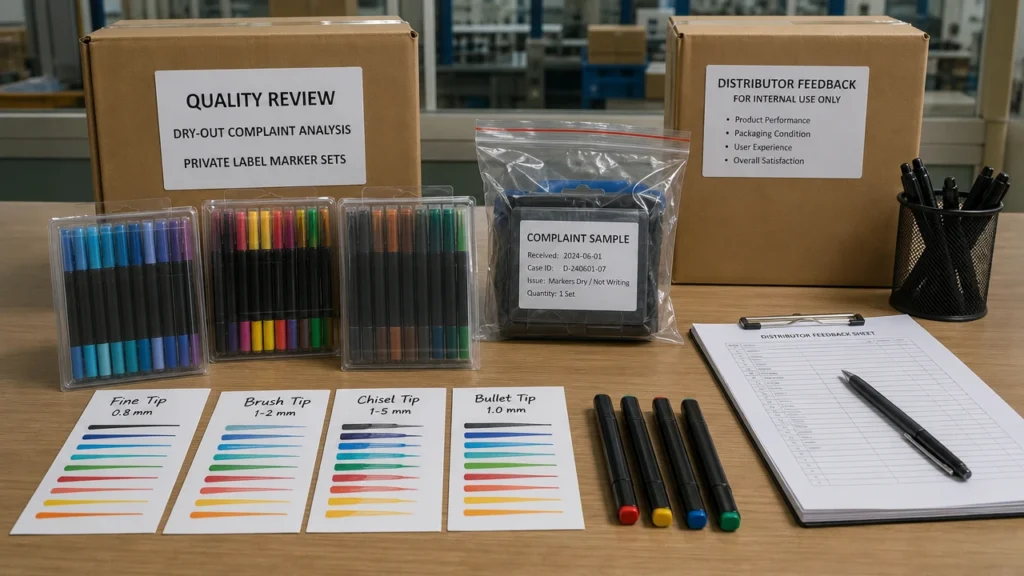
Respuesta rápida
We cut repeat dry-out complaints by treating the issue as a finished-product system problem. It was not only an ink problem. The fix plan checked cap seal, nib fit, ink flow, packing pressure, carton handling, storage exposure, and complaint tracking. The biggest change was simple. Every reorder had to tie the buyer complaint, kept sample, production batch, and pre-shipment writing test together.
Enlaces rápidos
- Respuesta rápida
- Antecedentes del Caso
- Primer Diagnóstico de Quejas por Secado de Marcadores
- Causas Raíz que Verificamos
- Cambios en la Fábrica
- Cambios del Lado del Distribuidor
- Lista de Verificación de Control de Calidad
- Resultados y Limitaciones
- Haga mejores preguntas al proveedor
- Preguntas frecuentes
Antecedentes del Caso
The distributor sold sets through a mixed channel. Retail stores. School-supply resellers. Online sellers. The complaint pattern was not dramatic at first. A few customers said some markers felt weak. Then several accounts reported markers that wrote for a short time and stopped. The product still sold in many spots. The distributor needed a cleaner answer before the next reorder.
The first mistake would have been blaming ink right away. Ink matters. Dry-out complaints can come from the cap, nib, barrel, storage time, carton pressure, hot warehouse conditions, or a slow retail shelf. We treated the case as a chain of small risks.
The distributor also needed compliance and marking files for retail review. For US art products, the CPSC sobre materiales de arte explains ASTM D-4236 marking hopes. The official ASTM D4236 page covers chronic health hazard marking. Those documents matter. They do not prove shelf performance. We kept compliance review apart from dry-out fixes.
Primer Diagnóstico de Quejas por Secado de Marcadores
We asked the distributor to send three groups of info. Complaint samples. Unopened kept sets from the same order, if any. The carton or barcode data tied to the complaint lots. That gave the factory team something better than screenshots and customer remarks.
| Evidencia Solicitada | Por Qué Era Necesaria | Qué Nos Ayudó a Decidir |
|---|---|---|
| Muestras de quejas | Mostraron si la tapa, la punta o la tinta tenían problemas visibles | Si el defecto era aislado o repetido |
| Juegos retenidos sin abrir | Separaron la condición de fábrica del manejo minorista | Si el problema existía antes del estante minorista |
| Etiqueta de lote o caja | Conectó las muestras de quejas con un lote de producción | Qué registros de lote revisar |
| Notas de almacenamiento | Mostraron exposición a calor, humedad y tiempo en estante | Si el envío o las condiciones del almacén pudieron haber contribuido |
| Colores afectados | Mostraron si el problema era específico de un color | Si verificar una tinta, una punta o toda la estructura del producto |
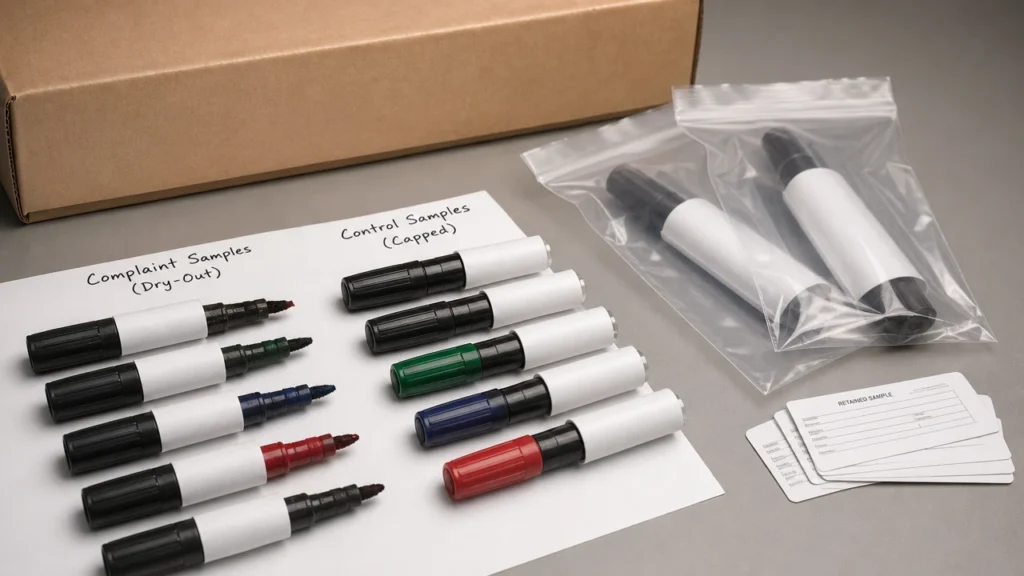
Causas Raíz que Verificamos
Dry-out complaints rarely have one clean cause. In this case, the useful question was not which part failed. It was which part of the system let a weak marker reach the buyer.
Sellado de la Tapa y Ajuste del Cuerpo
A cap can look right and still seal poorly. We checked whether the cap clicked firm. We checked whether the inner cap touched the nib area right. We checked whether cap looseness grew after carton pressure or handling. Small cap-fit changes matter. Water-based and acrylic systems can lose usable flow when the nib area stays open too long.
Ajuste de la Punta y Flujo de Tinta
A nib that fits too loose may write uneven. A nib that fits too tight may not pull ink at the expected speed. That is why we tied the dry-out review to finished-marker writing tests. We did not check the ink alone. For acrylic projects, the valve press marker technology page is useful background. Valve control changes how ink reaches the tip.
Presión del Empaque y Condiciones de Tránsito
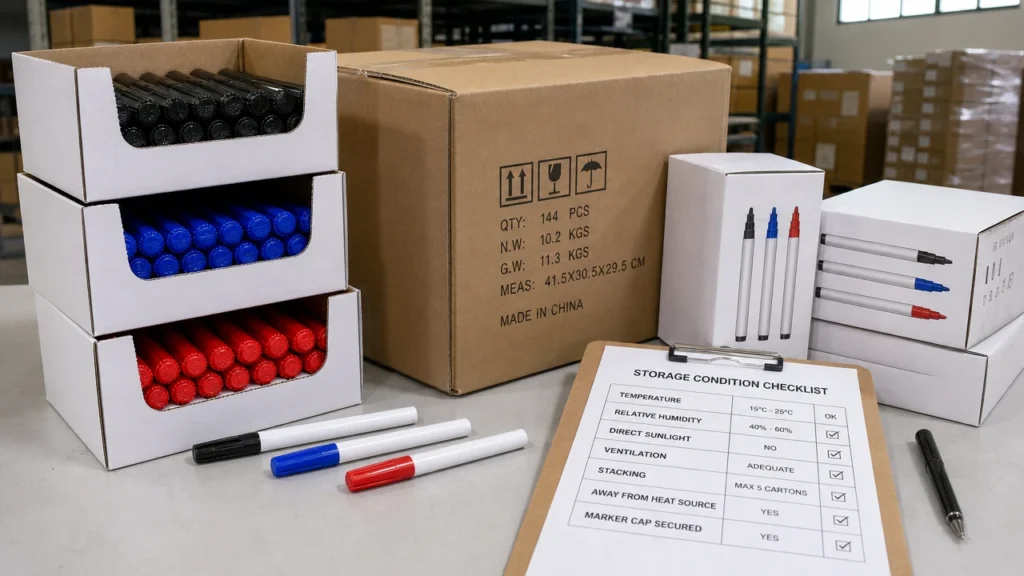
Packing can push caps, bend trays, or expose sets to heat and dryness in storage. The official ASTM D4332 page covers conditioning containers, packages, or packing parts to mimic field states in tests. For normal sourcing, buyers do not need a full lab program for every order. They should know that packing and environment shape complaints.
Cambios en la Fábrica
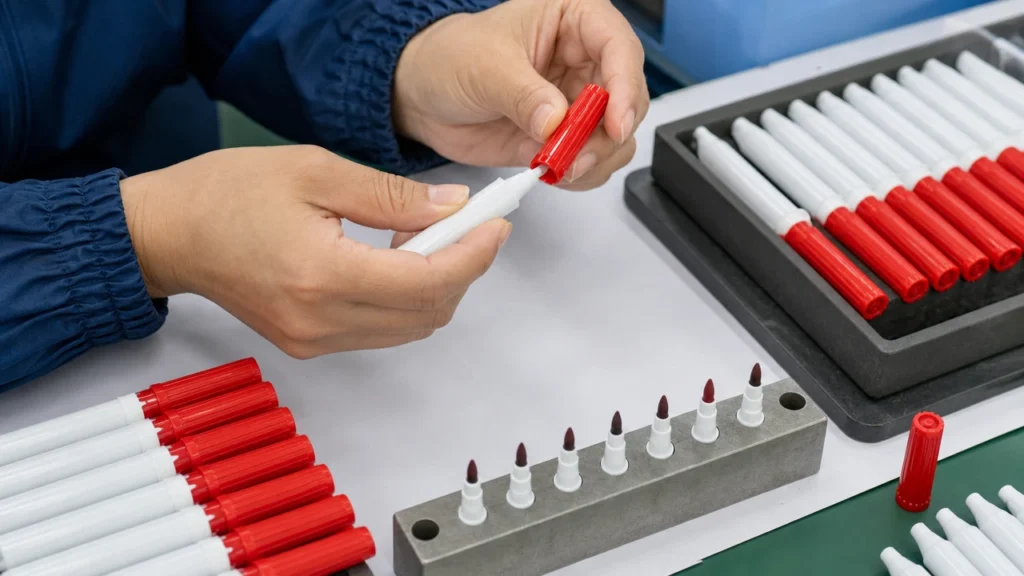
The fix focused on checks that could repeat on future orders. We did not want a one-time rescue. We wanted a flow the production team and the distributor could use again.
| Cambio | Qué Agregamos | Beneficio para el Comprador |
|---|---|---|
| Muestreo de ajuste de tapa | Verificaciones más frecuentes de la sensación de clic de la tapa, la firmeza y el ajuste posterior al manejo | Redujo la probabilidad de que unidades con sellado débil llegaran a las cajas |
| Verificación de flujo de punta | Pruebas de escritura de marcadores terminados después del ensamblaje y un breve período de reposo | Detectó marcadores que se veían bien pero escribían débilmente |
| Muestras retenidas | Juegos de muestras sellados vinculados al lote de producción y las etiquetas de caja | Hizo más rápida la trazabilidad de quejas futuras |
| Revisión del empaque | Verificó la presión de la bandeja, el contacto de la tapa, el apilado de cajas y el movimiento del empaque interno | Reducción del estrés evitable durante el transporte y el almacenamiento |
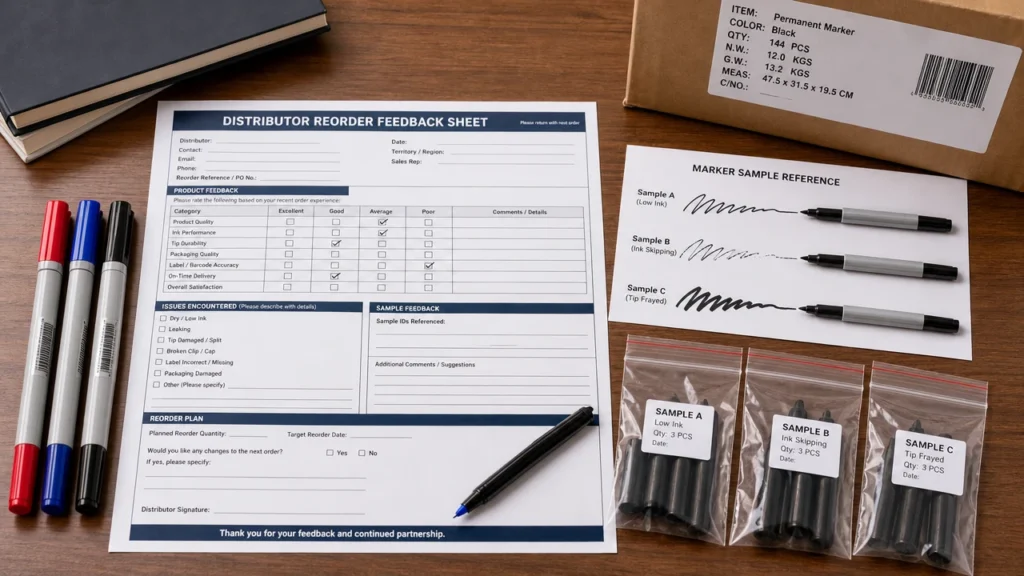
| Hoja de comentarios de quejas | Notas estandarizadas del distribuidor sobre lote, color, canal y tiempo en estantería | Conversión de quejas vagas en datos utilizables |
We also reviewed whether the product group, cap design, and packing format matched the distributor channel. Buyers planning retail sets can tie this step to the acrylic marker packing formats guide y la guía de tamaño de cartón y CBM.
Cambios del Lado del Distribuidor
The distributor also changed its own handling. That part matters. If the supplier fixes factory checks but the buyer stores cartons near heat, opens inner boxes early, or mixes lots without marks, the problem can return.
- Conservar un set de muestra sin abrir de cada envío y etiquetarlo con la orden de compra y la fecha de recepción.
- Almacenar las cajas de marcadores lejos del calor, la luz solar directa y las zonas de almacén muy secas.
- Solicitar a las cuentas de ventas que registren el SKU afectado, color, lote, tiempo en estantería y fotos antes de reponer existencias.
- Separar las quejas por secado de las quejas por color de tinta, fugas y reclamos por empaque dañado.
- Enviar muestras de quejas de vuelta en bolsas selladas para que la fábrica pueda inspeccionar tapas y puntas sin mayor exposición.
A steady reorder file also helped. The distributor tied complaint notes to the next PO. The new run could then be checked against real field feedback. That is close to the color-consistency reorder flow. Dry-out control just focuses on cap seal, nib flow, and storage instead of color match.

Lista de Verificación de Control de Calidad
For future orders, we turned the case into a simple QC checklist. The checklist is not a promise. It catches common fail points before the product reaches the distributor.
| Punto de control de calidad | Verificación en fábrica | Verificación del distribuidor |
|---|---|---|
| Sellado de la tapa | Verificar el ajuste de la tapa después del ensamblaje y después del manejo de muestras | Inspeccionar sets aleatorios después de recibir las cajas |
| Estado de la punta | Verificar la posición de la punta, la humedad y la intensidad de escritura | Probar muestras retenidas antes de liberar un reorden |
| Flujo de tinta | Realizar trazos de muestra después de un breve período de reposo | Separar los informes de flujo débil de los informes de secado total |
| Presión del empaque | Revisar el ajuste de la bandeja, el contacto de la tapa y el apilado de cajas | Verificar si las cajas llegaron aplastadas o expuestas al calor |
| Trazabilidad del lote | Etiquetar muestras retenidas y referencias de cajas | Registrar lote, SKU, canal y fecha de la queja |
| Archivos de cumplimiento | Mantener los documentos de etiquetado y pruebas relevantes listos | No confundir los archivos de cumplimiento con la prueba de rendimiento en estantería |
For wider check and compliance context, buyers can review the ASTM D-4236 report guide, los Guía de abastecimiento de marcadores de acuarela, y ZH Stationery's certifications page.
Resultados y Limitaciones
After the fix flow ran, the distributor had a cleaner complaint process and fewer repeat dry-out talks on the next order. The useful result was not a marketing number. It was control. The buyer and factory could name the affected SKU. They could compare kept samples. They could check cap and nib state. They could decide whether the issue came from production, packing, storage, or retail handling.
There are limits. No supplier can remove every dry-out risk after months of storage and mixed retail handling. Heat, wetness, shelf time, user behavior, and packing damage all matter. ISO 554 is a useful note that test conditions should be controlled when results are compared. For B2B sourcing, the practical lesson is simpler. Keep the test state steady before judging whether a batch changed.
That is why ZH Stationery treats dry-out complaints as a factory-and-channel problem. Factory checks matter. The distributor's receiving check, storage, and feedback care decide how fast the issue can be traced. Buyers who want to know factory ability can review the recorrido por la fábrica y quiénes somos .
Haga mejores preguntas al proveedor
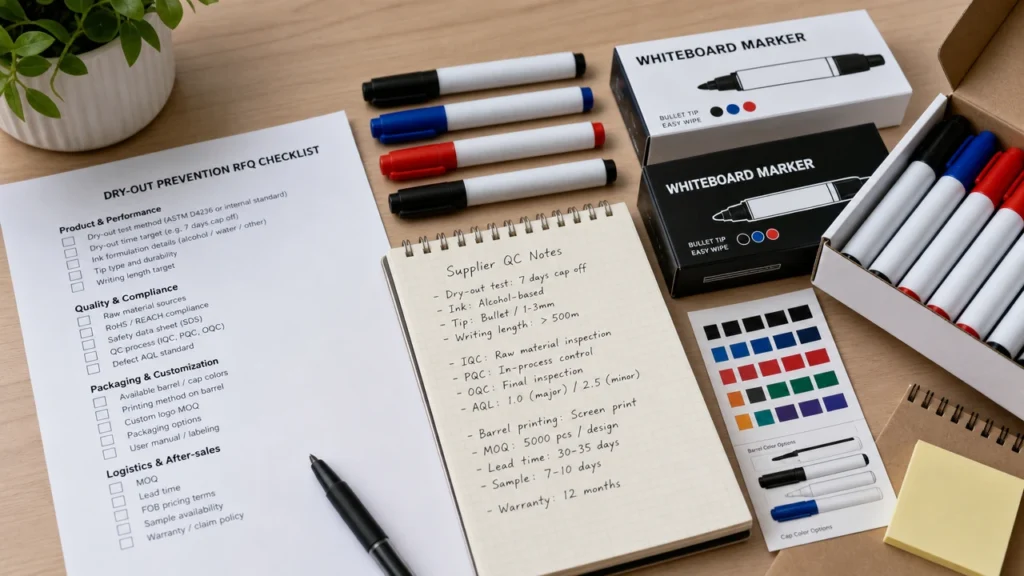
When dry-out risk matters, ask questions that force a supplier to describe the control method. Do not accept only a product pitch.
| Pregunta | Una respuesta útil debe incluir |
|---|---|
| ¿Cómo verifican el sellado de la tapa antes del envío? | Método de muestreo, momento de inspección y qué se considera una tapa débil |
| ¿Prueban marcadores terminados o solo muestras de tinta? | Prueba de escritura de marcadores terminados, tiempo de reposo y reglas de colores afectados |
| ¿Cómo se etiquetan las muestras retenidas? | Número de orden de compra, SKU, fecha de lote, referencia de caja o lote y método de almacenamiento |
| ¿Qué verificaciones de presión del empaque se utilizan? | Ajuste de bandeja, contacto de tapa, apilado de cajas y revisión de protección de envío |
| ¿Cómo deben reportarse las quejas por secado? | Fotos, colores afectados, número de lote, tiempo en estantería, notas de almacenamiento y proceso de devolución de muestras |
| ¿Qué cambios requieren reaprobación? | Tapa, punta, cuerpo, fórmula de tinta, bandeja de empaque, tarjeta de retail o estructura de caja |
Preguntas frecuentes
These FAQs cover the buyer questions that usually appear after a distributor gets dry-out complaints.
What usually causes dry-out complaints from distributors?
Weak cap seal, poor nib fit, ink loss in storage, damaged packing, long heat or dry-air time, and uneven retail handling. The supplier should check the finished marker, not only the ink mix.
Can a factory promise markers never dry out?
No good supplier should. Dry-out risk depends on design, ink system, cap fit, storage, shipping route, shelf time, and user behavior. A factory can cut preventable risks with cap-fit control, writing tests, kept samples, packing checks, and clear storage instructions.
Should distributors test samples before every reorder?
For repeat programs, yes. A short reorder check can confirm cap fit, nib flow, stroke strength, and packing state before mass production. If the product changed, treat it as a controlled update, not a simple reorder.
What should buyers ask after a dry-out case appears?
Ask for the lot number, production date, carton mark, photos of cap and nib, storage state, shelf time, and whether the issue hits one color, one SKU, or the whole shipment. Without this, the factory cannot trace the likely cause.
Does ASTM D-4236 fix dry-out problems?
No. ASTM D-4236 covers chronic health hazard marking for art products. It is not about cap seal or shelf performance. It matters for compliance. Dry-out control needs design, packing, storage, and QC checks.
¿Cuál es la mejor redacción de RFQ para prevenir el secado de los bolígrafos?
Use specific language. Require cap-fit checks, nib-flow sampling, kept samples, carton guard, storage instructions, and a fix flow for complaints. Avoid vague lines like premium quality or long shelf life unless the supplier defines how they are tested.
Conclusión
Dry-out complaints are easier to cut when buyer and factory stop treating them as isolated customer remarks. The better flow is practical. Collect samples and trace the batch. Check cap and nib fit, review packing pressure, and control storage guesses. Build the next reorder around what was learned.
If you are sourcing private-label markers for a distributor channel, send ZH Stationery the marker type, cap design, packing format, destination market, expected shelf time, and any past complaint notes. The team can turn those notes into a sampling and QC checklist before the next order.
Guía relacionada: Cómo mantener la consistencia del color de los rotuladores entre pedidos repetidos.
Guía relacionada: Cómo manejar quejas de clientes sobre rotuladores secos o diferencias de color.