
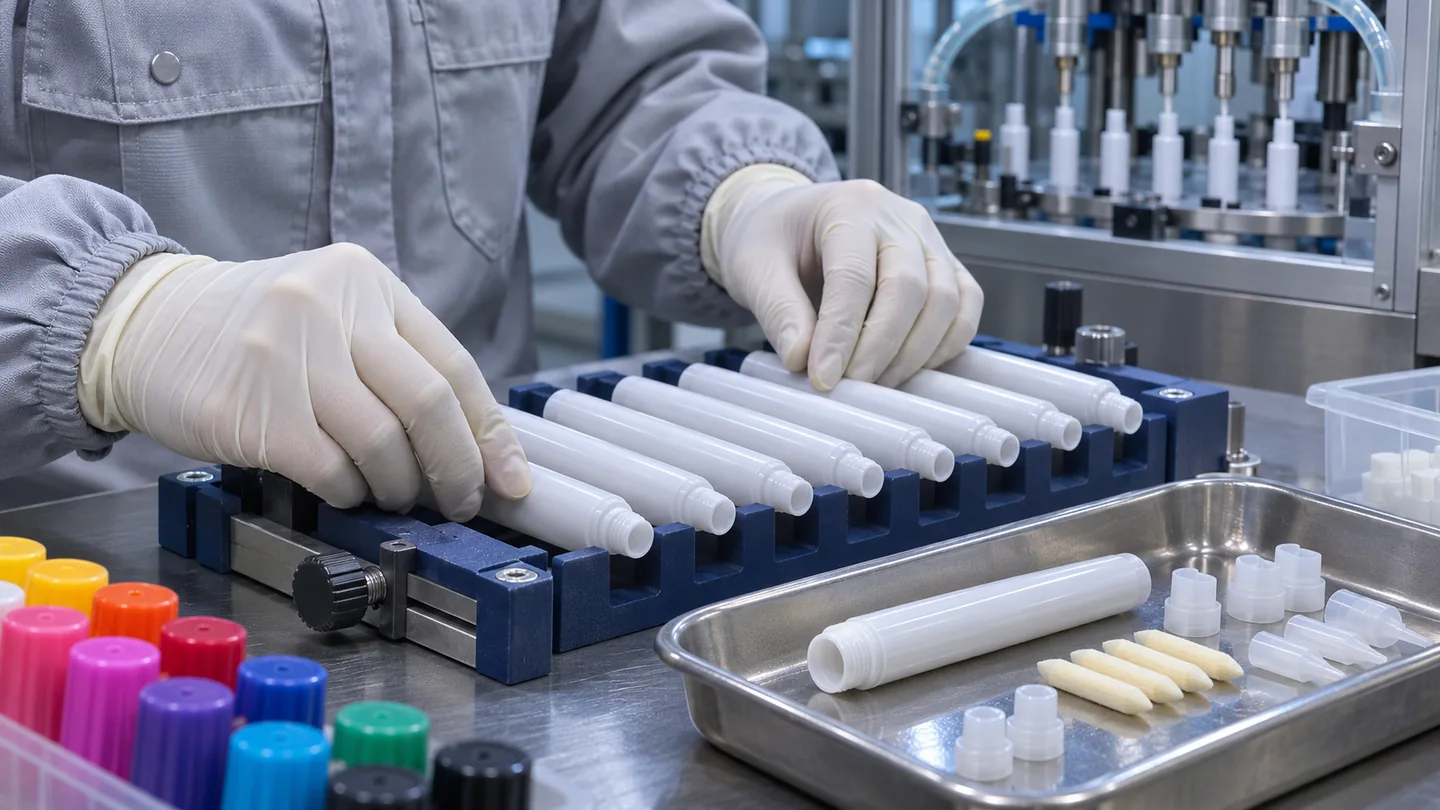
You have shortlisted three Chinese suppliers for your private-label acrylic paint marker line. Every sales rep promises factory-direct pricing, low MOQs, and compliant ink—and all three send decent hand-assembled samples. The real risk appears on your third or fifth reorder: batch color drift, dried-out brush tips in Amazon FBA cartons, or an invalid test report that freezes your listing.
This 2026 OEM/ODM buyer checklist gives brand owners and procurement managers a verifiable, five-stage qualification framework to vet a custom acrylic marker manufacturer—covering ink-delivery architectures (valve-action, cotton-core, and 2026 direct-liquid systems), concrete factory QC thresholds (ΔE ≤ 1.5–2.0, vacuum leak limits, and nib write-out meters), unified 50,000-pen MOQ math, US/EU/UK export compliance (ASTM D-4236, CPSIA/CPC, EN 71-3, CE/UKCA, and REACH), and five red flags that expose trading companies.
Quick Answer: 5-Stage Factory Filter
- Verify ink-delivery capability first: Do not confuse nib material with ink delivery. Confirm whether the plant engineers valve-action (pump), cotton-core (capillary), or direct-liquid (ink-regulator) acrylic systems in-house rather than buying generic pre-filled barrels.
- Demand numeric QC thresholds in your PO: Require spectrophotometer batch color tolerance (ΔE ≤ 1.5–2.0), cap-seal vacuum testing (-0.02 to -0.04 MPa), 45–50 °C aging stability, and nib write-out length benchmarks—never accept generic wall certificates.
- Audit MOQ math against real production lines: True OEM/ODM factory runs start at 50,000 total pens per order (e.g., 4,176 sets of 12 colors or 2,088 sets of 24 colors). Per-color ink minimums (3,000–5,000 pens) and packaging sub-minimums apply inside that 50,000-pen program—not as standalone 500-set custom orders.
- Lock 2026 US, EU, and UK compliance files upfront: Require ISO/IEC 17025 lab PDFs dated within 12 months covering ASTM D-4236 + CPSIA/CPC (US children/student sets), EN 71-3 + CE/UKCA + REACH (EU/UK), and 16-section SDS tied to your actual ink formula.
Stage 1: Ink Systems & 2026 Shifts
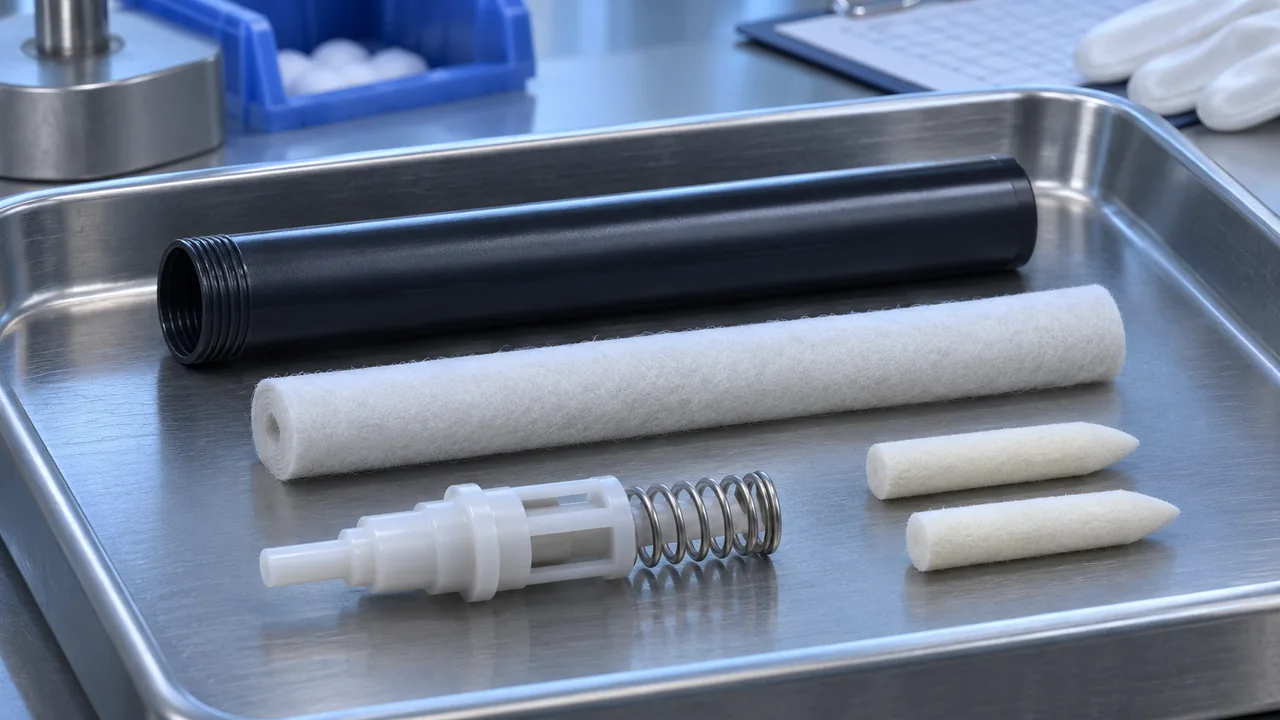
A common sourcing mistake is treating valve-press and fiber-tip as opposite categories. In pen engineering, both valve-action and cotton-core acrylic markers use porous fiber or nylon nibs—the true dividing line is ink-delivery architecture. In 2026, B2B buyers must evaluate all three commercial architectures, including the fast-growing direct-liquid (free-ink) segment:
| Ink-Delivery System | Compatible Nibs | Shelf Life | FOB / Pen Delta | Best 2026 Channel Fit |
|---|---|---|---|---|
| Cotton-Core Capillary / Wicking | Polyester/acrylic bullet, chisel, or nylon brush | 18–24 months (horizontal) | 1.0× Baseline ($0.08–$0.11 single) | Entry/mid retail, school kits, mainstream dual-tip sets |
| Valve-Action Spring Pump | Acrylic/polyester bullet, extra-fine, or chisel | Higher (24+ months) (sealed valve) | +25% to +40% ($0.11–$0.16 single) | Rock, wood, glass & dark-surface heavy-opacity lines |
| Direct-Liquid Free-Ink Regulator | Calibrated nylon brush or precision bullet | 24+ months (airtight cap) | +50% to +80% ($0.15–$0.26+) | 2026 flagship Amazon/DTC lines & dual-chamber sets |
Nib cost delta buyers should budget: Upgrading from a standard Japanese/Taiwanese acrylic or polyester bullet nib to a resilient nylon soft brush nib typically adds $0.015–$0.035 per pen in BOM cost, while requiring tighter reservoir capillary calibration to prevent tip fraying or flooding. Compare tip pairings and freight CBM impact in our dual-tip vs. single-tip acrylic marker guide and valve-action vs. capillary engineering breakdown.
What actually changed for 2026 OEM sourcing:
- Direct-liquid (ink-regulator) demand surge: Free-ink acrylic markers with finned air-pressure regulators eliminate cotton-core ink loss and deliver full saturation to the last drop—making regulator assembly and barometric leak testing a core factory capability check in 2026.
- Stricter 2026 EU & US compliance enforcement: With the EU advancing its Toy Safety Regulation (TSR) framework (stricter PFAS/SVHC substance controls and Digital Product Passport readiness) and Amazon US enforcing automated 12-month ISO 17025 lab report checks for children’s art kits, generic undated factory certificates no longer pass intake.
- Landed-cost cube & PCR resin pressure: Higher ocean/FBA storage tiers and European retailer sustainability mandates have pushed buyers to audit per-1,000-set carton CBM (0.90 CBM slim single-tip vs. 2.55 CBM jumbo dual-tip) and request 30%–50% PCR recycled PP barrels where applicable.
Stage 2: Hard Factory QC Thresholds
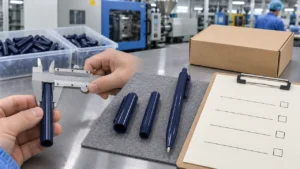
Any trading company can list words like spectrophotometer, viscosity, and airtightness in a brochure. A real custom acrylic marker manufacturer documents pass/fail numerical thresholds on every production lot and lets you write them into your purchase order:
| QC Parameter | Test Method & Instrument | Target Factory Acceptance Limit | Risk Prevented |
|---|---|---|---|
| Batch Color Delta E | Spectrophotometer (D65 light) vs. approved master drawdown | ΔE ≤ 1.5 (core brand colors) ΔE ≤ 2.0 (full 24–60 shade sets) | Visible shade drift across reorders |
| Ink Viscosity & Stability | Rotational viscometer at 25 °C + 45–50 °C oven aging (72 h–14 d) | 8–18 mPa·s (valve-action) 3–8 mPa·s (cotton-core); zero caking | Pigment settling, pale strokes, clogged valves |
| Cap Airtightness | Negative-pressure vacuum chamber + 45 °C 7-day weight loss | -0.02 to -0.04 MPa (3–5 min) zero leak; < 1.0% ink evaporation weight loss | Dry nibs on arrival & air-freight blowouts |
| Nib Abrasion & Write-Out | 45° constant-load writing machine on 80 gsm standard paper | ≥ 180–250 m (1.0–3.0 mm fiber bullet) ≥ 120–180 m (nylon soft brush, no fray) | Premature nib mushrooming or dry-out |
| Pre-Shipment AQL | ISO 2859-1 (ANSI/ASQ Z1.4) General Inspection Level II | Critical: 0 | Major: 1.5–2.5 Minor: 4.0 (dual-end write-out check) | Defective cartons reaching Amazon FBA |
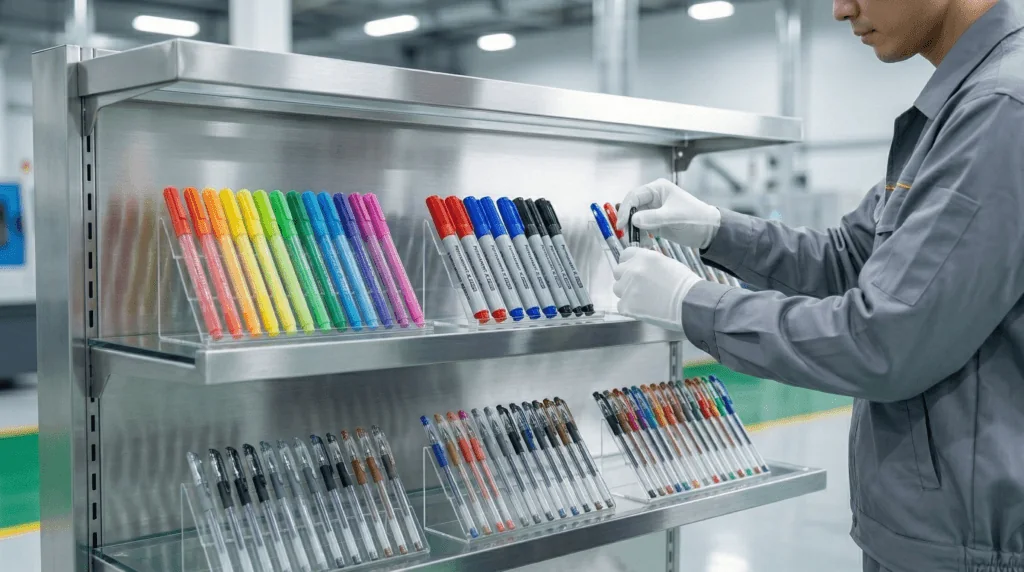
For deeper color-control protocols across repeat shipments, review our reorder color consistency guide and pre-order sample testing and defect-to-QC guide.
Stage 3: OEM Matrix & MOQ Math
One of the fastest ways buyers get burned is misreading sub-component minimums as standalone factory MOQs. At an industrial pen plant, custom OEM/ODM production requires a unified minimum of 50,000 total pens per order (counted across all individual pens produced—for example, 4,176 sets of 12 colors, 2,088 sets of 24 colors, or 1,060 sets of 48 colors). Every line item in the customization matrix below operates inside that 50,000-pen production commitment—never as a standalone 500-set custom manufacturing run:
| Customization Tier | Sub-Minimum (Inside 50,000-Pen Order) | Setup / Tooling Cost | Lead-Time Impact |
|---|---|---|---|
| Barrel Logo Print Silk screen / heat-transfer / UV | ≥ 2,000–5,000 pens per barrel artwork (within 50,000-pen total PO) | $50–$150 plate/screen; +$0.005–$0.02 / pen | Included in standard 25–35 day mass run |
| Custom Pantone Barrel Injection-molded PP color | ≥ 5,000 pens per barrel color (covers hopper purge & color masterbatch) | Usually built into OEM unit FOB | +3–5 days for color plaque approval |
| Custom Pantone Ink Lab-formulated pigment shade | ≥ 3,000–5,000 pens per custom shade (minimum stable mixing-tank batch) | Lab matching included or credited on PO | +10–15 days for lab aging & drawdowns |
| Custom Retail Packaging Color box / PP case / pouch | Matches 50,000-pen set count (e.g., 2,088×24); ≥ 1,000–2,000 boxes per print version | $100–$300 box die-cut; PP/tin molds quoted | Parallel with pen run once artwork locks |
| Private Barrel / Cap Mold Exclusive ODM steel tooling | 50,000+ pens per custom mold (amortizes steel tooling cost) | $3,000–$15,000+ (buyer owns mold) | +20–30 days for CAD, CNC steel & T1 trials |
Reality check on MOQ quotes: If a supplier promises full custom Pantone ink, custom-printed barrels, and custom color boxes for just 500 sets of 12 colors (6,000 pens total) at normal factory pricing, they are almost certainly relabeling generic wholesale stock or outsourcing to an unmonitored workshop. Standard stock models can be ordered in small trial quantities for technical evaluation, but real factory-controlled OEM production follows the 50,000-pen threshold. For detailed tooling checks and packaging/freight math, see our pen mold tooling guide, B2B acrylic marker packaging guide, and carton size & CBM guide.
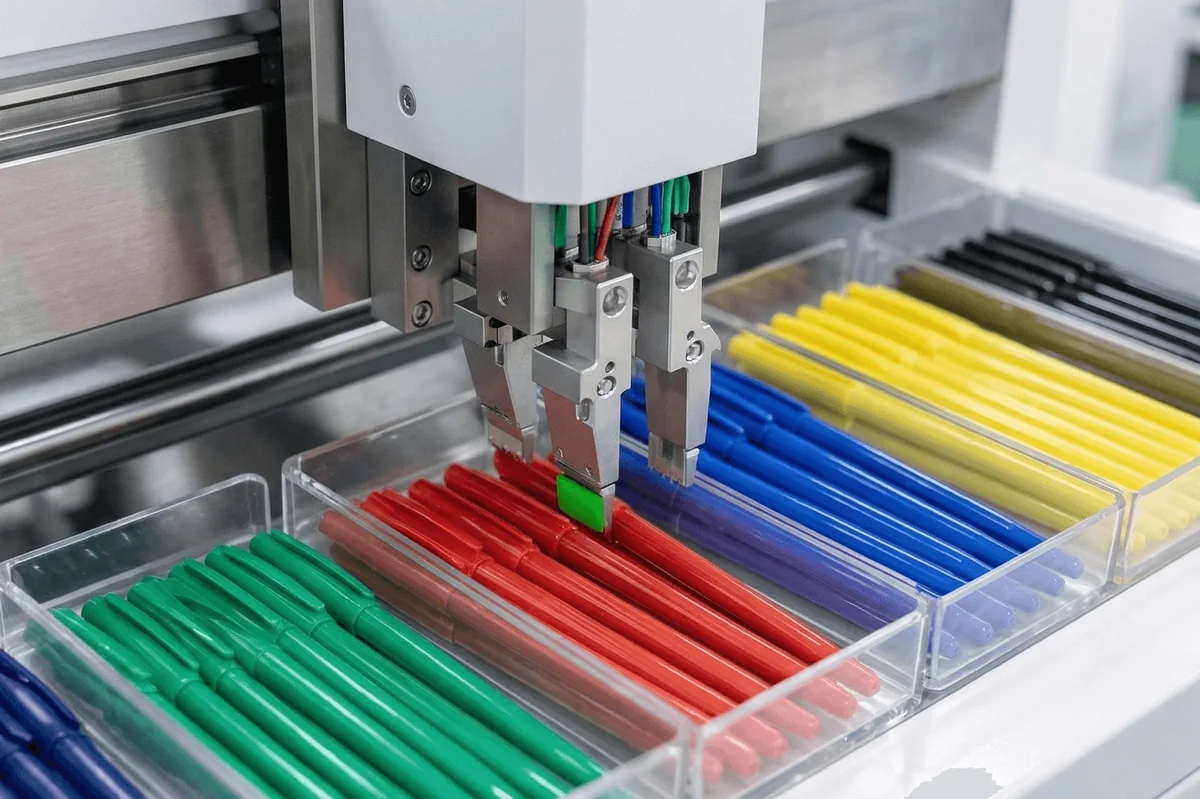
Stage 4: 2026 US, EU & UK Compliance
Compliance requirements depend on both destination market and target age grade (adult craft vs. children/student kits aged 12 and under). Never ship before verifying these mandatory files:
- United States (Retail & Amazon US): ASTM D-4236 chronic-toxicity evaluation (required LHAMA conformance statement printed on packaging), full 16-section SDS for ocean/air transport, and—for any set marketed to or reasonably used by children aged 12 and under—mandatory CPSIA lab testing plus a written CPC (Children’s Product Certificate). Review report anatomy in our ASTM D-4236 test report guide.
- European Union & United Kingdom: EN 71-3 heavy-metal migration testing (paired with EN 71-1 mechanical and EN 71-2 flammability for children’s art sets), REACH SVHC screening, ventilated cap anti-asphyxiation conformance (ISO 11540 where barrel/cap geometry applies), plus mandatory CE (EU) and UKCA (Great Britain) conformity markings and technical files.
- How to verify a report is real: Reject undated certificates or logos pasted onto Word docs. Require full PDF test reports issued within the past 12 months by an ISO/IEC 17025-accredited lab (SGS, Intertek, TÜV, or BV), naming the actual ink formulation/SKU—and verify the report number directly on the lab’s online portal. View our factory compliance documentation overview.
Stage 5: 5 Trading Company Red Flags
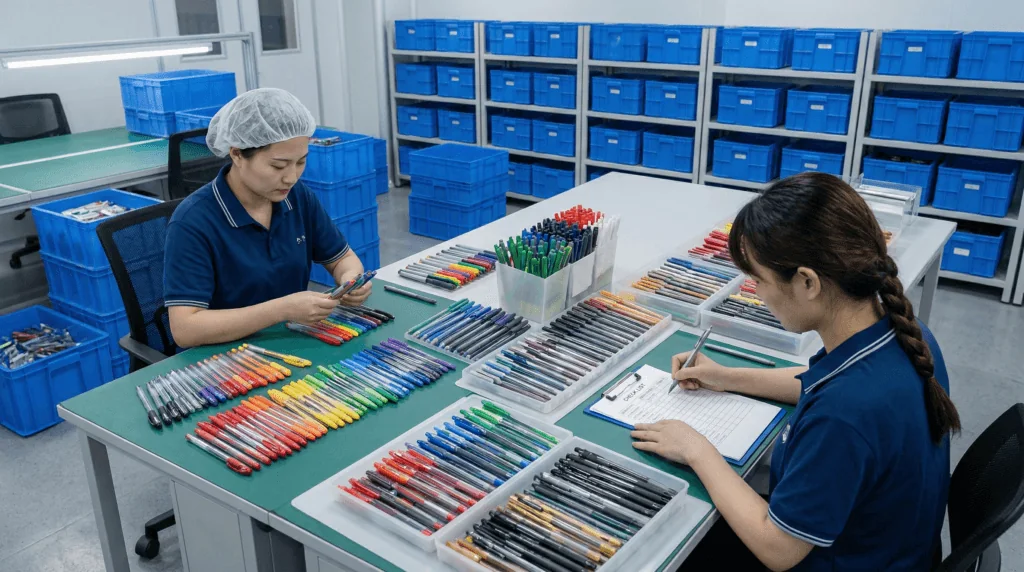
Use these five live-verification tests during your supplier video call to separate a genuine custom acrylic marker manufacturer from a middleman:
- Refusing a live walk from injection molding to ink lab: Confidentiality protects client artwork—never the existence of injection molding presses, ink mixing tanks, valve assembly lines, or QC benches. A supplier who only shows stacked cartons in a warehouse is reselling.
- Saying “yes” to any low custom MOQ without pricing logic: Real factories calculate machine purge waste, screen setup, and ink-tank minimums. Instant approval on 500-set custom OEM orders without explaining stock-model constraints signals a trader shopping spot inventory.
- Inability to name base pigments or ink viscosity: An in-house ink engineer immediately names titanium dioxide (white opacity), carbon black, quinacridone (magenta), or phthalocyanine (blue/green) and cites viscosity ranges. A middleman only knows the cap color code.
- Hand-made golden samples that drift in mass production: Always require pre-production line samples pulled from actual filling and capping machines—not hand-filled lab tubes—and benchmark them against your master ΔE drawdown.
- Hesitation on bilingual NDA and written mold ownership: A professional ODM factory signs NDAs before receiving artwork and states in writing that customer-paid steel molds remain exclusive buyer property.
FAQs
Why does the customization matrix show 3,000–5,000 pens per color if the OEM MOQ is 50,000 pens?
50,000 total pens is the minimum combined production run for a custom OEM/ODM order (for example, 4,176 sets of 12 colors or 2,088 sets of 24 colors). Within that 50,000-pen order, individual custom Pantone ink shades require at least 3,000–5,000 pens per color for mixing-tank stability, and custom barrel colors require at least 5,000 pens per color to cover injection-molding purge waste—they are sub-minimums inside the order, not standalone factory MOQs.
What is the real difference between valve-action, cotton-core, and direct-liquid acrylic markers?
All three use porous fiber or nylon nibs; the difference is the ink-delivery system. Valve-action uses a spring piston valve for maximum heavy-pigment opacity and 24+ month shelf life; cotton-core uses a fibrous capillary reservoir for ready-to-write budget and dual-tip sets; direct-liquid uses a finned air-pressure regulator for free-flowing saturation without cotton-core absorption loss.
What QC pass/fail numbers should I include in an acrylic marker purchase order?
Specify spectrophotometer color tolerance (ΔE ≤ 1.5 for core brand colors, ≤ 2.0 for full sets), cap-seal vacuum testing (-0.02 to -0.04 MPa for 3–5 minutes with under 1% 45 °C aging weight loss), nib write-out length (≥ 180–250 m for fiber bullet or ≥ 120–180 m for nylon brush), and ISO 2859-1 Level II AQL (Critical 0, Major 1.5–2.5).
Which compliance certificates are mandatory for selling acrylic markers in the US, EU, and UK in 2026?
For the US, require ASTM D-4236 conformance, a 16-section SDS, plus CPSIA testing and a CPC if marketed to children aged 12 and under. For the EU and UK, require EN 71-3 (plus EN 71-1/2 for kids sets), REACH SVHC compliance, ISO 11540 cap safety where applicable, and CE/UKCA conformity documentation—all backed by ISO 17025 lab PDFs dated within 12 months.
How long does custom OEM/ODM acrylic marker development take?
Private-label orders using existing molds (custom logo, barrel color, and retail packaging) typically take 25–35 days after artwork approval. Custom Pantone ink formulation adds 10–15 days for lab matching and aging checks, and private steel barrel or cap molds add 20–30 days for CNC tooling and T1 trial samples.
Can I verify a factory and test stock samples before committing to 50,000 pens?
Yes. Reputable source factories provide a live video walkthrough of injection molding, ink formulation lab, assembly, and QC benches, and ship small trial quantities of standard stock valve-action, cotton-core, or dual-tip acrylic markers for opacity, drop, and aging evaluation before you lock your 50,000-pen OEM production run.
Request Factory Audit & Samples
Put this five-stage checklist directly to work. Schedule a live video walkthrough of ZH Stationery’s Tonglu injection-molding workshops, in-house ink R&D lab, automated assembly lines, and AQL inspection benches—and request stock acrylic marker samples plus recent ISO 17025 compliance reports via our wholesale acrylic paint markers page or contact page.
OEM/ODM MOQ Policy: Custom OEM/ODM production starts at 50,000 total pens per order (counted by individual pens produced—for example, 4,176 sets of 12 colors, 2,088 sets of 24 colors, or 1,060 sets of 48 colors). Sub-minimums for custom ink shades or barrel colors apply within that 50,000-pen order; standard stock models are available in smaller trial quantities for technical evaluation.
Related Reading
- Dual-Tip vs Single-Tip Acrylic Markers: B2B Cost, CBM & Margin Guide
- Acrylic Marker Packaging: 5 B2B Formats That Impact Margins
- Carton Size & CBM Guide for Marker Sets (12–60 Colors)
- How to Source Acrylic Paint Markers from China: Export & FBA Workflow
- Marker Pen Factory Audit Checklist: 12 On-Site OEM Checks & Benchmarks
- Pen Mold Factory in China: 5 OEM Checks for Tooling & T1 Acceptance