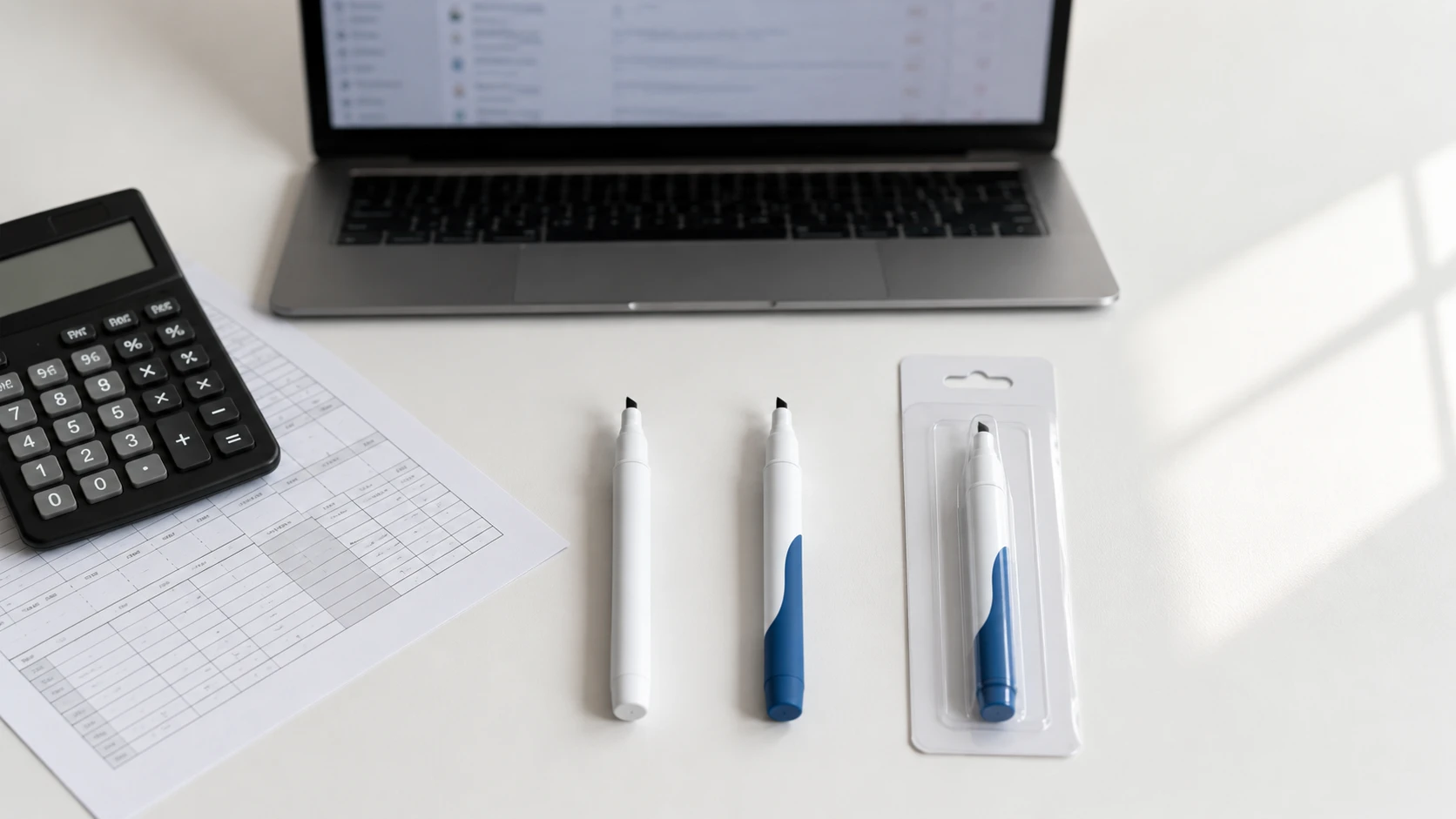
When you compare quotes for custom pens, the numbers rarely line up. One factory quotes $0.18 per pen, another quotes $0.32, and neither one explains why. The difference hides in mold charges, ink type, packaging, testing, and order volume.
This lack of clarity is not an accident. The supply chain hides cost variables that first-time buyers do not know to ask about. Budgets that look fine at the quote stage fall apart during production.
This article maps the real cost structure of custom pen manufacturing. It covers mold investment, per-unit cost drivers, MOQ math, packaging, certification costs, and the places where cutting cost creates the most risk. The goal is not to give you a price. It is to make sure you know what belongs in the quote before you accept one.
Spis treści

Szybka odpowiedź: Co decyduje o koszcie produkcji niestandardowych długopisów?
Rozwój formy to największy koszt początkowy — niestandardowe kształty korpusów wymagają precyzyjnych form stalowych, których koszt zależy od liczby gniazd, złożoności geometrii oraz tego, czy fabryka obrabia formy wewnętrznie, czy zleca je na zewnątrz.
- Mold development is the largest upfront cost. Custom barrel shapes need precision steel molds, and the price depends on cavity count, geometry, and whether the factory machines molds in-house or outsources them.
- MOQ określa, jak amortyzowana jest inwestycja w formę — ten sam koszt formy rozłożony na 2000 sztuk daje zupełnie inny koszt jednostkowy niż na 20 000 sztuk.
- MOQ determines how mold investment is amortized. The same mold cost spread across 50,000 units is meaningful; across 250,000 units it becomes small.
- Packaging is not an afterthought. Custom retail boxes, blister cards, gift sets, and branded inner trays each add cost per unit, and multi-SKU sets multiply packaging complexity.
- Compliance and certification costs are real and recurring. EN71, ASTM D-4236, and REACH testing must be renewed, and each product variant may require its own test documentation.
For brand owners and buying teams, these factors help you set sharper sourcing and inspection standards.
Zrozumienie kosztów produkcji niestandardowych długopisów: szczegółowe zestawienie kosztów
Before you negotiate a per-unit price, understand what the number really means. This table maps each cost part to its impact on your total spend.
| Typowy zakres lub czynnik | Co kupujący często pomijają | Rozwój formy (nowy korpus/nakrętka) |
| Napędzany liczbą gniazd, złożonością części i gatunkiem stali | Amortyzacja formy to oddzielne obliczenie od ceny jednostkowej; fabryka oferująca niską cenę jednostkową może rozkładać koszt formy na nierealistycznie wysoką wielkość zamówienia, zawyżając koszty przyszłych zamówień | Formuła tuszu |
| Najtańszy na bazie wody; średni na bazie alkoholu; specjalistyczny metaliczny, fluorescencyjny lub o niskim zapachu z premią | Wewnętrzne R&D tuszu zmniejsza koszt dopasowania koloru na partię w czasie; zlecona formuła tuszu dodaje marżę strony trzeciej i opóźnienia w reformulacji | Specyfikacja końcówki |
| Standardowe końcówki włókniste w cenie bazowej; końcówki pędzelkowe, podwójne i specjalistyczne precyzyjne z premią | Jakość materiału końcówki bezpośrednio wpływa na doświadczenie użytkownika (strzępienie, stałość przepływu tuszu); różnica kosztów między standardową końcówką poliestrową a premium nylonową może wynosić ułamki centa na sztukę, ale determinuje wskaźniki zwrotów | Metoda druku na korpusie |
| Sitodruk najtańszy dla jednokolorowego; druk UV dla wielokolorowego; hot stamping z premią | Trwałość druku jest zmienna — logo, które ściera się po trzech tygodniach w piórniku, generuje więcej skarg niż nieco droższe logo drukowane UV, które wytrzymuje cały okres użytkowania produktu | Print durability varies. A logo that rubs off after three weeks in a pencil case generates more complaints than a slightly more expensive UV-printed logo that lasts the product’s lifetime. |
| Koszt zautomatyzowanej linii wbudowany w cenę jednostkową; montaż ręczny dodaje koszt pracy i zmienność | Zautomatyzowane napełnianie z kontrolą wagową w linii zmniejsza błędy wypełnienia, które powodują nierówne pisanie; koszt tej automatyzacji jest w inwestycji kapitałowej fabryki, a nie jako osobna pozycja — ale fabryki niższej jakości bez automatyzacji przenoszą koszty zmienności pracy na kupującego poprzez wyższe wskaźniki wad | Automated filling with inline check-weighing reduces fill-weight errors that cause inconsistent writing; the cost of that automation is in the factory’s capital investment, not a separate line item. But lower-quality factories without automation pass labor-driven variability costs to the buyer through higher defect rates |
| Najtańsze w workach zbiorczych; średnie w jednokolorowym pudełku; premium w niestandardowym pudełku detalicznym, karcie blister lub zestawie upominkowym | Opakowanie to miejsce, gdzie koszt przyrostowy rośnie najszybciej — pudełko detaliczne za 15 centów na 10 000 sztuk to 1500; na pięć wariantów SKU staje się 7500; na roczne zamówienie 100 000 sztuk przekracza 15 000 | Packaging is where incremental cost adds up fastest. A 15-cent retail box across 10,000 units is $1,500; across five SKU variants it becomes $7,500; across an annual order of 100,000 units it crosses $15,000. |
| EN71-3 dla UE; ASTM D-4236 dla USA; REACH tam, gdzie ma zastosowanie | Testy muszą być odnawiane (zazwyczaj co 12–24 miesiące lub gdy zmieniają się formuły); „certyfikowana” fabryka może posiadać testy tylko dla podzbioru swojej linii produktów, a nie dla konkretnego SKU, które zamawiasz | Fracht i logistyka |
| Fracht morski w cenie bazowej; fracht lotniczy 3–5× premium; wpływ mają wymiary kartonu i waga | Optymalizacja kartonu (sztuk na karton, gęstość palety) bezpośrednio wpływa na koszt frachtu na jednostkę; źle zaprojektowane opakowanie eksportowe marnuje przestrzeń kontenera i dodaje koszt na wysłaną jednostkę | Wnioskiem z tej tabeli nie jest to, że powinieneś żądać najtańszej opcji w każdej kategorii. Niektóre pozycje — jakość formuły tuszu, gatunek materiału końcówki, konstrukcja uszczelki nakrętki — są warte dopłaty, ponieważ zapobiegają najważniejszym kosztom downstream: zwrotom klientów, negatywnym opiniom i utracie zamówień. |
The takeaway is not to pick the cheapest option in every row. Some line items are worth paying more for: ink quality, tip material, cap-seal design. They prevent returns, bad reviews, and lost reorders.
Gdzie ukryte są koszty produkcji niestandardowych długopisów: Inwestycja w formę
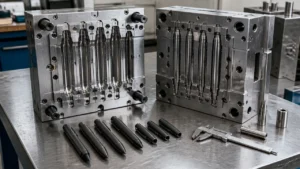
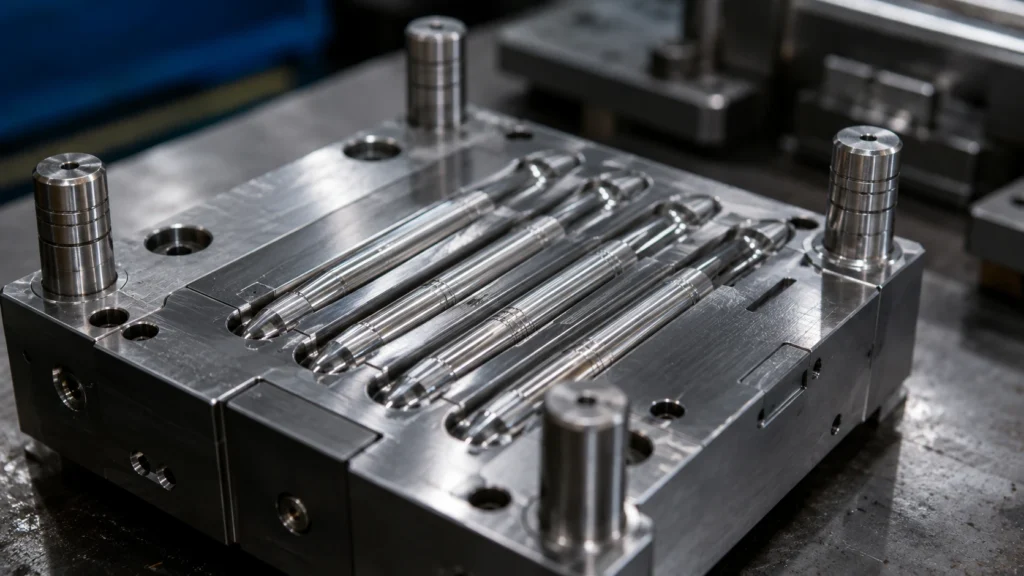
Mold development surprises buyers more than any other line item. It is also the one factories explain least clearly.
A mold is a precision steel tool, not a disposable template. A barrel mold has two or more steel blocks with cavities shaped like the part. Plastic is injected into those cavities under high pressure, cooled quickly, and ejected. The cavity count sets how many barrels come out per machine cycle. A single cavity makes one barrel per shot. A four-cavity mold makes four. An eight-cavity mold makes eight, but it costs more to machine and needs a bigger order to pay off.
The practical point is simple. A single-cavity mold for a standard cap or plug is a modest investment that spreads across a few thousand units. A multi-cavity barrel mold with a textured grip, custom shape, and tight tolerances costs much more, and it only becomes economical at higher volumes.
What matters is the mold price divided by the order quantity, which gives the mold cost per unit. At 50,000 pieces, the burden is real. At 100,000, it drops. At 250,000, it is near zero. Good volume talks aim for the order size where your total cost per unit works for your margin.
The minimum order for custom OEM/ODM programs is 50,000 pens per order, counted by total individual pens produced. For a 12-color pack, that equals roughly 4,200 sets, not 50,000 of each color. Standard stock models can be sampled at smaller trial sizes.
Wewnątrz ceny jednostkowej: Atrament, montaż oraz kompromis między kosztem a jakością
Once molds are handled, per-unit cost splits into materials, labor, and overhead. That simple split hides the decisions that shape your final number.
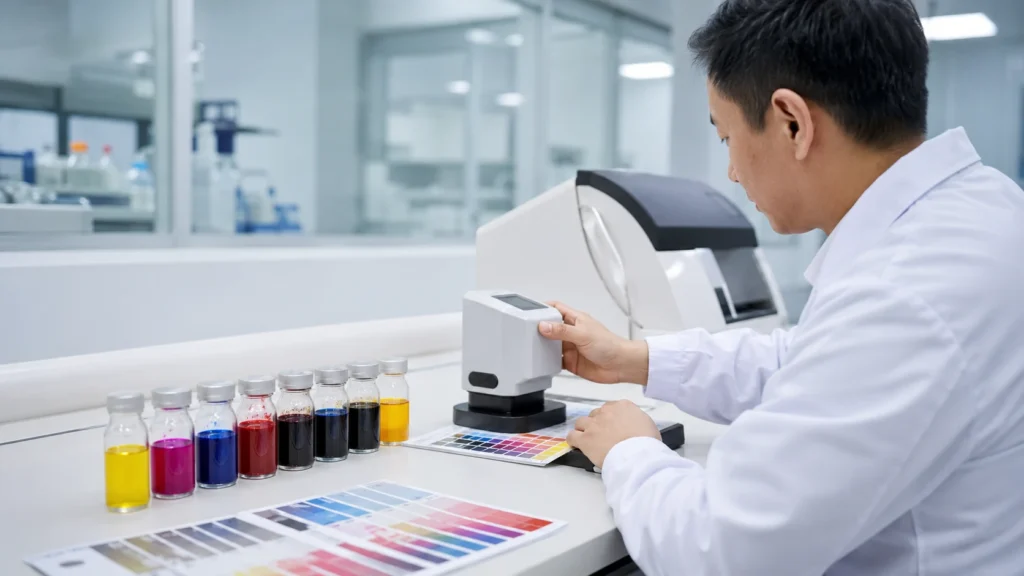
Ink is the biggest material cost driver. Water-based school ink costs less than alcohol-based art ink with strong color and blending. Metallic inks sit higher because suspended pigments need special processing. Gel ink is its own category, with flow properties that need precise control.
The ink price gap is real, but the bigger risk is not the ink itself. It is what happens when a factory buys ink from an outside supplier and that supplier changes a pigment or solvent between batches. Color that matched on order one may drift on order two. Fixing it, plus storing mismatched stock, can cost more than the ink savings.
Factories with in-house ink R&D control the formula at the source, match colors per batch, and lock formulas for repeat orders. That lab is not free. It sits inside the factory overhead and the unit price. For brands that depend on color consistency across seasons, it is worth paying for. ZH STATIONERY runs an in-house ink lab for marker pens, metallic markers, and acrylic markers. Batch color checks are part of the workflow, not an outside service.
Assembly and filling costs scale with automation. Automated lines with inline weighing and cap-torque checks make fewer bad units than manual lines with end-of-line sampling. The automated price per unit may be slightly higher, but the total cost (including returns, replacements, and reputation) is almost always lower.
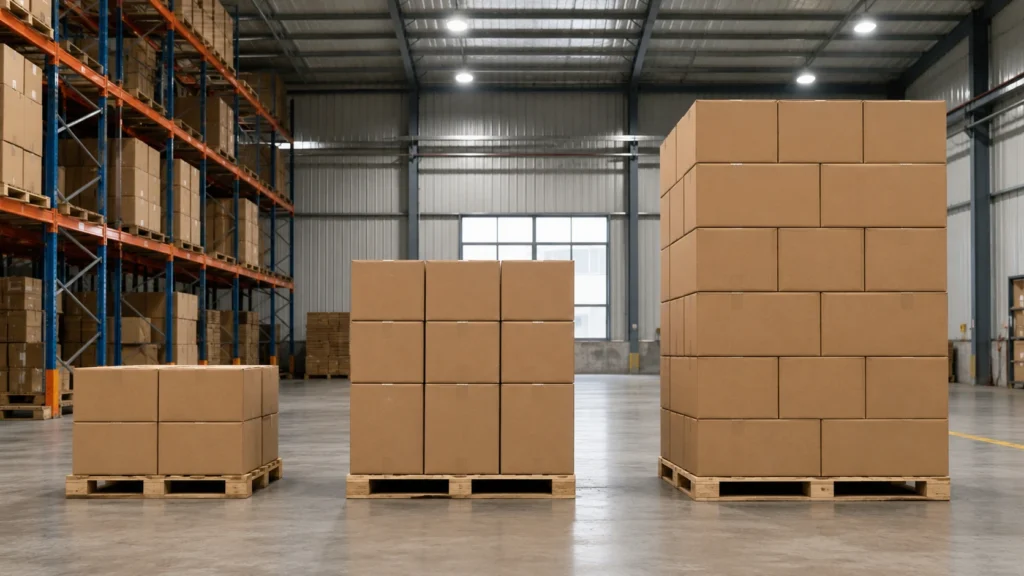
Jak MOQ Zmienia Wszystko w Koszcie Jednostkowym
The minimum order quantity is not just a factory rule. It is a pricing mechanism. Here is why.
Every production run has fixed costs: machine setup, line changeover, ink batch prep, and QC records. These costs are the same at 50,000 units or 250,000. The difference is how many units share the load.
At 50,000 pieces, the fixed cost per unit is meaningful. At 100,000, it drops a lot. At 250,000, it hits a floor. Past that volume, savings come from material buying power and container loading, not from spreading fixed costs.
Tworzy to praktyczne ramy decyzji dla kupujących:
- 50,000 pens per order: Custom OEM/ODM entry point, counted by total individual pens produced. Mold amortization and fixed costs are real at this size, so the per-unit price still carries the tooling burden.
- 50,000–100,000 units: Mold amortization and fixed-cost absorption begin to work well. Per-unit cost drops noticeably. This is the typical range for private-label brands building repeatable product lines.
- 100,000–250,000 units: Per-unit cost approaches optimal levels. Raw material purchasing at scale, dedicated line scheduling, and container-load shipping add further savings.
- 250,000+ units: Marginal per-unit savings slow. The negotiation shifts from unit price to payment terms, shipment scheduling, and multi-SKU coordination.
A factory with 26+ years of OEM/ODM experience and a 10,000+ square meter base with 8 production workshops, like ZH STATIONERY, can run trial orders and large bulk orders. The capability to look for is not just MOQ flexibility. It is steady quality from 50,000 to 500,000+ units, and a factory that only hits quality on slow, small runs cannot scale.
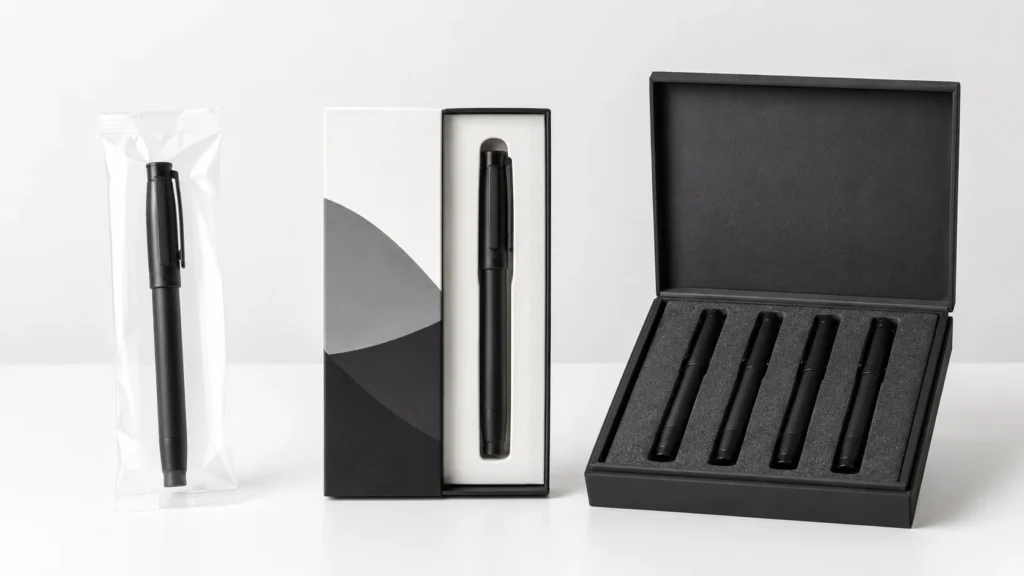
Opakowanie: Mnożnik kosztów, który większość kupujących nie docenia
Packaging is not just the box the pen comes in. It shapes unit cost, freight, shelf look, and sometimes customs classification.
Oto jak kumulują się koszty pakowania:
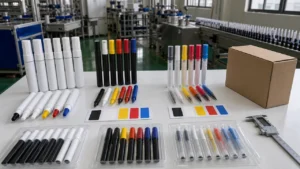
- Warstwa pierwsza: opakowanie podstawowe. This is what the consumer sees on the shelf: the blister card, the display box, the hang-sell pouch. Every design decision at this layer affects per-unit cost: single-color printing versus full-color, standard cardstock versus premium textured paper, simple tuck-flap boxes versus magnetic-close gift boxes. A Analiza czynników kosztowych niestandardowego markera Analiza czynników kosztowych niestandardowego markera, która ignoruje szczegóły pakowania, jest w zasadzie zgadywaniem.
- Warstwa druga: opakowanie wewnętrzne. Multi-pen sets, assorted color packs, and gift configurations require inner trays, dividers, or elastic bands to hold individual pens in position. These components add cost per set and increase assembly labor. A 12-color marker set does not cost 12x the price of a single marker. It costs more, because the set packaging, inner tray, and assembly all add line items that do not exist in a single-pen SKU.
- Warstwa trzecia: kartony eksportowe. The outer carton determines how many units fit in a shipping container. Carton dimensions, stacking strength, and pallet density all affect your per-unit freight cost. Sometimes the difference is enough to offset a seemingly attractive factory price. A factory that designs export cartons for container optimization (minimizing wasted air space, maximizing units per pallet) delivers a lower total landed cost even if its unit price is slightly higher than a competitor who ships in oversized boxes.
- Warstwa czwarta: etykietowanie zgodności. Barcodes, country-of-origin markings, age-grading labels, and safety warnings (the “Conforms to ASTM D-4236” statement required for U.S. art materials) all occupy real estate on the package and must be printed accurately. A packaging misprint on a compliance label can render an entire shipment unsellable in a specific retail channel, and the loss is far larger than any printing savings.
For private-label buyers, packaging is where factory customization pays off. ZH STATIONERY supports color boxes, PVC boxes, display boxes, gift sets, blister cards, private-label barrel printing, custom color sets, and barcode or warning labels. In-house packaging means faster proofs, lower revision costs, and the same QC discipline as the product.
Certyfikacje i zgodność: pozycja, której nie można pominąć
Compliance is not optional for the U.S. and Europe, and it is not free. Every product variant in a regulated market needs documented proof of safety. The costs repeat with each batch, so budget for them from day one.
Per the U.S. Consumer Product Safety Commission (CPSC), all art materials sold in the United States need a toxicology review under the Labeling of Hazardous Art Materials Act (LHAMA). This includes markers, gel pens, and paint pens, and applies to adults and children alike. The label must state “Conforms to ASTM D-4236.”
For products marketed to children under 12, CPSIA adds mandatory third-party testing for lead and phthalates. The tests run at a CPSC-accredited lab, and the importer issues a Children’s Product Certificate.
In the European Union, the Toy Safety Directive requires EN71 compliance for products classified as toys. EN71-3, which tests the migration of 19 heavy metals, is the most critical and expensive test for ink products.
Practical budget points for buyers:
- Testy certyfikacyjne muszą obejmować konkretny SKU produktu i formułę tuszu, a nie tylko ogólną kategorię produktów fabryki.
- Raporty z testów zazwyczaj wymagają odnowienia co 12–24 miesiące lub za każdym razem, gdy zmienia się formuła tuszu lub źródło materiałów.
- “Certyfikat fabryczny” sprzed dwóch lat, obejmujący inny produkt, nie jest ważny dla Twojej przesyłki.
- Third-party testing through ISO 17025-accredited labs (SGS, Intertek, TUV, BV) is the standard. In-house test results do not satisfy U.S. or EU customs requirements.
- Każdy dodatkowy wariant produktu (inna rodzina kolorów tuszu, inny materiał korpusu, inny typ końcówki) może wymagać oddzielnych testów.
ZH STATIONERY supports EN71 and ASTM D-4236 certified options with batch-level testing records, so the paperwork is tied to real production runs. Ask this question: “Can you provide a dated report from an accredited lab covering this exact product spec?” If the answer is slow or vague, raise the certification budget or change suppliers.
Często zadawane pytania
Jaka jest typowa minimalna ilość zamówienia (MOQ) dla niestandardowych markerów?
The minimum order for custom OEM/ODM programs is 50,000 pens per order, counted by total individual pens produced. For a 12-color pack, that equals roughly 4,200 sets, not 50,000 of each color. Standard stock models can be sampled at smaller trial sizes.
Jakie czynniki najbardziej wpływają na koszt jednostkowy niestandardowego pisaka markerowego?
Five cost drivers stand out. Ink type: water-based is cheapest, alcohol and specialty inks cost more. Tip style: brush and dual-tip designs add cost. Barrel printing: silkscreen is cheapest, multi-color UV adds cost. Packaging: polybag is cheapest, custom retail boxes add the most. Order volume: bigger orders cut per-unit cost. Certification testing is not per-unit, but plan for it in the project budget.
Dlaczego fabryki pobierają oddzielne opłaty za rozwój form?
Mold development is a one-time capital cost. The factory pays for steel, machining, and trial runs up front, so it charges the tooling separately instead of folding it into the unit price. If the mold cost were built into the per-unit price, every repeat order would keep paying for the mold forever. A separate tooling charge keeps pricing fair for one-time and repeat orders alike. Separately, agree who owns the tool and design files, because paying a tooling charge does not by itself give you ownership.
Jak mogę obniżyć całkowity koszt zamówienia niestandardowych długopisów bez utraty jakości?
Three strategies work. First, cut SKU variants, because every color, tip, or packaging format adds setup cost. Second, raise order volume within what your sales forecast supports, so fixed costs spread over more units. Third, standardize packaging: use one box template for several SKUs with different artwork. An OEM factory with 26+ years can suggest cost cuts that do not touch the user experience.
Jakie certyfikaty powinienem uwzględnić w budżecie przy imporcie długopisów do USA i Europy?
For the U.S. market, budget for ASTM D-4236 (LHAMA) review plus CPSIA testing if you sell to children under 12. For Europe, budget EN71-3 and REACH documentation where needed. Testing repeats per batch and costs more with more variants. Get a test cost estimate before ordering, and confirm the factory uses ISO 17025-accredited labs.
Czy taniej jest produkować partiami, czy złożyć jedno duże zamówienie?
One large order is almost always cheaper per unit. It spreads mold cost, cuts the fixed-cost burden, and unlocks container freight. The tradeoff is inventory cost and cash flow. A hybrid works for many brands: a large base order for core SKUs plus small replenishment orders to adjust color and pack mix. ZH STATIONERY supports both, from 50,000-pen trials to bulk runs.
If you source marker pens or metallic markers for a private-label brand or wholesale channel, share your target specification first. Include ink type, tip style, color count, packaging, and expected volume. Then ask for a clear cost breakdown that covers mold, per-unit, packaging, certification, and freight. Contact ZH STATIONERY to start that conversation.
Related guide: For compliance planning, see Produkcja długopisów.
Powiązane artykuły
- Jak negocjować MOQ z chińskimi fabrykami długopisów, nie niszcząc relacji
- Producent niestandardowych markerów akrylowych: Lista kontrolna dla nabywcy OEM/ODM na rok 2026
- Producent niestandardowych długopisów w kształcie zwierząt: Przewodnik kupującego OEM/ODM po materiałach, formach, bezpieczeństwie i MOQ
For quality system frameworks, see Zasoby zarządzania jakością ISO.