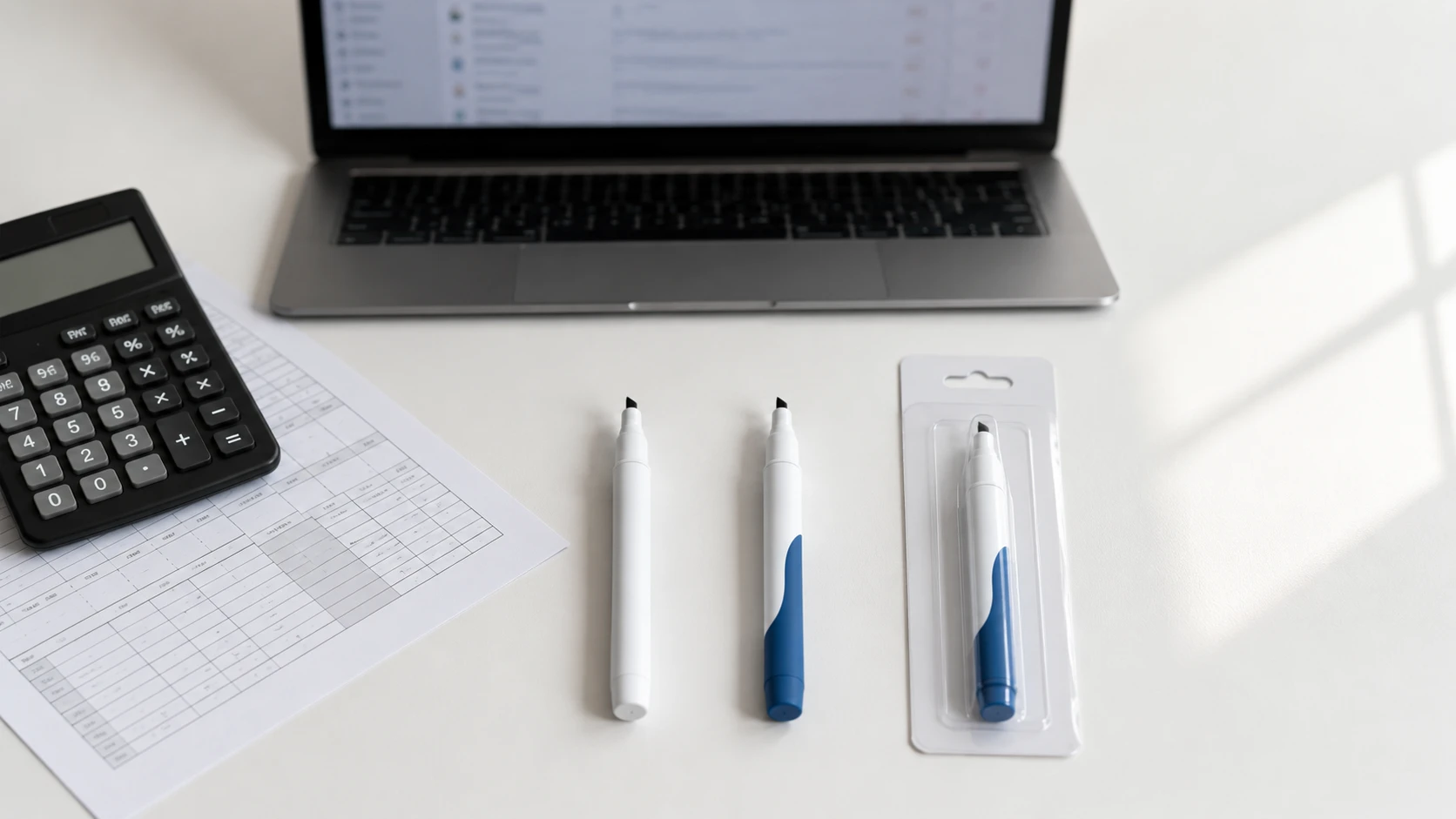
When you compare quotes for custom pens, the numbers rarely line up. One factory quotes $0.18 per pen, another quotes $0.32, and neither one explains why. The difference hides in mold charges, ink type, packaging, testing, and order volume.
This lack of clarity is not an accident. The supply chain hides cost variables that first-time buyers do not know to ask about. Budgets that look fine at the quote stage fall apart during production.
This article maps the real cost structure of custom pen manufacturing. It covers mold investment, per-unit cost drivers, MOQ math, packaging, certification costs, and the places where cutting cost creates the most risk. The goal is not to give you a price. It is to make sure you know what belongs in the quote before you accept one.
Table of Contents

Quick Answer: What Determines Custom Pen Manufacturing Cost?
Here are the five cost drivers every buyer should map before contacting a factory:
- Mold development is the largest upfront cost. Custom barrel shapes need precision steel molds, and the price depends on cavity count, geometry, and whether the factory machines molds in-house or outsources them.
- Per-unit manufacturing cost is driven by ink type (water-based is cheapest, alcohol-based and specialty metallic inks cost more), tip specification, and assembly complexity.
- MOQ determines how mold investment is amortized. The same mold cost spread across 50,000 units is meaningful; across 250,000 units it becomes small.
- Packaging is not an afterthought. Custom retail boxes, blister cards, gift sets, and branded inner trays each add cost per unit, and multi-SKU sets multiply packaging complexity.
- Compliance and certification costs are real and recurring. EN71, ASTM D-4236, and REACH testing must be renewed, and each product variant may require its own test documentation.
For brand owners and buying teams, these factors help you set sharper sourcing and inspection standards.
Understanding Custom Pen Manufacturing Cost: A Line-By-Line Breakdown
Before you negotiate a per-unit price, understand what the number really means. This table maps each cost part to its impact on your total spend.
| Cost Component | Typical Range or Driver | What Buyers Often Miss |
| Mold development (new barrel/cap) | Driven by cavity count, part complexity, and steel grade | Mold amortization is a separate calculation from per-unit price; a factory quoting a low unit price may be spreading mold cost across an unrealistically high order volume, inflating future reorder costs |
| Ink formulation | Water-based cheapest; alcohol-based mid-range; specialty metallic, fluorescent, or low-odor at premium | In-house ink R&D reduces per-batch color-matching cost over time; outsourced ink formulation adds third-party markup and reformulation delays |
| Tip/nib specification | Standard fiber tips at baseline; brush tips, dual-tip, and specialty precision tips at premium | Tip material quality directly affects end-user experience (fraying, ink flow consistency); the cost difference between a standard polyester tip and a premium nylon tip may be fractions of a cent per unit but determines return rates |
| Barrel printing method | Silkscreen cheapest for single-color; UV printing for multi-color; hot stamping at premium | Print durability varies. A logo that rubs off after three weeks in a pencil case generates more complaints than a slightly more expensive UV-printed logo that lasts the product’s lifetime. |
| Assembly and filling | Automated line cost built into per-unit price; manual assembly adds labor cost and variability | Automated filling with inline check-weighing reduces fill-weight errors that cause inconsistent writing; the cost of that automation is in the factory’s capital investment, not a separate line item. But lower-quality factories without automation pass labor-driven variability costs to the buyer through higher defect rates |
| Packaging (per unit) | Bulk polybag cheapest; single-color box mid-range; custom retail box, blister card, or gift set at premium | Packaging is where incremental cost adds up fastest. A 15-cent retail box across 10,000 units is $1,500; across five SKU variants it becomes $7,500; across an annual order of 100,000 units it crosses $15,000. |
| Certification and testing | EN71-3 for EU; ASTM D-4236 for US; REACH where applicable | Testing must be renewed (typically every 12–24 months or when formulations change); a “certified” factory may only hold testing for a subset of its product line, not the specific SKU you are ordering |
| Freight and logistics | Sea freight baseline; air freight 3–5× premium; affected by carton dimensions and weight | Carton optimization (units per carton, pallet density) directly affects per-unit freight cost; poorly designed export packaging wastes container space and adds cost per shipped unit |
The takeaway is not to pick the cheapest option in every row. Some line items are worth paying more for: ink quality, tip material, cap-seal design. They prevent returns, bad reviews, and lost reorders.
Where Custom Pen Manufacturing Cost Hides: Mold Investment
Mold development surprises buyers more than any other line item. It is also the one factories explain least clearly.
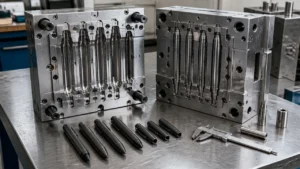
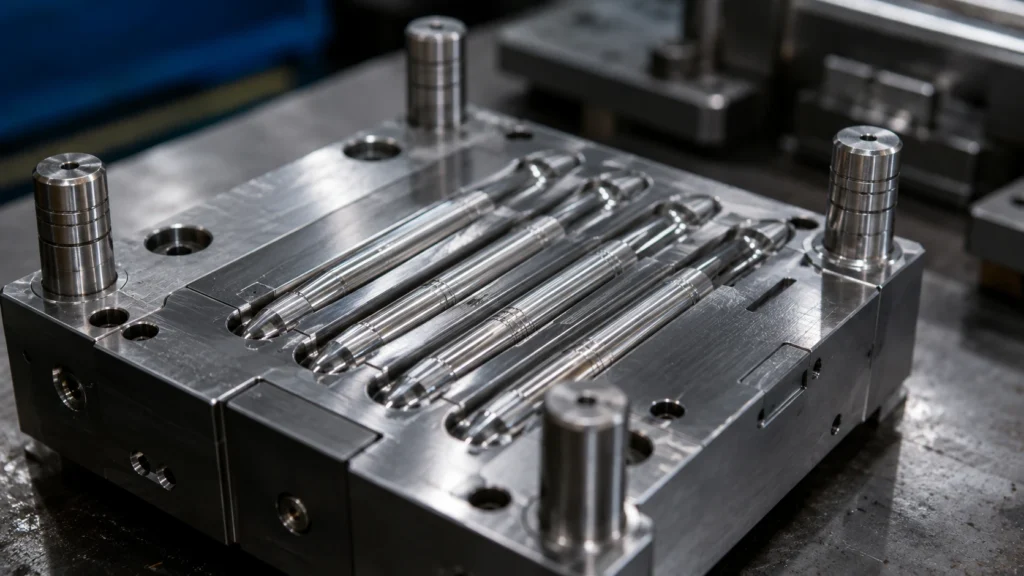
A mold is a precision steel tool, not a disposable template. A barrel mold has two or more steel blocks with cavities shaped like the part. Plastic is injected into those cavities under high pressure, cooled quickly, and ejected. The cavity count sets how many barrels come out per machine cycle. A single cavity makes one barrel per shot. A four-cavity mold makes four. An eight-cavity mold makes eight, but it costs more to machine and needs a bigger order to pay off.
The practical point is simple. A single-cavity mold for a standard cap or plug is a modest investment that spreads across a few thousand units. A multi-cavity barrel mold with a textured grip, custom shape, and tight tolerances costs much more, and it only becomes economical at higher volumes.
What matters is the mold price divided by the order quantity, which gives the mold cost per unit. At 50,000 pieces, the burden is real. At 100,000, it drops. At 250,000, it is near zero. Volume planning should target an order size at which the total cost per unit supports your margin.
The minimum order for custom OEM/ODM programs is 50,000 pens per order, counted by total individual pens produced. For a 12-color pack, that equals roughly 4,200 sets, not 50,000 of each color. Standard stock models can be sampled at smaller trial sizes.
Inside The Per-Unit Price: Ink, Assembly, And The Cost-Quality Tradeoff
Once molds are handled, per-unit cost splits into materials, labor, and overhead. That simple split hides the decisions that shape your final number.
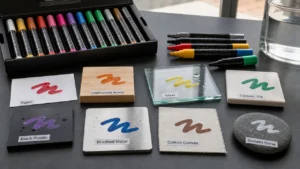
Ink is the biggest material cost driver. Water-based school ink costs less than alcohol-based art ink with strong color and blending. Metallic inks sit higher because suspended pigments need special processing. Gel ink is its own category, with flow properties that need precise control.
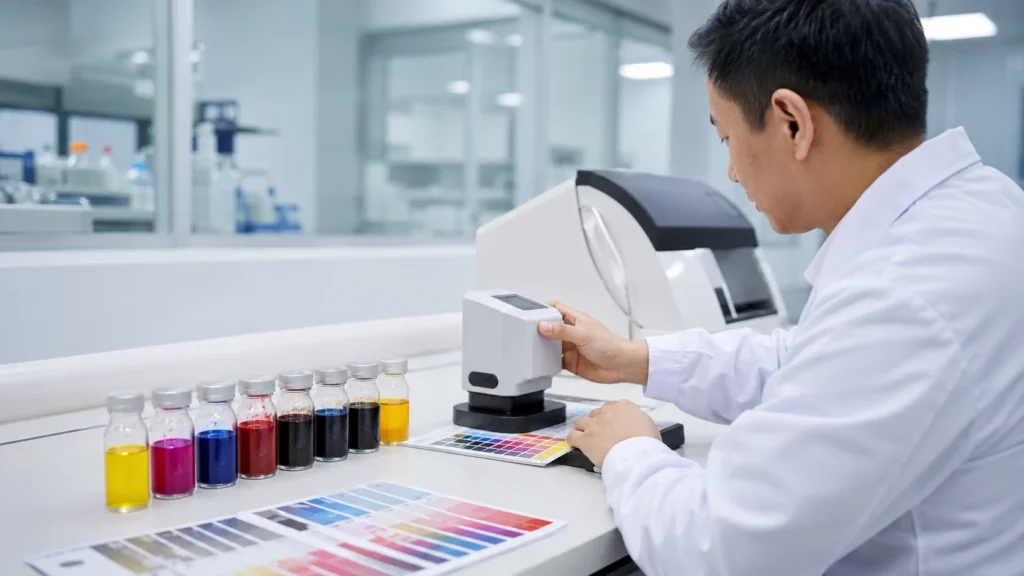
The ink price gap is real, but the bigger risk is not the ink itself. It is what happens when a factory buys ink from an outside supplier and that supplier changes a pigment or solvent between batches. Color that matched on order one may drift on order two. Fixing it, plus storing mismatched stock, can cost more than the ink savings.
Factories with in-house ink R&D control the formula at the source, match colors per batch, and lock formulas for repeat orders. That lab is not free. It sits inside the factory overhead and the unit price. For brands that depend on color consistency across seasons, it is worth paying for. ZH STATIONERY runs an in-house ink lab for marker pens, metallic markers, and acrylic markers. Batch color checks are part of the workflow, not an outside service.
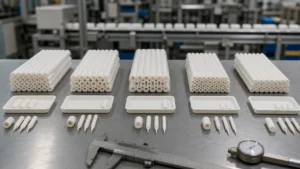
Assembly and filling costs scale with automation. Automated lines with inline weighing and cap-torque checks make fewer bad units than manual lines with end-of-line sampling. The automated price per unit may be slightly higher, but the total cost (including returns, replacements, and reputation) is almost always lower.
How MOQ Changes Everything About Your Unit Cost
The minimum order quantity is not just a factory rule. It is a pricing mechanism. Here is why.
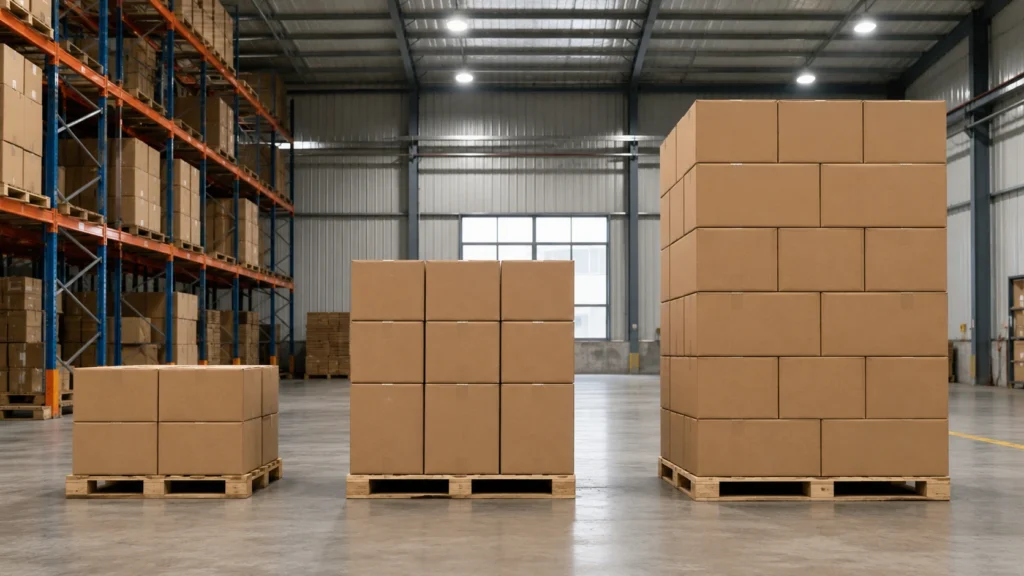
Every production run has fixed costs: machine setup, line changeover, ink batch prep, and QC records. These costs are the same at 50,000 units or 250,000. The difference is how many units share the load.
At 50,000 pieces, the fixed cost per unit is meaningful. At 100,000, it drops a lot. At 250,000, it hits a floor. Past that volume, savings come from material buying power and container loading, not from spreading fixed costs.
This creates a practical framework for buyer decisions:
- 50,000 pens per order: Custom OEM/ODM entry point, counted by total individual pens produced. Mold amortization and fixed costs are real at this size, so the per-unit price still carries the tooling burden.
- 50,000–100,000 units: Mold amortization and fixed-cost absorption begin to work well. Per-unit cost drops noticeably. This is the typical range for private-label brands building repeatable product lines.
- 100,000–250,000 units: Per-unit cost approaches optimal levels. Raw material purchasing at scale, dedicated line scheduling, and container-load shipping add further savings.
- 250,000+ units: Marginal per-unit savings slow. The negotiation shifts from unit price to payment terms, shipment scheduling, and multi-SKU coordination.
A factory with 26+ years of OEM/ODM experience and a 10,000+ square meter base with 8 production workshops, like ZH STATIONERY, can run trial orders and large bulk orders. The capability to look for is not just MOQ flexibility. It is steady quality from 50,000 to 500,000+ units, and a factory that only hits quality on slow, small runs cannot scale.
Packaging: The Cost Multiplier Most Buyers Underestimate
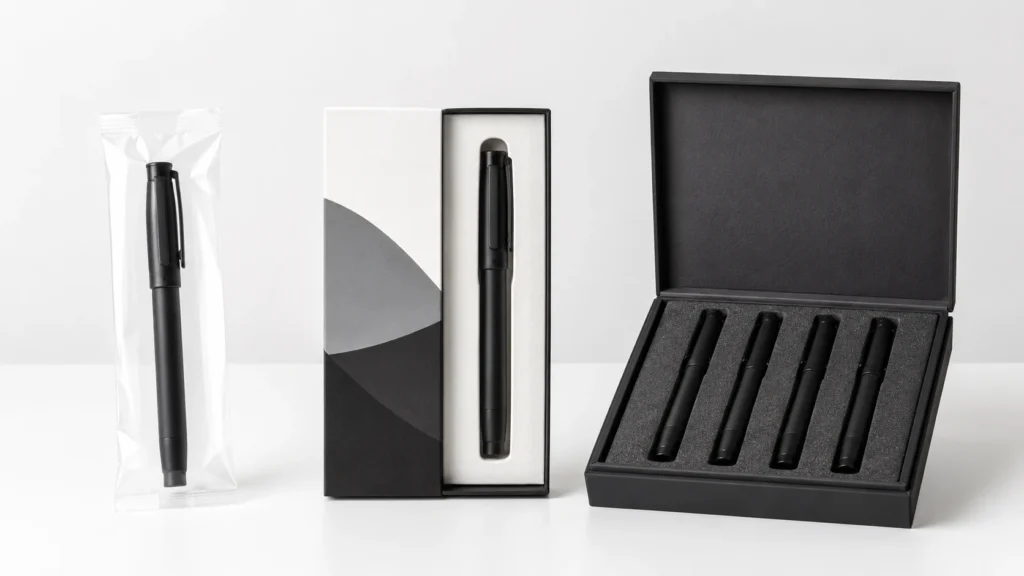
Packaging is not just the box the pen comes in. It shapes unit cost, freight, shelf presentation, and sometimes customs classification.
Here is how packaging costs compound:
- Layer one: primary packaging. This is what the consumer sees on the shelf: the blister card, the display box, the hang-sell pouch. Every design decision at this layer affects per-unit cost: single-color printing versus full-color, standard cardstock versus premium textured paper, simple tuck-flap boxes versus magnetic-close gift boxes. A custom marker pen cost factors analysis that ignores packaging detail is essentially guessing.
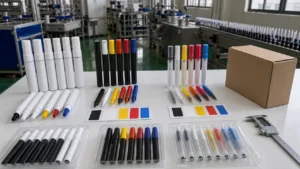
- Layer two: inner packaging. Multi-pen sets, assorted color packs, and gift configurations require inner trays, dividers, or elastic bands to hold individual pens in position. These components add cost per set and increase assembly labor. A 12-color marker set does not cost 12x the price of a single marker. It costs more, because the set packaging, inner tray, and assembly all add line items that do not exist in a single-pen SKU.
- Layer three: export cartons. The outer carton determines how many units fit in a shipping container. Carton dimensions, stacking strength, and pallet density all affect your per-unit freight cost. Sometimes the difference is enough to offset a seemingly attractive factory price. A factory that designs export cartons for container optimization (minimizing wasted air space, maximizing units per pallet) delivers a lower total landed cost even if its unit price is slightly higher than a competitor who ships in oversized boxes.
- Layer four: compliance labeling. Barcodes, country-of-origin markings, age-grading labels, and safety warnings (the “Conforms to ASTM D-4236” statement required for U.S. art materials) all occupy real estate on the package and must be printed accurately. A packaging misprint on a compliance label can render an entire shipment unsellable in a specific retail channel, and the loss is far larger than any printing savings.
For private-label buyers, packaging is where factory customization pays off. ZH STATIONERY supports color boxes, PVC boxes, display boxes, gift sets, blister cards, private-label barrel printing, custom color sets, and barcode or warning labels. In-house packaging means faster proofs, lower revision costs, and the same QC discipline as the product.
Certifications And Compliance: The Line Item That Cannot Be Skipped
Compliance is not optional for the U.S. and Europe, and it is not free. Every product variant in a regulated market needs documented proof of safety. The costs repeat with each batch, so budget for them from day one.
Per the U.S. Consumer Product Safety Commission (CPSC), all art materials sold in the United States need a toxicology review under the Labeling of Hazardous Art Materials Act (LHAMA). This includes markers, gel pens, and paint pens, and applies to adults and children alike. The label must state “Conforms to ASTM D-4236.”
For products marketed to children under 12, CPSIA adds mandatory third-party testing for lead and phthalates. The tests run at a CPSC-accredited lab, and the importer issues a Children’s Product Certificate.
In the European Union, the Toy Safety Directive requires EN71 compliance for products classified as toys. EN71-3, which tests the migration of 19 heavy metals, is the most critical and expensive test for ink products.
Practical budget points for buyers:
- Certification testing must cover the specific product SKU and ink formulation, not just the factory’s general product category.
- Test reports typically need renewal every 12–24 months, or whenever the ink formulation or material sourcing changes.
- A “factory certification” that dates from two years ago and covers a different product is not valid for your shipment.
- Third-party testing through ISO 17025-accredited labs (SGS, Intertek, TUV, BV) is the standard. In-house test results do not satisfy U.S. or EU customs requirements.
- Each additional product variant (different ink color family, different barrel material, different tip type) may require separate testing.
ZH STATIONERY supports EN71 and ASTM D-4236 certified options with batch-level testing records, so the paperwork is tied to real production runs. Ask this question: “Can you provide a dated report from an accredited lab covering this exact product spec?” If the answer is slow or vague, raise the certification budget or change suppliers.
Frequently Asked Questions
What Is The Typical MOQ For Custom Marker Pens?
The minimum order for custom OEM/ODM programs is 50,000 pens per order, counted by total individual pens produced. For a 12-color pack, that equals roughly 4,200 sets, not 50,000 of each color. Standard stock models can be sampled at smaller trial sizes.
What Factors Most Affect The Per-Unit Cost Of A Custom Marker Pen?
Five cost drivers stand out. Ink type: water-based is cheapest, alcohol and specialty inks cost more. Tip style: brush and dual-tip designs add cost. Barrel printing: silkscreen is cheapest, multi-color UV adds cost. Packaging: polybag is cheapest, custom retail boxes add the most. Order volume: bigger orders cut per-unit cost. Certification testing is not per-unit, but plan for it in the project budget.
Why Do Factories Charge For Mold Development Separately?
Mold development is a one-time capital cost. The factory pays for steel, machining, and trial runs up front, so it charges the tooling separately instead of folding it into the unit price. If the mold cost were built into the per-unit price, every repeat order would keep paying for the mold forever. A separate tooling charge keeps pricing fair for one-time and repeat orders alike. Separately, agree who owns the tool and design files, because paying a tooling charge does not by itself give you ownership.
How Can I Reduce The Total Cost Of A Custom Pen Order Without Sacrificing Quality?
Three strategies work. First, cut SKU variants, because every color, tip, or packaging format adds setup cost. Second, raise order volume within what your sales forecast supports, so fixed costs spread over more units. Third, standardize packaging: use one box template for several SKUs with different artwork. An OEM factory with 26+ years can suggest cost cuts that do not touch the user experience.
What Certifications Should I Budget For When Importing Pens To The U.S. And Europe?
For the U.S. market, budget for ASTM D-4236 (LHAMA) review plus CPSIA testing if you sell to children under 12. For Europe, budget EN71-3 and REACH documentation where needed. Testing repeats per batch and costs more with more variants. Get a test cost estimate before ordering, and confirm the factory uses ISO 17025-accredited labs.
Is It Cheaper To Manufacture In Batches Or Place One Large Order?
One large order is almost always cheaper per unit. It spreads mold cost, cuts the fixed-cost burden, and unlocks container freight. The tradeoff is inventory cost and cash flow. A hybrid works for many brands: a large base order for core SKUs plus small replenishment orders to adjust color and pack mix. ZH STATIONERY supports both, from 50,000-pen trials to bulk runs.
If you source marker pens or metallic markers for a private-label brand or wholesale channel, share your target specification first. Include ink type, tip style, color count, packaging, and expected volume. Then ask for a clear cost breakdown that covers mold, per-unit, packaging, certification, and freight. Contact ZH STATIONERY to start that conversation.
Related guide: For compliance planning, see OEM ODM Pen Manufacturing.
Related Reading
- How to Negotiate MOQ with Chinese Pen Factories Without Burning the Relationship
- Custom Acrylic Markers Manufacturer: The OEM/ODM Buyer Checklist for 2026
- Custom Animal-Shaped Pens Manufacturer: OEM/ODM Buyer’s Guide to Materials, Molds, Safety, and MOQ
For quality system frameworks, see ISO quality management resources.