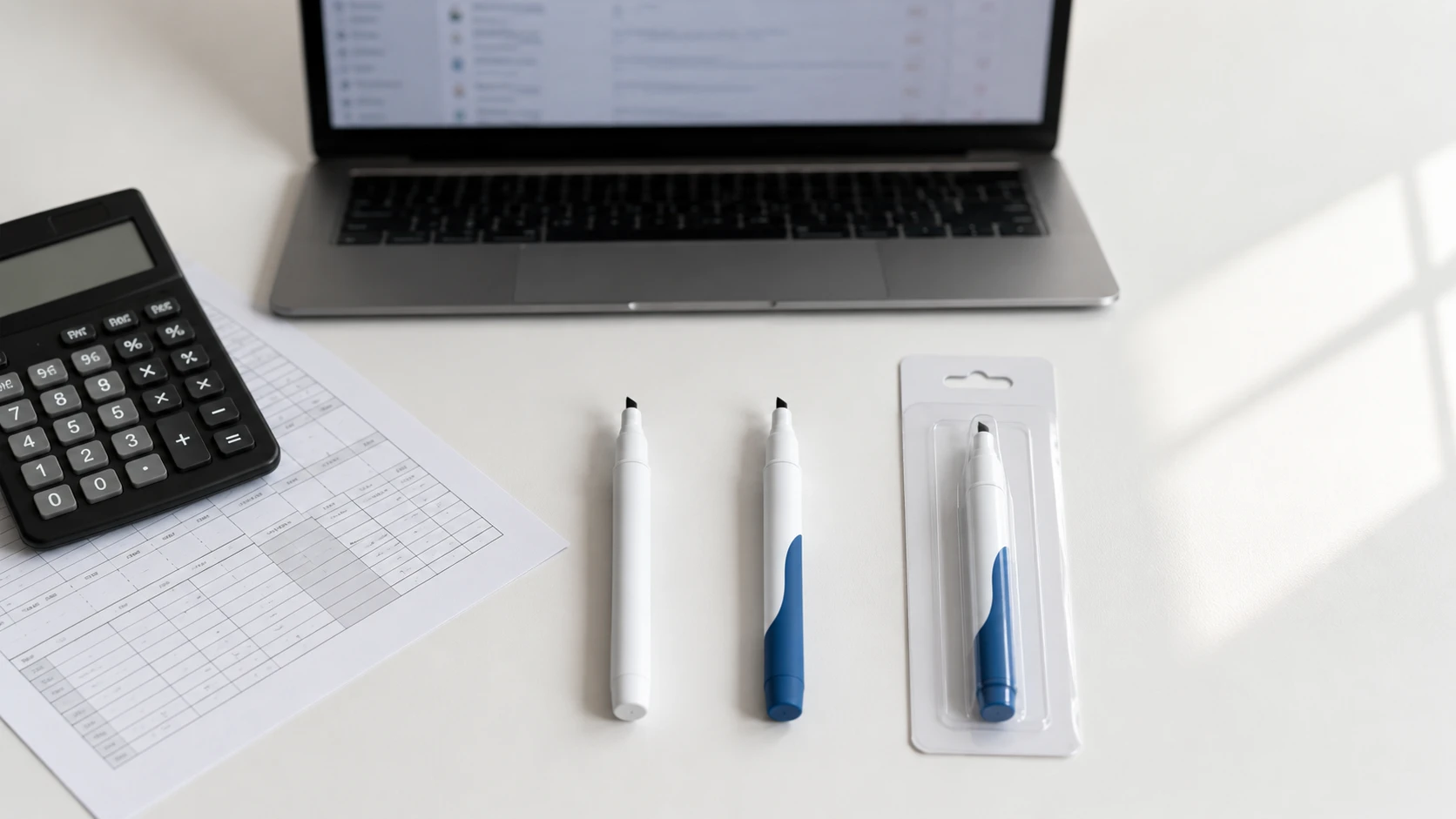
When you compare quotes for custom pens, the numbers rarely line up. One factory quotes $0.18 per pen, another quotes $0.32, and neither one explains why. The difference hides in mold charges, ink type, packaging, testing, and order volume.
This lack of clarity is not an accident. The supply chain hides cost variables that first-time buyers do not know to ask about. Budgets that look fine at the quote stage fall apart during production.
This article maps the real cost structure of custom pen manufacturing. It covers mold investment, per-unit cost drivers, MOQ math, packaging, certification costs, and the places where cutting cost creates the most risk. The goal is not to give you a price. It is to make sure you know what belongs in the quote before you accept one.
Tabla de Contenidos

Respuesta Rápida: ¿Qué Determina el Costo de Fabricación de Bolígrafos Personalizados?
El desarrollo del molde es el mayor costo inicial: las formas personalizadas del cuerpo requieren moldes de acero de precisión cuyo costo depende del número de cavidades, la complejidad geométrica y si la fábrica mecaniza los moldes internamente o los subcontrata.
- Mold development is the largest upfront cost. Custom barrel shapes need precision steel molds, and the price depends on cavity count, geometry, and whether the factory machines molds in-house or outsources them.
- El MOQ determina cómo se amortiza la inversión en el molde: el mismo costo de molde distribuido entre 2,000 unidades produce un costo unitario muy diferente que entre 20,000 unidades.
- MOQ determines how mold investment is amortized. The same mold cost spread across 50,000 units is meaningful; across 250,000 units it becomes small.
- Packaging is not an afterthought. Custom retail boxes, blister cards, gift sets, and branded inner trays each add cost per unit, and multi-SKU sets multiply packaging complexity.
- Compliance and certification costs are real and recurring. EN71, ASTM D-4236, and REACH testing must be renewed, and each product variant may require its own test documentation.
For brand owners and buying teams, these factors help you set sharper sourcing and inspection standards.
Comprensión del costo de fabricación de bolígrafos personalizados: un desglose línea por línea
Before you negotiate a per-unit price, understand what the number really means. This table maps each cost part to its impact on your total spend.
| Rango típico o factor determinante | Lo que los compradores a menudo pasan por alto | Desarrollo del molde (nuevo cuerpo/tapa) |
| Determinado por el número de cavidades, la complejidad de la pieza y el grado del acero | La amortización del molde es un cálculo separado del precio unitario; una fábrica que cotiza un precio unitario bajo puede estar distribuyendo el costo del molde en un volumen de pedido poco realista, inflando los costos de reorden futuros | Formulación de la tinta |
| La de base acuosa es la más barata; la de base alcohólica es de rango medio; las tintas metálicas especializadas, fluorescentes o de bajo olor tienen una prima | La I+D de tinta interna reduce el costo de igualación de color por lote con el tiempo; la formulación de tinta subcontratada añade un margen de terceros y retrasos por reformulación | Especificación de la punta/boquilla |
| Las puntas de fibra estándar son la línea base; las puntas de pincel, de doble punta y las puntas de precisión especializadas tienen una prima | La calidad del material de la punta afecta directamente la experiencia del usuario final (deshilachado, consistencia del flujo de tinta); la diferencia de costo entre una punta de poliéster estándar y una punta de nailon premium puede ser de fracciones de centavo por unidad, pero determina las tasas de devolución | Método de impresión del cuerpo |
| La serigrafía es la más barata para un solo color; la impresión UV para varios colores; el estampado en caliente tiene una prima | La durabilidad de la impresión varía: un logotipo que se borra después de tres semanas en un estuche genera más quejas que un logotipo impreso con UV ligeramente más caro que dura toda la vida del producto | Print durability varies. A logo that rubs off after three weeks in a pencil case generates more complaints than a slightly more expensive UV-printed logo that lasts the product’s lifetime. |
| El costo de la línea automatizada está incluido en el precio unitario; el ensamblaje manual añade costo laboral y variabilidad | El llenado automatizado con pesaje en línea reduce los errores de peso de llenado que causan escritura inconsistente; el costo de esa automatización está en la inversión de capital de la fábrica, no en una partida separada, pero las fábricas de menor calidad sin automatización transfieren los costos de variabilidad laboral al comprador a través de tasas de defectos más altas | Automated filling with inline check-weighing reduces fill-weight errors that cause inconsistent writing; the cost of that automation is in the factory’s capital investment, not a separate line item. But lower-quality factories without automation pass labor-driven variability costs to the buyer through higher defect rates |
| La bolsa de polietileno a granel es la más barata; la caja de un solo color es de rango medio; la caja minorista personalizada, la tarjeta blíster o el estuche de regalo tienen una prima | El empaque es donde el costo incremental se acumula más rápido: una caja minorista de 15 centavos en 10,000 unidades es 1,500 €; en cinco variantes de SKU se convierte en 7,500 €; en un pedido anual de 100,000 unidades supera los 15,000 € | Packaging is where incremental cost adds up fastest. A 15-cent retail box across 10,000 units is $1,500; across five SKU variants it becomes $7,500; across an annual order of 100,000 units it crosses $15,000. |
| EN71-3 para la UE; ASTM D-4236 para EE. UU.; REACH cuando corresponda | Las pruebas deben renovarse (generalmente cada 12–24 meses o cuando cambian las formulaciones); una fábrica "certificada" puede tener pruebas solo para un subconjunto de su línea de productos, no para el SKU específico que está pidiendo | Flete y logística |
| El flete marítimo es la línea base; el flete aéreo tiene una prima de 3 a 5 veces; afectado por las dimensiones y el peso de la caja | La optimización de la caja (unidades por caja, densidad del palé) afecta directamente el costo de flete por unidad; un empaque de exportación mal diseñado desperdicia espacio en el contenedor y añade costo por unidad enviada | La conclusión de esta tabla no es que deba exigir la opción más barata en cada categoría. Algunas partidas (calidad de la formulación de la tinta, grado del material de la punta, diseño del sello de la tapa) valen la pena pagar más porque evitan los costos posteriores que más importan: devoluciones de clientes, reseñas negativas y pérdida de reordenes. |
The takeaway is not to pick the cheapest option in every row. Some line items are worth paying more for: ink quality, tip material, cap-seal design. They prevent returns, bad reviews, and lost reorders.
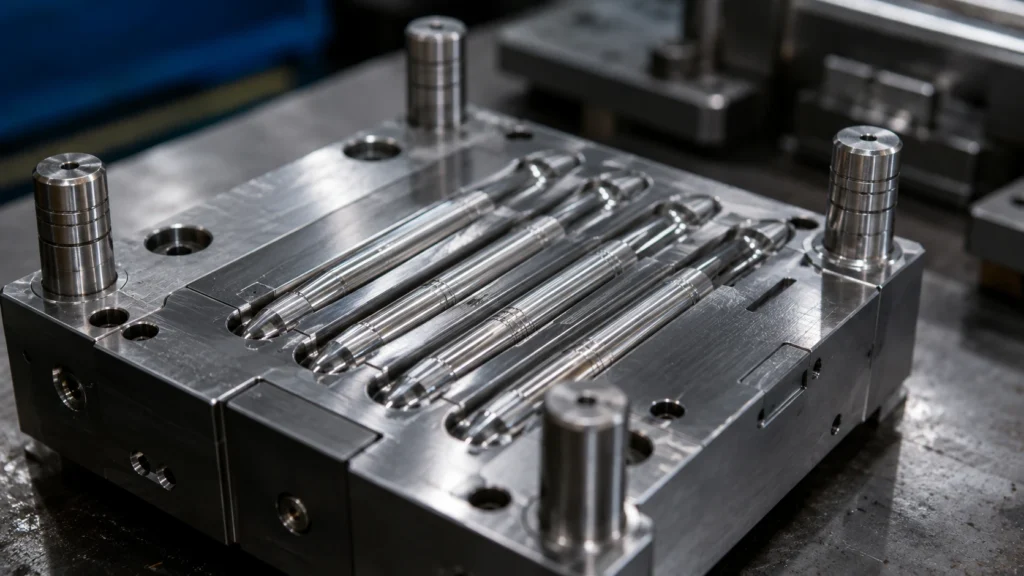
Donde se esconde el costo de fabricación de bolígrafos personalizados: Inversión en moldes
Mold development surprises buyers more than any other line item. It is also the one factories explain least clearly.
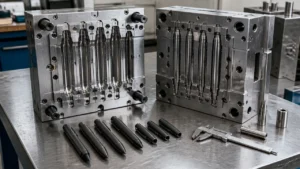
A mold is a precision steel tool, not a disposable template. A barrel mold has two or more steel blocks with cavities shaped like the part. Plastic is injected into those cavities under high pressure, cooled quickly, and ejected. The cavity count sets how many barrels come out per machine cycle. A single cavity makes one barrel per shot. A four-cavity mold makes four. An eight-cavity mold makes eight, but it costs more to machine and needs a bigger order to pay off.
The practical point is simple. A single-cavity mold for a standard cap or plug is a modest investment that spreads across a few thousand units. A multi-cavity barrel mold with a textured grip, custom shape, and tight tolerances costs much more, and it only becomes economical at higher volumes.
What matters is the mold price divided by the order quantity, which gives the mold cost per unit. At 50,000 pieces, the burden is real. At 100,000, it drops. At 250,000, it is near zero. Good volume talks aim for the order size where your total cost per unit works for your margin.
El pedido mínimo para programas personalizados OEM/ODM es de 50.000 bolígrafos por pedido, contados por el total de bolígrafos individuales producidos. Para un paquete de 12 colores, eso equivale aproximadamente a 4.200 estuches, no 50.000 de cada color. Los modelos estándar en stock pueden muestrearse en cantidades de prueba más pequeñas.
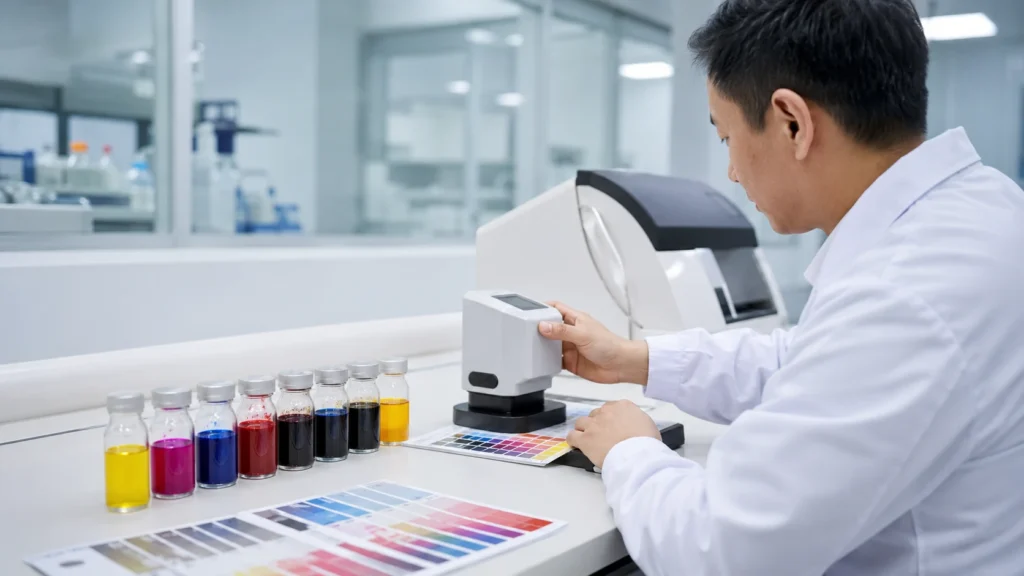
Dentro del Precio por Unidad: Tinta, Ensamblaje y la Compensación entre Costo y Calidad
Once molds are handled, per-unit cost splits into materials, labor, and overhead. That simple split hides the decisions that shape your final number.
Ink is the biggest material cost driver. Water-based school ink costs less than alcohol-based art ink with strong color and blending. Metallic inks sit higher because suspended pigments need special processing. Gel ink is its own category, with flow properties that need precise control.
The ink price gap is real, but the bigger risk is not the ink itself. It is what happens when a factory buys ink from an outside supplier and that supplier changes a pigment or solvent between batches. Color that matched on order one may drift on order two. Fixing it, plus storing mismatched stock, can cost more than the ink savings.
Factories with in-house ink R&D control the formula at the source, match colors per batch, and lock formulas for repeat orders. That lab is not free. It sits inside the factory overhead and the unit price. For brands that depend on color consistency across seasons, it is worth paying for. ZH STATIONERY runs an in-house ink lab for marker pens, metallic markers, and acrylic markers. Batch color checks are part of the workflow, not an outside service.
Assembly and filling costs scale with automation. Automated lines with inline weighing and cap-torque checks make fewer bad units than manual lines with end-of-line sampling. The automated price per unit may be slightly higher, but the total cost (including returns, replacements, and reputation) is almost always lower.
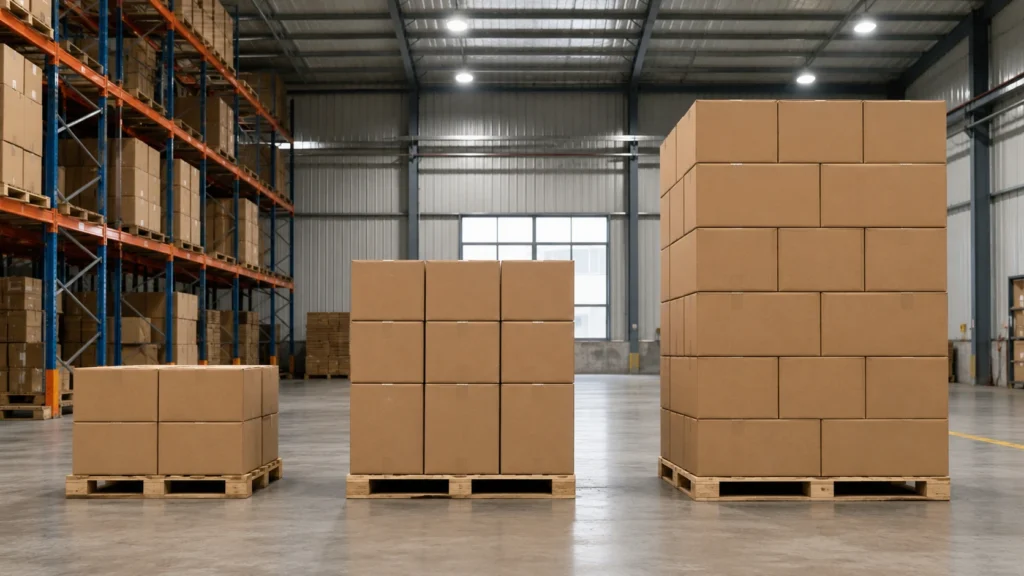
Cómo el MOQ Cambia Todo Acerca de su Costo Unitario
The minimum order quantity is not just a factory rule. It is a pricing mechanism. Here is why.
Every production run has fixed costs: machine setup, line changeover, ink batch prep, and QC records. These costs are the same at 50,000 units or 250,000. The difference is how many units share the load.
At 50,000 pieces, the fixed cost per unit is meaningful. At 100,000, it drops a lot. At 250,000, it hits a floor. Past that volume, savings come from material buying power and container loading, not from spreading fixed costs.
Costo unitario más alto. Mejor para pruebas de mercado, tiradas de edición limitada y primeros proyectos de marca privada donde el riesgo de inventario importa más que el margen por unidad.
- 50,000 pens per order: Custom OEM/ODM entry point, counted by total individual pens produced. Mold amortization and fixed costs are real at this size, so the per-unit price still carries the tooling burden.
- 50,000–100,000 units: Mold amortization and fixed-cost absorption begin to work well. Per-unit cost drops noticeably. This is the typical range for private-label brands building repeatable product lines.
- 100,000–250,000 units: Per-unit cost approaches optimal levels. Raw material purchasing at scale, dedicated line scheduling, and container-load shipping add further savings.
- 250,000+ units: Marginal per-unit savings slow. The negotiation shifts from unit price to payment terms, shipment scheduling, and multi-SKU coordination.
A factory with 26+ years of OEM/ODM experience and a 10,000+ square meter base with 8 production workshops, like ZH STATIONERY, can run trial orders and large bulk orders. The capability to look for is not just MOQ flexibility. It is steady quality from 50,000 to 500,000+ units, and a factory that only hits quality on slow, small runs cannot scale.
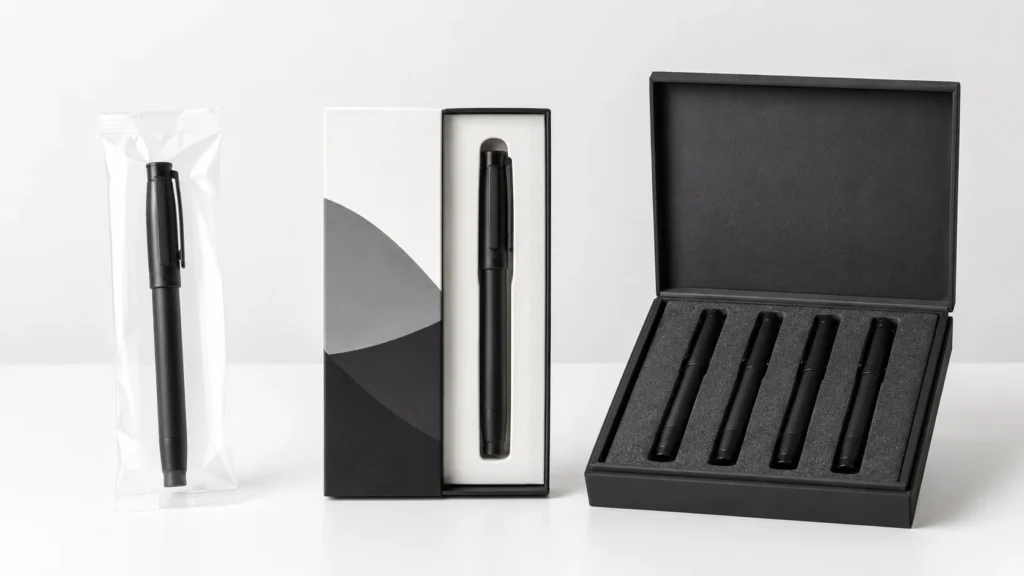
Embalaje: El multiplicador de costos que la mayoría de los compradores subestiman
Packaging is not just the box the pen comes in. It shapes unit cost, freight, shelf look, and sometimes customs classification.
Así es como los costos de empaque se acumulan:
- Capa uno: empaque primario. This is what the consumer sees on the shelf: the blister card, the display box, the hang-sell pouch. Every design decision at this layer affects per-unit cost: single-color printing versus full-color, standard cardstock versus premium textured paper, simple tuck-flap boxes versus magnetic-close gift boxes. A análisis de factores de costo de marcadores personalizados que ignore los detalles del empaque es esencialmente una suposición.
- Capa dos: empaque interior. Multi-pen sets, assorted color packs, and gift configurations require inner trays, dividers, or elastic bands to hold individual pens in position. These components add cost per set and increase assembly labor. A 12-color marker set does not cost 12x the price of a single marker. It costs more, because the set packaging, inner tray, and assembly all add line items that do not exist in a single-pen SKU.
- Capa tres: cajas de exportación. The outer carton determines how many units fit in a shipping container. Carton dimensions, stacking strength, and pallet density all affect your per-unit freight cost. Sometimes the difference is enough to offset a seemingly attractive factory price. A factory that designs export cartons for container optimization (minimizing wasted air space, maximizing units per pallet) delivers a lower total landed cost even if its unit price is slightly higher than a competitor who ships in oversized boxes.
- Capa cuatro: etiquetado de cumplimiento normativo. Barcodes, country-of-origin markings, age-grading labels, and safety warnings (the “Conforms to ASTM D-4236” statement required for U.S. art materials) all occupy real estate on the package and must be printed accurately. A packaging misprint on a compliance label can render an entire shipment unsellable in a specific retail channel, and the loss is far larger than any printing savings.
For private-label buyers, packaging is where factory customization pays off. ZH STATIONERY supports color boxes, PVC boxes, display boxes, gift sets, blister cards, private-label barrel printing, custom color sets, and barcode or warning labels. In-house packaging means faster proofs, lower revision costs, and the same QC discipline as the product.
Certificaciones y Cumplimiento Normativo: La Partida que No se Puede Omitir
Compliance is not optional for the U.S. and Europe, and it is not free. Every product variant in a regulated market needs documented proof of safety. The costs repeat with each batch, so budget for them from day one.
Per the U.S. Consumer Product Safety Commission (CPSC), all art materials sold in the United States need a toxicology review under the Labeling of Hazardous Art Materials Act (LHAMA). This includes markers, gel pens, and paint pens, and applies to adults and children alike. The label must state “Conforms to ASTM D-4236.”
For products marketed to children under 12, CPSIA adds mandatory third-party testing for lead and phthalates. The tests run at a CPSC-accredited lab, and the importer issues a Children’s Product Certificate.
In the European Union, the Toy Safety Directive requires EN71 compliance for products classified as toys. EN71-3, which tests the migration of 19 heavy metals, is the most critical and expensive test for ink products.
Practical budget points for buyers:
- Las pruebas de certificación deben cubrir el SKU del producto específico y la formulación de la tinta, no solo la categoría general del producto de la fábrica.
- Los informes de prueba generalmente necesitan renovarse cada 12–24 meses, o cada vez que cambie la formulación de la tinta o el abastecimiento de materiales.
- Una “certificación de fábrica” que data de hace dos años y cubre un producto diferente no es válida para su envío.
- Third-party testing through ISO 17025-accredited labs (SGS, Intertek, TUV, BV) is the standard. In-house test results do not satisfy U.S. or EU customs requirements.
- Cada variante de producto adicional (diferente familia de color de tinta, diferente material del barril, diferente tipo de punta) puede requerir pruebas separadas.
ZH STATIONERY supports EN71 and ASTM D-4236 certified options with batch-level testing records, so the paperwork is tied to real production runs. Ask this question: “Can you provide a dated report from an accredited lab covering this exact product spec?” If the answer is slow or vague, raise the certification budget or change suppliers.
Preguntas Frecuentes
¿Cuál es el MOQ típico para rotuladores personalizados?
El pedido mínimo para programas personalizados OEM/ODM es de 50.000 bolígrafos por pedido, contados por el total de bolígrafos individuales producidos. Para un paquete de 12 colores, eso equivale aproximadamente a 4.200 estuches, no 50.000 de cada color. Los modelos estándar en stock pueden muestrearse en cantidades de prueba más pequeñas.
¿Qué factores afectan más el costo por unidad de un marcador personalizado?
Five cost drivers stand out. Ink type: water-based is cheapest, alcohol and specialty inks cost more. Tip style: brush and dual-tip designs add cost. Barrel printing: silkscreen is cheapest, multi-color UV adds cost. Packaging: polybag is cheapest, custom retail boxes add the most. Order volume: bigger orders cut per-unit cost. Certification testing is not per-unit, but plan for it in the project budget.
¿Por qué las fábricas cobran por separado el desarrollo de moldes?
Mold development is a one-time capital cost. The factory pays for steel, machining, and trial runs up front, so it charges the tooling separately instead of folding it into the unit price. If the mold cost were built into the per-unit price, every repeat order would keep paying for the mold forever. A separate tooling charge keeps pricing fair for one-time and repeat orders alike. Separately, agree who owns the tool and design files, because paying a tooling charge does not by itself give you ownership.
¿Cómo puedo reducir el costo total de un pedido de bolígrafos personalizados sin sacrificar la calidad?
Three strategies work. First, cut SKU variants, because every color, tip, or packaging format adds setup cost. Second, raise order volume within what your sales forecast supports, so fixed costs spread over more units. Third, standardize packaging: use one box template for several SKUs with different artwork. An OEM factory with 26+ years can suggest cost cuts that do not touch the user experience.
¿Qué certificaciones debo considerar en mi presupuesto al importar bolígrafos a los Estados Unidos y Europa?
For the U.S. market, budget for ASTM D-4236 (LHAMA) review plus CPSIA testing if you sell to children under 12. For Europe, budget EN71-3 and REACH documentation where needed. Testing repeats per batch and costs more with more variants. Get a test cost estimate before ordering, and confirm the factory uses ISO 17025-accredited labs.
¿Es más barato fabricar por lotes o realizar un pedido grande único?
One large order is almost always cheaper per unit. It spreads mold cost, cuts the fixed-cost burden, and unlocks container freight. The tradeoff is inventory cost and cash flow. A hybrid works for many brands: a large base order for core SKUs plus small replenishment orders to adjust color and pack mix. ZH STATIONERY supports both, from 50,000-pen trials to bulk runs.
If you source marker pens or metallic markers for a private-label brand or wholesale channel, share your target specification first. Include ink type, tip style, color count, packaging, and expected volume. Then ask for a clear cost breakdown that covers mold, per-unit, packaging, certification, and freight. Contact ZH STATIONERY to start that conversation.
Related guide: For compliance planning, see Fabricación de bolígrafos OEM ODM.
Lecturas relacionadas
- Cómo negociar el MOQ con fábricas chinas de bolígrafos sin dañar la relación
- Fabricante de Marcadores Acrílicos Personalizados: La Lista de Verificación para Compradores OEM/ODM en 2026
- Fabricante de bolígrafos personalizados con forma de animal: guía del comprador OEM/ODM sobre materiales, moldes, seguridad y MOQ
For quality system frameworks, see Recursos de gestión de calidad ISO.