

子供用マーカーを調達するとき、真に安全な食品グレードのマーカーインクを見つけることが、ほとんどのB2Bブランドにとって最大の悩みだ。ほとんどの企業にとって、答えは安全性だ。1つの化学的リスクがリコール、高額な法的争い、ブランドの崩壊につながり得る。今日、バイヤーは無毒または食品グレードの製品を求めている。
長年の研究開発実績を持つ元工場として、業界の事実をお伝えする必要があります。すべての食品グレードマーカーが本当に安全とは限りません。真の化学的安全性とは何かを考えてみましょう。当社工場が高度なインク技術を用いて、子供たちとお客様のビジネスをどのように守っているかをご紹介します。
1. 偽の「食品グレード」表示の抜け穴
「食品グレード」という言葉は、しばしばマーケティング上のトリックです。多くの工場は危険な近道を使います。食品グレードの着色料、つまりインクを赤や青にする染料を使用します。そしてパッケージに「食品グレード」と印刷します。その他の成分は無視します。
インクは色だけではありません。液体の流動性を保つために溶剤が必要です。カビを防ぐために鮮度保持剤が必要です。安価で低品質なマーカーでは、これらの隠れた成分がしばしば刺激の強い工業用化学物質です。
子供は手にインクを付けたり、キャップを口に入れたりする可能性があります。完成品を対象年齢層と想定される使用方法に照らして確認してください。全成分、キャップ、エンドプラグを確認してください。「工業用防腐剤」という言葉だけで特定の病気や長期的な影響を推測しないでください。成分の特定、暴露量、製品固有のレビューが重要です。

2. 私たちの革新:「インクを食品のように」という基準
この業界の問題を解決するために、当社の研究開発チームは厳格な新基準を構築しました。それを「インク・アズ・フード」という考え方と呼んでいます。当社のマーカーインクに含まれるすべての成分は、厳格な食品添加物基準を満たす必要があります。例えば、 GB 2760規格当社は着色料を替えるだけではない。溶剤、バインダー、鮮度保持剤を天然の食品に安全な選択肢に変える。当社の チーム がこの取り組みを主導しています。
自然由来の成分を使用しても、マーカーはきちんと描けるのかと疑問に思われるかもしれません。答えはイエスです。高度なブレンド技術と乳化技術により、当社のエンジニアはインクの鮮やかさ、滑らかさ、安定性を維持しています。紙の上では色が深く鮮明に発色します。インクは速乾性すぎず、良好に流れます。子供向けの高品質な画材を作るために有毒な化学物質は必要ないことを証明しました。
3. 最大の課題:天然防腐剤とUSP51試験
安全なインクの最も難しい点は、細菌やカビの繁殖を防ぐことです。マーカーは数か月間、棚や倉庫に保管されます。鮮度保持剤がなければ、水性インクはすぐにカビが生える可能性があります。旧来の工場では強力な化学殺生物剤を使用します。当社はその近道を拒否しました。天然の食品グレード鮮度保持剤のみを使用した防御システムを構築しました。
その効果を証明するために、当社のインクを認定第三者機関に送り、 USP51抗菌有効性試験これは厳格な世界的テストだ。製品が細菌の増殖を止めるかどうかを検査する。ラボは大腸菌や黄色ブドウ球菌のような強力な細菌に対してテストした。カンジダ・アルビカンスのような強力なカビに対してもテストした。
ZH Stationery has confirmed that supporting USP 51 test records exist. They include counts below 10 cfu/g at days 14 and 28. Review the real report for the tested formula, organisms, method, and pass rules. Below 10 cfu/g is not proof of zero germs. An antimicrobial result does not by itself mean the ink is edible. It also does not review every chemical exposure risk.
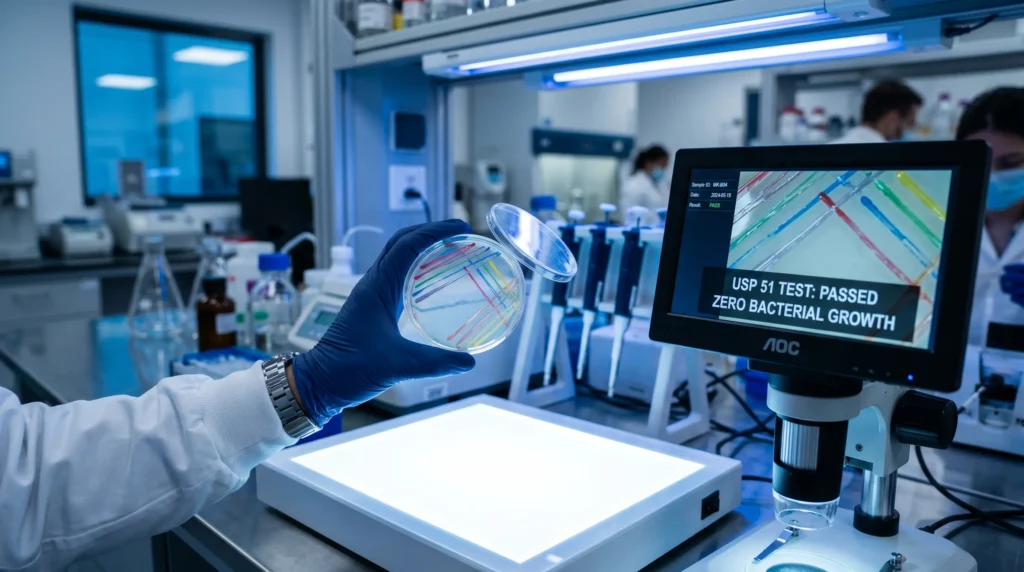
科学的结果は卓越したものでした。過酷な化学防腐剤を使用していないにもかかわらず、当社のインクは14日後および28日後も細菌の増殖がゼロでした。総細菌数は10 cfu/g未満(非常に安全とみなされるレベル)に保たれました。この確かなデータは、当社の天然配合が、子供を化学的害から守りながら、優れた長期的な防菌効果を提供することを証明しています。“
当社工場では、B2Bパートナーと最終ユーザーに対して完全な誠実さを信じている。だから明確な警告を述べなければならない。当社のインク部品は食品に使えるほど安全だが、マーカーは食べられない。
なぜか?筆記用品工場は食品厨房ではない。成形機、工場の空気、組立ラインは厳格な産業安全基準に従う。食品焼成の衛生基準には従わない。子供は決してマーカーを食べるべきではない。
食品添加剤の部品は、完成したマーカーを食品や化粧品にするものではありません。筆記用途と警告を明確に保ってください。皮膚接触、口に入れる可能性、その他の実際の曝露は、適切な製品チェックを通じて確認してください。化学的リスクをゼロやほぼゼロと呼んではいけません。

当社の極めて「食品グレード」な配合は、目に見えない安全網として機能するように設計されています。誤ってインクが皮膚に付着したり、紙に描いた際にその近くで呼吸をしたり、ペンを一時的に口に入れたりした場合に子供を守ります。化学的リスクをほぼゼロに減らしますが、製品はあくまで描画のためのツールであり、スナック菓子ではありません。適切な警告ラベルは、必ず最終製品のパッケージに表示されるべきです。
信頼できるプレミアムな筆記ブランドを望むなら、あなたと同じくらい安全性を真剣に受け止める製造業者が必要です。当社の完全な食品グレードインクマーカーは、EUのEN71-3およびEN71-9規則を含む厳しい世界基準に合格しています。
インクの深い化学的作業を管理する真の源流工場を選ぶことで、あなたはユーザーを守れます。また、コンプライアンス違反からグローバルサプライチェーンも守れます。偽の安全ラベルにブランドを賭けてはいけません。当社と協力して、本当に安全で鮮やかで高品質なマーカーを教室や家庭に届けましょう。
関連ガイド: 2026年にプレミアムマーカーへの投資が価値ある理由.
関連記事
What “Food-Grade” Can and Cannot Mean for a Marker
The phrase gets used loosely, and the looseness is the problem. For a marker, “food-grade” cannot mean the ink is edible. It can mean some narrower and more defensible things: that the ink contains no substance prohibited under food-contact regulations, that the pigments used appear on an approved list, and that the finished ink passes a migration test appropriate to the intended contact scenario.
Each of those claims requires a specific document. “No prohibited substances” needs a formulation review against the relevant positive list. “Approved pigments” needs the color index numbers named. “Passes migration” needs a test report naming the simulant, the temperature, the contact time, and the detection limit.
A supplier who says “food-grade” and produces none of those is using the phrase as marketing. That is common, and buyers who do not ask for the underlying documents are the ones who discover the gap when a retailer’s compliance team reviews the file.
The Regulatory Gap Between Food Contact and Art Material
Food-contact materials and art materials are regulated under separate frameworks with different assumptions about exposure.
Food-contact regulation assumes the material touches food and models migration into the food over a defined time and temperature. Art material regulation assumes the material is used as intended — drawn with, not eaten — and focuses on acute and chronic hazard labeling.
For a marker that might be used on a plate or a cake topper, both frameworks are relevant. The art material review covers the labeling obligation; the food-contact review covers the migration question. Passing one does not satisfy the other, and a supplier that offers only the art material statement has not addressed the part of the risk a food-contact buyer actually cares about.
There is also a practical middle ground worth naming: many products marketed as food-safe are not intended to touch food at all. They are intended to decorate packaging or write on labels. In that case the correct claim is about the packaging material, not about the ink.
Preservatives: The Hardest Formulation Problem
Water-based ink supports microbial growth. Without an effective preservative, a marker reservoir becomes a culture medium within weeks. That is why preservative choice is the hardest part of building a genuinely food-safe water-based ink.
The common preservatives — isothiazolinones, formaldehyde releasers, and various organic acids — are effective and inexpensive. Several of them are also restricted or under scrutiny in food-contact contexts, which puts formulators in a bind: the preservative that works best is often the one that is hardest to defend.
Natural alternatives exist but come with tradeoffs. Some are pH-sensitive and lose effectiveness as the ink ages. Some have narrow spectrum coverage, leaving a gap against either bacteria or fungi. Some interact with pigments and cause color shift over shelf life.
The practical answer for most programs is a preservation system rather than a single agent, validated by a challenge test that models the actual product. A challenge test inoculates the ink with representative organisms and measures whether the system recovers. It is the only credible evidence that a preservative package works in that specific formulation.
How to Verify a Supplier’s Claim
Four documents separate a verifiable claim from a marketing phrase.
Formulation declaration. A list of the substances in the ink, by function, with the regulatory status of each named. A supplier that refuses to disclose the formulation to a buyer under NDA is not protecting a trade secret; it is declining to be checked.
Pigment identification. The color index numbers for every pigment used. This lets the buyer check the pigments against the positive list for the target market independently.
Migration test report. The simulant used, the temperature and contact time, the detection limit, and the result. A report without those parameters is not reproducible.
Challenge test report. The organisms tested and the recovery results, tied to the specific formulation and the specific preservative concentration.
A supplier who can produce all four is doing the work. A supplier who produces one and calls it food-grade is selling a phrase.
よくある質問
Does food-grade mean the ink is safe to eat? No. It means the ink meets certain restrictions relevant to food contact. Edibility is a different claim and should never be implied.
Can a marker be both art-material compliant and food-contact compliant? Yes, but both reviews have to be done. One does not imply the other.
Why is preservative choice so difficult? Because the most effective preservatives are often the most restricted, and natural alternatives have narrower coverage or stability problems.
What should I ask for first? The formulation declaration and the pigment color index numbers. Without those, nothing downstream can be verified.
The Cost of Getting This Wrong
A failed food-contact claim is not a marketing embarrassment. It is a recall event. If a retailer discovers that a marker sold as food-safe has no migration test behind it, the product comes off the shelf, the buyer loses the program, and the factory’s name goes on an internal do-not-use list that persists for years.
The cost is asymmetric. Doing the testing costs a few thousand dollars and adds two to three weeks to the timeline. Skipping it costs the entire program plus the relationship. That math is not close.
Buyers should also distinguish between the two failure modes. A product that fails a test is a technical problem with a known fix. A product that claims compliance without testing is a credibility problem, and credibility does not come back through a reorder.