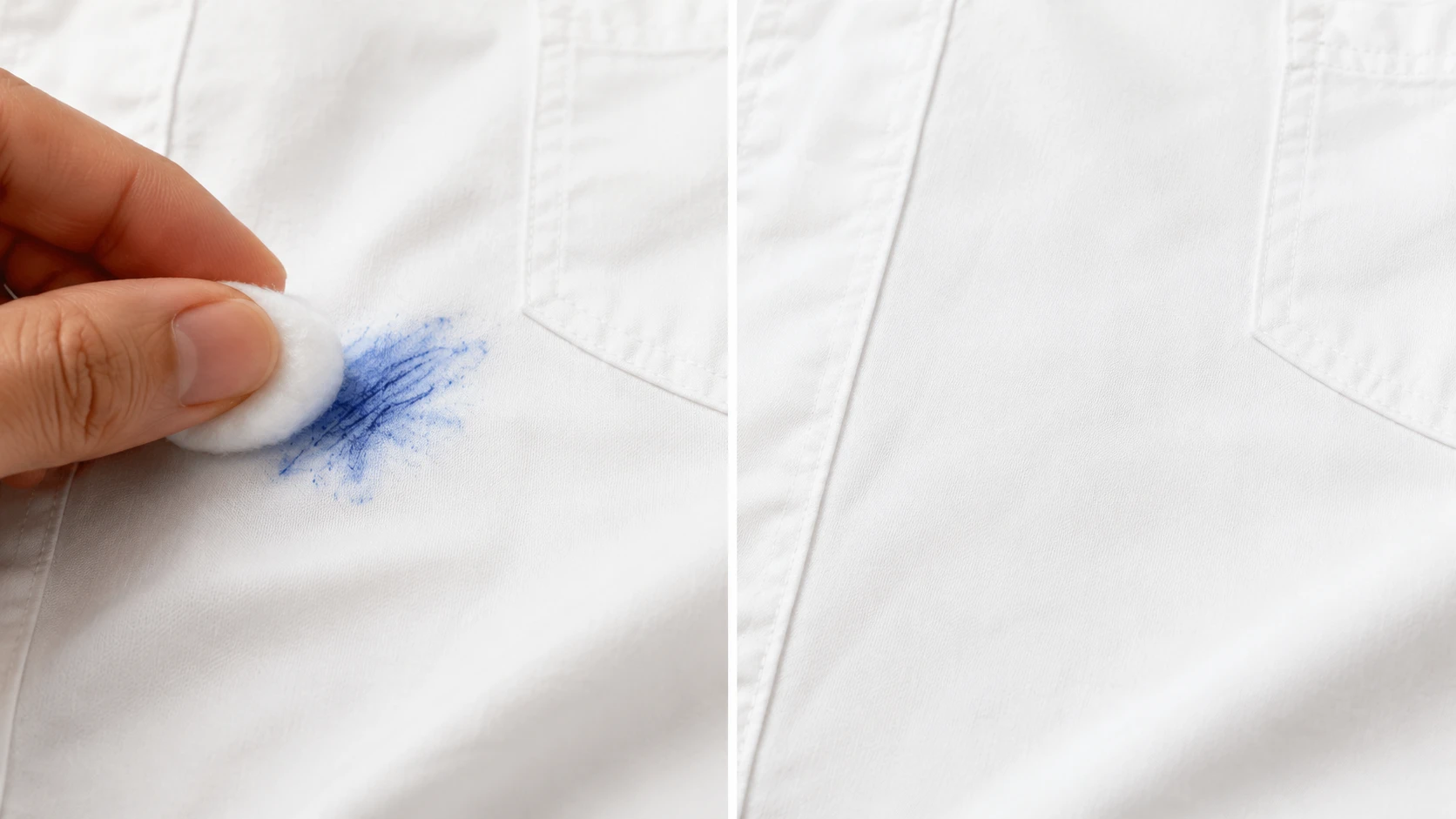
A teacher grabs a whiteboard marker, uncaps it, waves toward the board, and leaves a blue streak across a white shirt sleeve. The stain looks permanent. She tries water. Soap. Scrubbing. Nothing works. The marker goes in the trash. The brand goes on a mental blacklist.
For B2B buyers sourcing dry erase markers, that moment is not just buyer frustration. It is a quality failure with a real cost. Every end user who cannot lift a stain is a lost repeat buyer. Every school that swaps brands after one complaint is a buying call you never hear about.
Dry erase stain removal difficulty is not random. It follows from ink-formulation decisions made at the factory. Know what makes a stain removable. Know what makes it permanent. Then you have a practical frame for judging marker quality before bulk orders. Start with the ink quality guide.
Table of Contents
Quick Answer: How To Remove Dry Erase Marker Stains
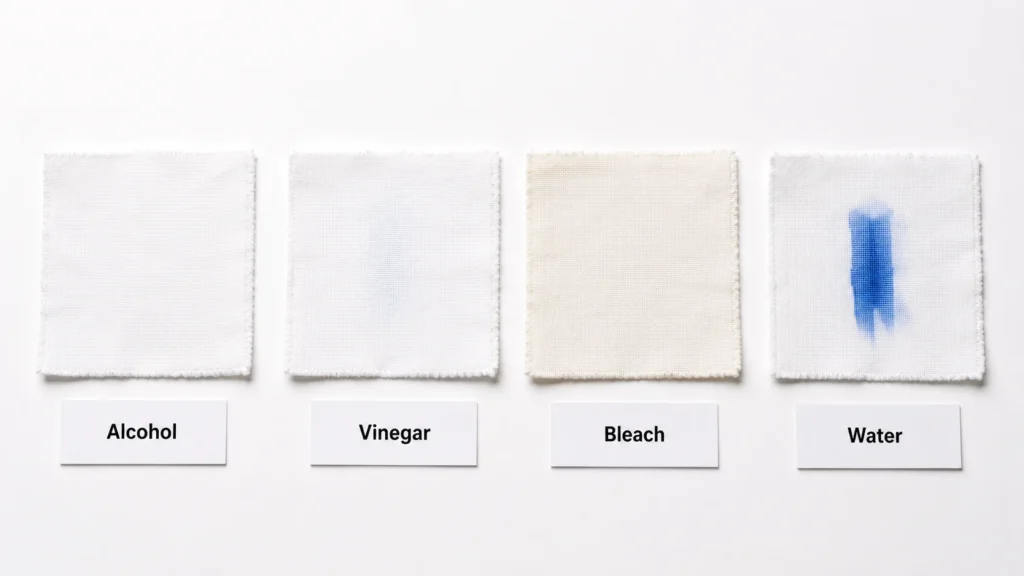
The methods below are ranked by effect. Each one works or fails because of exact ink chemistry:
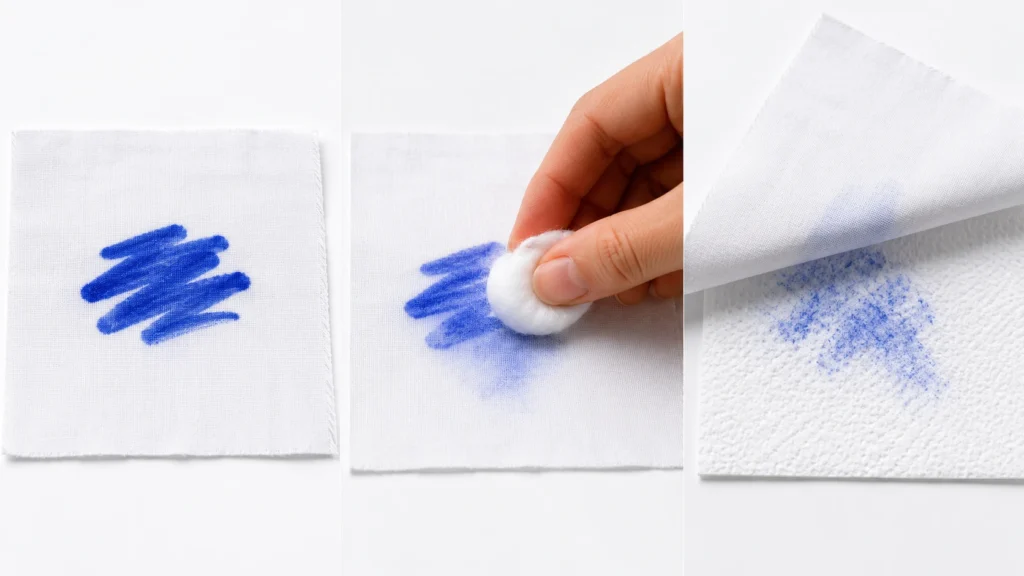
- Rubbing alcohol (isopropyl alcohol, 70 to 90 percent) is the strongest option. It re-dissolves the resin binder that traps pigment in fabric fibers, so you blot the ink out instead of scrubbing it deeper. Dry erase ink uses alcohol as its solvent carrier. The same chemistry that keeps ink liquid in the barrel is the chemistry that removes it from fabric.
- White vinegar is a mild acid. It can break down some resin binders, but it’s slower and weaker than alcohol on heavy stains. It’s the safest choice for delicate fabrics where alcohol might discolor the material.
- Lemon juice does roughly what vinegar does. The citric acid helps loosen pigment from fiber surfaces. Best on fresh, light stains on cotton.
- Bleach removes pigment by oxidation. White fabrics only. It destroys the color molecules instead of dissolving the binder, which means it can damage the fabric if you overdo it.
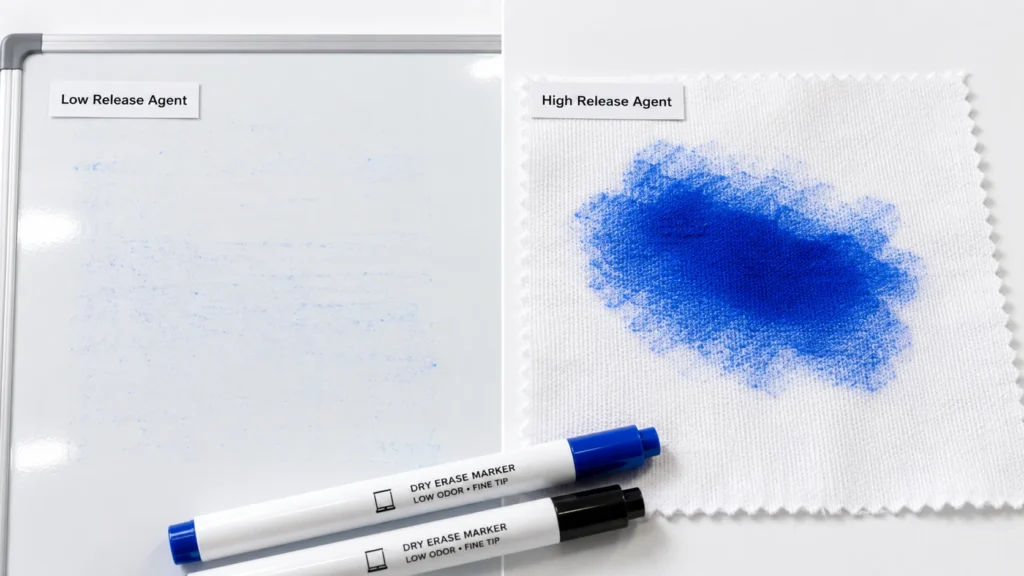
- Water and soap, on their own, almost never work. The silicone polymer release agent in dry erase ink is designed to repel water. That’s the whole reason the ink erases cleanly from a whiteboard. It’s also why it won’t rinse out of clothing with water based detergents.
For brand owners and buying teams, these factors help set sharper sourcing and quality check bars.
What Dry Erase Marker Stain Removal Difficulty Reveals About Marker Ink Quality
Every removal method wins or fails by a specific chemical interaction with the ink. For B2B buyers, the removal profile of a marker says more about ingredient quality than any catalog line does:
| Removal Method | How It Works on Dry Erase Ink | What It Reveals About Ink Formulation | B2B Quality Signal |
| Rubbing alcohol (isopropyl) | Re-dissolves the resin binder holding pigment on fabric fibers; matches the original solvent carrier chemistry | Ink uses alcohol-soluble resin; pigment is not chemically bonded to fibers | Standard alcohol-based solvent system. Check solvent purity and evaporation rate. |
| White vinegar (acetic acid) | Mild acid partially breaks resin-to-fiber adhesion; less effective when release agent concentration is high | Resin has some acid sensitivity; release agent level affects removal ease | High release agent (good for board erasing) makes acid-based removal harder. There’s a direct tradeoff between board performance and stain removal. |
| Bleach (oxidation) | Destroys pigment color molecules through oxidation; does not dissolve the binder resin | Pigment susceptibility varies: organic pigments bleach out; inorganic metal oxides resist | Pigment type matters. Organic pigments (azo compounds) bleach. Titanium dioxide and iron oxide pigments don’t. Ask the supplier which chemistry they use. |
| Water + detergent | Tries to emulsify and suspend pigment; release agent coating repels water | Release agent is doing its job. Water resistance is intentional. | A marker whose ink washes out with plain water has too little release agent for proper board erasability. That’s a formulation choice, not a defect. |
| Heat (iron, dryer) | Cross-links the resin binder to fabric fibers, locking the stain in permanently | Resin is thermosetting. Once heat-cured, solvent re-dissolution stops working. | Heat-set stains cause the most permanent damage. Packaging needs clear cold-water-only washing instructions. |
The table shows something buyers rarely hear. The same formula calls that make a marker erase clean from a board, strong release agent, alcohol-soluble resin, steady pigment, are the same calls that make it stain clothing. The best markers are not stain proof. They are stain manageable. Their chemistry answers well when you use the right removal method.
Why Fabric Type Changes Everything About Stain Removal
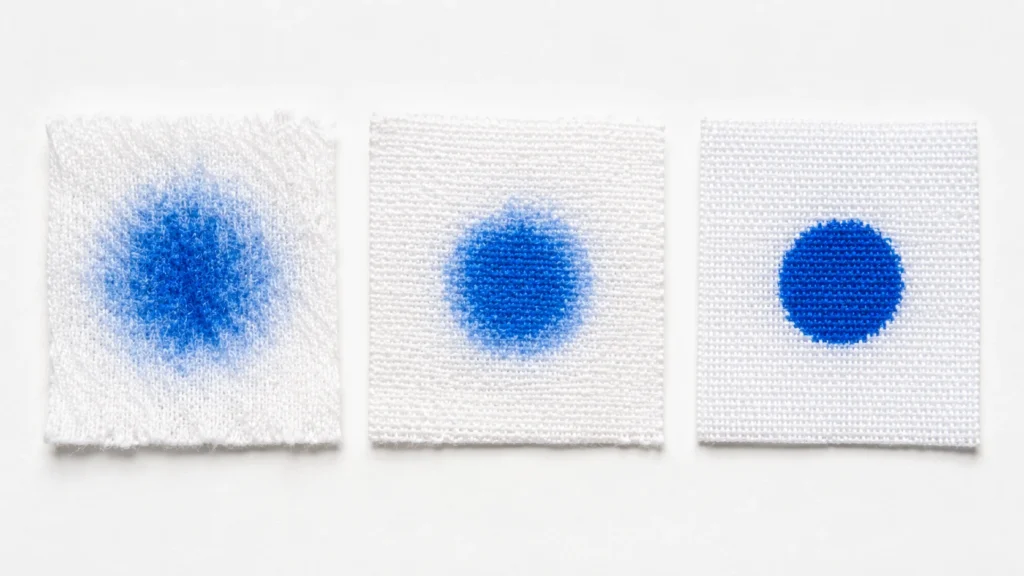
Fabrics are not all equally stainable. Fiber pores and chemistry decide how deep the pigment goes and how hard it is to pull out.
Cotton is the worst. Cotton fibers are hollow, ribbon-like cellulose. They wick liquid into the core fast. When alcohol solvent carries pigment into a cotton fiber, the pigment ends up trapped inside the fiber cavity, not just on the surface. Water cannot reach pigment that deep. Rubbing alcohol can, because it travels the same route the solvent took.
Polyester is a different problem. Polyester fibers are synthetic and water-shy. They do not take water. They do take organic solvents. The alcohol in dry erase ink moves into polyester easy and carries pigment deep into the fiber body. When solvent leaves, the pigment is locked inside that smooth polymer. Solvent removal works on polyester only when the stain is fresh, within minutes to hours. Once the resin cures, heat speeds this, polyester stains get brutal.
Cotton-polyester blends join both problems. Cotton wicks ink in. Polyester traps it. Act fast. Use the right solvent. Never add heat before the stain is fully lifted.
Silk and wool are protein fibers. They take pigment fast. Strong solvents hurt them. Diluted vinegar or special dry-cleaning solvents are safer than rubbing alcohol, though weaker on heavy stains.
For B2B buyers, here is the point. The fabric your end users wear decides how they feel your product. A marker that makes easy stains on 100 percent cotton swatches can leave permanent marks on the poly-cotton blend uniforms in real classrooms. When a supplier says washable, ask what fabric they tested. A vague answer means the data is not solid.
The Formulation Tradeoff B2B Buyers Need To Understand
Dry-erase ink formulation involves a built-in tradeoff. The three traits buyers want most fight each other.
- Clean board erasability needs a strong release agent, typically a silicone polymer that forms a non-bonding film between the pigment and the whiteboard surface. More release agent means a cleaner erase. But that same release agent repels water, which is why detergent can’t remove clothing stains. Better board performance equals harder stain removal.
- Strong color needs high pigment loading, typically 30 to 50 percent of the ink formula by weight. More pigment means bolder, more visible writing on the board. It also means more solid particles available to get trapped in fabric fibers when a stain happens. Better color equals worse staining.
- Washability requires switching from pigment to polymeric dyes (which dissolve at the molecular level and wash out in laundry) or adding dyeblocker compounds that stop colorants from bonding to fabric. Polymeric dyes give slightly less intense color on the board. Dyeblockers cost more and can affect ink viscosity. Better washability means accepting tradeoffs in board performance or manufacturing cost.
No factory solves this. B2B buyers move through it by understanding their market's priorities. A school brand puts washability first. Teachers forgive slightly lighter board writing if uniforms survive the week. An office brand puts board performance first. Adults are less likely to ink their clothes. They complain about ghosting.
A factory with its own ink lab can tune pigment-to-dye ratio, release agent level, and dye blockers by what the market needs. ZH Stationery has built custom inks for marker pens, dry erase included, across 26-plus years of OEM/ODM work. See the paint marker process and alcohol marker makers pages. The skill is knowing which trades your market takes.
What B2B Buyers Should Test Before Placing A Dry Erase Marker Order
Catalog lines will not tell you how a marker really stains fabric. Run these four tests instead:
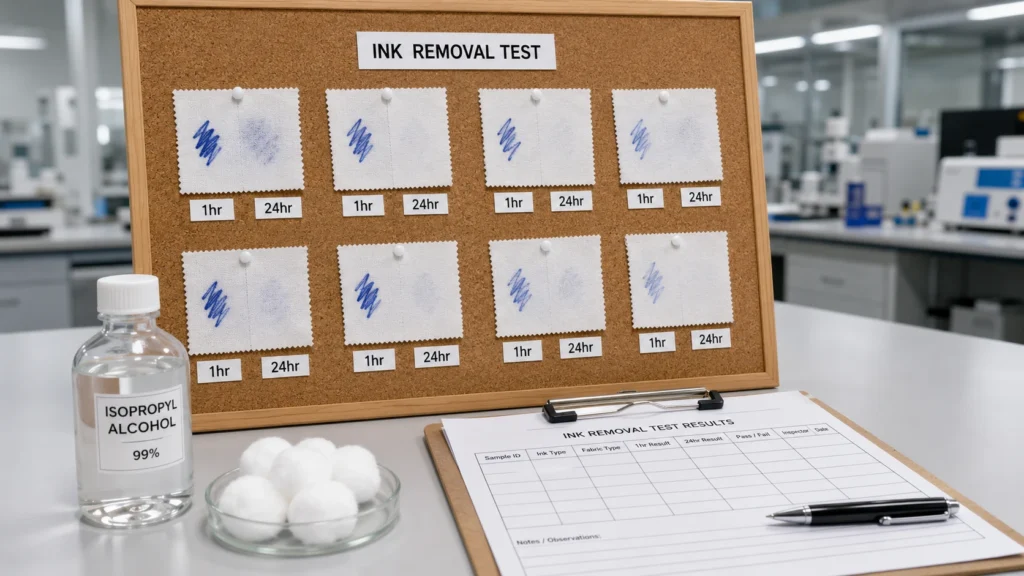
- Fabric washability on poly-cotton blend. Apply ink to a 65/35 poly-cotton swatch (the most common school uniform fabric). Let it dry one hour. Try removing it with 70 percent isopropyl alcohol using the blotting method. On a separate dried stain, wait 24 hours and try again. Record how much pigment stays behind each time. This simulates the real scenarios your product will face.
- Board erasability after 24 hours. Write on a standard whiteboard. Let the ink sit for 24 hours. Erase with a dry cloth. A quality formulation leaves nothing behind. Ghosting means insufficient release agent or wrong resin chemistry, both of which also affect stain removal.
- Cap-off recovery. Remove the cap. Leave the marker exposed for two hours. Then write. It should start immediately, no skipping, no priming. Cap-off failure comes from solvent evaporation rate and cap-seal design, both of which the factory controls at the formulation stage.
- Heat-set stain test. Apply ink to fabric. Let it dry one hour. Press with a warm iron (no steam) for 10 seconds. Try removing with alcohol. If the stain goes permanent after heat, the resin is thermosetting. That means end users who accidentally toss a stained shirt through the dryer will never get it out. This belongs on your packaging warning.
A factory that runs 100 percent check on every unit before packing, across a 10,000+ sqm site with 8 workshops, can make this data. ZH Stationery works that way. See the factory tour and the custom marker manufacturer. The question is not does your ink wash out. Ask: can you show wash data on poly-cotton blend after 1 hour and 24 hours, with and without heat?
Frequently Asked Questions
What Is The Most Effective Way To Remove Dry Erase Marker From Clothes?
Rubbing alcohol, 70 to 90 percent. It re-dissolves the resin binder that holds pigment on fibers. The chemistry matches the solvent carrier the marker itself uses. Put alcohol on a clean cloth. Blot from the outside edges inward. Do not rub. Rubbing pushes pigment deeper. Swap the cloth as it picks ink. Keep going until no more pigment moves. Then wash in cold water. Never add heat before the stain is fully out.
Why Does Rubbing Alcohol Remove Dry Erase Stains When Water And Soap Cannot?
Dry erase ink has a silicone release agent that makes it water-shy. That is on purpose. It is the same trait that lets ink wipe clean from a board. Water and soap cannot pass this silicone wall. Rubbing alcohol works because it is close to the solvent already in the ink, isopropanol or ethanol. It re-dissolves the resin that traps pigment so the pigment can lift. See the RSC explainer.
Does Vinegar Work For Removing Dry Erase Marker Stains?
White vinegar can partly lift light, fresh dry erase stains. It weakens the bond between resin and fibers. It is weaker than alcohol and safer on silk and wool, where alcohol may discolor. For cotton and polyester, alcohol is still better. Vinegar works best as a pre-wash for mild stains.
Why Do Some Dry Erase Markers Stain Worse Than Others?
Three things in the formula set stain weight. Pigment size. Smaller particles go deeper. Release agent level. More agent gives better board erase and worse stain lift. Pigment versus dye. Dye inks wash out easier. Markers loaded with pigment and strong release agent perform best on the board and stain worst on fabric. That is not a defect. It is a trade. The patent example shows the chemistry direction.
Can Heat-Set Dry Erase Stains Ever Be Removed?
No. Once heat hits a dry erase stain, from iron, dryer, or hot water, the resin bonds to the fibers and the stain becomes near-permanent. The solvent ways that work on fresh stains stop because the bond changed. Packing should always say wash in cold water only for garments with marker ink. ZH Stationery, after 26-plus years of global work, knows which warning language prevents complaints.
How Should B2B Buyers Evaluate Dry Erase Marker Washability Before Purchasing?
Ask the supplier for wash data on 65/35 poly-cotton blend, not 100 percent cotton swatches. Get results for 1 hour and 24 hour set times, with and without heat. Make sure they used 70 percent isopropyl and the blot method, not scrubbing. If the supplier cannot give this for your exact SKU, the wash claim is not verified. ZH Stationery puts batch wash files in the standard QC pack for dry erase orders.
If you source dry erase markers for school programs, office retail, or private label, contact ZH Stationery to talk ink options, ask wash samples, and judge specs for your market. See the contact page.
Related guide: 10 Marker Techniques Every Aspiring Artist Should Know.
Related Reading
- Dry Erase Marker Ink Explained: Why Some Formulas Stain Fabrics and What B2B Buyers Should Check
- How to Get Sharpie Off Dry Erase Board: 3 Chemical-Free Removal Hacks
- Wet Erase Markers Sourcing Report 2026: B2B Buyer Guide
- Classic Blackboard Material: Core Components and Eco-Friendly Updates
- permanent marker removal from plastic
- permanent marker use on CDs
- wet erase markers comparison guide
- food-grade marker ink guide