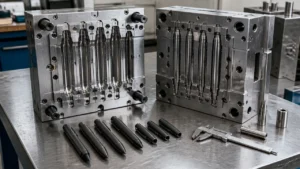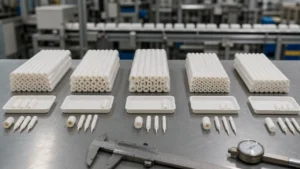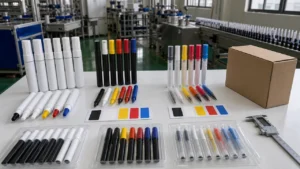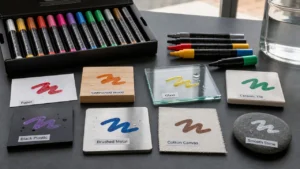
The ASI 2023 Ad Impressions Study says 52% of respondents would keep and use a promotional writing instrument for at least a year. That is a historical survey result for writing instruments. It is not a nine-month average or a promise for engraved gift sets. Judge a custom-pen program by the chosen sample, recipient fit, and measured repeat use.
But not all custom pens are the same product. The difference between a laser-engraved brass rollerball that a client keeps for years and a pad-printed plastic ballpoint that ends up in a drawer is big. The plastic one may even leak in a shirt pocket. That gap comes from manufacturing choices made long before the logo goes on. Procurement managers who understand those choices can source pens that strengthen their brand. Those who do not end up with 2,000 units of regret.
This guide walks through the full sourcing process for custom engraved pens. It covers engraving methods, material choices, factory-level QC metrics, and the workflow that turns a logo into a finished product. It is written for brand owners, marketing directors, and procurement teams who want a real return from their pen program, not just a check box on a promo list.
Table of Contents
Quick Answer: What Makes Custom Engraved Pens A High-ROI B2B Investment?
Corporate pen programs win or fail on three things. The first is writing quality the end user actually feels. The second is how long the branding survives daily use. The third is whether the pen's perceived value matches the relationship it supports. Get all three right and you have a tool that creates impressions at a fraction of a cent each. Miss any one and the pen becomes invisible, or worse, a negative brand signal.
- Laser engraving on metal barrels produces a permanent mark that won’t fade, chip, or peel. The logo is part of the pen, not sitting on top of it. This matters for client gifts and executive onboarding kits where the pen represents your brand for years, not weeks.
- Pad printing is the cost-effective standard for plastic promotional pens (ideal for trade shows and high-volume giveaways where unit economics drive the decision. The imprint can handle up to four spot colors on curved surfaces.
- Material choice directly shapes perceived value. A brass barrel with a satin finish feels fundamentally different in the hand than an injection-molded plastic barrel. The weight, the thermal conductivity, the surface texture) these sensory signals tell the recipient whether this pen is a disposable giveaway or a kept object.
- Ink quality and refill compatibility determine whether the pen gets used or abandoned. A smooth-flowing rollerball refill (ISO 12757-2 compliant) turns a promotional pen into a daily driver. A scratchy, skipping ballpoint gets tossed.
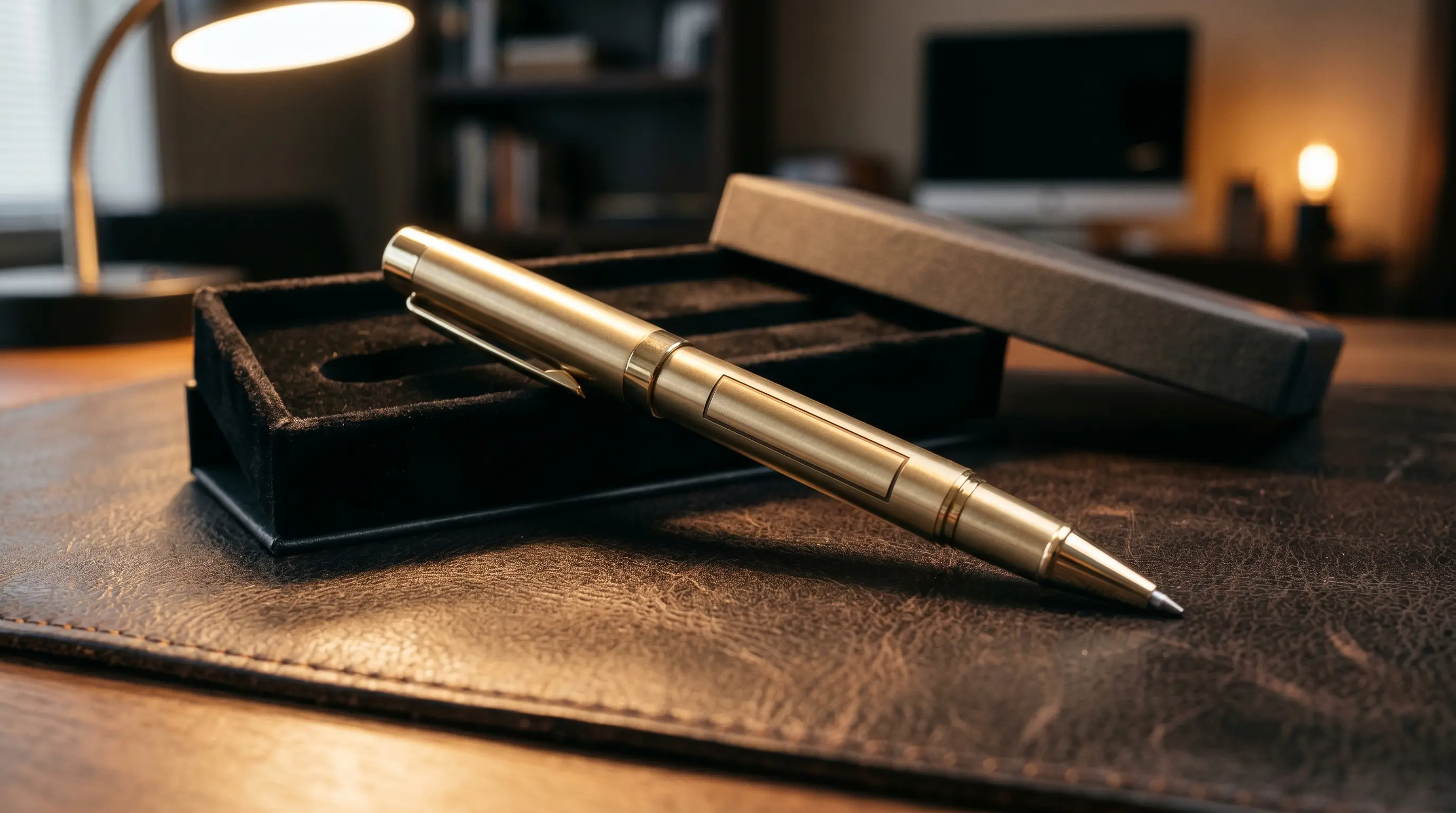
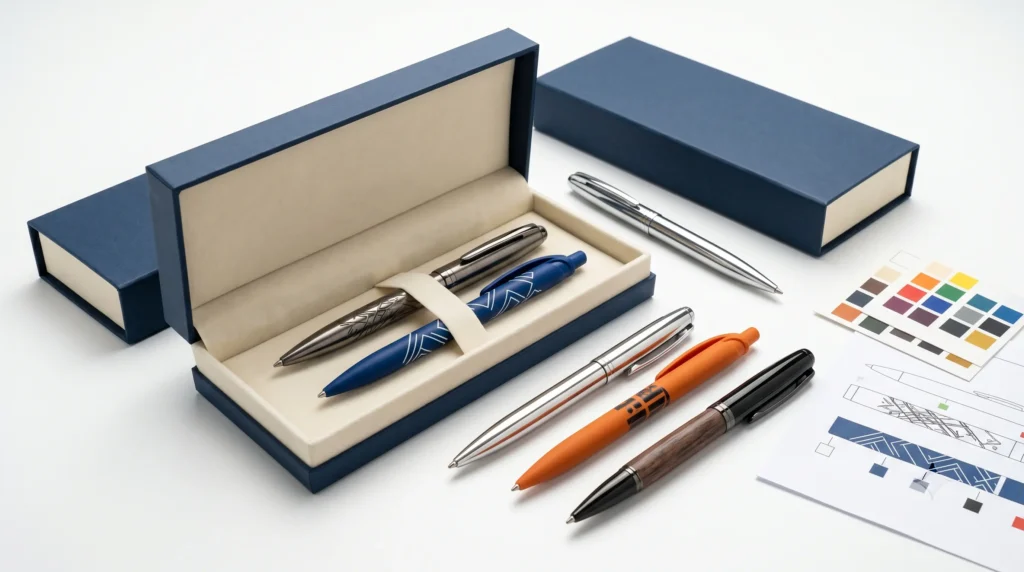
- Packaging amplifies perceived value. A metal pen in a presentation box reads as a gift. The same pen loose in a polybag reads as a sample. For client-facing programs, the presentation matters almost as much as the product.
These factors help procurement managers set precise quality specs and inspection rules. That is also where sourcing conversations usually start to go wrong.
Custom Engraved Pens: A B2B Buyer’s Quality Evaluation Table
When custom engraved pens fail in the user's hands, the procurement manager rarely hears about it directly. The signs come sideways. Reorder rates drop. Clients say the swag felt cheap. A marketing director notices nobody at the conference used the pens. Here is how common complaints trace back to manufacturing choices:
| Common Feature / Issue | Why It Matters / Fails (Root Cause of Customer Complaints) | Checks To Agree With The Supplier |
| Engraving fades or becomes illegible within months | Laser power set too low during engraving; insufficient depth to survive surface wear from daily handling | Agree the engraving method and depth for the chosen alloy and coating; approve a sample after an agreed rub test. |
| Pen leaks ink into pocket or bag | Tip-to-barrel seal tolerance too loose; ink viscosity too low for the feed system’s capillary design | Agree a leakage-test method and conditions for the specific refill and barrel; review batch results. |
| Click mechanism jams or fails after moderate use | Spring tension inconsistent; injection molding flash on internal cam track interferes with smooth actuation | Agree a mechanism endurance target and acceptance criteria; inspect dimensions and actuation consistency. |
| Logo placement is visibly off-center or crooked | Manual alignment without fixture; inconsistent barrel indexing during engraving/printing | Approve logo position on the first sample; agree fixtures, alignment tolerance, and in-process sampling. |
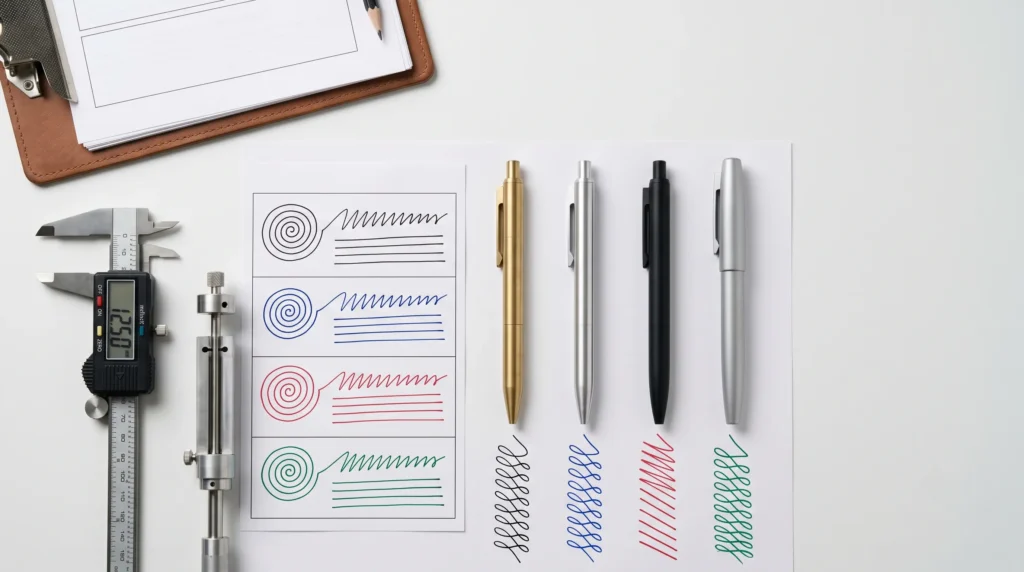
| Writing skips or requires excessive pressure | Ball seat geometry inconsistent; ink viscosity mismatch with ball diameter; tip debris from poor assembly hygiene | Agree write-out and flow checks for the selected refill; confirm test load, paper, and environmental conditions. |
| Color or finish varies between units in the same order | Anodizing bath parameters drift over production run; paint/coating thickness inconsistent across batch | Approve a master finish sample; agree color and coating checks with the supplier. |
A factory that can show QC logs per batch, with traceability to raw material lots, operates at a different level. It is far above one that offers a verbal promise of quality control. The logs show whether the supplier measures what matters. The absence of logs shows the opposite.
The Engraving Methods That Define Pen Quality
Choosing how your logo appears on a pen is not mainly a design choice. It is a material fit decision that decides how long the branding lasts. The three methods used in pen customization each have their own physics, their own material needs, and their own failure modes.
Laser Engraving: Permanent, Precise, Material-Dependent
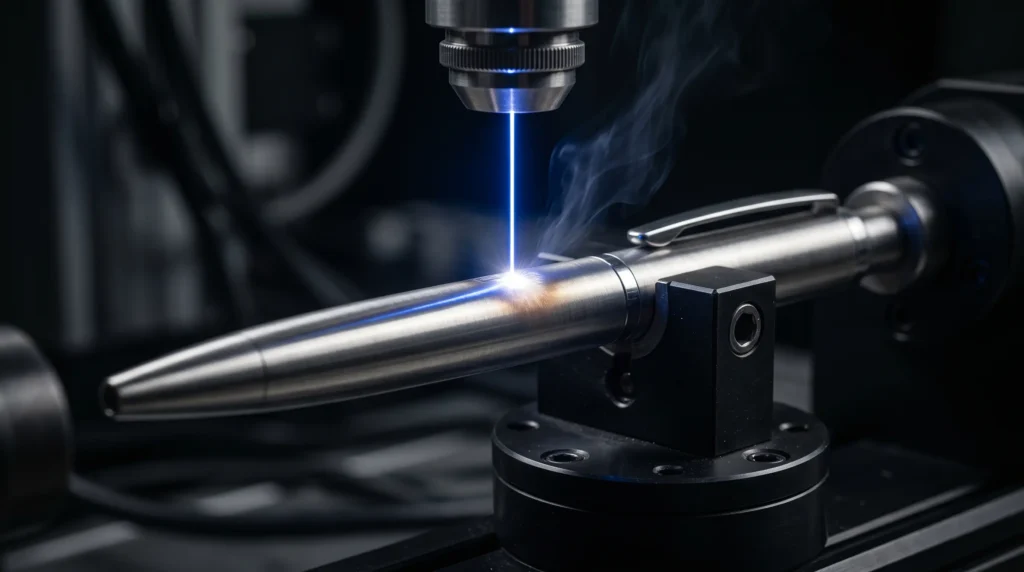
Laser engraving does not lay ink on a surface. It removes material. A focused beam, usually a fiber laser for metals or a CO2 laser for wood and some plastics, vaporizes a thin layer of the barrel. The result is a mark below the surface, not on top of it.
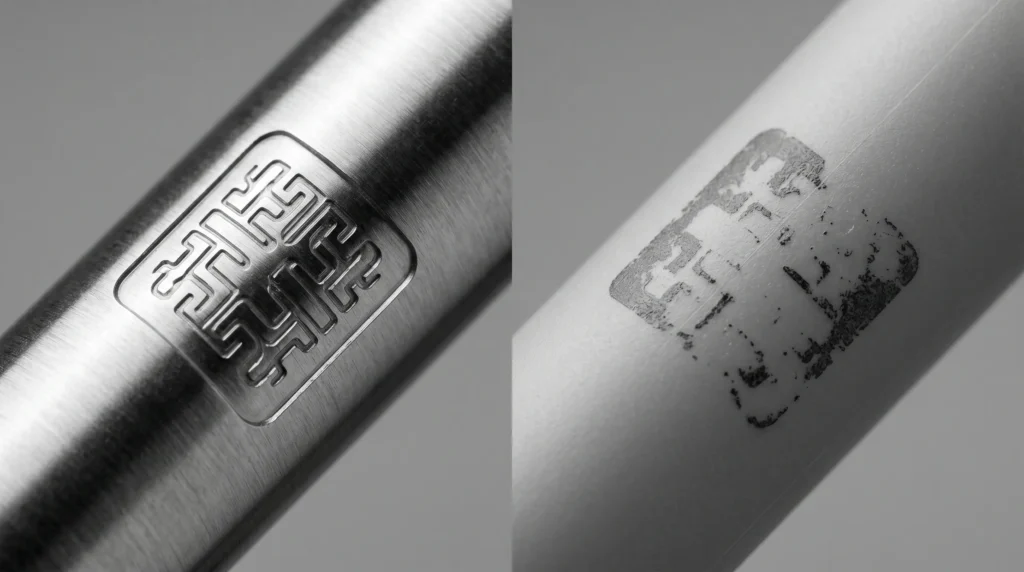
That matters because surface-applied ink fails in predictable ways. It rubs against pocket fabric. It reacts with hand oils and sanitizer. It flakes at stress points where the barrel bends. Laser engraving avoids all of these, because nothing sits on the surface to wear off. The mark is missing material, not a layer that can separate.
The trade-off is color. Laser engraving is monochrome. The engraved area shows the base material tone. On anodized aluminum, the mark reads as a lighter silver against the colored surface. On brass, it gives darker contrast. On stainless steel, it is a subtle matte impression that catches light differently. Brands that must reproduce a specific PMS color on the barrel may prefer pad printing or screen printing. Brands that want a permanent, premium look on metal should choose laser engraving.
On a production line, laser speed depends on the design area. A simple logo might take 3 to 5 seconds per pen. At ZH STATIONERY's Tonglu plant, automated lines handle over 1,000 SKUs a year. The engraving station runs inline with quality inspection. Every engraved pen passes dimensional and visual checks before packing.
Laser engraving is faster than multi-color pad printing for simple designs. It will not copy gradients or photos. It works on metal, wood, bamboo, and certain hard plastics. It does not work on soft or flexible barrels.
Pad Printing: The Curved-Surface Workhorse
Pad printing solves a problem flat methods cannot touch: printing on a round, curved, or odd surface. A silicone pad picks up ink from an etched plate, the cliche, and presses it onto the barrel. The pad bends around the curve in one pass. Its give makes clean prints possible on a radius that would break a flat screen.
Pad printing handles up to four spot colors. Each color needs its own plate and pass. The ink bonds to plastic through solvent loss and chemical grip. The process is cost-effective above 300 units. Setup cost, plates, color match, and machine tuning spread across the run, so per-unit cost drops as volume grows.
The wear limit for pad printing is lower than laser. The ink sits on the surface, so time and friction attack it. A pad-printed logo on a plastic pen living in a pocket for six months will show wear. On a pen that stays on a conference table for occasional notes, it stays clean for years. Match the method to the use. That is the difference between a pen that still carries your brand and one that does not.
Screen Printing And Hot Stamping: Niche Applications
Screen printing pushes ink through a mesh stencil onto a flat or gently curved surface. It gives thicker, more opaque color than pad printing, which helps when a bold logo is the goal. It suits tight-radius round pens less well. Hot stamping uses heat and pressure to move metallic or pigmented foil onto the barrel. The result is a shiny, luxury look. Both are secondary options. Screen printing fits flat-barrel promo pens. Hot stamping fits premium gift packs where metallic shine adds value.
Pen Materials, Mechanisms, And The Engineering Behind Perceived Value
The reason a brass pen feels different from a plastic one is not opinion. It is physics. Weight, heat feel, and surface texture drive the impression.
A brass barrel, at about 8.5 g per cubic cm, weighs three to four times more than an ABS plastic barrel of the same size, which is about 1.05 g per cubic cm. When someone picks the pen up, the extra mass reads as substantial before a single word is written. Metal feels cool to the touch and warms slowly. That reinforces the effect. These are not marketing signals. They are physical facts the brain reads as quality before conscious thought.
Metal Vs. Plastic: What The Customer Actually Feels
Aluminum is the middle ground. It is lighter than brass, about 2.7 g per cubic cm, but still heavier than plastic. Anodized finishes add color that will not chip, because the color lives inside the oxide layer. Stainless steel is heavier, harder, and resists scratches better than brass or aluminum. Each material says something different. A light anodized aluminum pen with bright colors says modern, creative, approachable. A heavy stainless rollerball with a brushed finish says established, serious, permanent.
Plastic pens rule the promo market for one reason: unit cost. Above 1,000 units, a pad-printed plastic ballpoint might run 50 cents to 1.50 dollars per unit. A laser-engraved metal rollerball might run 3 to 8 dollars. The question is not which is better. It is which fits the business context.
For a trade show handing out 2,000 pens, plastic with pad printing makes sense. Cost per impression is tiny, and the crowd expects a giveaway, not a gift. For a client onboarding kit or an executive thank-you, a metal pen with laser engraving says the relationship matters. Using the wrong material in the wrong context wastes budget. It also sends the wrong message.
Ink Systems And Refill Compatibility
A pen that looks good but writes poorly hurts your brand more than a pen nobody uses. The ink system, ballpoint, rollerball, or gel, sets the writing feel. The refill standard decides whether the pen stays useful after the first ink runs out.
Ballpoint refills use oil-based ink with viscosity around 10,000 to 20,000 centipoise. The ink flows through a small ball socket, usually 0.7mm or 1.0mm, and needs slight pressure to write. Ballpoints work across temperature extremes. They do not dry out easily. They write on most papers, including glossy and coated stock. The trade-off is feel. Ballpoints are less fluid than rollerballs, and the ink color is less rich.
Rollerball refills use water-based ink with much lower viscosity, around 5 to 10 centipoise. The ink flows freely, almost like a fountain pen, and makes darker, richer lines with zero pressure. The smooth feel has a cost. Rollerballs are picky about paper and bleed through thin sheets. They dry out faster when left uncapped. For premium corporate pens used on good paper, signing contracts and writing notes, rollerballs deliver a clearly better experience.
For B2B buyers placing custom pen orders, ask one question early: what refill standard does this pen use? If the answer is common, like Parker-style G2, Cross, or international rollerball, the recipient can replace the refill. That extends the pen's useful life and your brand's exposure window by years. If the answer is a proprietary refill from one manufacturer, the pen is effectively disposable.
Certifications & Custom Manufacturing For Corporate Pen Programs
Sourcing custom engraved pens at scale means managing safety and quality rules that vary by market. For promotional pens in the US and EU, the baseline includes:
- ASTM D-4236 (U.S. art materials): CPSC guidance covers toxicological review and chronic-hazard labeling. Conformance is not a guarantee that a product has no hazards; confirm whether the item is an art material.
- EN 71 (EU toys): Toy classification and conformity requirements determine applicability. An adult promotional pen does not become a toy merely because a child could use it. For a toy, match chemical, mechanical, and other applicable requirements to its materials and intended use.
- REACH (EU): Broader chemical regulation covering Substances of Very High Concern (SVHC) across all product categories, not just children’s items.
- ISO 9001: Quality management system certification. Indicates the manufacturer follows documented, auditable processes for production, inspection, and corrective action) but does not by itself guarantee product quality.
- Prop 65 (California): Requires warning labels if products contain chemicals known to cause cancer or reproductive harm above specific exposure thresholds. Relevant for any pens distributed in California.
When you evaluate suppliers, ask for reports for the specific pen, ink, coating, and use. Check the lab scope, sample identity, standard edition, and results against the rules that apply. A generic statement or a report for an unrelated model cannot prove your order is compliant.
Key B2B manufacturing services to evaluate when sourcing:
- Multiple customization methods in-house: laser engraving for metal barrels, pad printing for plastic barrels, screen printing for flat surfaces.
- Full packaging customization (from individual velvet sleeves and presentation boxes to bulk polybag packing for trade show distribution.
- 3D design support and physical prototyping: CAD renderings within 72 hours, physical pre-production samples in 5–7 days.
- Quality inspection protocol: 100% inline automated inspection, plus strict AQL sampling; every unit checked before packing.
- Free samples for qualified buyers to evaluate material quality, writing performance, and engraving precision before committing to a production order.
If you are sourcing custom engraved pens for a corporate program and want to talk specs, materials, or volume pricing, reach the ZH STATIONERY team.
Frequently Asked Questions
Q: What’s The Difference Between Laser Engraving And Pad Printing For Custom Pens?
Laser engraving removes material with a focused beam. The mark sits below the surface, so it will not fade, chip, or peel. The logo is literally part of the pen. Pad printing moves ink from an etched plate to the barrel with a silicone pad. It wraps around curved surfaces, supports up to four spot colors, and costs less per unit at high volume. The ink sits on top and wears with friction over months of daily use. Choose laser for metal pens meant as client gifts and executive kits. Choose pad printing for high-volume plastic pens for trade show distribution.
Q: How Long Does It Take To Produce A Custom Engraved Pen Order?
Standard lead times run 2 to 4 weeks for stock models with logo engraving. Fully custom designs with new molds run 6 to 8 weeks. The timeline breaks down roughly like this. Digital proof and approval take 2 to 3 days. Pre-production sampling takes 5 to 7 days. Production takes 10 to 20 days depending on volume and complexity. Add shipping: 7 to 14 days by sea, 3 to 5 days by air. Plan around the event date. For makers with automated lines and in-house laser engraving, like ZH STATIONERY, engraving runs inline with quality checks. The step adds little time to the normal cycle.
Q: What’s The Minimum Order Quantity For Custom Engraved Pens?
The minimum order for custom OEM/ODM programs is 50,000 pens per order, counted by total individual pens produced. For a 12-color pack, that equals roughly 4,200 sets, not 50,000 of each color. Standard stock models can be sampled at smaller trial sizes.
Q: Can I Get Samples Before Placing A Bulk Order?
Yes, and you should. Most B2B makers offer two sample types. A stock sample, sometimes called a random sample, lets you judge material quality, weight, balance, and writing before any customization. A pre-production sample, or PP sample, carries your actual logo on the chosen model. It is made on the same equipment that will run the order. The PP sample is the last chance to check engraving depth, logo placement, and finish before production. Ask for both when budget and time allow.
Q: What File Format Do I Need To Provide For Pen Engraving?
Vector files are required for sharp, scalable engraving and printing. Submit your logo in .AI, .EPS, or .SVG. These formats define graphics as math paths, not pixels, so the mark stays crisp at any size. If you only have a raster file, .JPG or .PNG, most makers offer basic vector conversion. Complex logos may need extra design work. For laser engraving, simpler is better. Thin lines, small text, and fine details cut cleanly. Gradients, shadows, and photos will not translate.
Q: How Do I Verify A Supplier’s Quality Control Process For Custom Pen Orders?
Ask to see batch QC logs from a recent run. Not a summary. The actual log sheets. Look for ink viscosity per batch. Look for laser power calibration records. Look for dimensional checks on barrel threads and cap fit. Look for write-out test results, at least 400 meters of continuous writing without skipping. A factory that tracks these and ties them to lots runs real quality control. One that cannot produce the records is running visual inspection alone. That catches obvious defects but misses the systemic issues behind complaints weeks later. To talk quality standards directly with the ZH STATIONERY team, use the contact page.
A corporate pen program is a rare buying decision where details pay back for years. Getting them wrong produces a slow, quiet stream of brand damage. Nobody tracks that in a spreadsheet. The pen leaks in a client's bag. The logo fades to a smudge after three months. The mechanism jams mid-signature.
None of these are catastrophic alone. Together, they shape how people feel about your brand.
The fix is not spending more money. It is understanding the manufacturing variables that decide whether a pen earns a place in someone's hand or gets buried in a drawer. Material choice. Engraving method. Ink system. Cap seal. These are engineering calls, not marketing calls. Sourcing from a manufacturer who treats them that way is how you build a custom pen program that works.
Related guide: For another view of factory capability and process control, see Custom Acrylic Markers Manufacturer.
Related Reading
- Corporate Gifting 2026: Why Engraved Metal Pen Sets Win
- Corporate Gift Pen Sets: How to Source Premium Metal Pens from China
- Luxury Corporate Pen Market: Why Europe Commands a 36% Share and How Overseas Brands Can Compete
- How to Choose the Right Pen Tip: A Buyer’s Guide to Nib Types, Sizes, and Materials
- MOQ negotiation guide for Chinese pen factories