
An artist buys a 48-color watercolor marker set. The colors are lovely. The blending is smooth. Two weeks later, three markers are dry. Not empty. Dry. The caps were on. The ink just stopped flowing. The artist leaves one star and goes back to the old brand.
For B2B buyers, watercolor marker sourcing is not about the color palette. It is about the reservoir tech. That call decides whether your markers last two weeks or two years on a shelf. Direct-liquid feed versus fiber-tip core. It sounds like an engineering note. It is the biggest factor in your return rate, your refill model, and whether artists trust your brand enough to uncap a marker from six months ago. Start with the dried-out markers guide.
Two reservoir techs. Two failure patterns. A small set of tests that tell you which one your factory can really build.
Table of Contents
Quick Answer: Watercolor Marker Sourcing
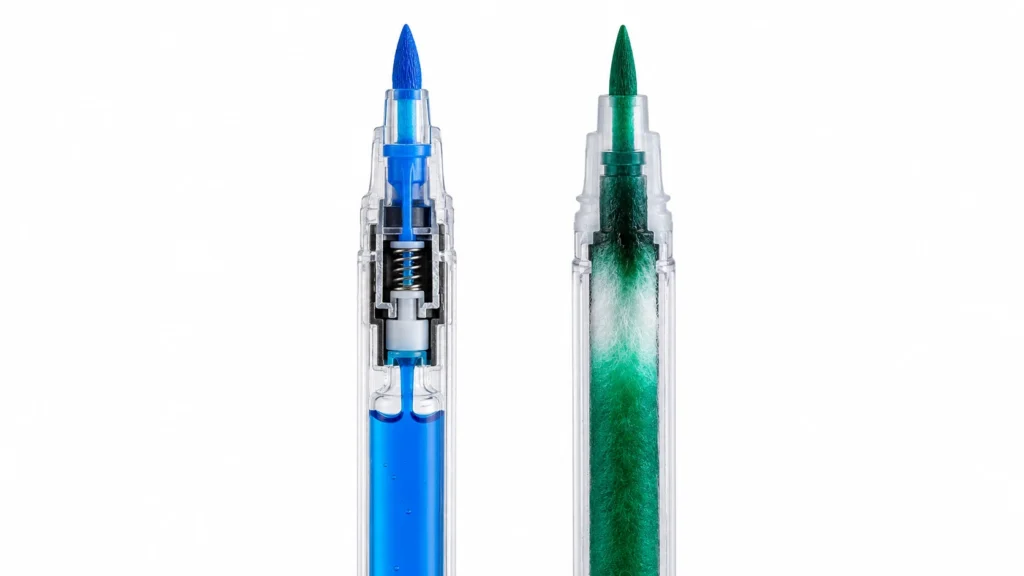
The two systems on the metrics that matter:
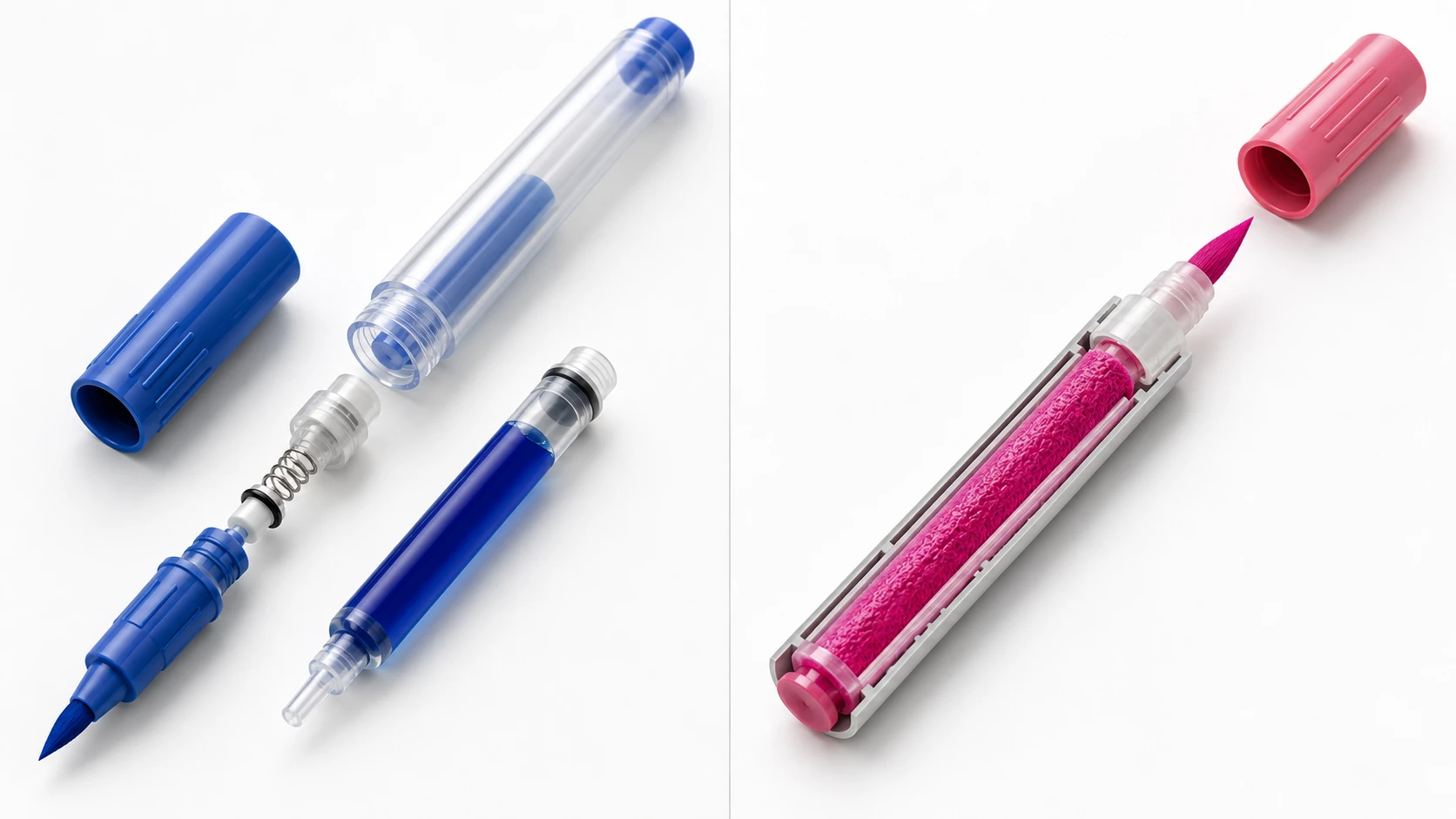
- Direct-liquid markers hold free liquid ink in a reservoir and feed it to the nib through a designed flow-control system. Some are refillable, but only when the barrel, seals and refill instructions support it. Check flow consistency and leakage rather than assuming either follows from the reservoir type.
- Fiber-reservoir markers hold ink in an absorbent core that feeds the nib by capillary action. Some are disposable and others are designed for refilling. The nib material, reservoir design, access method and specified replacement ink must be evaluated together.
- A refill program can be built around either suitable reservoir design. Copic’s official instructions show ink being added into a marker core, demonstrating why a fiber reservoir alone is not evidence that refilling is impossible. This example does not establish compatibility with a different brand or a water-based watercolor formula.
- The nib fails on both systems. Watercolor ink is thin. It flows fast. A nib that cannot regulate the flow floods the paper. A nib that frays under continuous water exposure turns a brush marker useless. Test nib durability with ink, not water.
For brand owners and buying teams, these factors help set sharper sourcing and quality check bars.
How Each System Fails
Every watercolor marker complaint has an engineering root cause:
| Complaint | Direct-Liquid Root Cause | Fiber-Tip Root Cause | B2B Quality Signal |
| Marker stopped despite having ink | Valve seal failed; ink evaporated through microscopic leak | Fiber core dried from cap-seal failure; capillary path broken | Direct: valve seal test per unit. Fiber: cap-seal vacuum test per unit |
| Color varies between strokes | Wick feed rate inconsistent; nib saturation uneven | Fiber core density uneven; some channels run dry before others | Both: continuous writing test over 200m with spectrophotometer |
| Nib frays or deforms | Nib material not rated for continuous water; fibers swell, separate | Same failure, plus fiber core debris clogs nib channels | Both: nib immersion in ink 72hrs; abrasion under controlled pressure |
| Colors vary between batches | Dye concentration drifts; no spectrophotometer check | Same cause; no quality difference between systems here | Both: batch spectrophotometer delta-E under 1.5 |
| Ink leaks during shipping | Barrel seal fails under pressure or temperature; liquid ink escapes | Fiber core overfilled; temperature expansion pushes ink out | Direct: altitude/pressure sim. Fiber: fill-volume verification |
Direct-liquid markers fail when the valve or seal is cheap. Fiber-tip markers fail when the cap seal or core density is cheap. Cheap means a build shortcut, not a retail price.
Direct-Liquid: The Refill Model
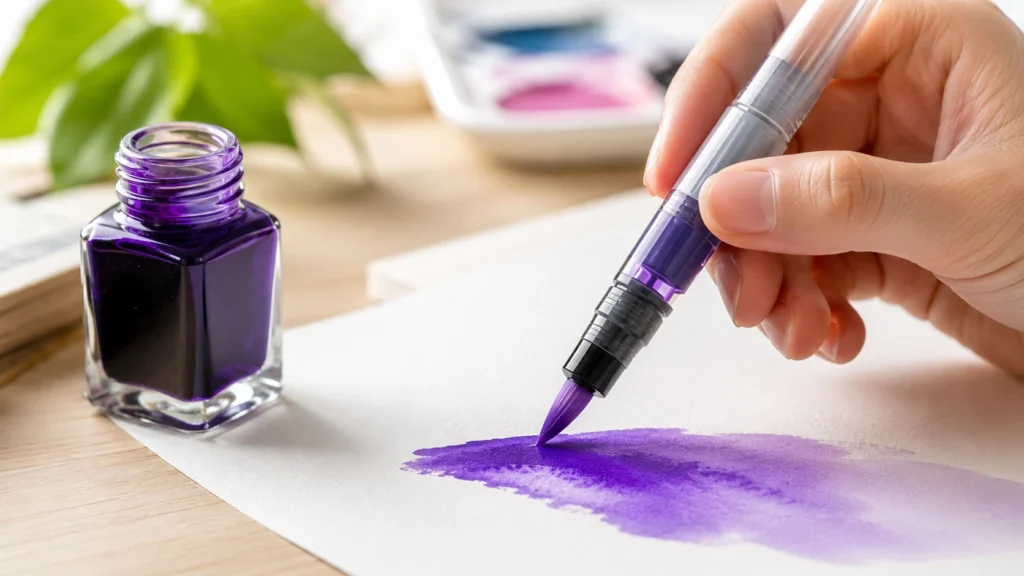
A direct-liquid watercolor marker holds dye ink as free liquid in the barrel. No fiber core. Ink reaches the nib through a spring valve. Press the nib to open. Or a wick draws liquid straight to the tip. See the patent example for the format background.
Same idea as a fountain pen, in marker form. The ink is thin by need. You cannot thicken it like acrylic paint. It must flow through narrow paths by gravity and capillary pull. That makes the chemistry harder. Dyes must dissolve well. Flow agents must stop surface pull from trapping ink in the barrel. Keep-fresh agents must stop bacteria in water-based liquid that sits sealed for months. The B2B marker guide covers the line context.
A free-liquid core can offer useful ink capacity without an absorbent part. Capacity, delivery steadiness, and refillability must be checked on the finished marker. If refill sales are part of the plan, ask for a fitting ink, a set fill method, clear steps, and repeat-fill tests.
The build test is the seal. A direct-liquid marker is a sealed water tank. Leak. Loss. Seal fail under heat cycles. The marker shows up half-empty or dry. The valve must open clean, close full, and hold through shipping, storage, and daily use. A factory that cannot show per-unit valve-seal tests is not ready for direct-liquid at scale. ZH Stationery makes direct-liquid watercolor markers with its own ink lab. The custom marker manufacturer and valve-press vs fiber-tip pages show the shared valve experience.
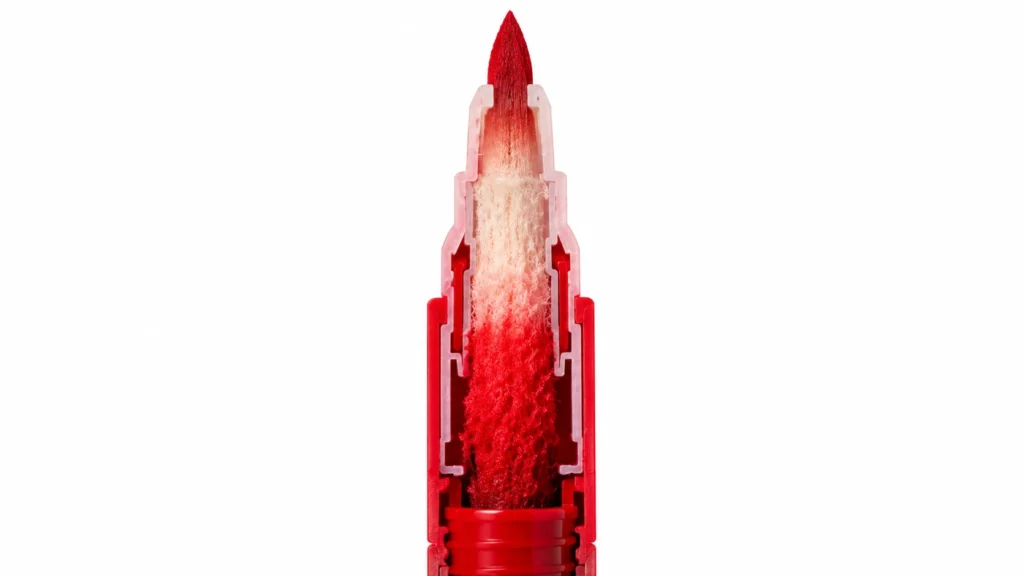
A fiber-tip watercolor marker is a capillary marker. A polyester fiber core fills the barrel, wet with dye ink. The nib wicks from the core by capillary pull. No moving parts. No valves. Just the cap between ink and air. That simple build puts fiber-tip in every budget segment. See the old patent example for the mechanism.
Fiber-Tip: Simple System, Hard Deadline
As an absorbent core drains, ink delivery can weaken. That does not mean adding fitting ink always kills the core. Check refill access, leaks, color steadiness, and nib recovery on a model built for refill. Follow the manufacturer steps. Do not improvise on a sealed one-time marker.
The cap seal decides everything. Perfect seal, years of use. A 0.1mm gap in the inner cap liner, dead in weeks. Water-based ink leaves. No water, no wick. The dye sets inside the fibers. Capillary pull stops. Marker dead.
For B2B buyers, the fiber-tip QC list is shorter but not lighter. Test cap seal per unit. The factory needs vacuum-decay checks, not a look. Test ink drain. Write the marker dry. Measure color steadiness through the first 80 percent of volume. If color drops hard after 50 percent, the core density is off. Compare against premium marker bars and ISO 16778 where useful.
Ask ZH Stationery for the test records for the proposed model and planned use. Confirm which checks run on every unit and which use batch samples. General factory history does not prove that every proposed test ran on every product.
What B2B Buyers Should Test Before Placing An Order
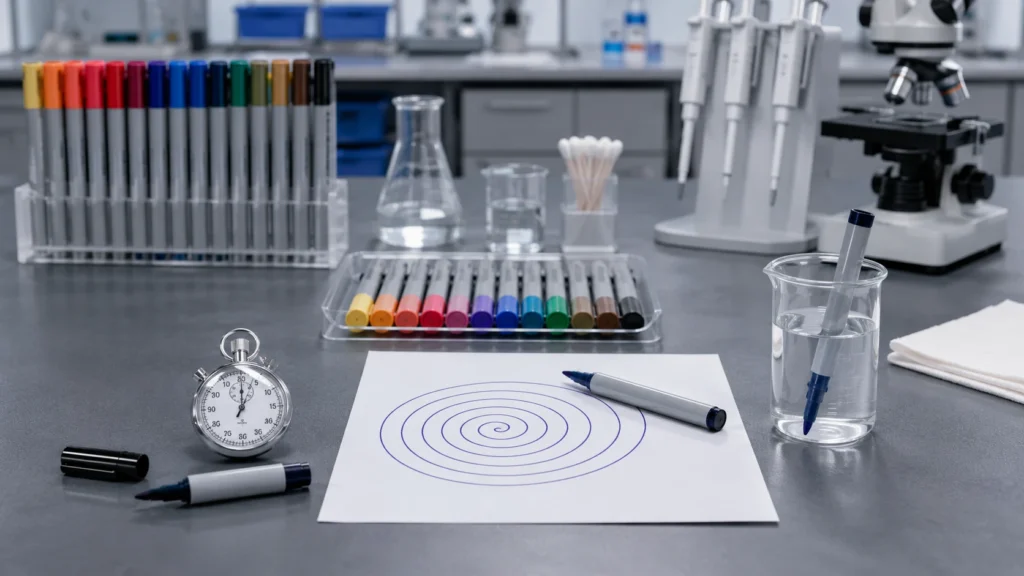
- For direct-liquid markers: check activation according to the model instructions, then examine leakage in the intended storage orientations. Repeat writing after a defined capped storage interval. For a refillable model, compare line intensity and leakage before and after refilling with the specified ink and quantity. Agree the intervals and acceptance limits before testing.
- For fiber-reservoir markers: agree a cap-off exposure and recovery procedure, and record startup strokes, line continuity and color strength afterward. Check delivery as the ink is consumed. Assess nib stability with the actual compatible ink and storage conditions; a long water soak is not a universal acceptance test.
- For both designs: compare production samples against an approved color reference on the same paper, at the same drying time and under the same lighting. If using instrumental color measurements, specify the measurement conditions, color-difference formula and agreed tolerance. A delta-E limit is not meaningful without those conditions.
Direct-liquid systems hold free ink. Fiber-core systems hold ink in an absorbent part. Both need a fitting nib and good cap seal. Neither build alone sets refillability, life, or color steadiness. Compare the finished designs with the same ink, storage conditions, and writing tests.
Frequently Asked Questions
What Is The Difference Between Direct-Liquid And Fiber-Tip Watercolor Markers?
Some can be refilled if the manufacturer built them for that. A fiber core does not by itself block refill. Use the set ink and fill amount. Check the exact watercolor marker steps. An alcohol-marker refill is not a stand-in for a water-based mix.
Can You Refill Fiber-Tip Watercolor Markers?
Water. Long water touch. Standard nibs made for alcohol ink are not built for it. Fibers swell. Binders soften. Shape fails. Watercolor markers need nibs with water-repellent binders that hold when wet. A factory making both should use different nib parts, not the same one. See the watercolor pen line.
Why Do Watercolor Marker Nibs Fail Faster Than Regular Nibs?
Budget: 12 to 24. Mid-tier artist: 36 to 48 with a blender. Premium: 60 to 100, modular sets for collection building. Each color is its own SKU for making, filling, and QC. A factory running 2,000-plus SKUs a year, like ZH Stationery, can hold large color ranges without mixing errors. See the factory tour.
How Many Colors In A Watercolor Marker Set?
Yes. ASTM D-4236 for the US. EN71-3 for Europe. REACH where it applies. Water-based means fewer VOCs than alcohol markers. That eases certification. Dye chemistry still needs toxicology review. Get current, dated reports from ISO 17025 labs that name your exact SKU.
Do Watercolor Markers Need The Same Certifications As Other Art Markers?
Yes, for U.S. and EU art markets. Watercolor markers sit in the same labeling class as other art markers: ASTM D-4236 in the U.S., and EN71-3 or REACH where the product reaches children in Europe. Then ask which reservoir system fits the planned use, how cap seal and color steadiness were tested, and whether that exact model supports refill. These answers help judge a supplier's technical grasp; they do not alone prove factory ownership. Contact ZH Stationery with your watercolor spec and sample needs.
What Should I Ask A Supplier Before Ordering Watercolor Markers?
Pick a watercolor marker by real writing performance, storage steadiness, handling, and cost. Compare reservoir designs on the same paper and use plan. Judge refill only where the manufacturer supports it. Send ZH Stationery your planned user, ink needs, nib format, and packing brief to plan a useful sample compare.
Related guide: For additional market context, see H1 2025 China Pen Market Report.
Related Reading
- Best Alcohol Markers Manufacturers in China: A B2B Buyer’s Guide
- How to Choose the Right Pen Tip: A Buyer’s Guide to Nib Types, Sizes, and Materials
- acrylic marker packaging formats
- dual tip vs single tip marker strategy
- Latin America stationery importer guide
- carton size and CBM guide for marker sets
- ASTM D-4236 test report guide
- 12 vs 24 vs 36 vs 48 vs 60 color marker sets guide
The minimum order for custom OEM/ODM programs is 50,000 pens per order, counted by total individual pens produced. For a 12-color pack, that equals roughly 4,200 sets, not 50,000 of each color. Standard stock models can be sampled at smaller trial sizes.