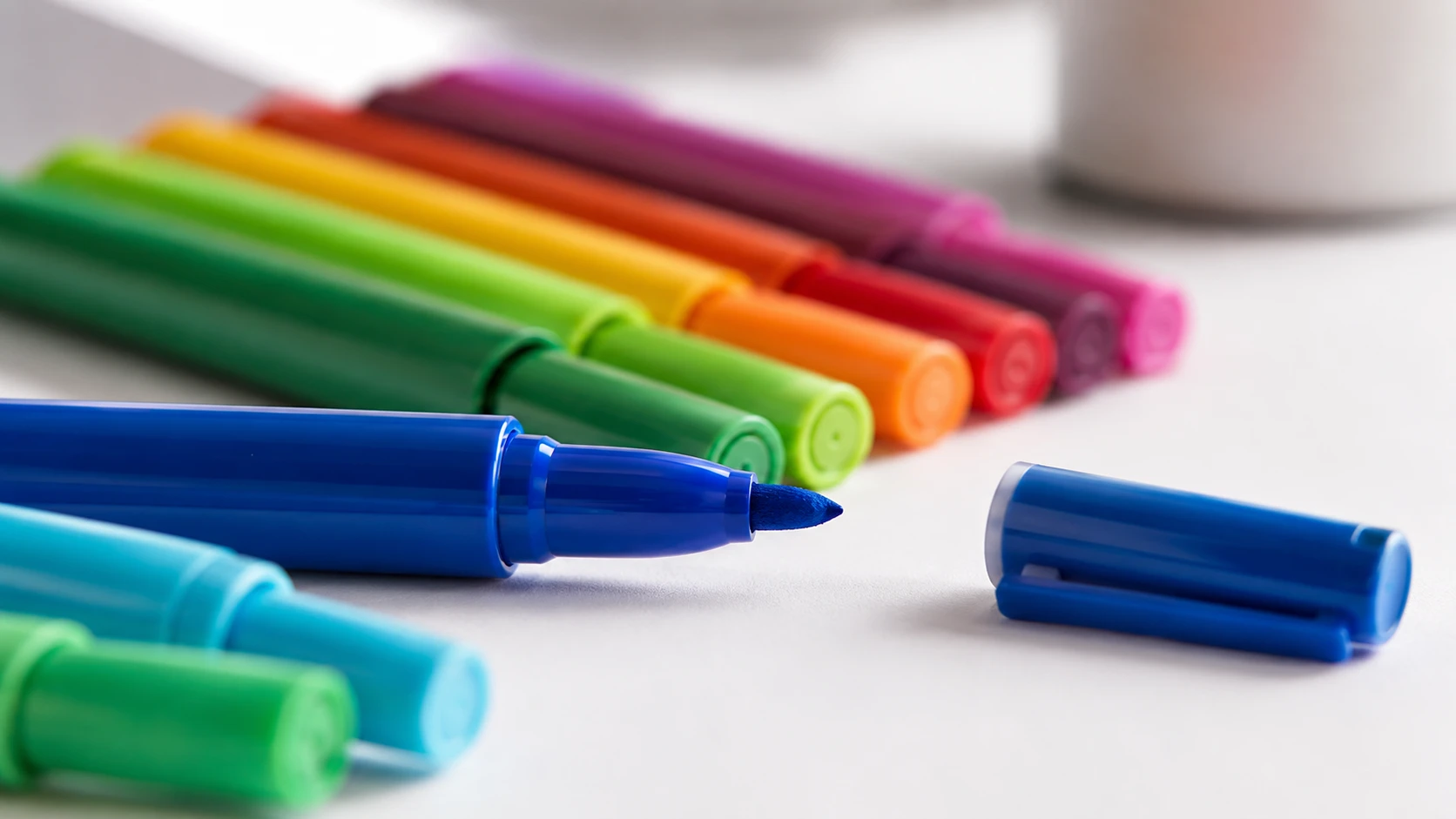
Every stationery buyer has faced the same frustrated customer. The message goes like this: I just bought these markers last month, and they are already dried out. For a consumer, that is an annoyance. For a brand owner, wholesaler, or retail buyer, the stakes are higher. Orders run from 50,000 to 500,000 units. Dried-out markers mean returns, bad reviews, and lasting damage to brand reputation.
Marker pen quality control is not just a factory-floor concern. It is the biggest factor in whether your products survive shipping, shelf time, and daily use. When a marker dries out early, one specific point in production failed. That point can be ink mixing, cap sealing, nib fit, or storage stability testing.
Understanding why markers dry out, and what factory controls prevent it, gives B2B buyers a practical framework. Use it to evaluate suppliers, cut after-sales complaints, and build product lines customers trust.
目次
簡単な回答:マーカーが乾燥する理由と、B2Bバイヤーが注目すべき点は何か?
Marker dry-out happens when the solvent in the ink evaporates faster than the sealing system can stop it. For B2B buyers, the root causes fall into four groups:
- キャップシールの不良 (The most common cause. If the cap doesn’t create a consistent airtight barrier, alcohol-based solvents escape within days. Even microscopic gaps in the cap-to-barrel seal accelerate evaporation across an entire production batch.
- インク配合の不均衡) When the solvent-to-pigment ratio isn’t precisely controlled, ink either evaporates too quickly or separates during storage. This is especially common when factories source ink from third-party suppliers without batch-level verification.
- ペン先とファイバーシステムの不一致 (If the nib material, fiber density, and ink viscosity aren’t engineered as a coordinated system, capillary action breaks down. The tip clogs, ink stops flowing, and the marker feels “dead” even when the reservoir is full.
- 保管および輸送時の不安定性) Markers shipped through high-temperature containers or stored in unconditioned warehouses can experience accelerated solvent loss before they ever reach a retail shelf.
These factors help brand owners and procurement managers set tighter sourcing and inspection standards. Do it before a production run turns into a customer service problem.
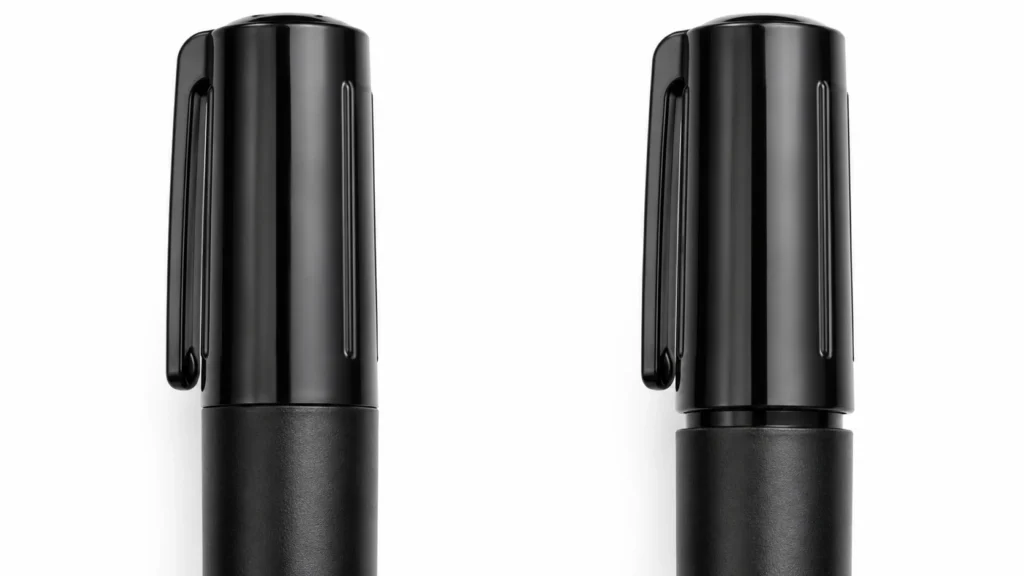
一般的なマーカーの乾燥不良問題:エンドユーザーのクレームが明らかにする工場品質の実態
When customers say this marker is dried out, they are describing a symptom. Each version of that complaint points to a different production gap. Here is how to read the signals:
| 共通の特徴/問題 | 重要/失敗する理由(顧客クレームの根本原因) | 工場の品質管理指標 |
| マーカーが初回使用から数週間で乾燥する | 溶剤がキャップとバレルのシールの隙間から蒸発する。アルコールベースのインクは特に空気交換の影響を受けやすい。 | 温度サイクルおよび繰り返し開閉シミュレーションにおけるキャップシールの気密性試験 |
| 色が薄くなる、スジ状になる、または不均一になる | Ink formulation instability (solvent evaporates but pigment remains concentrated, or pigment separates from the solvent base during shelf storage | バッチレベルの粘度測定、ΔE許容差による色差試験、および加速劣化プロトコル |
| ペン先が硬化する、ほつれる、またはインクの送出を停止する | インク化学とペン先ファイバー素材との非互換性。ペン先が圧縮されたり、乾燥した顔料でファイバーが詰まると、毛細管流が崩壊する。 | 実際の生産インク配合と組み合わせたペン先耐久性サイクル試験。流量一貫性の検証。 |
| 「満タン」と表示されたマーカーが、空のようにしか書けない | 内部ファイバーリザーバーが均一に飽和しない。充填中に空気溜まりが形成され、リザーバーからペン先への毛細管経路を遮断する。 | 自動充填量検証。基準値との重量比較によるリザーバー飽和度検査。 |
| バッチ全体が早期乾燥を示す | Systematic manufacturing defect) mold tolerance drift in cap/barrel dimensions, material grade substitution, or ink batch variation | 受入材料検査プロトコル。キャップ-バレル嵌合面寸法の統計的プロセス管理モニタリング。 |
The pattern is consistent. End-user complaints about dried-out markers almost never trace back to one bad unit. They trace back to a quality control choice, or the lack of one. That choice was made weeks earlier on the production floor.
マーカーの乾燥に関する科学的原理:バレル内部で何が起こっているのか
To judge a supplier's quality control, you first need to know what you are controlling. Marker dry-out is not one problem. It is a chain reaction that starts with chemistry and ends with mechanics.
アルコールベース vs 水性インクシステムとマーカーペンの耐久性基準
The ink type decides how fast a marker dries out, and which quality checks matter most.
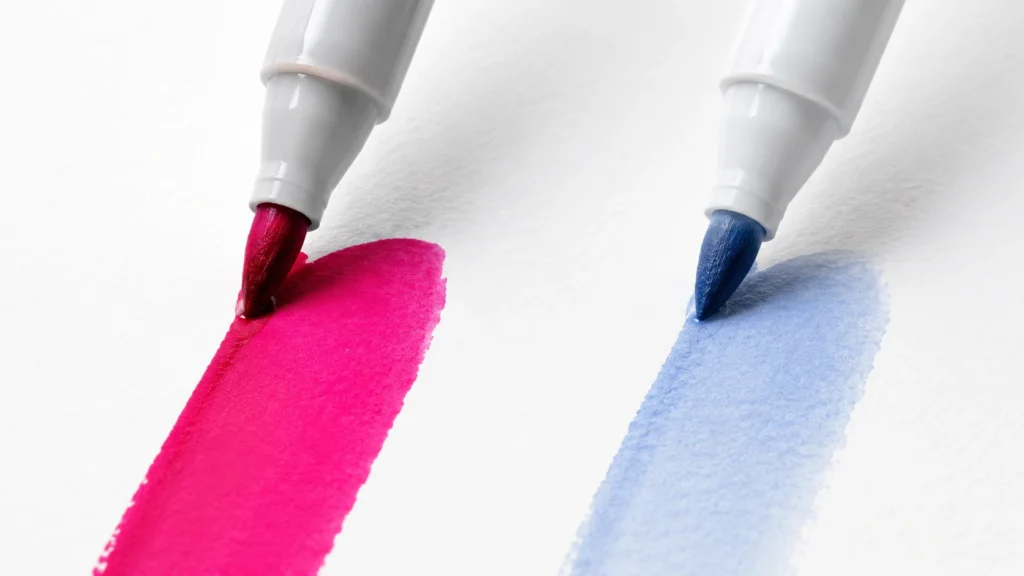
Alcohol-based markers use solvents like ethanol or isopropanol to carry pigment through the nib. These solvents evaporate fast by design. That is what gives alcohol markers their quick drying and blendable feel. But it also means that once the cap seal fails, damage shows in days, not weeks. A marker can write well at the factory. It can still arrive at the customer's door already weak. That happens when the cap cannot hold a near-perfect seal through shipping temperature swings.
Water-based markers are kinder on evaporation speed. They bring a different set of challenges. Water-based inks can pick up biological contamination, such as fungal growth inside the reservoir. They can also suffer pigment settling during long storage. Without proper biocide treatment and viscosity control, problems show at the customer's end. Markers can arrive working but deliver uneven, streaky color. Customers read that as drying out.
The takeaway for buyers is simple. The ink system you choose decides which QC checks matter most. Alcohol markers demand rigorous cap sealing checks. Water-based markers demand storage stability tests and contamination prevention.
キャップシールがどのように保存期間を決定するか
If one production detail separates markers that last from markers that do not, it is the cap seal. Not the cap design on the prototype. Not the cap fit on the approved sample. The seal consistency across 50,000 units.
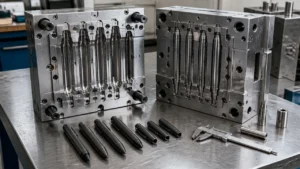
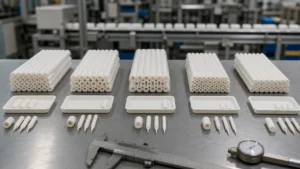
Here is what happens in production. The cap and barrel are molded separately. They are often made from different plastics, such as PP for barrels and PE or special resins for caps. Each material expands and shrinks at its own rate with temperature changes. The tolerance between cap inner diameter and barrel outer diameter must stay tight. If it does not, the seal varies from unit to unit.
A fraction of a millimeter on the mating surface can turn an airtight seal into a slow leak. Multiply that across a production run, and you get the most frustrating problem in stationery. Some markers last two years, others dry out in two months, and there is no visible difference between them.
Cap-off testing measures writing performance after the nib is exposed. It does not directly measure how well a closed cap seals. Evaluate closed-cap storage or evaporation performance separately. Record temperature, time, sample size, and writing criteria. Compare results with the approved product spec.
Some factories treat cap seal integrity as a standard production checkpoint. It is not a one-time design check there. In those factories, batch-to-batch dry-out complaints drop sharply. The testing gear and records pay for themselves in fewer returns. That math matters whether you source 50,000 pens for a test market or 500,000 for a retail chain.
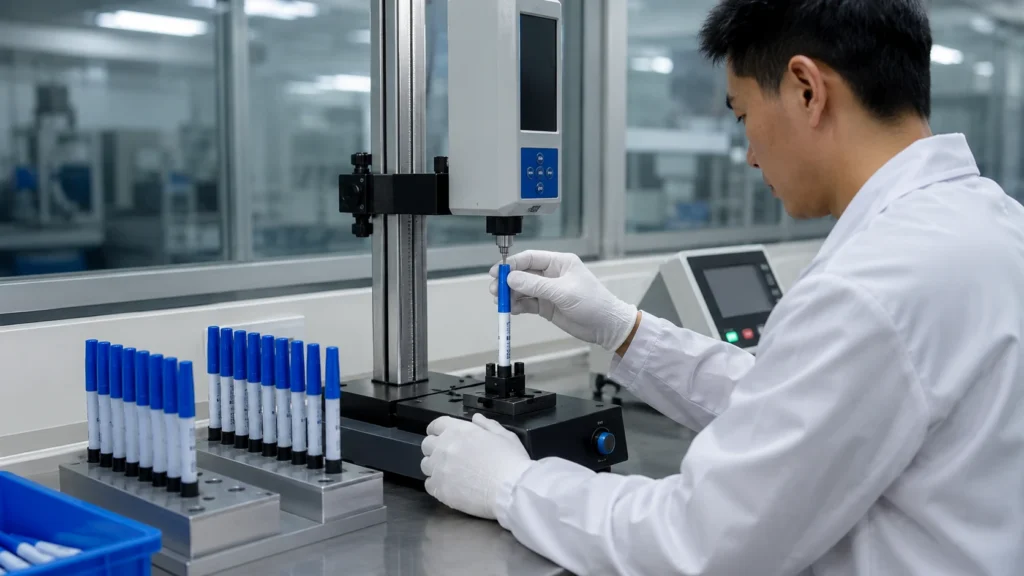
B2Bバイヤーがサプライヤーの品質管理システムにおいて評価すべき点
When you source markers for a private-label brand, retail program, or wholesale catalog, quality control matters early. It is not something you check after production. It is something you judge before you place the order. Here are the areas where supplier differences matter most.
マーカーペンインクの配合:自社開発 vs 外部委託
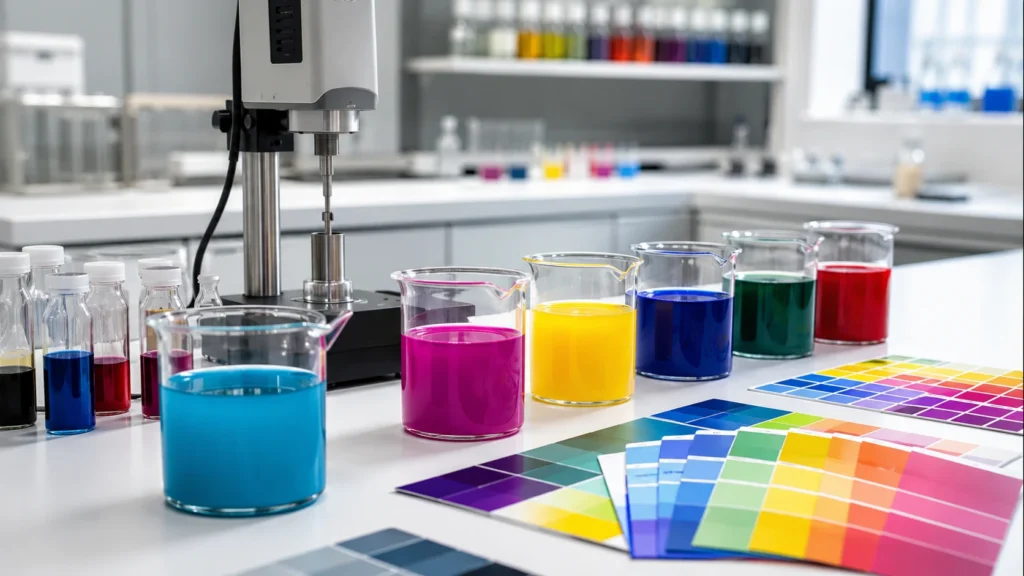
Where a factory gets its ink tells you a lot about consistency. Factories that mix ink in-house, with their own R&D lab, can find and fix issues within hours. They control pigment dispersion, solvent ratios, and batch tests in one place. When a color drifts, the cause is found at the mixing stage. It is not discovered after 20,000 units are filled.
Factories that buy ink from third parties face a different reality. They rely on the supplier's quality claims. Ink viscosity can shift between batches. That is common when solvent ratios are not precise. The line may then produce markers that look the same but perform differently. The thinner batch dries out faster. The thicker batch clogs sooner. Same SKU, same box, different customer experience.
For B2B buyers ordering at scale, the practical question is not whether the factory tests ink. It is whether the factory can show batch records that link specific ink data to specific production runs. Good records trace raw pigment lots through mixing, viscosity tests, color checks, and filling. That separates real control from after-the-fact inspection.
ZH STATIONERY runs an in-house ink R&D lab. Alcohol-based and water-based mixes are developed and tested before production. That ability was built over 26+ years of OEM/ODM work. What matters is what it enables: batch-specific ink performance data for buyers, instead of generic promises.
生産環境:自動化、検査、およびプロセス制御
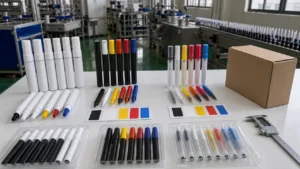
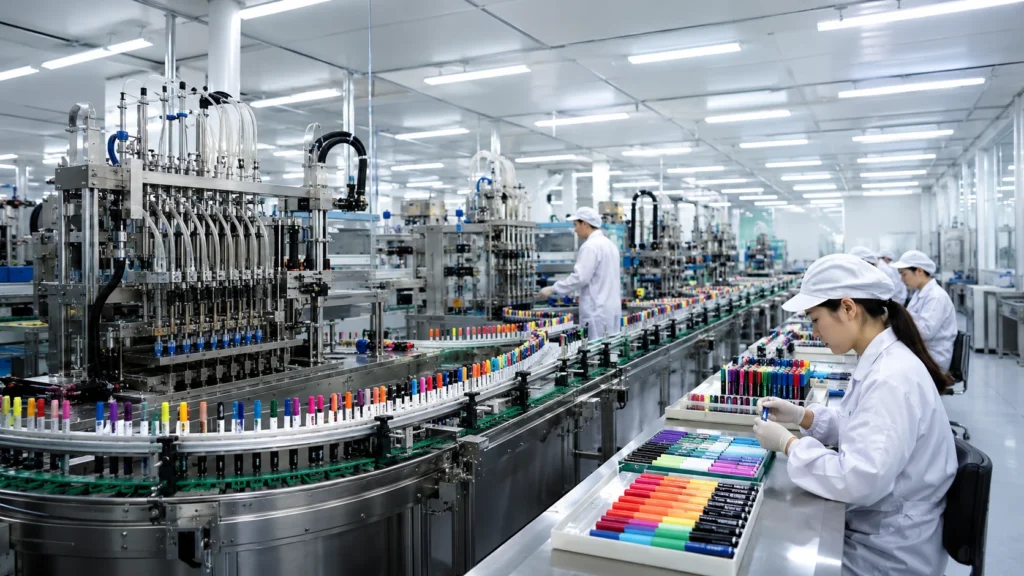
A 10000+ sqm factory area with 8 production workshops is more than a capacity number. It is a quality signal. Automated ink filling cuts the volume swings that make some markers run dry while others stay wet. Automated cap assembly applies steady seating force instead of operator feel. And when 100% of units pass visual and functional checks before packing, the defect escape rate drops.
Automation does not erase quality problems. It makes them systematic instead of random. That makes them traceable and fixable. A well-documented production line with clear checkpoint data gives buyers something samples cannot. It gives confidence that batch two will match batch one.
For buyers developing new SKUs, 3D design and physical sampling matter as much as automation. A factory can make a physical sample from your design files. The sample shows barrel feel, cap fit, and tip performance before mold creation. That cuts the iteration cycles that delay launches and raise costs.
重要な認証および製造基準
When markers are sold in U.S. and European markets, safety compliance is not optional. It is a legal requirement with direct business impact. Two standards matter most for marker buyers.
- ASTM D-4236 ASTM D-4236は、アートおよびクラフト材料に関する米国規格です。これは、製品が急性および慢性の健康リスクについて毒物学者によって評価され、あらゆる危険性が明確に表示されることを要求します。マーカーペンの場合、これはインク配合が資格のある毒物学者によって審査され、意図された使用に対して安全であると判断されたことを意味します。
- EN71 is the European toy safety standard. Part 3 specifically addresses the migration of heavy metals (relevant for markers that may be used by children. EN71-9 covers organic chemical compounds, and the broader EN71 framework sets mechanical and physical requirements including cap safety standards to prevent choking hazards.
These certificates are not marketing badges. They are proof that a factory sent products to third-party testing, and that its ink meets regulated safety limits. For buyers importing into the EU or U.S., current reports should be a basic requirement. EN71 and ASTM D-4236 are not a bargaining point.
Beyond safety, here are the production abilities that support steady quality in bulk marker sourcing:
- The minimum order for custom OEM/ODM programs is 50,000 pens per order, counted by total individual pens produced. For a 12-color pack, that equals roughly 4,200 sets, not 50,000 of each color. Standard stock models can be sampled at smaller trial sizes.
- Custom packaging options (blister cards, color boxes, display stands) designed for specific retail channel requirements
- 3D設計と物理サンプル作成の能力により、買い手は金型生産に着手する前に、美観と機能的な適合性の両方を検証できます。
- 特定の色の要件に合わせ、かつ対象市場の状況に応じて粘度を調整するための、社内インク研究開発体制。
When a factory has built these abilities over decades of OEM/ODM work, the base for consistent quality already exists. The buyer's job is to verify that the documented process matches real production. It is not to build quality control from scratch.
よくある質問
1. キャップをしていてもマーカーペンが乾燥する原因は何ですか?
A weak closed-cap seal is one possible cause. Ink delivery, fill level, and storage exposure also need checks. Evaluate sealing with closed-cap leakage or evaporation tests and storage tests. Use cap-off tests separately to check recovery after exposure. Do not treat them as proof of cap sealing.
2. 乾燥したマーカーは復活させることができますか、それとも本質的に不良品なのでしょうか?
For end users, short-term revival can work. Soak the tip in isopropyl alcohol, or add a few drops of solvent into the barrel. That restores writing because you are replacing the lost solvent, so the remaining pigment can flow again. From a product quality view, a marker that needs revival has already failed. The solvent escaped, the ink chemistry changed, and performance will never match a properly sealed unit. For B2B buyers, markers that arrive dried out point to a production defect. The same is true when they dry out after a few uses. The cause is most likely cap sealing, ink stability, or storage during transport. These units should trigger a supplier quality review, not a customer workaround. If you are researching how to fix dried-out markers for your line, fix the production process. Do not teach users revival tricks.
3. B2Bの買い手は、製品の耐久性についてマーカーペンサプライヤーをどのように評価すべきですか?
Ask for separate evidence on cap-off recovery, closed-cap storage, and nib-to-ink fit. Record the conditions and pass limits for each test. Connect the results to the SKU and batch you are ordering. ZH Stationery has confirmed unit-level functional inspection; ask which batch and development tests apply to your product.
4. What is the difference between alcohol-based and water-based markers in shelf life?
Alcohol-based markers evaporate faster and need stronger cap sealing. Their solvent chemistry resists biological growth and can stay stable for long periods when sealed well. Water-based markers evaporate slower but face other risks. Pigment can settle over time. Fungus can grow in the reservoir. Freeze-thaw changes can hurt them during winter shipping. Neither system is automatically better. The deciding factor is whether production addresses each ink type's weak points. Alcohol markers need airtight seals and tight tolerances. Water-based markers need biocide treatment, viscosity control, and climate-aware storage.
5. 米国および欧州市場向けのマーカーペンには、どのような認証が必要ですか?
For the U.S. market, ASTM D-4236 certification confirms the ink passed a toxicology review. It also confirms proper labeling under LHAMA. For Europe, EN71 is the baseline, especially Part 3 for heavy metal migration and Part 9 for organic compounds. Some buyers also ask for REACH records on specific substances. Certificates should be current. They should come from accredited third-party labs. They should cover the exact ink mixes in your order. Always check that the documents match the products being shipped.
6. 品質の一貫性を損なうことなく、マーカーペンをカスタマイズできますか?
Yes, when the factory's quality system is built to handle change. Customization adds variables. Different barrel colors change the plastic's pigment mix. Different cap materials change sealing behavior. Unique packaging can expose products to different storage conditions. A factory with documented checkpoints at each stage can absorb these variables. The checkpoints cover incoming material checks, in-process ink tests, and finished product tests. Project-based MOQs let brands validate custom products with the right sample and pilot plan before full production. If you want to discuss specs, ink mixes, packaging, or quality test plans for custom markers, contact ZH STATIONERY. We will review your needs and send samples.
結論
When a marker dries out, the customer does not blame the cap seal or the ink mix. They blame the brand. For B2B buyers, marker pen quality control is not technical curiosity. It is about protecting the reputation you have built. That holds whether you run a private-label line, stock retail shelves, or supply schools.
The markers that last are the ones where ink mixing, cap sealing, nib fit, and production consistency were treated as one system. They were not separate buying decisions. When you evaluate suppliers, look past samples and price sheets. Ask about cap-off time data, batch-level ink records, and in-process checkpoints. The answers tell you more about durability than any catalog.
If you are sourcing marker pens, metallic markers, or gel pens for your brand or retail program, contact ZH STATIONERY. We can discuss specs and request samples. We can also review quality documents before you commit to production.
関連ガイド: 関連するコンプライアンス計画については、以下を参照してください。 2026年中国におけるマーカーペン製造業者トップ7.