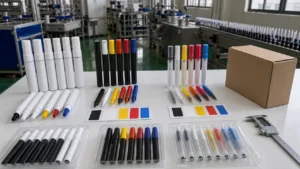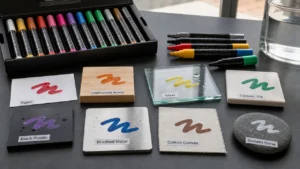

When B2B buyers source writing instruments for education, retail, food service, or office channels, the choice between wet erase markers and other pen types is rarely personal. It is a product-line decision. It affects end-user satisfaction, return rates, and channel fit.
Wet erase markers hold a clear spot in the marker category. They resist accidental smudging. They work on non-porous surfaces under heat and humidity. They stay readable until someone removes them on purpose. Yet many buying teams default to dry erase markers without checking whether wet erase fits their customers better. Permanent markers, gel pens, and ballpoints each serve different use cases. Knowing the boundaries helps buyers avoid stocking products their channels do not need.
This article compares wet erase markers with other common pen and marker types. It maps the differences to real usage scenarios. It gives professional buyers a practical framework for their next product-line refresh.
Table of Contents

Quick Answer: When Should B2B Buyers Choose Wet Erase Markers Over Other Pen Types?
- Wet erase markers are the right choice when end users need semi-permanent writing that resists accidental smudging) signage, menu boards, reusable labels, overhead transparencies, and display boards in high-traffic environments.
- Dry erase markers win when fast, frequent updates matter more than smudge resistance (classrooms, meeting rooms, brainstorming sessions, and any environment where content changes multiple times per day.
- Permanent markers serve industrial labeling, shipping, and multi-surface marking where removal is not needed.
- Gel pens and ballpoint pens dominate paper-based writing, personal stationery, and everyday office use) they are not interchangeable with marker pens in most sourcing scenarios.
- Water-based washable markers target the children’s and educational segment, where non-toxicity and easy cleanup from skin and fabric are the primary purchase drivers.
For brand owners and buying teams, these distinctions sharpen product-line planning and supplier review. The start point is simple: no single pen type covers every channel.
Market Signals: Why Pen Type Diversification Is Reshaping B2B Stationery Sourcing
Market estimates are useful only when their product definitions match what you are sourcing. Wet erase, dry erase, permanent, and art markers serve different surfaces and removal needs. Build the buying brief around the writing surface, the cleaning method, refill needs, and channel demand. Do not use a broad market forecast as proof of demand for one ink type.
Those numbers tell a clear story. Marker pens remain a growth category. The more useful signal for B2B buyers sits under the headline figures.
Three shifts are quietly changing which pen types distributors and brand owners prioritize:
- Workplace and classroom use cases. Compare how customers use the board: frequently erased notes need easy dry removal, while static menus and signs need resistance to accidental smudging. Ask distributors for their own reorder history instead of assuming a universal restocking rate.
- Food service and retail channels are expanding their marker spend. Restaurants use wet erase markers on menu boards and order displays where smudge resistance matters. Retailers rely on them for window signage and price displays that stay legible through a full sales day. These channels are not buying the same markers as schools) they need semi-permanent, high-contrast ink that does not ghost when finally removed. Wet erase markers serve this need more reliably than dry erase alternatives.
- Material and packaging requirements. Ask the buyer which recycled-content, refillability, packaging, and chemical-documentation requirements apply to the order. Verify each claim against the actual material and product specification rather than using an unsupported category growth percentage.
The practical takeaway is simple. A single-SKU approach to marker pens leaves gaps. Channels are splitting by use case. Suppliers who understand the technical differences between marker types can help you build a coherent product matrix. They do more than fill a purchase order.

Wet Erase Markers Vs. Other Pen Types: A B2B Buyer’s Comparison Table
The table below maps key performance differences across common pen and marker types. It links them to the root causes of end-user complaints. It also links them to the factory-level quality checks that prevent those complaints.
| Common Feature / Issue | Why It Matters / Fails (Root Cause of Customer Complaints) | Checks To Agree With The Supplier |
| Wet erase semi-permanent ink vs. dry erase temporary ink | Wet erase ink uses water-based or paste-based formulations that bond lightly to non-porous surfaces. When users apply dry erase ink to a surface that needs long-lasting visibility (a menu board, a logistics label) the writing smudges within hours, triggering complaints about “poor quality.” The problem is not the marker; it is the mismatch between ink type and use case. | Batch-level adhesion and erasability testing on standardized non-porous panels; ink formulation checked for consistency between lab and production batches |
| Wet erase smudge resistance vs. dry erase erasability | Dry erase markers wipe away with a dry cloth (the feature that makes them ideal for classrooms also makes them unreliable for static signage. Wet erase markers require a damp cloth for removal, which prevents accidental erasure from hand contact, humidity, or light rubbing. Misapplication causes the highest return rate in the marker category. | Smudge-resistance testing under controlled humidity and contact-pressure conditions; color retention measured after 24-hour exposure |
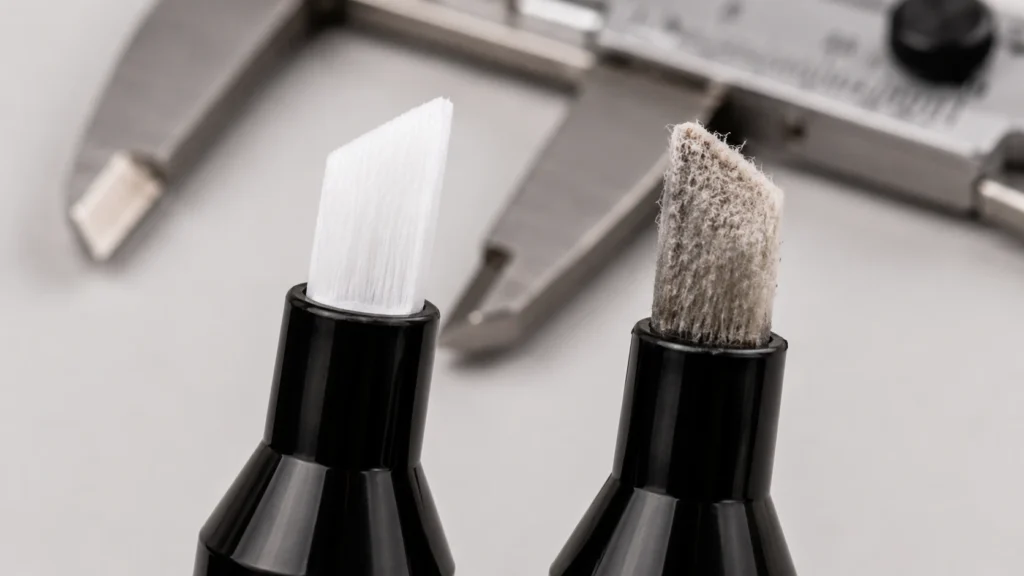
| Tip durability across pen types | Felt tips in budget markers fray after sustained use, producing inconsistent line width. Nylon and POM tips last longer but cost more. Wet erase markers used in food service and retail environments face heavier daily wear than classroom dry erase markers) tip material selection directly affects perceived product quality. | Accelerated wear testing (continuous writing distance measurement); tip material batch verification against specification |
| Ink drying speed across categories | Alcohol-based dry erase inks dry in 5–10 seconds; water-based wet erase inks take 15–30 seconds. Users accustomed to instant-dry performance may smudge wet erase writing before it sets. B2B buyers need to match drying speed to the channel (fast-paced classrooms need quick-dry; static displays can tolerate slower curing. | Drying-time measurement under standardized temperature and humidity; cap-off time tested to verify ink does not dry inside the barrel during normal use intervals |
| Color vibrancy on dark or glossy surfaces | Wet erase markers typically deliver higher contrast on dark surfaces (black menu boards, tinted glass) than dry erase markers. This is because wet erase ink sits on top of the surface as a pigmented film, while dry erase ink can appear translucent on dark backgrounds. Buyers sourcing for restaurant and retail channels should verify color performance on the target surface, not on white paper. | Colorimetry testing on multiple surface types (whiteboard, black marker board, glass); opacity and contrast-ratio measurement per batch |
| Safety and odor across ink types | Alcohol-based permanent and dry erase markers can emit VOCs that cause complaints in enclosed spaces. Water-based wet erase markers and washable children’s markers produce lower odor. For school and healthcare channels, ink chemistry directly affects sell-through and compliance risk. | Confirm product classification and applicable chemical and labeling requirements for the specific model and destination. |
Each row points to the same sourcing rule. The best marker is the one matched to the intended use case and channel. Buying on price alone, without understanding these differences, is the most reliable method to generate returns.
How To Build A Balanced Marker Pen Product Line: A Sourcing Framework
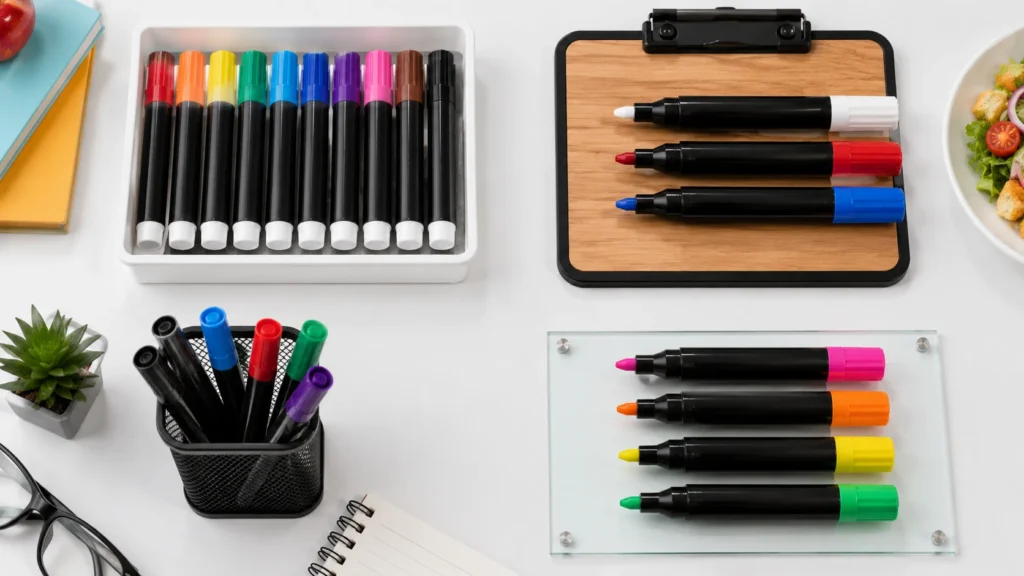
Most B2B buyers do not need to choose between wet erase and dry erase. They need both. They often need permanent markers, gel pens, and washable children's markers too. The mix should match their distribution channels. The question is how to structure the matrix without overcomplicating inventory.
Map Ink Type To Channel, Not To Price
Start with the end user. If your largest channel is K-12 education, dry erase markers in black, blue, red, and green will lead volume. Wet erase serves a smaller niche for overhead projectors and permanent displays. If your largest channel is food service or retail, wet erase becomes the core SKU. Dry erase then plays a support role for back-of-house whiteboards.
This channel-first approach stops the most common sourcing mistake. That mistake is buying a mix that looks balanced on a spreadsheet but matches no real customer's usage pattern.
Verify Ink Formulation Control At The Supplier Level
Ink steadiness is one of the most underrated quality variables in marker sourcing. When ink comes from third-party suppliers, mixes can drift between runs. A batch that writes smoothly in March may feel dry or streaky in September.
At facilities where ink is mixed in-house and checked batch by batch, color and viscosity drift stay under control. Some OEM makers run dedicated ink R&D labs. They test each pigment batch before it enters the line. This matters most for wet erase markers. Adhesion and clean removal must balance exactly. Ink that bonds too weakly smudges. Ink that bonds too strongly leaves ghosting.
ZH STATIONERY is a marker pen manufacturer with 26+ years of OEM/ODM experience. It runs an in-house ink R&D lab. Color matching and mix stability are verified before production batches move. For wet erase markers going to food service or retail, that control lowers the risk of batch-to-batch drift. Drift is what generates complaints.
Match Tip Specifications To Real Usage
Tip type and material shape perceived quality as much as ink does. Bullet tips serve general writing. Chisel tips give variable line width for signage. Fine tips handle detail work. For wet erase markers on menu boards and display signs, chisel and bullet tips lead. For classroom overhead projectors, fine tips let teachers fit more content on one sheet.
Nylon tips last longer than standard felt under heavy daily use. They add cost. POM tips offer the highest durability for industrial work. Buyers should put tip material in the RFQ, not just tip shape. A felt chisel tip and a nylon chisel tip deliver very different writing lives.
Treat Packaging As A Channel-Specific Variable
A marker that sells well in blister-card retail packaging may fail in bulk classroom packs. European buyers increasingly ask for recyclable or reduced-plastic packaging. U.S. big-box retailers often require specific hang-hole sizes and barcode placement. Wet erase markers in food service channels benefit from packaging that states surface fit and cleaning steps clearly. The person in a restaurant kitchen is not reading a spec sheet.
Custom packaging at the factory lets buyers align SKUs with channel needs without running multiple suppliers. A facility making 2,000+ new SKUs per year with full packaging support gives you room to test formats across markets. There is no retooling delay.
Quality Control Signals B2B Buyers Should Verify Before Bulk Orders
Supplier audits and spec sheets are useful. The clearest quality signals often come from watching a factory's routine work, not its polished presentations.
- Pre-shipment inspection coverage. Ask which visual and functional checks are performed, whether every unit or a sample is inspected, and how defects are recorded and corrected. Sampling and full inspection have different scopes; neither supports a universal defect-detection percentage without evidence from the actual process.
- Cap-off and dry-out testing. A marker that dries out two weeks after the end user opens it generates returns. Cap-off time testing) leaving uncapped markers exposed for set intervals and then measuring writing performance (should be part of every production batch inspection. For wet erase markers, which use water-based formulations, cap seal integrity is especially important because the ink evaporates faster than alcohol-based alternatives when exposed to air.
- Surface compatibility verification. Wet erase markers are designed for non-porous surfaces) whiteboards, glass, laminated boards, metal, plastic. But “non-porous” is a category, not a specification. A marker that writes cleanly on one brand of whiteboard may ghost on another. Quality-focused suppliers test each batch on multiple standardized surface types and maintain a ghosting-performance log that buyers can review.
- Documentation scope and standard edition. Match the report to the ordered model, ink, materials, and applicable standard edition. A report is not automatically invalid because it is three years old. EU toy guidance explains the toy framework; do not use a whiteboard-market report as evidence of an EN 71 revision.

Frequently Asked Questions
1. What Is The Difference Between Wet Erase And Dry Erase Markers?
Wet erase markers use water-based or paste-based semi-permanent ink. Removal needs a damp cloth. The ink bonds lightly to non-porous surfaces. It resists smudging from hand contact, humidity, or light rubbing. Dry erase markers use alcohol-based ink. It wipes off with a dry cloth or eraser. That makes it ideal for fast-changing content in classrooms and meeting rooms. The choice is a use-case call. Wet erase suits static signs, menu boards, and displays. Dry erase suits places where information updates often.
2. Can Wet Erase Markers Be Used On All Whiteboard Surfaces?
Wet erase markers work on most non-porous surfaces. That includes standard whiteboards, glass boards, laminated surfaces, metal, and plastic. They shine on black marker boards and lit display panels, where dry erase ink can look faint. Some low-cost melamine whiteboards have microscopic surface pores. Those can trap wet erase ink and cause ghosting. Buyers should test marker-surface fit with their own board supplier before bulk orders. Ask the marker manufacturer for ghosting data.
3. How Should B2B Buyers Evaluate Marker Pen Suppliers For Wet Erase Products?
Ask for the actual ink spec, surface-compatibility samples, and tip material with cap-off test conditions. Match the documents to the ordered model and target market. Review the inspection plan and batch records. In-house mixing or full inspection alone does not prove steady quality.
4. What Certifications Do Wet Erase Markers Need For The U.S. And European Markets?
In the U.S., CPSC art-material guidance describes toxicological review and chronic-hazard labeling under ASTM D-4236. In the EU, toy rules apply when the product is classed as a toy. CE marking is not a universal need for adult stationery. Agree the product class and documents with the buyer. Review ZH Stationery documents for the specific model. Do not assume one report covers every marker.
5. What Is The Typical MOQ For Custom Wet Erase Markers?
The minimum order for custom OEM/ODM programs is 50,000 pens per order, counted by total individual pens produced. For a 12-color pack, that equals roughly 4,200 sets, not 50,000 of each color. Standard stock models can be sampled at smaller trial sizes.
6. What Causes Wet Erase Markers To Ghost Or Stain Whiteboard Surfaces?
Ghosting usually comes from one of three factors. Ink stays on the surface too long, for weeks or months. The board is low quality, with microscopic pores that trap pigment. Or the ink mix has too much binder and grips too hard. High-quality wet erase ink balances grip and removal. It holds against smudging. It does not leave residue after cleaning. If you are sourcing wet erase markers or other marker pens for your brand, contact ZH STATIONERY. We can discuss ink specs, send product documents, and test samples on your target board surfaces.
Conclusion: A Sourcing Strategy Built On Use Cases, Not Assumptions
The global marker pen market is projected to grow to USD 2.9 billion by 2032. That reflects more than rising consumption. Channels are pulling specs in different directions. Education, food service, retail, corporate, and logistics all want slightly different products.
For B2B buyers, the smart sourcing strategy is not one product that does everything okay. Match each marker type to the channel and use case it serves best. Verify that the supplier's ink mixing, tip quality, and inspection support batch steadiness. Build a product matrix your distribution partners can trust without explanation.
The marker category rewards buyers who know the technical details. It punishes those who treat all markers as the same commodity. The difference shows in return rates and repeat orders. It shows in whether your customers trust your line enough to grow it.
Related guide: For related compliance planning, see Best Alcohol Markers Manufacturers in China.
Related Reading
- Wet Erase Markers Sourcing Report 2026: B2B Buyer Guide
- Dry Erase Marker Ink Explained: Why Some Formulas Stain Fabrics and What B2B Buyers Should Check
- How to Choose the Right Pen Tip: A Buyer’s Guide to Nib Types, Sizes, and Materials
- food-grade marker ink guide
- children's marker OEM safety guide
- formaldehyde testing in stationery guide
- edible marker pen guide
- classic blackboard material guide