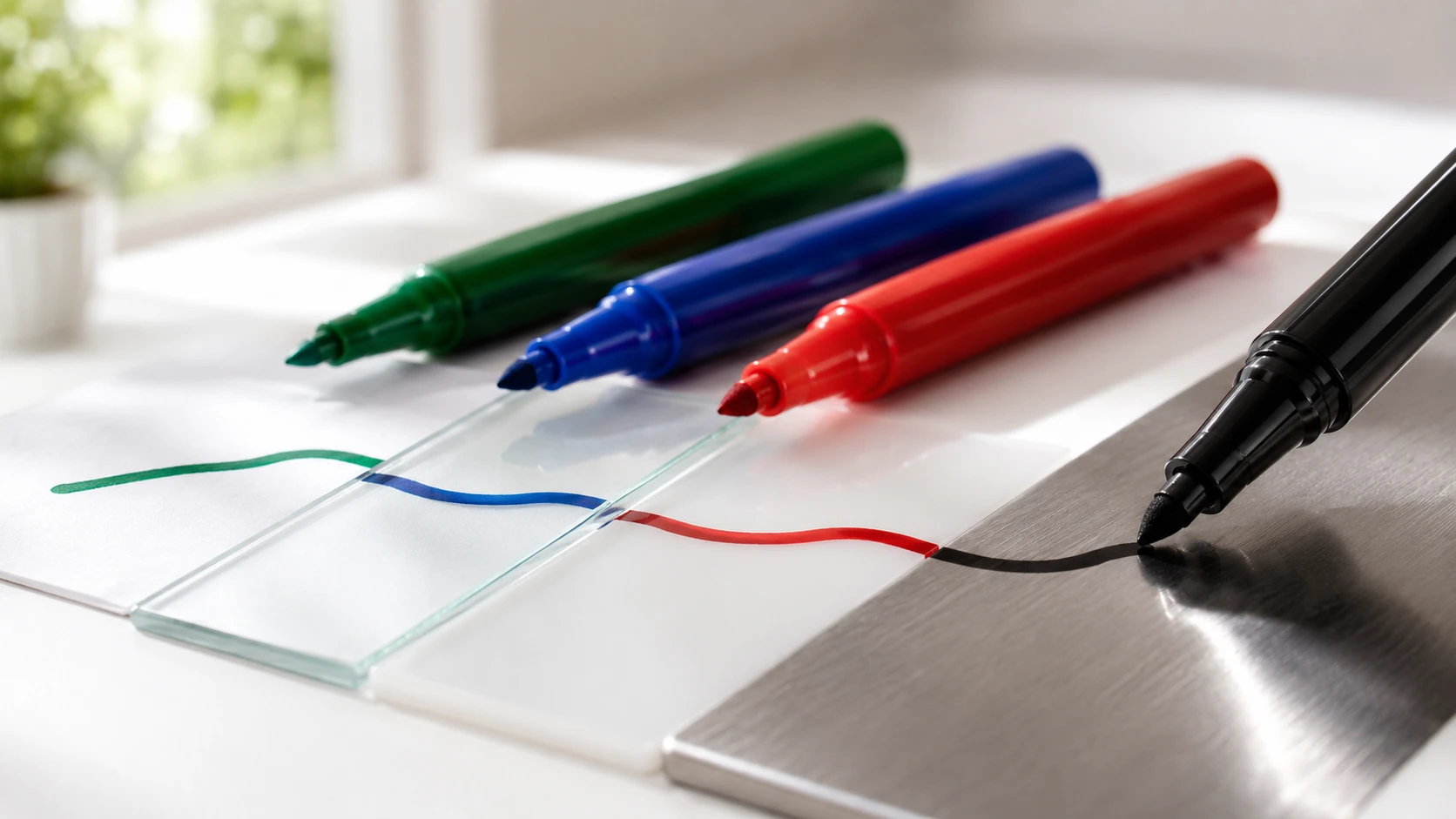
A customer may complain about a pale line or ink that washes off after one rain shower. The real cause is usually not the pen. The cause is a chain of sourcing decisions made months earlier: solvent grade, resin chemistry, pigment mixing, and batch tests.
Brand owners, wholesalers, and buyers who order 50,000 or more permanent markers need to understand what is inside the barrel. This knowledge is not just theory. It is the difference between a product that builds loyalty and one that creates returns and complaints.
Aquisição B2B de canetas marcadoras affects every link in the supply chain. A marker that writes unevenly, dries out in weeks, or will not stick to plastic can hurt a whole brand. This guide connects ink chemistry to supplier checks, so you can judge marker quality before ordering.
Índice
Resposta Rápida: O Que Determina a Qualidade de uma Caneta Permanente no Nível de Fabricação?
Three core ink parts decide how a marker performs, and factory control over each part decides how consistent the product is:
- Sistema solvente: The carrier liquid (typically alcohols like ethanol, isopropanol, or n-propanol) that keeps ink fluid inside the barrel and evaporates upon application. Solvent purity and evaporation rate directly affect writing smoothness, dry time, and cap-off longevity.
- Resina / aglutinante: The film-forming polymer (commonly phenolic, acrylic, or ketone resins) that bonds pigment to the writing surface after solvent evaporation. Resin type and concentration determine adhesion strength, water resistance, and whether the mark is genuinely permanent.
- Corante: Pigmentos ou corantes solventes que fornecem cor. A distribuição do tamanho das partículas afeta a intensidade da cor, a resistência à luz e se a tinta flui suavemente pela ponta sem entupir.
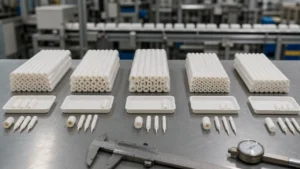
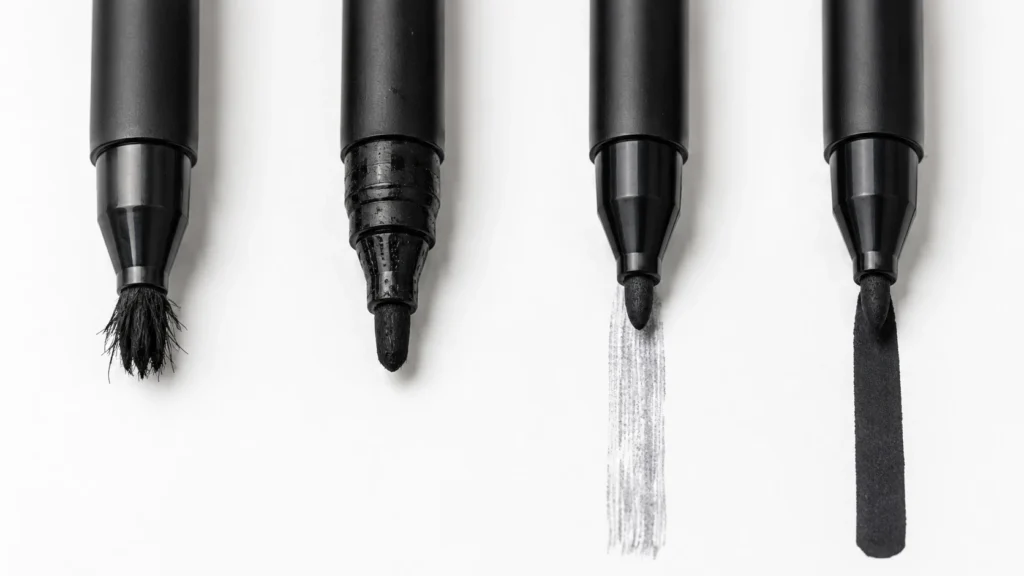
- Engenharia da ponta e do reservatório: The polyester fiber reservoir and felt tip must deliver consistent ink flow. Cap-off time (how long a marker can sit uncapped and still write) depends equally on ink formulation and cap seal tolerance.
For buying teams, these four variables help you write clearer specs and run sharper audits before production starts, not after complaints arrive.
Aquisição B2B de Canetas Marcadoras: Reclamações de Consumidores Que Apontam para Problemas de Fabricação
Every complaint about a marker points back to a factory process you can check. This table links what users feel to what factories control, and it belongs in your lista de verificação de avaliação de fornecedores checklist.
| Reclamação Comum do Cliente | Causa Raiz no Nível de Fabricação | Métrica de Controle de Qualidade da Fábrica |
| A caneta seca dentro de semanas após o primeiro uso | Alta volatilidade do solvente sem umectante adequado; tolerância ruim da vedação da tampa | Cap-off time testing per agreed spec (standard alcohol pens 15-30 minutes, low-evaporation designs longer); seal integrity batch inspection |
| Tinta aparece desbotada, com riscos ou irregular | Dispersão inconsistente do pigmento; moagem inadequada durante a preparação da base de moagem | Análise da distribuição do tamanho das partículas (alvo abaixo de 150nm); verificação de cor por espectrofotômetro por lote de produção |
| “Tinta ”permanente” sai com água | Conteúdo insuficiente de resina ou química de resina errada; filme não resiste à umidade | Teste de solubilidade da resina e formação de filme; teste de adesão e resistência à água em múltiplos tipos de substrato |
| Ponta desfia ou colapsa após uso moderado | Material de ponta de fibra de baixa qualidade; química da tinta incompatível com o aglutinante da ponta | Teste de durabilidade da ponta por traçado (mínimo de 500 metros); verificação de compatibilidade do material da ponta com a formulação específica da tinta |
| Tinta vaza ou forma borrões durante a escrita | Reservatório superlotado; interface ponta-reservatório inadequada; viscosidade da tinta fora da especificação | Verificação do volume de enchimento com tolerância de ±0,5ml; teste de viscosidade em temperatura controlada (tipicamente 4–15 cps para sistemas de canetas marcadoras) |
| Cores variam notavelmente entre lotes do mesmo SKU | Ausência de padronização de cor por espectrofotômetro; fornecedor de pigmento alterado sem reformulação | Batch-level spectrophotometer matching (delta-E under 1.5); pigment supplier qualification and documented change-control process |
This table is one of the most useful tools a B2B buyer can bring to a factory visit. Ask for these measurements, not just a promise that quality control exists.
Entendendo a Formulação da Tinta de Caneta Marcadora: O Sistema de Três Componentes
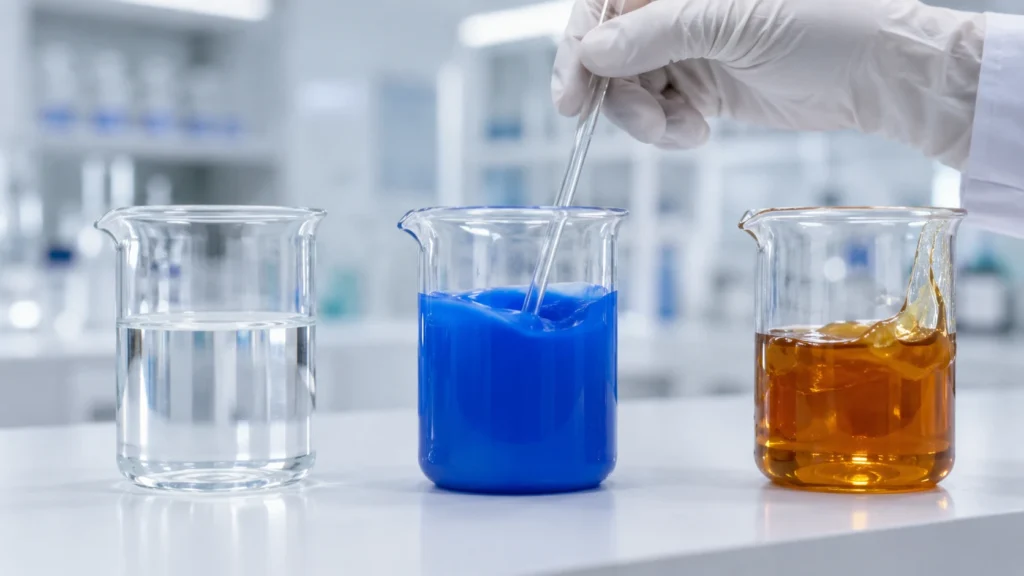
Every marker works on the same idea. Three parts share one sealed barrel: solvent, colorant, and resin. The mix changes the moment the nib touches a surface.
O Solvente: Mais do Que Apenas um Veículo
The solvent carries the ink. Inside the marker, it dissolves the resin and keeps the colorant floating. This thin liquid moves through the reservoir and nib by da ação capilar. As canetas permanentes modernas markers use alcohols like ethanol, isopropanol, and n-propanol because they dry evenly. These alcohols are less toxic than the xylene and toluene used in older inks.
Solvent quality shows up in writing. Cheap industrial alcohol can carry dirt that changes dry time or creates a smell. Suppliers who use cleaner solvent grades produce markers with steady drying and fewer odor complaints. That difference appears in return rates, not in spec sheets.
A Resina: O Que Realmente Torna uma Caneta Permanente
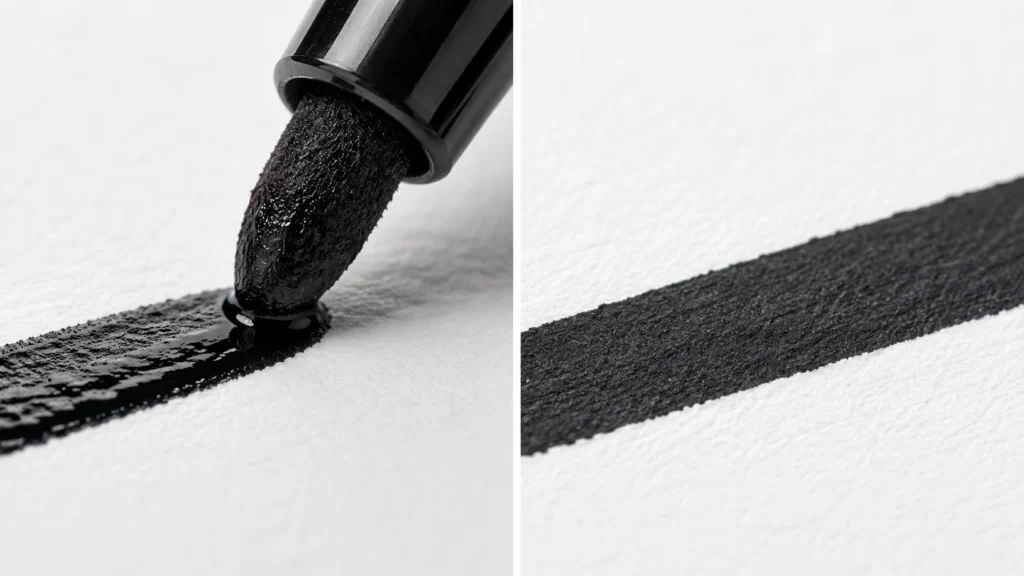
The resin is what makes the ink permanent. Ask what share of the ink is resin, because more resin usually means stronger adhesion. After the solvent dries, the resin leaves a thin, Película insolúvel em água that locks the pigment to the surface. It sticks by weak forces on smooth surfaces and by physical grip on porous ones. Phenolic resins are common because they dissolve well in alcohol, dry fast, and hold onto many materials.
Resin quality is the single biggest difference between a mark that stays and one that rubs off. When you audit a factory, ask how it proves resin performance. Adhesion tests on glass, plastic, metal, and coated paper tell you more than any catalog or sales promise.
O Corante: Pigmentos vs. Corantes
Permanent markers use two color systems. Pigments are tiny solid particles that sit on the surface. Dyes are liquids that soak in. Pigments give better fade resistance and opacity. Dyes give stronger color at lower cost. Pigment inks need careful milling and mixing, or the nib will clog and the color will vary.
Factories with their own ink lab can control pigment particle size before production starts. Factories without that skill depend on outside ink suppliers, and a supplier change can quietly change your product. Map this risk during your audit.
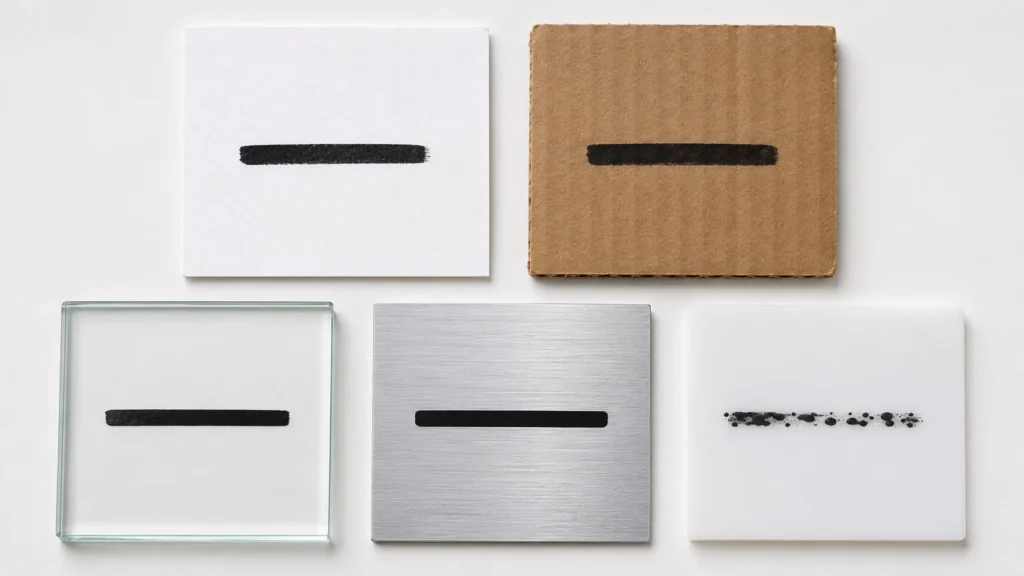
Química de Superfície e Controle de Qualidade de Canetas Permanentes: Por Que o Substrato é Importante
A marker does not just write on a surface. It reacts with it. The surface matters as much as the ink.
Glass, metal, and many plastics have no pores to grip, so the resin film sticks by surface energy alone. This is why markers on polypropylene and polyethylene can be uneven across brands. Paper and cardboard absorb the ink into their fibers, which adds physical grip to the chemical bond.
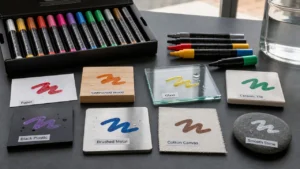
The practical rule is simple. If your users write on glass, metal, or plastic, the resin must be chosen for those surfaces. Industrial labels, warehouse floors, and store signs are common uses. A marker that works on cardboard can fail on a plastic bin. Ask for adhesion test data on the exact surfaces you sell to. That moves the talk from “our quality is good” to numbers you can check. That is the core of effective Controle de qualidade de marcadores permanentes.
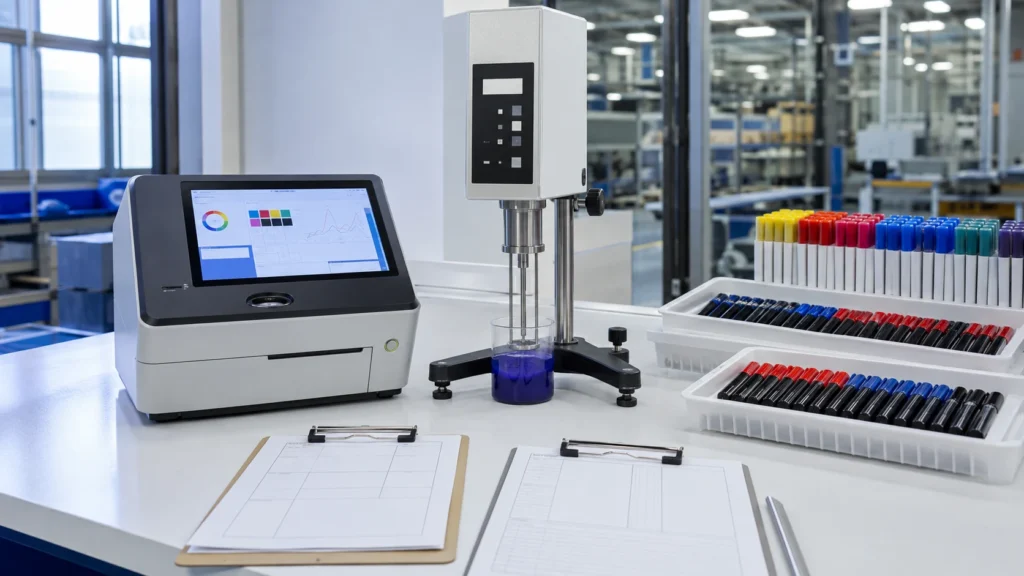
Certificações, Conformidade e O Que Significam para Compradores em Atacado
When you sell permanent markers in the U.S. or Europe, compliance is not optional. It is the price of customs clearance, retail placement, and liability protection.
Compliance follows the product’s use, not a blanket rule. For markers sold as children’s toys, EN71 Parts 3 and 9 apply in Europe. ASTM D-4236 plus CPSIA testing apply in the U.S. For industrial and adult-use permanent markers, the critical documents are different. You need MSDS or SDS for safe handling and shipping. REACH and CLP cover EU sales, LHAMA conformance covers U.S. art materials, and California Proposition 65 warnings apply where required. The Guia de materiais de arte CPSC explains how the labeling rules apply.
A factory with verified EN71 e ASTM D-4236 shows that its materials, ink, and processes follow accepted safety limits. For you, the proof is a current report from an independent lab, not a logo on a website.
Certificates alone are not enough. Also check these factory capabilities:
- The minimum order for custom OEM/ODM programs is 50,000 pens per order, counted by total individual pens produced. For a 12-color pack, that equals roughly 4,200 sets, not 50,000 of each color. Standard stock models can be sampled at smaller trial sizes.
- Custom packaging design support, from individual sleeve cards to retail display boxes
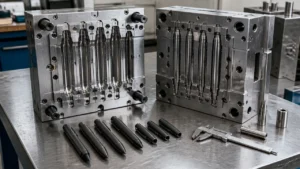
- 3D design and rapid physical sampling so you can test barrel shapes, cap designs, and color finishes before mold production
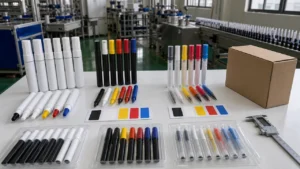
- 100% inline automated inspection for fill weight, cap torque, and nib retention, plus strict AQL sampling before shipment
- In-house ink formulation capability, which cuts dependence on third-party ink suppliers and speeds up color matching for custom projects
These operational factors never appear on a certificate, but they decide whether your order arrives on spec and your customers stay happy.
Perguntas Frequentes
O Que Torna uma Caneta Permanente Diferente de uma Caneta Comum?
The difference is the resin. Permanent markers use water-insoluble resins, usually phenolic or acrylic, that form a durable film after the solvent dries. Washable markers use water-soluble resins that come off with soap and water. For buyers, this choice decides product position and target market.
Como os Compradores Podem Avaliar a Qualidade da Tinta de Canetas Permanentes Antes de Fazer um Pedido em Atacado?
Request samples and test them on the surfaces your customers actually use, not just office paper. Check flow from first stroke to last, recovery after 15-30 minutes uncapped, and water resistance after drying. Use your agreed cap-off standard if it differs. Also check color match across pens in the same batch. Run the same test on five pens from one batch, because consistency matters as much as the first good stroke. Ask for batch records: viscosity, particle size, color meter readings, and adhesion results. A factory like ZH STATIONERY, with 26+ years of OEM/ODM and its own ink lab, can usually provide these records. Its testing is built into production, not added later.
Por Que Algumas Canetas Permanentes Desbotam Mais Rápido Que Outras?
Fading comes from colorant chemistry and the environment. Pigment inks resist UV light better than dyes, but milling quality matters too. UV, oxygen, and ozone speed up fading for every ink, which is why archival markers use special pigment systems. Ask suppliers if they run accelerated UV aging tests and what lightfastness rating their ink reaches.
Quais Certificações de Segurança os Compradores B2B Devem Exigir para Canetas Permanentes?
Match the documents to the product. EN71 applies to toys, not to every pen. ASTM D-4236 covers art material labeling, not every hazard. Review the product model and the report scope using Orientação para classificação de papelaria na UE e escopo da ASTM D4236. Request product-specific reports instead of assuming a factory certificate covers every run.
As Canetas Permanentes Podem Ser Personalizadas para Marcas Próprias?
Yes, and working directly with an OEM factory beats a trading company for this. You can match barrel colors to Pantone or RAL, print logos with pad or silk printing, and design custom caps and clips. Packaging can go from simple sleeves to display boxes, and custom ink colors are possible too. A factory with in-house ink R&D can match your color and keep it stable across batches. Ask which Pantone colors the factory has already matched, because that shortens your development time. The minimum order for custom OEM/ODM programs is 50,000 pens per order, counted by total individual pens produced. For a 12-color pack, that equals roughly 4,200 sets, not 50,000 of each color. Standard stock models can be sampled at smaller trial sizes.
Como os Tipos de Superfície Afetam o Desempenho das Canetas Permanentes, e Como Isso Deve Influenciar as Decisões de Fornecimento?
Different surfaces need different resins. Glass, metal, and plastic need resins that match surface energy. Paper, cardboard, and wood rely on physical grip as ink soaks into the fibers. If your customers use markers on many surfaces, include multi-substrate adhesion tests in the QC plan. Discuss the end-user surfaces with the factory’s technical team so the ink matches the application and complaints stay low.
If you source markers, metallic pens, or gel pens for private-label, retail, or school channels, entrar em contato com a ZH STATIONERY. Ask about specs, samples, packaging, and bulk quotes.
Leitura relacionada
- Controle de Qualidade de Canetas Marcadoras: Por que as Canetas Secam e o que os Compradores em Atacado Devem Saber
- Qualidade da Tinta Acrílica: 5 Testes que Compradores B2B Devem Realizar Antes de Fazer um Pedido
- Como Remover Marcador Permanente de Plástico: O Que Compradores B2B Devem Saber Sobre a Química da Tinta
- Você pode escrever em CDs com marcador permanente? Veja o que realmente acontece