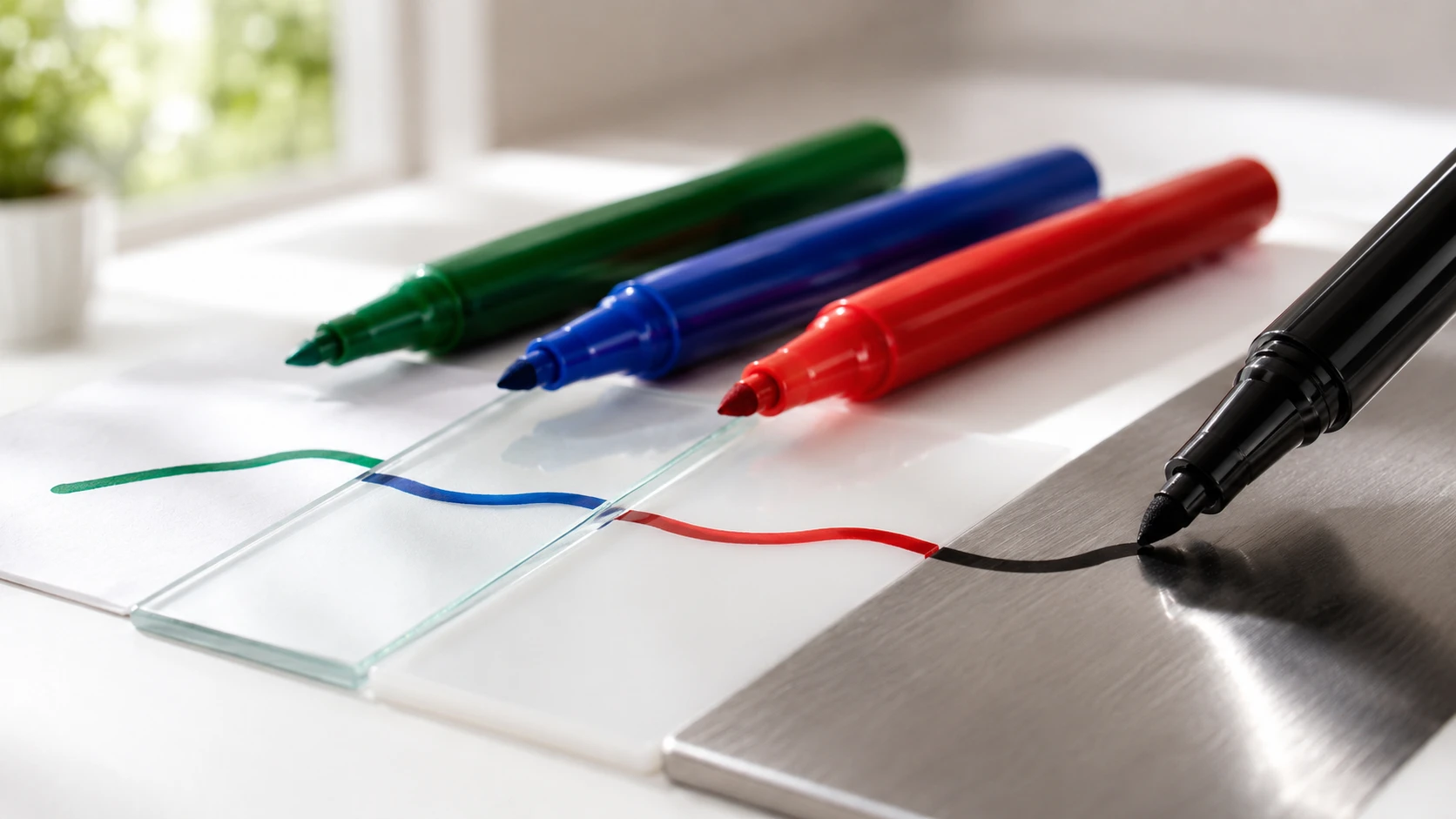
Lorsqu'un client se plaint qu'un marqueur permanent a laissé un trait pâle et irrégulier — ou pire, que l'encre “ permanente ” s'est effacée après une seule averse — le vrai problème ne vient généralement pas du marqueur individuel qu'il a acheté. Il s'agit d'une chaîne de décisions prises des mois plus tôt, au stade de l'approvisionnement, concernant les qualités de solvant, la chimie des résines, la dispersion des pigments et la vérification de la qualité au niveau du lot.
Pour les propriétaires de marques, les grossistes et les responsables achats qui s'approvisionnent en marqueurs permanents en quantités de 5 000 unités et plus, comprendre la chimie à l'intérieur du corps du marqueur n'est pas une curiosité académique. C'est la différence entre un produit qui fidélise la clientèle et un autre qui génère des retours, des réclamations et une perte d'espace de vente au détail.
L'approvisionnement B2B en marqueurs Les décisions se répercutent à chaque niveau de la chaîne d'approvisionnement. Un marqueur qui écrit de manière irrégulière, sèche en quelques semaines ou ne parvient pas à adhérer aux surfaces non poreuses ne frustre pas seulement un utilisateur final — il peut endommager la réputation d'une marque dans toute une catégorie de papeterie. Cet article comble le fossé entre les principes fondamentaux de la chimie des encres et l'évaluation pratique des fournisseurs, vous offrant un cadre technique pour évaluer la qualité des marqueurs permanents avant de vous engager sur un bon de commande.
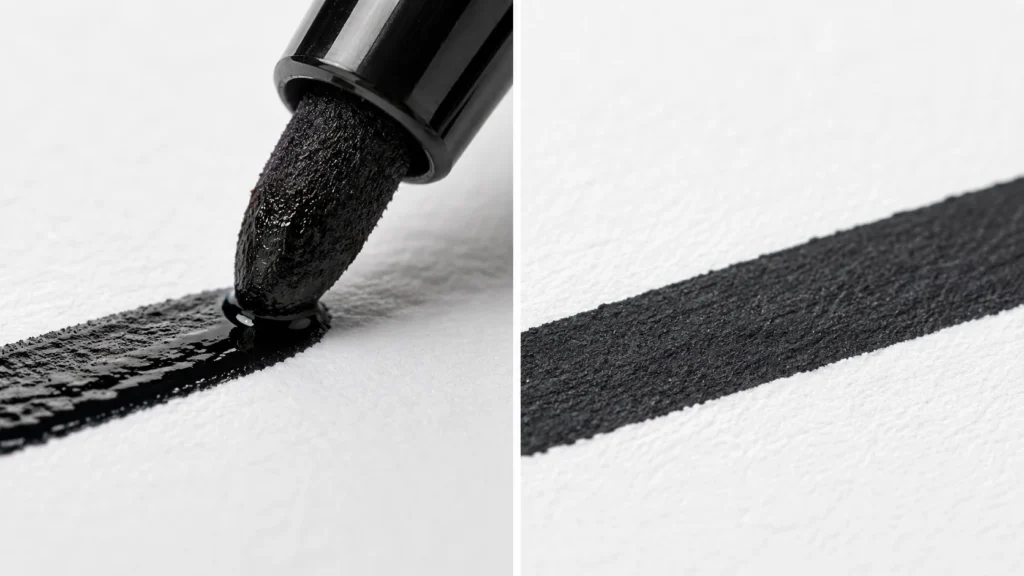
Table des matières
Réponse rapide : Qu'est-ce qui détermine la qualité des marqueurs permanents au niveau de la fabrication ?
La performance d'un marqueur permanent est régie par trois composants principaux de l'encre et la rigueur avec laquelle ils sont contrôlés pendant la production :
- Système de solvant : Le liquide porteur — généralement des alcools comme l'éthanol, l'isopropanol ou le n-propanol — qui maintient l'encre fluide à l'intérieur du corps et s'évapore lors de l'application. La pureté du solvant et son taux d'évaporation affectent directement la fluidité de l'écriture, le temps de séchage et la longévité hors capuchon.
- Résine / liant : Le polymère filmogène — couramment des résines phénoliques, acryliques ou cétoniques — qui lie le pigment à la surface d'écriture après évaporation du solvant. Le type et la concentration de la résine déterminent la force d'adhérence, la résistance à l'eau et si la marque est véritablement permanente.
- Colorant : Pigments ou colorants solvants qui fournissent la couleur. La distribution de la taille des particules affecte l'intensité de la couleur, la résistance à la lumière et la capacité de l'encre à s'écouler uniformément à travers la pointe sans la boucher.
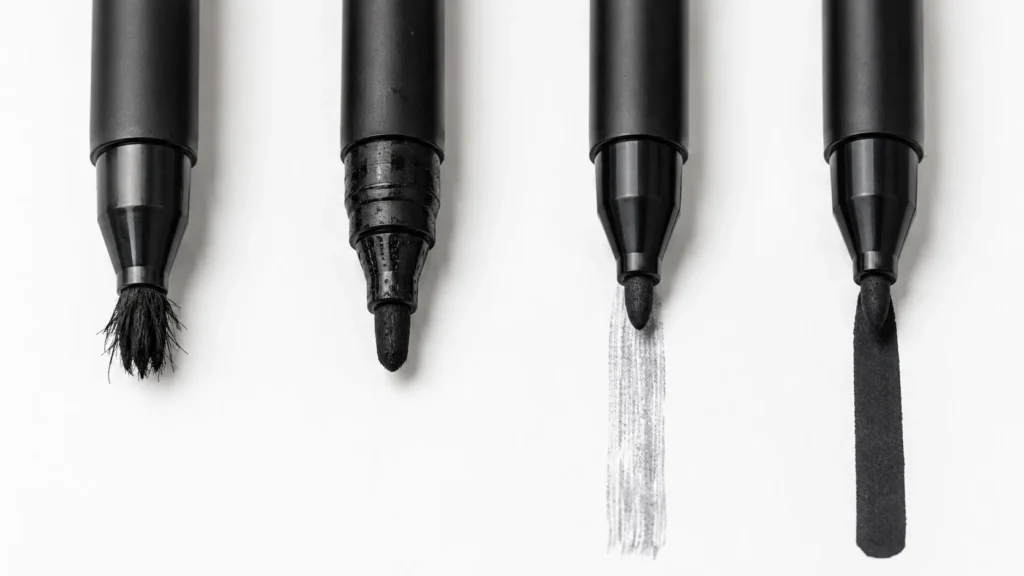
- Ingénierie de la pointe et du réservoir : Le réservoir en fibre de polyester et la pointe en feutre doivent assurer un débit d'encre constant. Le temps hors capuchon — combien de temps un marqueur peut rester sans capuchon et encore écrire — dépend à la fois de la formulation de l'encre et de la tolérance d'étanchéité du capuchon.
Pour les équipes d'approvisionnement et les gestionnaires de marque, comprendre ces variables aide à établir des spécifications de qualité plus claires et des critères d'audit fournisseur plus ciblés — avant le début de la production, et non après l'arrivée des réclamations.
Approvisionnement en marqueurs B2B : Réclamations des consommateurs indiquant des problèmes de fabrication
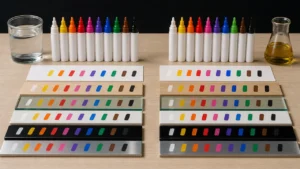
Chaque frustration d'un client face à un marqueur permanent correspond directement à une variable de fabrication qui devrait faire partie de votre liste de contrôle pour l'évaluation des fournisseurs Ce tableau relie ce que les utilisateurs finaux expérimentent à ce que les usines contrôlent.
| Réclamation courante du client | Cause racine au niveau de la fabrication | Mesure de contrôle qualité en usine |
| Le marqueur sèche dans les semaines suivant la première utilisation | Volatilité élevée du solvant sans humectant adéquat ; mauvaise tolérance d'étanchéité du capuchon | Test du temps hors capuchon (exposition minimale de 2 heures) ; inspection par lot de l'intégrité du joint |
| L'encre semble délavée, striée ou irrégulière | Dispersion de pigments incohérente ; broyage inadéquat lors de la préparation de la pâte de base | Analyse de la distribution de la taille des particules (cible inférieure à 150 nm) ; vérification colorimétrique par spectrophotomètre par lot de production |
| “L'encre ” permanente » s'efface avec de l'eau | Teneur insuffisante en résine ou mauvaise chimie de la résine ; le film ne résiste pas à l'humidité | Test de solubilité de la résine et de formation du film ; test d'adhérence et de résistance à l'eau sur plusieurs types de substrats |
| La pointe s'effiloche ou s'affaisse après une utilisation modérée | Matériau de la pointe en fibre de basse qualité ; chimie de l'encre incompatible avec le liant de la pointe | Test de durabilité de la pointe par course (minimum 500 mètres) ; vérification de la compatibilité du matériau de la pointe avec la formulation spécifique de l'encre |
| Fuite ou bavure d'encre lors de l'écriture | Réservoir trop rempli ; interface pointe-réservoir inappropriée ; viscosité de l'encre hors spécification | Vérification du volume de remplissage avec une tolérance de ±0,5 ml ; test de viscosité à température contrôlée (généralement 4–15 cps pour les systèmes de marqueurs) |
| Variations de couleur notables entre les lots d'une même référence (SKU) | Absence de standardisation colorimétrique par spectrophotomètre ; changement de fournisseur de pigments sans reformulation | Appariement colorimétrique par spectrophotomètre au niveau du lot (ΔE inférieur à 1,0) ; qualification du fournisseur de pigments et processus documenté de contrôle des modifications |
Cette correspondance entre l'expérience client et les mesures d'usine est l'un des outils les plus pratiques qu'un acheteur B2B puisse apporter à l'évaluation des fournisseurs. Lorsque vous visitez une usine ou examinez la documentation qualité d'un fournisseur, ce sont ces mesures spécifiques qu'il faut demander — pas seulement s'ils “ font du contrôle qualité ”.”
Comprendre la formulation de l'encre des marqueurs : le système à trois composants
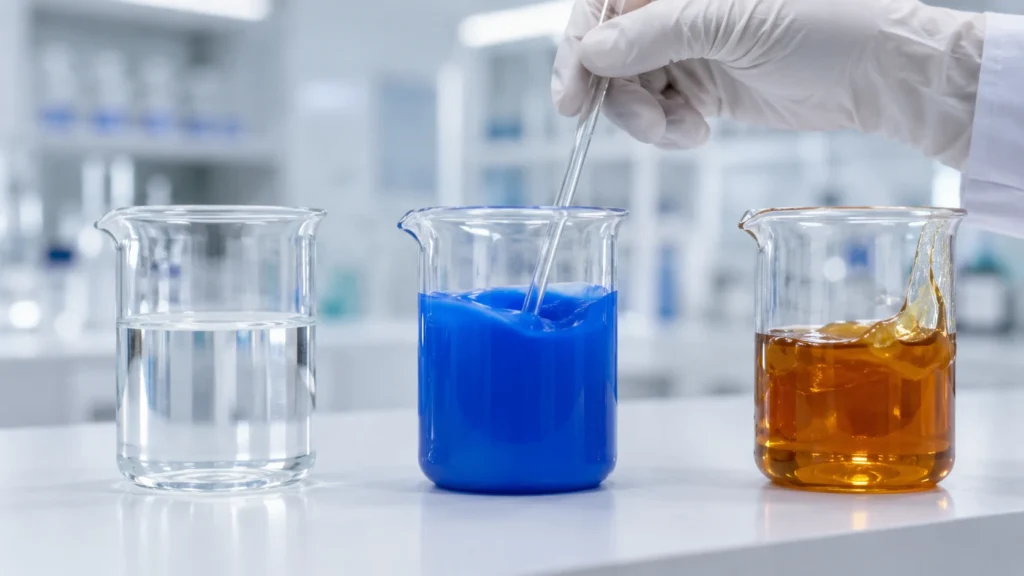
Chaque marqueur permanent, quelle que soit la marque, le prix ou le pays d'origine, fonctionne sur le même principe fondamental. Trois composants — solvant, colorant et résine — coexistent dans un corps scellé. Leur comportement change dès que la pointe entre en contact avec une surface.
Le solvant : bien plus qu'un simple vecteur
Le solvant est le véhicule de distribution. À l'intérieur du corps du marqueur, il dissout la résine et maintient le colorant en suspension dans un fluide à faible viscosité qui traverse le réservoir en polyester et la pointe en feutre par action capillaire. Les marqueurs permanents modernes utilisent des alcools — éthanol, isopropanol, n-propanol — choisis pour leurs profils d'évaporation équilibrés et leur toxicité moindre par rapport au xylène et au toluène courants dans les formulations plus anciennes.
Pour les acheteurs B2B, la qualité du solvant se traduit directement par les performances d'écriture. Les alcools industriels de qualité inférieure peuvent contenir des impuretés qui modifient les taux d'évaporation ou produisent des odeurs que les utilisateurs finaux remarquent. Les fournisseurs qui s'approvisionnent en solvants de qualité pharmaceutique ou réactif produisent des marqueurs avec des temps de séchage plus prévisibles et moins de réclamations concernant les odeurs chimiques fortes — une différence qui se manifeste dans les taux de retour, et non sur les fiches techniques.
La résine : ce qui rend réellement un marqueur permanent
La résine est ce qui définit le caractère “ permanent ”. Après évaporation du solvant, la résine forme un, film mince et insoluble dans l'eau qui verrouille le pigment sur la surface d'écriture — par des forces de van der Waals sur les substrats lisses et par un ancrage mécanique sur les substrats poreux. Les résines phénoliques sont largement utilisées dans les formulations de marqueurs permanents car elles combinent une bonne solubilité dans l'alcool, un séchage rapide et une forte adhérence sur divers matériaux.
La qualité et la concentration de la résine sont sans doute la variable la plus importante qui distingue un marqueur qui tient bon d'un autre qui s'efface ou se lave. Lors de l'évaluation d'un fournisseur, demander comment une usine valide la performance de la résine — par des tests d'adhérence sur le verre, le plastique, le métal et le papier couché — en dit plus sur la qualité réelle du produit que n'importe quelle description de catalogue ou promesse de vente.
Le Colorant : Pigments vs. Colorants
Les marqueurs permanents peuvent utiliser des pigments — particules insolubles qui se déposent sur la surface — ou des colorants solvants qui la pénètrent. Les pigments offrent généralement une meilleure résistance à la lumière et une meilleure opacité. Les colorants fournissent une couleur plus intense et transparente à des concentrations plus faibles. La distinction est importante car les encres à base de pigments nécessitent des processus de broyage et de dispersion plus sophistiqués pour éviter le colmatage de la pointe et garantir une couleur uniforme.
Dans les installations disposant d'une capacité de R&D interne pour l'encre, la taille des particules de pigment peut être contrôlée au niveau du laboratoire avant la mise à l'échelle de la production. Sans cette capacité, une usine dépend de fournisseurs d'encre tiers dont les changements de formulation peuvent affecter silencieusement la cohérence du produit — un risque de chaîne d'approvisionnement qu'il vaut la peine de cartographier lors des audits de contrôle qualité des marqueurs permanents.
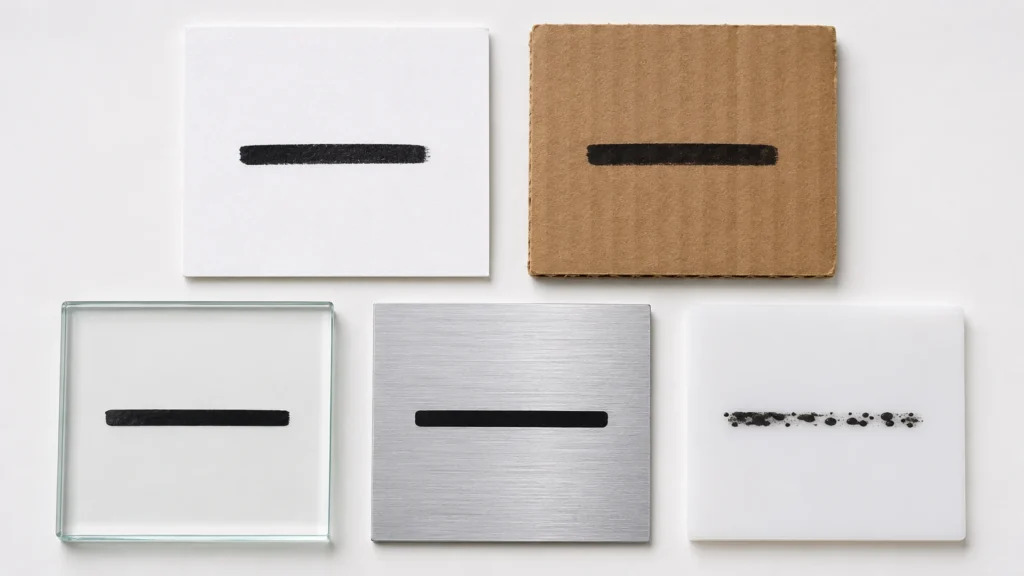
Chimie de surface et contrôle qualité des marqueurs permanents : pourquoi le substrat est important
Un marqueur n'écrit pas simplement sur une surface — il interagit avec elle chimiquement et mécaniquement. La permanence d'une marque donnée dépend du substrat au moins autant que de l'encre à l'intérieur du corps.
Les surfaces non poreuses comme le verre, le métal et certains plastiques présentent un défi d'adhérence distinct : sans pores pour s'accrocher, le film de résine repose entièrement sur la compatibilité de l'énergie de surface. C'est pourquoi la performance des marqueurs sur le polypropylène ou le polyéthylène — des plastiques à faible énergie de surface — est notoirement incohérente selon les marques. Les surfaces poreuses comme le papier et le carton absorbent l'encre dans leur matrice fibreuse, ajoutant un ancrage mécanique qui complète l'adhérence chimique.
Pour les acheteurs B2B, le point pratique est simple. Si vos utilisateurs finaux utiliseront principalement les marqueurs sur des surfaces non poreuses — étiquetage industriel, marquage de sols d'entrepôt, signalétique de vente au détail — le système de résine doit être spécifié pour ces conditions. Un marqueur qui écrit parfaitement sur du carton peut échouer complètement sur un bac de rangement en plastique. Lors de l'évaluation d'un fournisseur, demander des données de test d'adhérence spécifiques au substrat est l'une des questions les plus pertinentes que vous puissiez poser. Cela fait passer la conversation de “ notre qualité est bonne ” à des mesures de performance vérifiables — le cœur d'un contrôle qualité efficace des marqueurs permanents.
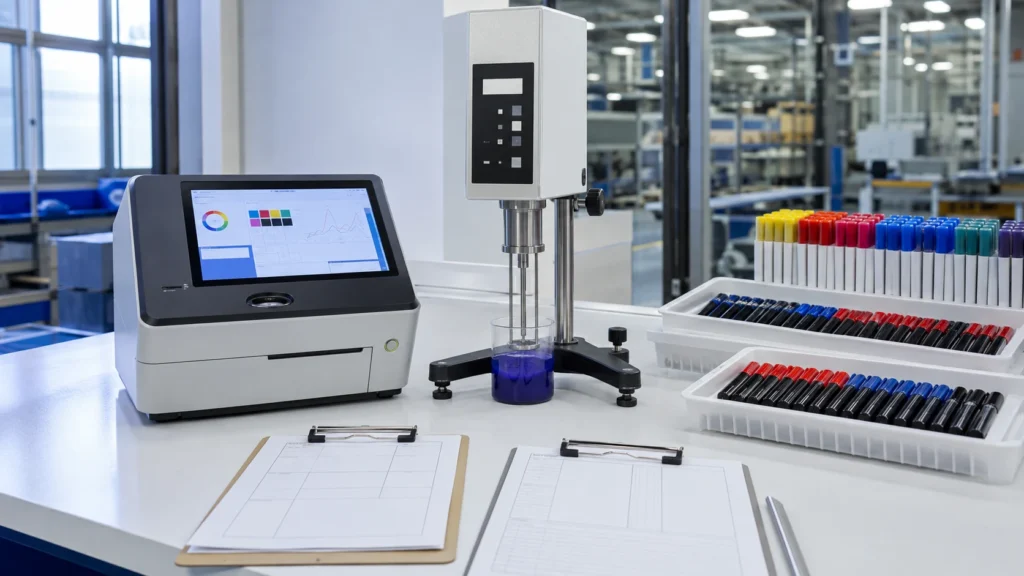
Certifications, Conformité Et Ce Qu'elles Signifient Pour Les Acheteurs En Gros
Lors de l'approvisionnement en marqueurs permanents pour la distribution aux États-Unis ou en Europe, la conformité n'est pas facultative. C'est une condition préalable au dédouanement, au placement en magasin de détail et à la protection contre la responsabilité civile.
La norme EN71 (Parties 1 à 3) est la norme de sécurité européenne couvrant les risques mécaniques, l'inflammabilité et la migration des métaux lourds provenant des encres et des matériaux dans les jouets et la papeterie. La norme ASTM D-4236 est la norme américaine exigeant que les matériaux d'art soient évalués pour les risques chroniques pour la santé avec un étiquetage approprié. Les deux normes s'appliquent car les marqueurs permanents — utilisés dans les écoles, les bureaux et les foyers — relèvent des réglementations générales sur la sécurité des produits de consommation dans les deux juridictions.
Une usine fonctionnant avec une conformité vérifiée aux normes EN71 et ASTM D-4236 démontre que son approvisionnement en matériaux, sa formulation d'encre et ses processus de production sont conformes aux seuils de sécurité internationalement reconnus. Ce qui importe pour les acheteurs : recherchez des rapports de test actuels et datés, émanant de laboratoires tiers accrédités — et non un logo de certification affiché sur un site web sans documentation justificative.
Au-delà des certificats de conformité, tenez compte de ces capacités opérationnelles lors de l'évaluation des normes de qualité d'un fournisseur de papeterie :
- Quantité minimale de commande (QMC) à partir de 2 000 pièces pour les commandes initiales, avec une flexibilité pour les essais de production sous marque privée.
- Assistance pour la conception d'emballages personnalisés — des pochettes individuelles aux boîtes de présentation pour la vente au détail.
- Capacité de conception 3D et de réalisation rapide d'échantillons physiques pour itérer sur les formes de corps, les conceptions de capuchons et les finitions colorées avant de s'engager dans la production de moules.
- Inspection visuelle et fonctionnelle à 100 % de chaque unité avant l'emballage, plutôt qu'un simple échantillonnage statistique par lots.
- Capacité interne de formulation d'encre — ce qui réduit la dépendance vis-à-vis des fournisseurs d'encre tiers et permet un appariement plus rapide des couleurs pour les projets personnalisés.
Ces facteurs opérationnels n'apparaissent pas sur un certificat, mais ils déterminent directement si votre commande arrive conforme aux spécifications et si vos clients finaux restent satisfaits.
Foire aux questions
Qu'est-ce qui distingue un marqueur permanent d'un marqueur ordinaire ?
La différence réside dans le système de résine. Les marqueurs permanents et non permanents utilisent des solvants et des colorants, mais les marqueurs permanents emploient des résines insolubles dans l’eau — généralement à base de phénol ou d’acrylique — qui forment un film durable et résistant à l’eau une fois le solvant évaporé. Les marqueurs lavables classiques utilisent des résines solubles dans l’eau, éliminables avec de l’eau et du savon. Pour les acheteurs B2B qui spécifient les exigences produit, le choix du système de résine est ce qui détermine fondamentalement le positionnement du produit et son adéquation au marché cible.
Comment les acheteurs peuvent-ils évaluer la qualité de l’encre des marqueurs permanents avant de passer une commande en gros ?
Demandez des échantillons physiques et testez-les sur les substrats réels utilisés par vos clients — pas seulement du papier de bureau. Vérifiez la consistance du flux d'encre de la première à la dernière trace, la récupération après 2+ heures sans capuchon, la résistance à l'eau après séchage complet, et la cohérence des couleurs entre plusieurs stylos d'un même lot. Demandez au fournisseur la documentation de contrôle qualité par lot : mesures de viscosité, analyse granulométrique, relevés spectrophotométriques et résultats de tests d'adhérence spécifiques au substrat. Une usine avec plus de 26 ans d' expérience en OEM/ODM et un laboratoire d'encre interne dédié — comme c'est le cas pour ZH STATIONERY — peut généralement fournir cette documentation technique car l'infrastructure de test est intégrée dans le flux de production, et non ajoutée après coup.
Pourquoi certains marqueurs permanents s'estompent-ils plus rapidement que d'autres ?
La décoloration est principalement fonction de la chimie des colorants et de la résistance environnementale. Les encres à base de pigments résistent généralement mieux à la dégradation par les UV que les encres à base de colorants, mais la taille des particules de pigment et la qualité de leur dispersion sont également importantes — des pigments mal broyés peuvent produire une couleur irrégulière. L'exposition aux rayons UV, à l'oxygène et à l'ozone accélère la décoloration pour tous les types d'encre, c'est pourquoi les marqueurs de qualité archive utilisent des systèmes pigmentaires spécialement conçus. Lors de l'approvisionnement, demandez aux fournisseurs s'ils effectuent des tests de vieillissement accéléré aux UV et quelles sont les notes de résistance à la lumière que leurs formulations atteignent dans des conditions standardisées.
Quelles certifications de sécurité les acheteurs B2B devraient-ils exiger pour les marqueurs permanents ?
Au minimum, EN71 pour la distribution européenne et ASTM D-4236 pour la distribution américaine. Ces normes vérifient que les formulations d'encre ne contiennent pas de niveaux dangereux de métaux lourds ou de toxines chroniques. Pour les acheteurs ciblant les circuits scolaires ou pour enfants, la conformité EN71 est non négociable. Certains marchés peuvent également exiger une documentation de conformité REACH. ZH STATIONERY détient des certifications EN71 et ASTM D-4236 à jour avec des tests par lot, ce qui signifie que les acheteurs reçoivent une documentation de conformité vérifiée liée à chaque cycle de production — et non des certificats obsolètes qui pourraient ne plus refléter l'approvisionnement actuel en matériaux.
Les marqueurs permanents peuvent-ils être personnalisés pour les marques de distributeur ?
Oui — et c'est un domaine où travailler directement avec un fabricant OEM de marqueurs crée des avantages mesurables par rapport à un approvisionnement via des sociétés de négoce. Les options de personnalisation incluent l'appariement des couleurs du corps selon les normes Pantone ou RAL, l'impression de logos par tampographie ou sérigraphie, la conception personnalisée de capuchons et de clips, un emballage sur mesure allant des pochettes individuelles aux boîtes prêtes pour la vente au détail, et le développement d'encres de couleur personnalisées. Les installations disposant d'un service R&D interne pour les encres peuvent formuler des couleurs spécifiques à une marque et les valider sur plusieurs lots de production — une capacité qui raccourcit les cycles de développement et réduit le risque de dérive colorimétrique. Les QMC pour les projets personnalisés commencent généralement autour de 2 000 à 5 000 pièces, selon la complexité de l'outillage.
Comment les types de surfaces affectent-ils les performances des marqueurs permanents, et comment cela devrait-il influencer les décisions d'approvisionnement ?
Différentes surfaces exigent différentes chimies de résine. Les surfaces non poreuses — verre, métal, plastiques — nécessitent des résines avec de forts domaines polaires et non polaires pour obtenir une adhérence par correspondance d'énergie de surface. Les surfaces poreuses — papier, carton, bois — reposent davantage sur un verrouillage mécanique lorsque l'encre s'absorbe dans la structure fibreuse du substrat. Si vos clients utilisent des marqueurs sur diverses surfaces — courant dans les environnements industriels, d'entrepôt et éducatifs — incluez des tests d'adhérence multi-substrats dans le protocole de contrôle qualité de votre fournisseur. Pour les acheteurs évaluant les options d'approvisionnement en marqueurs en vrac, discuter des exigences spécifiques de surface des utilisateurs finaux avec l'équipe technique du fabricant aide à adapter la formulation d'encre à l'application, réduisant ainsi les réclamations de performance après distribution.
Si vous vous approvisionnez en marqueurs permanents, marqueurs métalliques ou stylos gel pour des programmes de marque privée, la distribution au détail ou les circuits scolaires et éducatifs, vous pouvez contacter ZH STATIONERY pour discuter des spécifications, des échantillons, des exigences d'emballage et des devis de production en vrac.
相关指南: 如需相关的质量控制检查,请参阅 Fabrication de marqueurs.