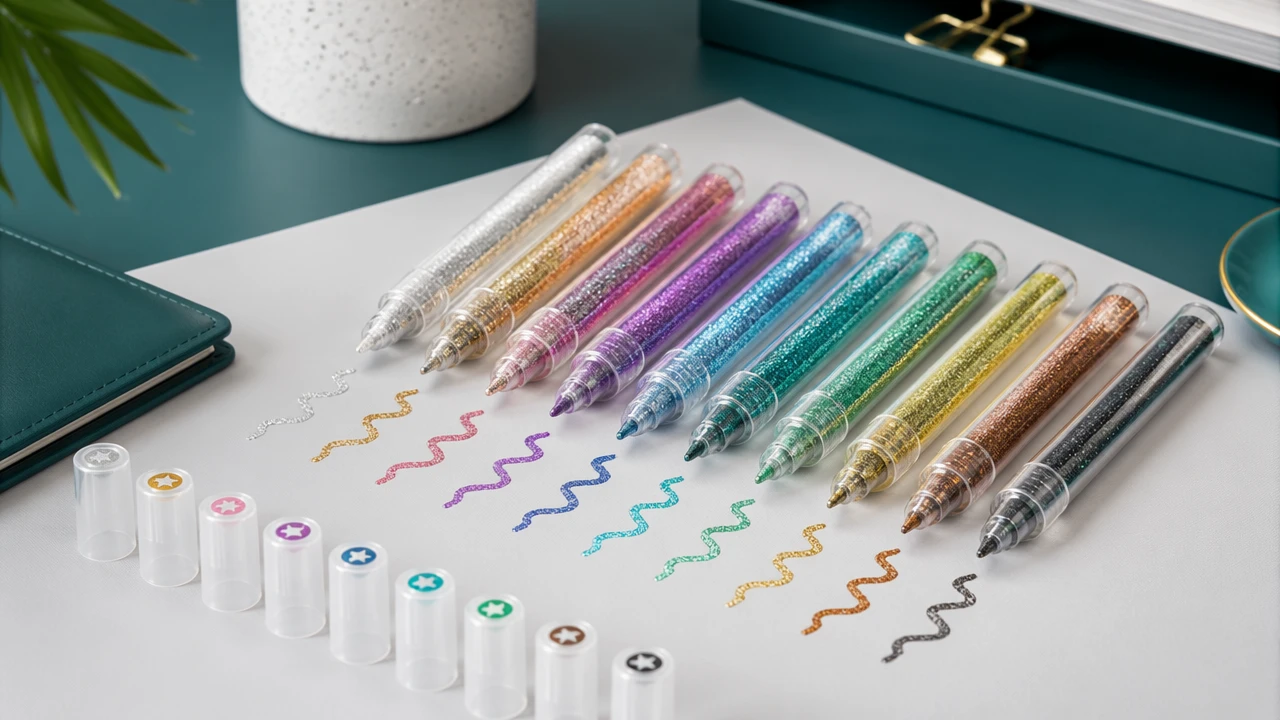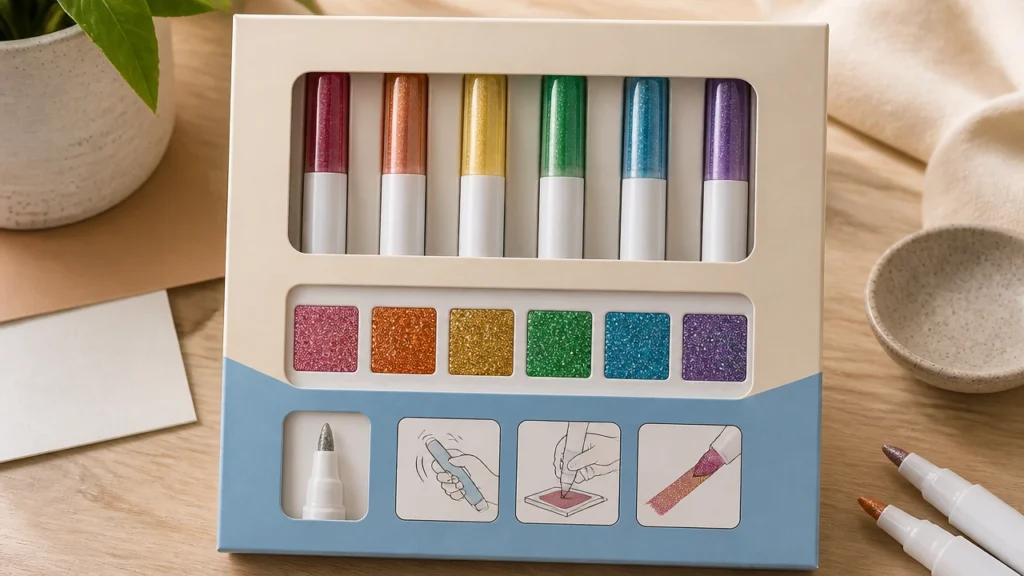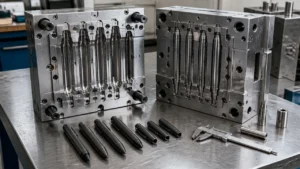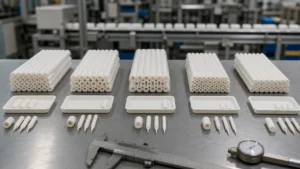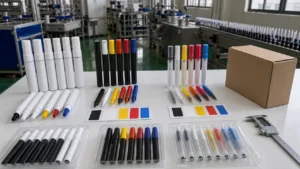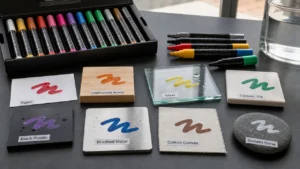
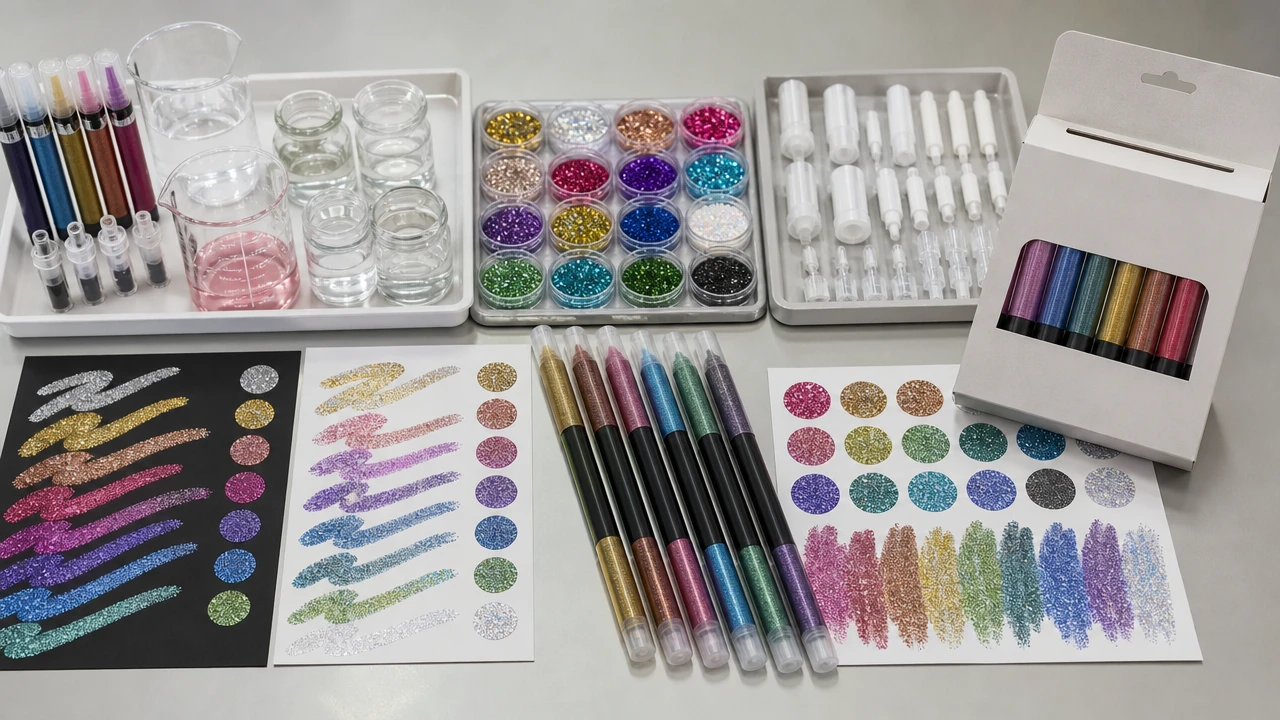
A glitter marker manufacturer must move decorative particles through a reservoir, valve, and nib without settling into a hard plug, flooding the surface, or leaving only clear binder. That makes glitter markers a formulation and ink-delivery project, not just a metallic color variation.
For OEM buyers, the key decisions are the ink base, particle type and size, suspension stability, opacity, tip geometry, valve flow, cap seal, surface claims, packaging, compliance review, and MOQ. Approve these together because a brighter glitter effect can create a harder flow problem.
ZH Stationery offers a super glitter acrylic paint marker range "품질에 대한 타협 없는 약속" valve-press marker platform for buyers comparing specialty paint-marker options.

빠른 답변
For broad craft and retail use, a water-based acrylic glitter marker is usually the most practical starting point. It can combine opaque pigment, glitter effect, and lower-odor positioning, but it still needs controlled priming, agitation instructions, drying time, and real surface tests. Fine particles and a compatible nib improve flow; larger or heavier decorative particles can increase sparkle but also settling and blockage risk.
Do not approve a glitter marker from one fresh sample. Test after storage, temperature conditioning, repeated use, restart, cap-off exposure, transport simulation, and the full claimed shelf-life plan.
빠른 링크
- How to Compare a Glitter Marker Manufacturer
- Particle and Suspension Control
- Tips, Valves, and Flow
- Surface and Performance Tests
- Packaging and Instructions
- MOQ and Customization
- Safety and EU Microplastics Review
- Supplier Questions
- 자주 묻는 질문
Compare Glitter Ink Systems
| Ink System | 최적 적합 | 강점 | Risk to Control |
|---|---|---|---|
| Water-based acrylic glitter | Rocks, wood, canvas, paper, glass, plastic, and general craft after testing | Opaque color plus glitter effect and broad retail positioning | Settling, valve flow, drying, adhesion, and sealer compatibility. |
| Transparent glitter or glitter glue-style ink | Paper crafts, cards, decorative accents | Strong sparkle where transparency is acceptable | Longer drying, raised film, weak coverage on dark surfaces. |
| Metallic pigment marker | Lettering and reflective color without visible glitter particles | Smoother flow and finer lines | Metallic sheen is not the same as glitter; claims and photos must be accurate. |
| Oil or solvent-based glitter system | Selected adult or hard-surface uses after review | Potential adhesion and finish benefits on some surfaces | Odor, ventilation, drying, flammability or hazard communication, and narrower user positioning. |
Ask whether the effect comes from reflective pigment, pearlescent material, visible decorative particles, or a mixture. Marketing terms such as glitter, shimmer, metallic, chrome, sparkle, and outline are not interchangeable. Approve the physical dry swatch and the exact wording.

Particle and Suspension Control
A glitter effect depends on how particles reflect light after the binder dries. Particle material, shape, size distribution, density, surface treatment, and concentration change both the appearance and the way the ink moves. A formula that looks dramatic in a bottle may not pass through the marker reliably.
| Control | What to Ask | Failure if Uncontrolled |
|---|---|---|
| Particle size distribution | Maximum size, average size, and lot consistency | Blocked nib, scratchy line, uneven sparkle, or particle separation. |
| Density and suspension | How quickly particles settle and how normal shaking restores uniformity | First strokes are clear binder and later strokes are overloaded. |
| Binder compatibility | Whether particles stay dispersed without attacking resin or additives | Clumps, viscosity drift, odor change, or weak dry film. |
| Filtration | How contamination is removed without filtering out the intended effect | Foreign particles, blocked valves, or reduced sparkle. |
| Batch release | Visual swatch, flow, viscosity or relevant in-process limits, and retained sample | Large sparkle and color differences between reorders. |
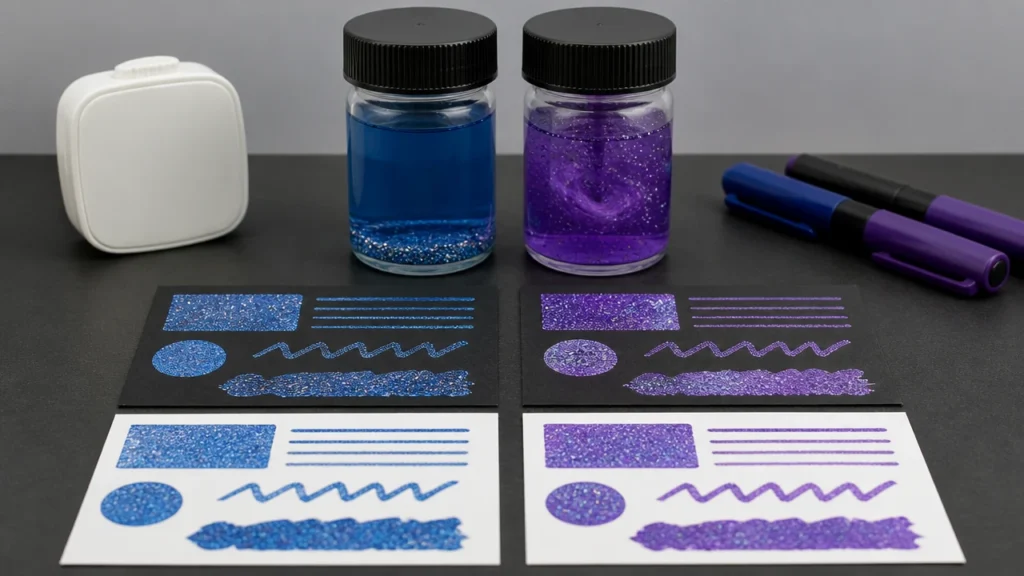
Keep a signed dry swatch on both light and dark reference surfaces. Use the marker color consistency guide to control appearance between batches, but add a separate glitter-density standard because color alone does not measure sparkle.

Tips, Valves, and Flow
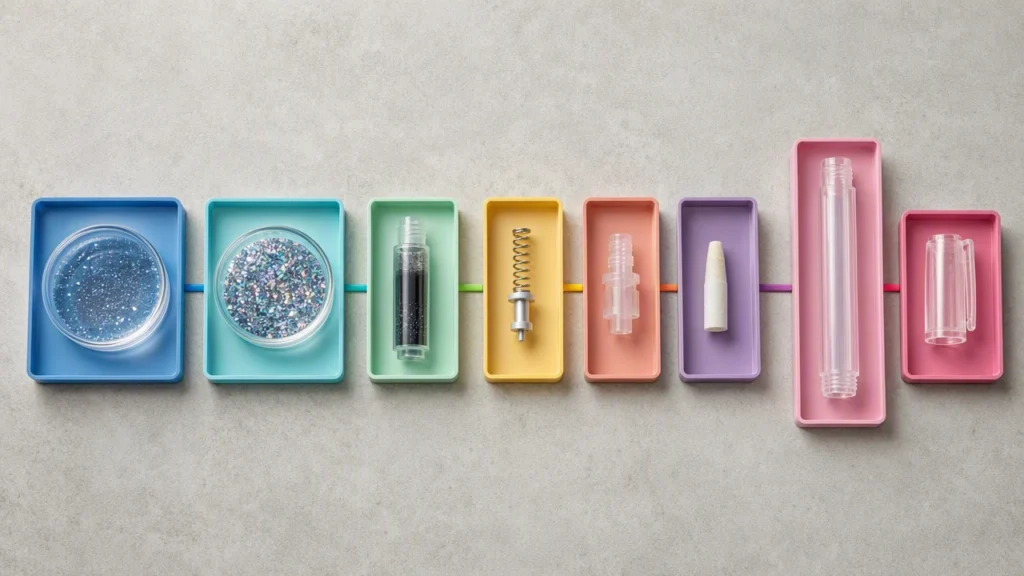
The tip must be open enough for the decorative system but controlled enough to make a clean line. The reservoir must hold and release a formula that may be thicker and more particle-heavy than ordinary dye ink. In valve markers, the user also needs a repeatable way to shake and prime the product.
| Component | 구매자 확인 | Typical Failure |
|---|---|---|
| 닙 | Line width, pore structure, hardness, abrasion, and particle passage | Dry line, fraying, clogged center, or uncontrolled broad stroke. |
| Valve | Opening force, return, sealing, ink dose, and orientation | Flooding, delayed start, leaking, or repeated pumping. |
| Reservoir | Capacity, saturation, compatibility, and release after storage | Ink trapped in the reservoir or inconsistent last-third performance. |
| Cap and plug | Seal force, vapor loss, crack resistance, and full closure | Dry nib, settled plug near tip, leakage, or cap complaints. |
| Mixing aid | Whether an internal agitator is used and whether the user can hear and feel it | Particles remain settled despite normal shaking. |
Test first use and restart with the exact instruction that will appear on the package. If the marker needs vigorous shaking, repeated pumping, or tip cleaning, state that honestly. A product video can teach the motion, but the box still needs a short usable instruction.
Surface and Performance Tests
| 테스트 | Method Decision | 기록할 사항 |
|---|---|---|
| Opacity and sparkle | Light and dark versions of every claimed surface | Coverage, glitter density, color, number of coats, and viewing angle. |
| Flow and line | First use, continuous line, dots, curves, and vertical use | Skipping, flooding, line width, and particle distribution. |
| 건조 | Touch-dry and handling time at defined temperature and humidity | Smear, tack, film damage, and transfer. |
| 접착력 | Scratch or tape method suitable for the surface and claim | Peeling, flaking, and edge failure after cure. |
| Restart and storage | Upright, horizontal, tip-down where relevant, conditioned and aged samples | Priming strokes, blocked nibs, leakage, and color/glitter separation. |
| 실러 호환성 | Buyer-selected water-based and solvent-based clear coats | Smear, clouding, gloss change, particle movement, or soft film. |
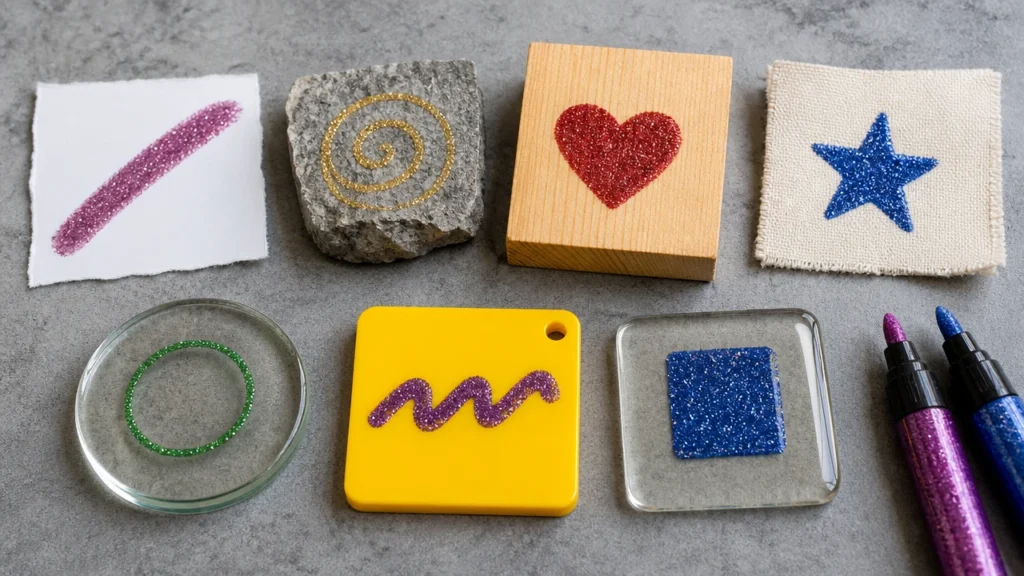
For end-use context, review the guides for paint pens on rocks and sealing "품질에 대한 타협 없는 약속" 목재용 아크릴 페인트 마커. A glitter marker should only carry those surface claims after the same formula, tip, dry time, and sealer system have been tested.

Packaging and User Instructions
Glitter markers need packaging that shows the effect without promising an impossible screen color. Use real dried swatches or carefully controlled photography. Include shake, prime, test, layer, dry, seal where relevant, recap, and storage instructions. Warn users that surfaces and sealers vary.
- Show the actual tip shape and line-width range.
- Explain whether the product is opaque glitter, transparent glitter, metallic, shimmer, or mixed effect.
- State which surfaces were tested and which require a test patch.
- Give a realistic drying instruction and note that full durability can take longer than touch-dry time.
- Keep warnings, responsible-party information, lot code, and market-specific statements legible.
- Protect valve tips and caps from crushing in the tray and export carton.
- Use a swatch chart that matches the finished production lot, not a generic digital gradient.
Compare retail formats with 아크릴 마커 포장 옵션 and verify master-carton assumptions with the carton and CBM guide. Glitter photography, dark-background printing, and specialty finishes can raise packaging MOQ even when the marker body is standard.

MOQ and Customization
Glitter marker MOQ is usually driven by the largest batch among specialty ink, particle purchase, barrel and cap colors, nib or valve components, printing, and retail packaging. A stock glitter formula in standard colors can be easier to start than a custom particle effect or custom mold.
| Customization | MOQ Driver | Risk-Reducing Option |
|---|---|---|
| Logo and stock set | Barrel print, label, or packaging setup | Use a validated stock formula and existing component colors. |
| Custom glitter color | Ink and particle batch, color matching, stability validation | Limit the launch palette and approve physical swatches. |
| Custom nib or line width | Component supplier minimum and flow revalidation | Choose a proven nib from the existing platform. |
| Custom case or box | Tooling or packaging conversion minimum | Use an existing tray with a custom printed sleeve or box for the pilot. |
| New formula or effect | Development, aging, testing, and production-yield economics | Run a paid pilot and freeze claims only after performance evidence. |
Safety, Labeling, and EU Microplastics Review
For U.S. consumer art materials, review the CPSC art materials requirements and the active ASTM D4236-26 labeling practice. Health Canada guidance advises users to follow labels, use suitable ventilation, and keep inappropriate materials away from children.
For EU sales, decorative particles require a specific material review. The European Commission microplastics overview states that the EU adopted a REACH restriction on intentionally added microplastics in 2023. ECHA guidance on the first microplastics measures notes that the first measures included a ban on loose glitter, but a glitter marker is not automatically the same legal category as loose glitter. Ask the supplier for particle identity and obtain product-specific REACH advice instead of assuming that every sparkle material is allowed or banned.
Also review packaging separately. PPWR and chemical rules operate alongside product-safety and art-material labeling. Do not use biodegradable, plastic-free, eco glitter, non-toxic, child-safe, or skin-safe claims without a defined basis.
더 나은 공급업체 질문을 하세요
- What creates the glitter effect: reflective pigment, pearlescent material, visible particles, or a blend?
- What particle-size range does the validated nib and valve pass?
- How long can samples stand before normal shaking restores a uniform line?
- Which surfaces, dry times, sealers, and storage orientations were tested?
- What cap-seal, leakage, restart, and temperature-conditioning results are available?
- Which formula and colors are covered by the toxicological or regulatory review?
- What is the MOQ driver for stock, custom-color, custom-packaging, and full-ODM versions?
- How will the factory prevent unapproved particle, binder, nib, or valve changes on reorders?
다음 자료를 활용하세요. 样品批准检查清单 and keep retained markers plus dry swatches. A fresh wet line is not enough to approve a shelf-life-sensitive specialty system.
자주 묻는 질문
1. What is the best ink system for glitter markers?
Water-based acrylic glitter is a practical starting point for broad craft and retail use because it can combine opaque color and sparkle. The final choice still depends on surface, user, particle system, drying, adhesion, and compliance needs.
2. Why do glitter markers need to be shaken?
Decorative particles can settle because they are denser than the liquid binder. A validated formula should return to a uniform line after the package’s normal shaking and priming instruction.
3. Are metallic markers the same as glitter markers?
No. Metallic markers often use fine reflective or pearlescent pigments for a smooth sheen. Glitter markers usually show more distinct sparkle particles. The line, opacity, flow, and marketing claim can differ.
4. What tip is best for a glitter marker?
The best tip passes the validated particle system while controlling line width and ink dose. Medium bullet or valve-press nibs are common starting points, but the buyer should test the exact formula, nib, and valve together.
5. What is the MOQ for custom glitter markers?
MOQ depends on specialty ink and particle batches, component colors, nib and valve sourcing, printing, and packaging. Ask for separate minimums for a stock formula, custom glitter colors, custom packaging, and new product development.
6. Are glitter markers affected by the EU microplastics restriction?
They may require review depending on the particle identity, form, concentration, use, and applicable transition or derogation. Do not assume that a marker is legally equivalent to loose glitter. Obtain the supplier’s material data and product-specific EU advice.
결론
A reliable glitter marker balances visual impact with flow stability. The buyer should approve the particle system, binder, nib, valve, cap, surfaces, dry time, sealer behavior, instructions, packaging, compliance file, and MOQ as one product.
For an OEM glitter marker project, send ZH Stationery the target surface, user, color count, glitter effect reference, tip size, packaging, claims, selling markets, order tiers, and launch date. The first samples should be tested fresh and after controlled storage before mass production is approved.