







You email a pen factory. You ask for 1,000 units. They reply “MOQ is 10,000.” You try to negotiate. They stop replying. You move on to the next factory. Same answer. After the fifth rejection, you start wondering if there is a secret handshake you are missing.
There is no secret handshake. There is a logic to MOQ that most Western buyers never learn because no factory will explain it directly. The factory is not being difficult. They are protecting their margin on an order that, at low volume, costs them more to set up than they make on the product. Once you understand why the number exists, you can negotiate it without the conversation going silent.
How to negotiate MOQ with Chinese pen factories comes down to knowing what drives the number, what you can offer in exchange for a lower one, and how to make the factory want to say yes.
Indice
Quick Answer: How To Negotiate MOQ With Chinese Pen Factories
What actually works:
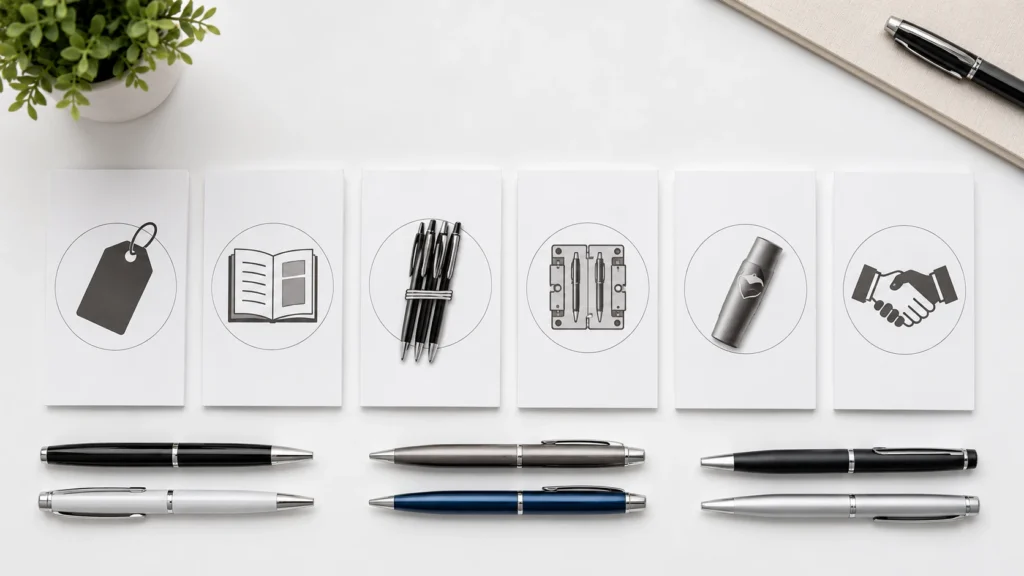
- Offer a higher unit price for a lower MOQ. The factory’s risk is setup cost. If you pay more per unit, you cover that risk without asking them to lose money. Simple formula: “What would the unit price be at 2,000 pieces instead of 10,000?” Let them name the number.
- Start with a catalog product, not a custom request. Factories lower MOQ for buyers they know. Place a small standard order first. Pay on time. Communicate clearly. Then ask about custom MOQ for your second order. You are not a stranger anymore.
- Bundle multiple SKUs into one order. If the factory’s MOQ is 2,000 per SKU and you want three color variants, ask whether 6,000 total across all three meets their minimum. Many factories care about total line time, not per-SKU volume.
- Offer to pay for the mold yourself. High MOQ often exists to amortize mold cost. If you pay for the mold separately, the per-unit MOQ drops. You own the mold. You can move production later if needed.
- Ask about semi-custom instead of full custom. Existing barrel molds with your logo printed cost a fraction of full custom setup. MOQ for semi-custom is typically half or less.
- Build the relationship before you negotiate. Visit the factory. Send a gift during Chinese New Year. Reference a mutual contact. The person who shows up gets better terms than the person who only emails.
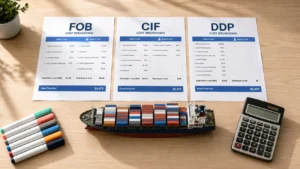
Prima di negoziare un prezzo unitario, devi capire cosa rappresenta effettivamente quel numero. Ecco una tabella della struttura dei costi che mappa i componenti di produzione al loro impatto sulla tua spesa totale.
Why MOQ Exists, And Why Pushing Too Hard Backfires
MOQ is not an arbitrary number. It is the volume at which the order becomes profitable after covering fixed costs.
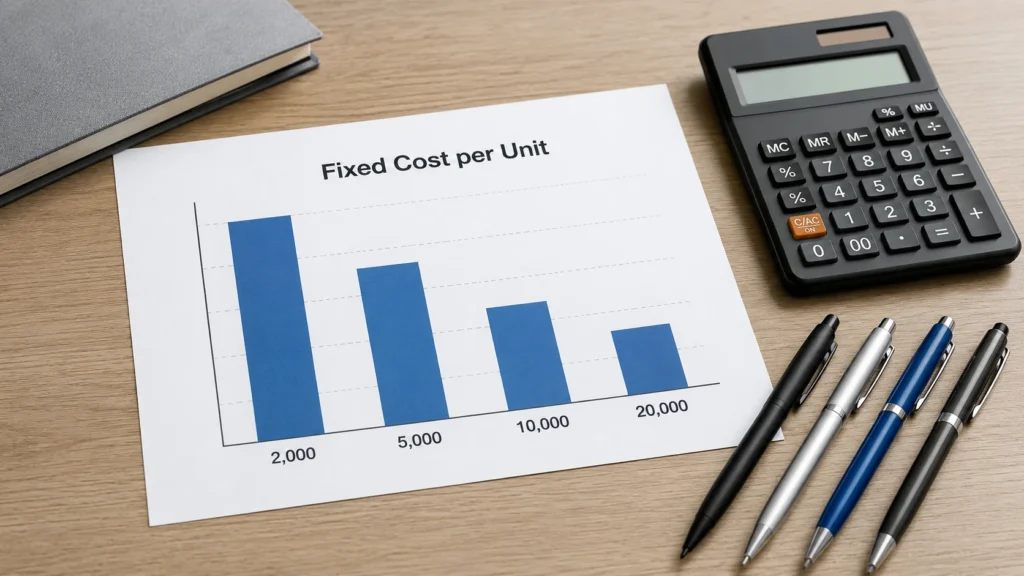
Every production run has costs that do not change with volume. Machine setup and calibration. Line changeover. Ink batch preparation. QC documentation per lot. These costs are identical whether you order 2,000 markers or 20,000. The only difference is how many units absorb them.
At 2,000 units, the fixed-cost burden per unit is high. The factory’s margin is thin or negative. At 10,000 units, the fixed cost per unit drops, and the factory makes money. When you push for an MOQ below their break-even point without offering anything in return, you are asking them to lose money. They do not argue. They just stop replying.
The buyers who succeed at negotiating MOQ with Chinese pen factories understand this math. They do not ask the factory to absorb a loss. They offer something that changes the calculation: a higher unit price, a commitment to future volume, an existing relationship that reduces perceived risk, or a willingness to carry costs the factory normally absorbs, like mold development.
What You Can Trade For A Lower MOQ
- Higher unit price. The most direct trade. If the factory clears $0.30 per unit at 10,000 pieces and you want 2,000, offer a unit price that gives them the same total margin on the smaller order. This is not expensive. A $0.15 per-unit increase on 2,000 pieces costs you $300. In exchange, you avoid buying 8,000 units of inventory you are not sure you can sell.
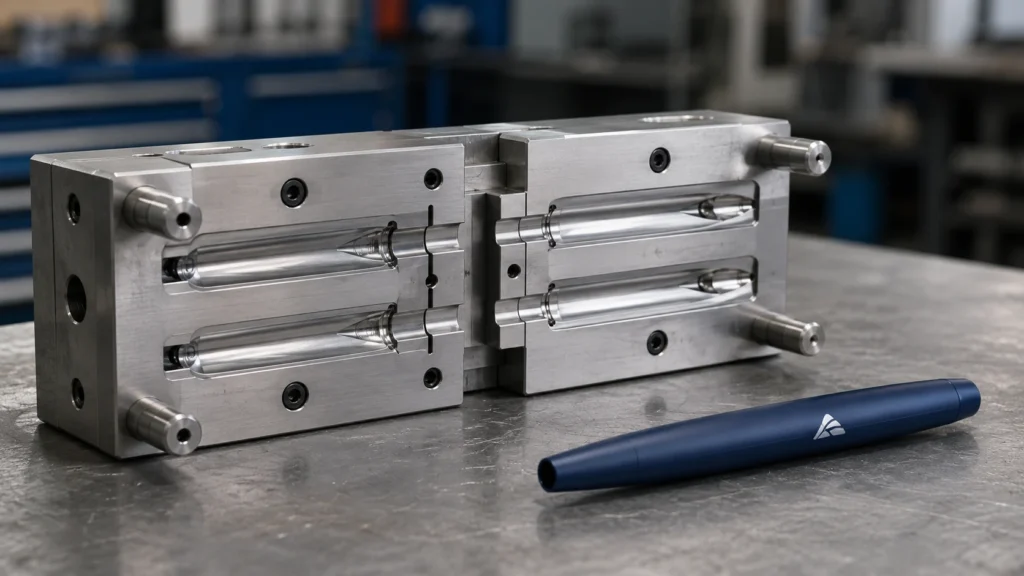
- Mold ownership. Custom molds are the biggest fixed cost in pen manufacturing. The factory’s MOQ partly exists to amortize that mold. Pay for the mold directly and the per-unit MOQ drops because the largest setup cost is already covered. You also own the mold, which means you can take it elsewhere later. That is a strategic asset, not a cost.
- Semi-custom instead of full custom. A fully custom barrel needs a new injection mold. Semi-custom uses existing molds with your logo on the barrel and your packaging. The setup cost gap is wide. MOQ for semi-custom can be half of full custom because the only setup is the printing plate and packaging. If your brand works with existing barrel shapes in custom colors, this is the fastest route to a lower MOQ.
- Future volume commitment. The factory worries you are a one-time buyer testing the market at their expense. If you can credibly say this is a trial leading to larger orders, they may accept a lower initial MOQ as a relationship investment. The word is “credibly.” Vague hopes do not work. Specific projections do. “We will test this SKU at 2,000 pieces. If sell-through meets projections, a 20,000-piece reorder follows within 90 days.” That they can evaluate. “We hope to grow this brand” they cannot.
- Consolidated multi-SKU orders. MOQ is often per SKU because each needs separate setup. Total production volume matters more than per-SKU volume for many fixed costs. Ask if three variants at 2,000 each, 6,000 total, meets their minimum, with separate setup charges per variant. The factory gets volume. You get variety.
- Relationship equity. A factory that knows you, knows you pay on time, communicate clearly, and do not make unreasonable demands. That history lowers their perceived risk. A known buyer gets terms a new buyer cannot. This is not unfair. It is the market pricing risk.
ZH CANCELLERIA works with buyers across the spectrum, from first-time projects at 2,000 pieces to established brands ordering tens of thousands. The standard MOQ of 2,000 pieces for suitable projects comes from a manufacturing setup designed for market testing without forcing buyers to overcommit.
What Never Works, And What Damages The Relationship
Some tactics backfire in ways Western buyers do not always recognize.
- Claiming a competitor offered a better MOQ. Chinese pen manufacturing is a small world. Factory owners in Tonglu know each other. They know each other’s pricing. If you claim Factory B offered MOQ of 500 pieces when the lowest any reputable factory in the region offers is 2,000, they know you are either lying or talking to a trading company that will deliver inconsistent quality. Neither impression helps.
- Pushing for a discount after the order is placed. The negotiation ends when the PI is confirmed. Asking for a lower price, extra samples, or upgraded packaging after production starts signals you will be difficult throughout the relationship. Factories remember. You become the buyer they quote high because they know you will chip away later.
- Treating the factory as an adversary. The best buyers treat factories as partners. They share sales data. Give honest quality feedback. Pay on time. Surface problems early. In a relationship-based culture, the partner gets MOQ flexibility, priority scheduling, and problem-solving effort that the adversarial buyer never sees.

Domande Frequenti
What Is The Typical MOQ For Custom Pens From Chinese Factories?
For standard pen models with logo printing, 2,000 to 3,000 pieces per SKU. For fully custom designs requiring new molds, 10,000 to 30,000 pieces. Some manufacturers, including ZH STATIONERY, accept trial orders from 2,000 pieces. Always confirm whether MOQ is per SKU, per color, or per total order. A 2,000-piece MOQ across a 12-color set means 24,000 individual markers, not 2,000.
Why Do Chinese Pen Factories Set Such High MOQs?
Setup costs. Machine calibration, ink batches, mold changes, QC documentation. These are fixed regardless of order size. The factory needs volume to amortize them and turn a profit. Below the break-even, they lose money. When you negotiate MOQ with Chinese pen factories, you are changing the economics so a smaller order becomes viable for them.
Can I Get A Lower MOQ If I Pay More Per Unit?
Yes. The most effective trade. Figure out the factory’s total margin at their standard MOQ, then offer a price that gives them the same total on your smaller order. The per-unit increase is modest. A $0.15 to $0.30 premium on 2,000 pieces costs $300 to $600 and avoids buying 8,000 units of unvalidated inventory.
Does Visiting The Factory Help With MOQ?
Significantly. Face-to-face matters in Chinese business culture. A buyer who visits, meets the team, and shows seriousness gets better terms than one who only emails. If traveling is not possible, video calls with the production floor visible are the next best option.
What Should I Never Say When Negotiating MOQ With Chinese Pen Factories?
Never claim a competitor offered a dramatically lower MOQ without proof. Never push for discounts after the PI is confirmed. Never treat the relationship as a one-time transaction. The factories that offer the most flexibility are the ones that see the buyer as a long-term partner.
How Does The Relationship Change After The First Order?
Order one proves you are real and you pay. Order two gets better MOQ terms. Order three gets priority scheduling. Order five gets credit terms. MOQ negotiation is not a one-time event. It compounds with every order you place and every invoice you pay. Contact ZH STATIONERY to discuss your pen project, request MOQ details, and start a supplier relationship that improves with every order.
Negotiating MOQ with Chinese pen factories is not about winning. It is about reaching a number where both sides make money and both sides want to repeat the order. Contattare ZH STATIONERY to discuss MOQ options for your pen product line.