










An artist buys a 48-color watercolor marker set. The colors are gorgeous. The blending is smooth. Two weeks later, three markers are dry. Not empty. Dry. The caps were on. The ink just stopped flowing. The artist leaves a one-star review and goes back to the brand they used before.
For B2B buyers, watercolor marker sourcing is not about the color palette. It is about the reservoir technology. That choice decides whether your markers survive two weeks or two years on a shelf. Direct-liquid feed versus fiber-tip reservoir. It sounds like an engineering footnote. It is actually the biggest factor in your return rate, your refill revenue model, and whether artists trust your brand enough to uncap a marker they bought six months ago.
Two reservoir technologies. Two failure patterns. A handful of tests that tell you which one your factory can actually manufacture.
Table des matières
Quick Answer: Watercolor Marker Sourcing
The two systems on the metrics that matter:
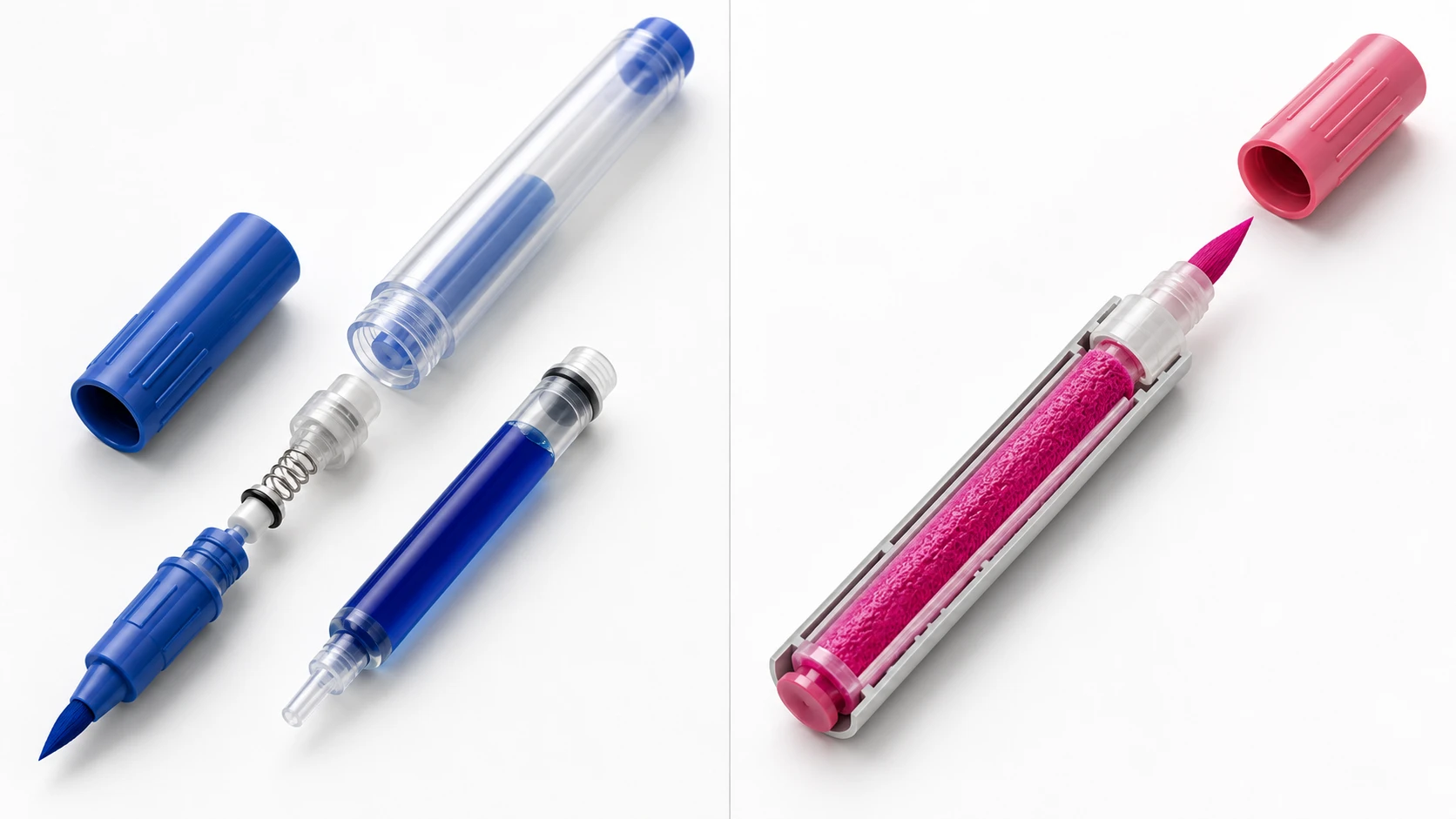
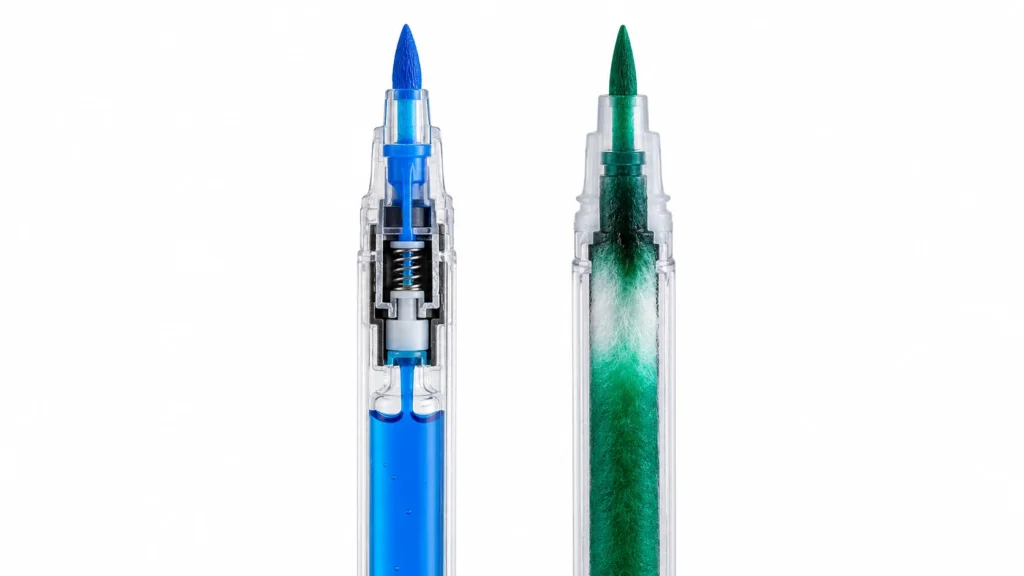
- Direct-liquid markers hold ink as free liquid in the barrel, delivered to the nib through a valve or wick. Consistent color. Refillable. Ink does not dry inside a fiber core because there is no fiber core. Higher manufacturing cost because valve mechanisms and liquid seals are harder to make than stuffing polyester wadding into a tube.
- Fiber-tip (capillary) markers soak ink into a polyester fiber core inside the barrel. The nib wicks from this core. Simple. Cheap to produce. Finite lifespan. The core dries out or depletes. Then the marker is dead. No refill. No revival.
- Refill revenue exists only with direct-liquid. A customer who buys a $40 set and $5 refill bottles for years has a lifetime value several times the initial purchase. Fiber-tip is one transaction. When it runs dry, the customer either buys another set from you or switches to a brand that offers refills.
- The nib fails on both systems. Watercolor ink is thin. It flows fast. A nib that cannot regulate the flow floods the paper. A nib that frays under continuous water exposure turns a brush marker useless. Test nib durability with ink, not water.
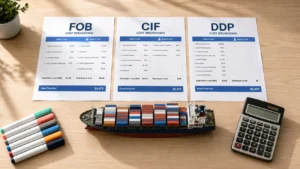
Avant de négocier un prix unitaire, vous devez comprendre ce que ce chiffre représente réellement. Voici un tableau de structure de coûts qui cartographie les composants de fabrication et leur impact sur vos dépenses totales.
How Each System Fails
Every watercolor marker complaint has an engineering root cause:
| Complaint | Direct-Liquid Root Cause | Cause racine pour pointe fibre | Signal de qualité B2B |
| Marker stopped despite having ink | Valve seal failed; ink evaporated through microscopic leak | Fiber core dried from cap-seal failure; capillary path broken | Direct: valve seal test per unit. Fiber: cap-seal vacuum test per unit |
| Color varies between strokes | Wick feed rate inconsistent; nib saturation uneven | Fiber core density uneven; some channels run dry before others | Both: continuous writing test over 200m with spectrophotometer |
| Pointe effilochée ou déformée | Nib material not rated for continuous water; fibers swell, separate | Same failure, plus fiber core debris clogs nib channels | Both: nib immersion in ink 72hrs; abrasion under controlled pressure |
| Variations de couleur entre les lots | Dye concentration drifts; no spectrophotometer check | Same cause; no quality difference between systems here | Both: batch spectrophotometer delta-E under 1.5 |
| Ink leaks during shipping | Barrel seal fails under pressure or temperature; liquid ink escapes | Fiber core overfilled; temperature expansion pushes ink out | Direct: altitude/pressure sim. Fiber: fill-volume verification |
Direct-liquid markers fail when the valve or seal is cheap. Fiber-tip markers fail when the cap seal or core density is cheap. “Cheap” means a manufacturing shortcut, not a retail price.
Direct-Liquid: The Refill Model
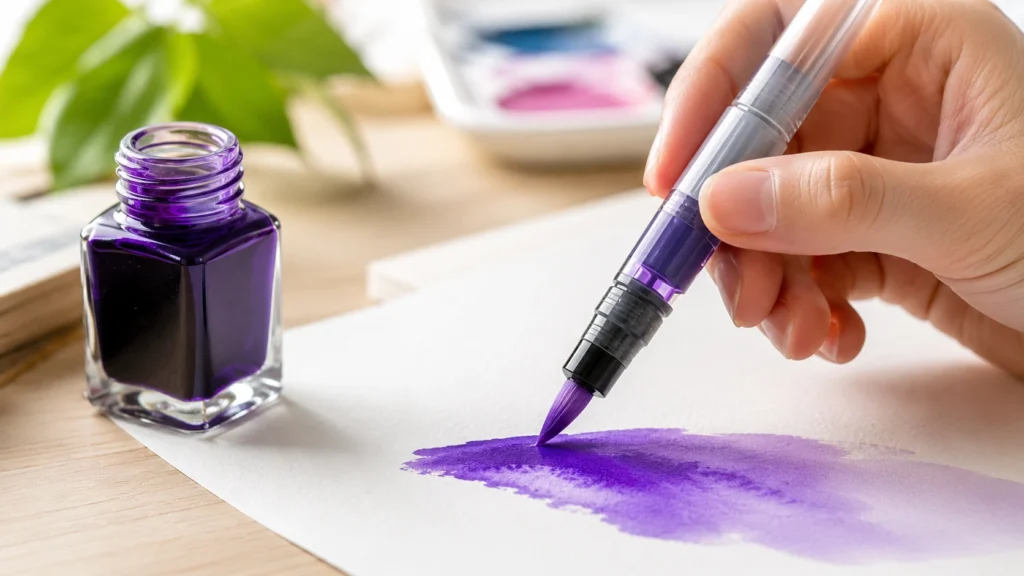
A direct-liquid watercolor marker holds dye-based ink as free liquid in the barrel. No fiber reservoir. Ink reaches the nib through a valve à ressort, press the nib to open, or through a wick drawing liquid directly to the tip.
Same principle as a fountain pen, marker format. The ink is thin by necessity. You cannot thicken it with modifiers the way you can acrylic paint. It has to flow through narrow channels by gravity and action capillaire. That makes the chemistry harder. Dyes must be highly soluble. Flow additives must stop surface tension from trapping ink in the barrel. Preservatives must prevent bacteria from growing in water-based liquid sitting sealed for months.
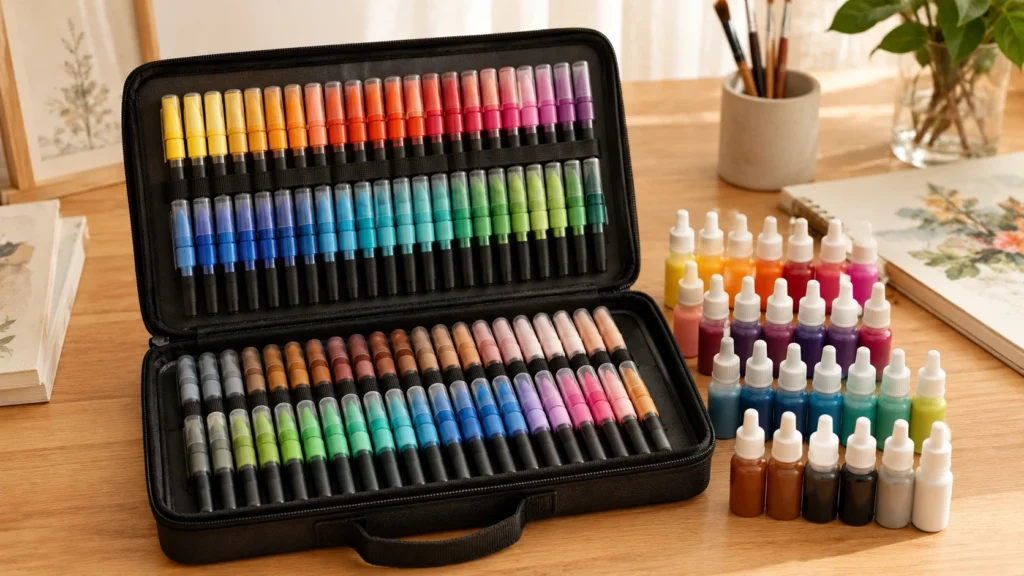
The advantages over fiber-tip. More usable ink volume. No absorbent material taking up space. Refillable. The barrel opens and takes liquid from a bottle. That creates a recurring revenue stream fiber-tip cannot offer. Consistent flow until empty. The liquid stays at full concentration to the last drop. A fiber-tip marker writes progressively drier as the core depletes.
The engineering challenge is the seal. A direct-liquid marker is a sealed water container. Leak, evaporation, seal failure under temperature cycling, and the marker arrives half-empty or dry. The valve must open cleanly, close completely, and hold that seal through shipping, storage, and daily use. A factory that cannot demonstrate valve-seal testing per unit is not ready for direct-liquid at scale.
ZH STATIONERY makes direct-liquid watercolor markers with its own ink lab. The valve-press experience from acrylic markers carries over. Both need precision spring-loaded seals that survive water-based ink for months of intermittent use.
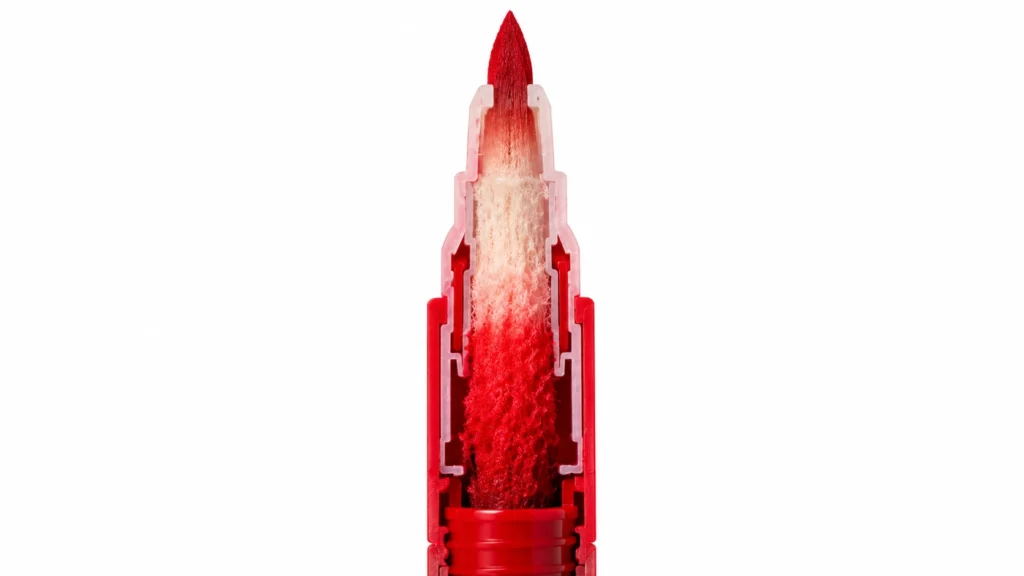
Fiber-Tip: Simple System, Hard Deadline
A fiber-tip watercolor marker is a capillary marker. Polyester fiber core fills the barrel, saturated with dye ink. The fiber nib wicks from this core by action capillaire. No moving parts. No valves. Just the cap between the ink and the air. That simplicity puts fiber-tip in every budget watercolor segment.
The tradeoff is lifespan. Finite ink space in the fiber core. Once depleted, done. You cannot refill a fiber core. The capillary structure that makes it work would be destroyed. Color intensity also drops as it empties. The last 20 percent of ink writes visibly lighter than the first 20 percent. The remaining ink sits trapped in the deepest fibers where wicking is slow.
The cap seal decides everything. Perfect seal, years of use. A 0.1mm gap in the inner cap liner, dead in weeks. Water-based ink evaporates. No water, no wicking. The dye crystallizes inside the fibers. Capillary action stops. Marker dead.
For B2B buyers, the fiber-tip QC list is shorter but not less important. Test intégrité du joint de capuchon per unit. The factory needs vacuum-decay testing, not a visual check. Test ink depletion. Write the marker dry and measure color consistency through the first 80 percent of volume. If color drops noticeably after 50 percent, the core density is off.
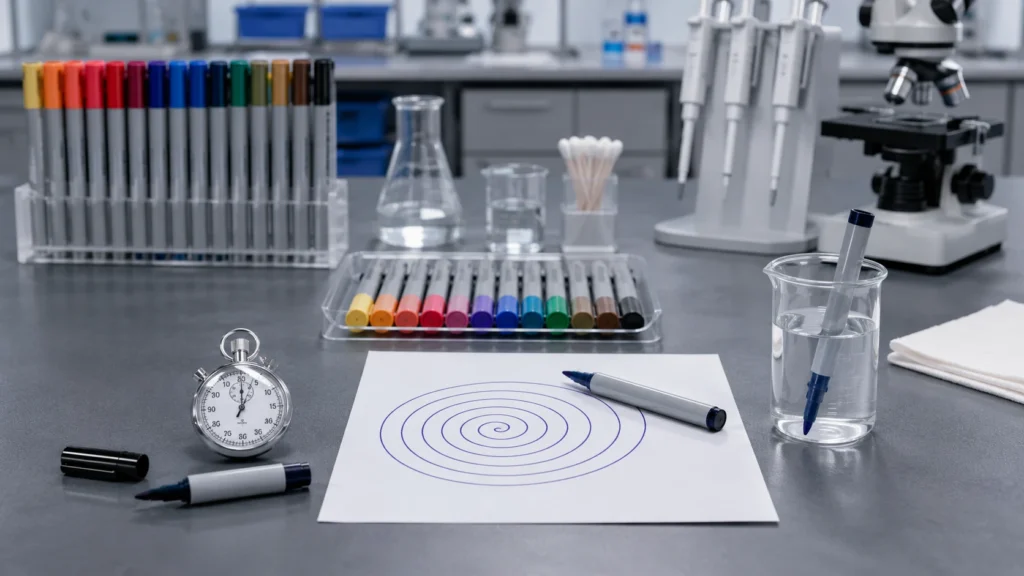
What B2B Buyers Should Test Before Placing An Order
- For direct-liquid markers: valve activation. Press the nib ten times. Opens on the first press, not the fifth. Leak test. Store horizontally 48 hours. No ink at the nib or barrel seam. Intermittent use. Use, cap, wait seven days. Writes immediately. Refill test. Refilled marker writes at same intensity as factory fill.
- Pour les marqueurs à pointe en fibre : cap-off recovery. Uncap 30 minutes, re-cap 24 hours, write. Should recover. Ink depletion. Write dry, measure color consistency through 80 percent of volume. Nib integrity. Soak in water 72 hours. No swelling, separating, or losing shape.
- Pour les deux : batch color matching. Two production run samples, side by side. Dye-based ink is more sensitive to formulation drift than pigment. Factory vérification par spectrophotomètre data, delta-E under 1.5 between batches.
A factory with in-house ink R&D and 26-plus years of OEM experience, like ZH STATIONERY, has this testing built into QC. The question is not “which system.” It is “show me the data proving this system works under my customers’ conditions.”
Foire aux questions
What Is The Difference Between Direct-Liquid And Fiber-Tip Watercolor Markers?
Direct-liquid stores free liquid ink in the barrel, delivered through valve or wick. Fiber-tip absorbs ink in a polyester core. Direct-liquid is refillable, consistent color until empty, higher manufacturing cost. Fiber-tip is simpler, cheaper, no refills possible, writes lighter as it empties.
Can You Refill Fiber-Tip Watercolor Markers?
No. The fiber core is saturated absorbent material. Adding ink destroys the capillary structure. Once done, disposable. This is the business model difference. Direct-liquid creates refill revenue. Fiber-tip depends on repeat set purchases.
Why Do Watercolor Marker Nibs Fail Faster Than Regular Nibs?
Water. Continuous water exposure. Standard nibs made for alcohol ink are not built for it. Fibers swell, bonding agents soften, shape fails. Watercolor markers need nibs with hydrophobic binders that hold up when saturated. A factory making both alcohol and watercolor markers should use different nib materials, not the same one.
How Many Colors In A Watercolor Marker Set?
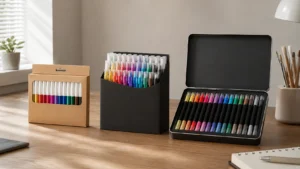
Budget: 12 to 24. Mid-tier artist: 36 to 48 with blender. Premium: 60 to 100, modular sets for collection building. Each color is its own SKU for manufacturing, filling, QC. A factory producing 2,000-plus SKUs per year, like ZH STATIONERY, can handle large color ranges without mixing errors or cross-contamination between filling stations.
Do Watercolor Markers Need The Same Certifications As Other Art Markers?
Oui. ASTM D-4236 for US, Crayons de couleur for Europe, REACH where applicable. Water-based means fewer VOCs than alcohol markers, easier certification. But dye chemistry still needs toxicological review. Current, dated test reports from laboratoires accrédités ISO 17025-accredited labs, referencing your specific SKU.
What Should I Ask A Supplier Before Ordering Watercolor Markers?
Which reservoir system for your market. Cap-seal or valve-seal test data per unit. Batch color consistency across two production runs. Refill bottle availability and MOQ for direct-liquid. If they can answer all four with data, they are a manufacturer. If not, trading company. Contacter ZH STATIONERY to discuss watercolor marker specs, request samples, and review batch QC documentation.
Watercolor marker sourcing comes down to a few choices. Which reservoir system fits your price point. Whether refill revenue matters to your business model. Whether your customers will accept a marker that writes lighter as it empties. Direct-liquid wins on lifetime value. Fiber-tip wins on unit cost. Neither wins with a failed cap seal. Contact ZH STATIONERY to discuss your watercolor marker requirements and get production samples for evaluation.