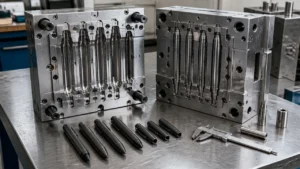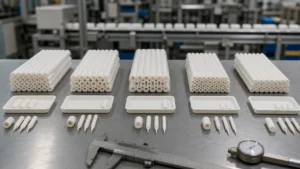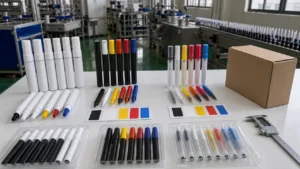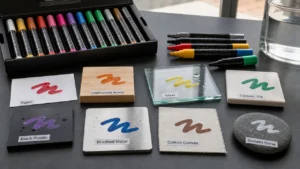
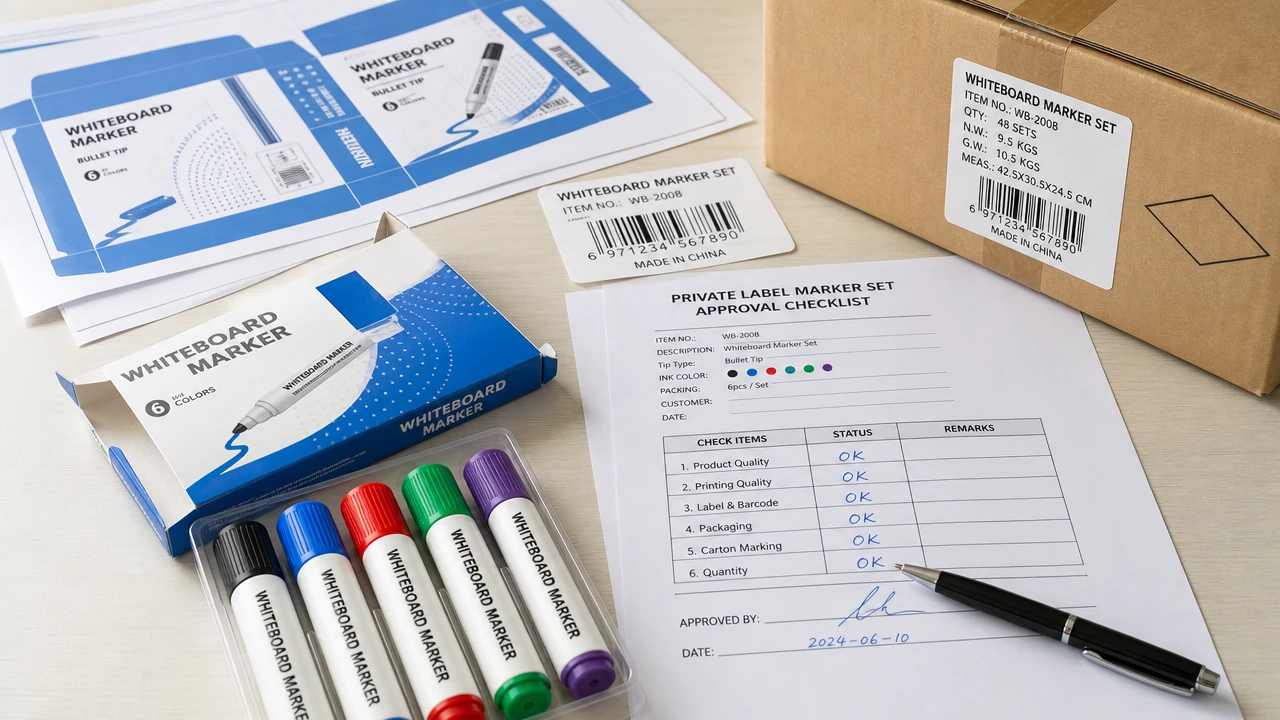
A private label marker order can pass the quote stage and still fail at sample sign-off. The buyer passes a barrel color from a photo. The retail card changes later. The barcode is checked after mass production. Or the signed sample does not match the final carton. A good sample approval checklist stops those small gaps from becoming shipment problems.
This guide is for importers, distributors, Amazon sellers, retail brands, and sourcing teams preparing custom marker sets with a China marker manufacturer. Use it before you sign the pre-production sample. Do not use it after production starts.
Réponse rapide
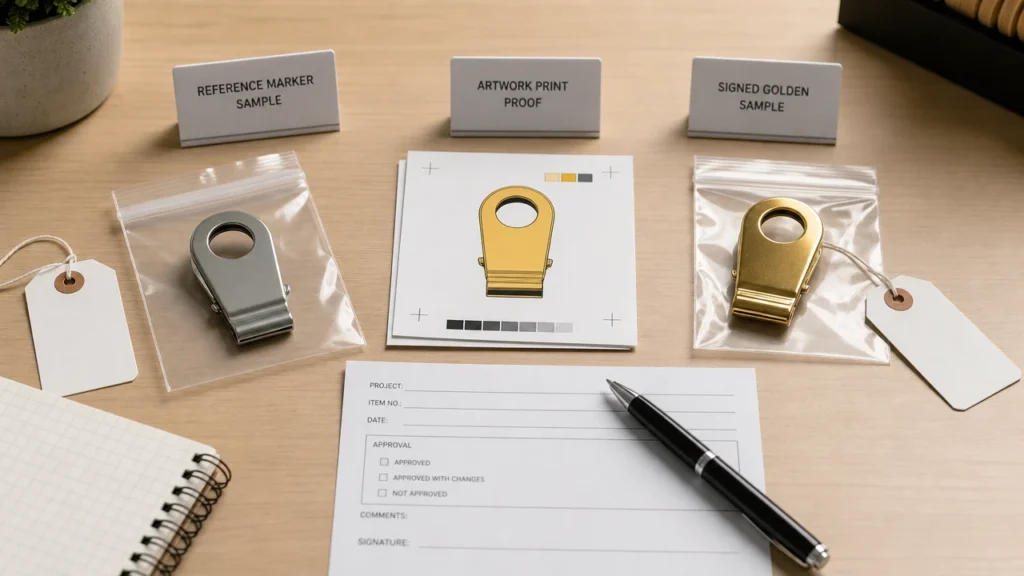
For private label marker orders, pass samples in four layers. Product performance. Appearance. Packing. Shipment marks. Do not pass from photos alone when the call touches color, nib feel, ink flow, cap fit, retail packing, barcode, carton marks, or compliance language. Keep one signed golden sample. Keep one supplier-retained sample. Keep one buyer-retained sample tied to the PO.
Liens rapides
- Réponse rapide
- Pourquoi l'approbation d'échantillon est importante
- Étapes d'approbation
- Liste de contrôle de l'échantillon produit
- Liste de contrôle de l'échantillon d'emballage
- Vérifications du code-barres et du carton
- Fichiers de conformité
- Champs du formulaire d'approbation
- Posez de meilleures questions au fournisseur
- FAQ
Pourquoi l'approbation d'échantillon est importante
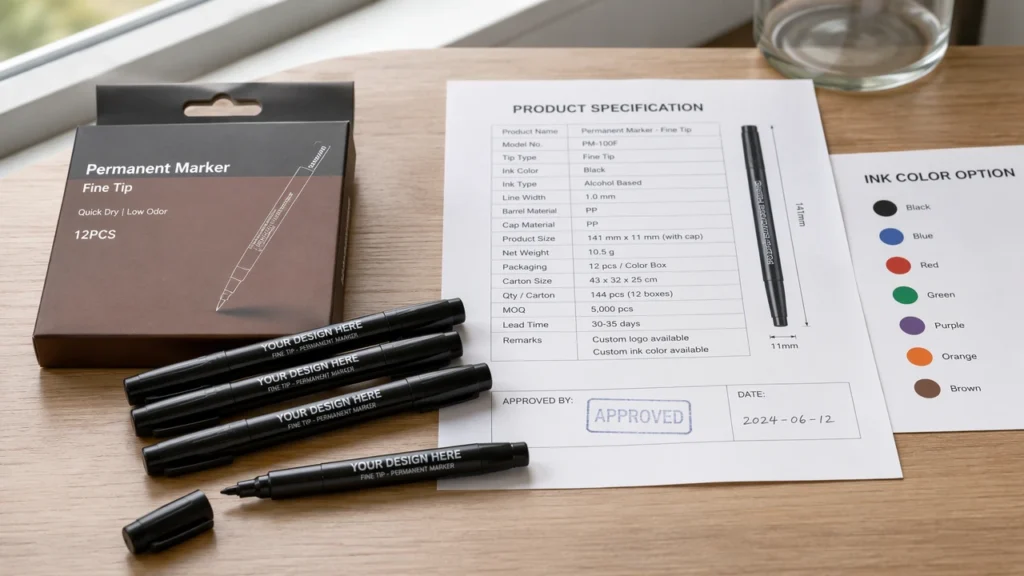
Private label markers usually join several picks in one SKU. Marker body. Ink system. Nib. Cap. Logo. Color order. Retail pack. Barcode label. Inner box. Export carton. If the buyer passes only the visible product, the hidden details can drift during production.
The sample stage should answer one practical question. What exactly is the factory allowed to copy in mass production? If the answer is vague, the supplier may treat the sample as a style base instead of a locked spec.
Buyers comparing marker groups can start with the ZH Stationery marker range. For packing picks, the acrylic marker packing guide is a useful partner, because packing format changes the sample work.
Étapes d'approbation
A simple sign-off flow beats one big final check. The buyer should decide which sample stage is needed before the RFQ is set. Each stage takes factory time and courier time.
| Étape d'échantillon | Ce qu'elle doit confirmer | Décision de l'acheteur |
|---|---|---|
| Échantillon de référence | Type général de marqueur, taille de l'ensemble, direction de l'emballage et niveau de prix cible | Si le projet vaut la peine d'être développé |
| Échantillon de maquette | Placement du logo, mise en page de l'étiquette, noms de couleurs, zone de code-barres et texte d'avertissement requis | Si le fichier de conception est prêt pour l'épreuve d'impression |
| Échantillon de pré-production | Matériaux réels, couleur du corps, pointe, débit d'encre, structure de l'emballage et marques de carton | Si la production en série peut commencer |
| Échantillon doré | La norme signée que la production et le contrôle qualité doivent suivre | Quel échantillon physique contrôle l'inspection finale |
| Échantillon d'expédition | Ensemble fini aléatoire issu de la production en série | Si la commande correspond toujours à la norme approuvée |
Liste de contrôle d'approbation des échantillons pour les commandes de marqueurs de marque privée
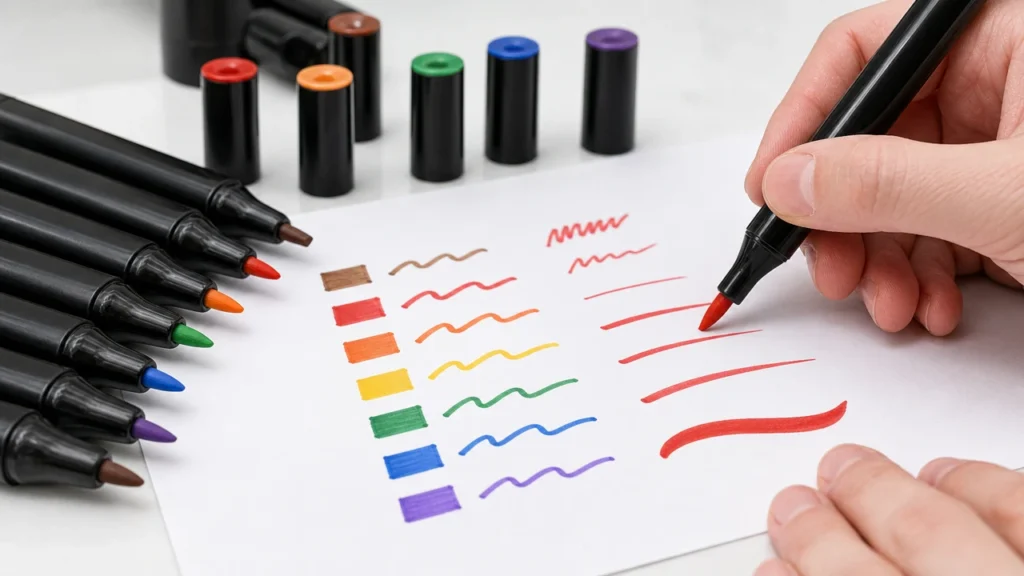
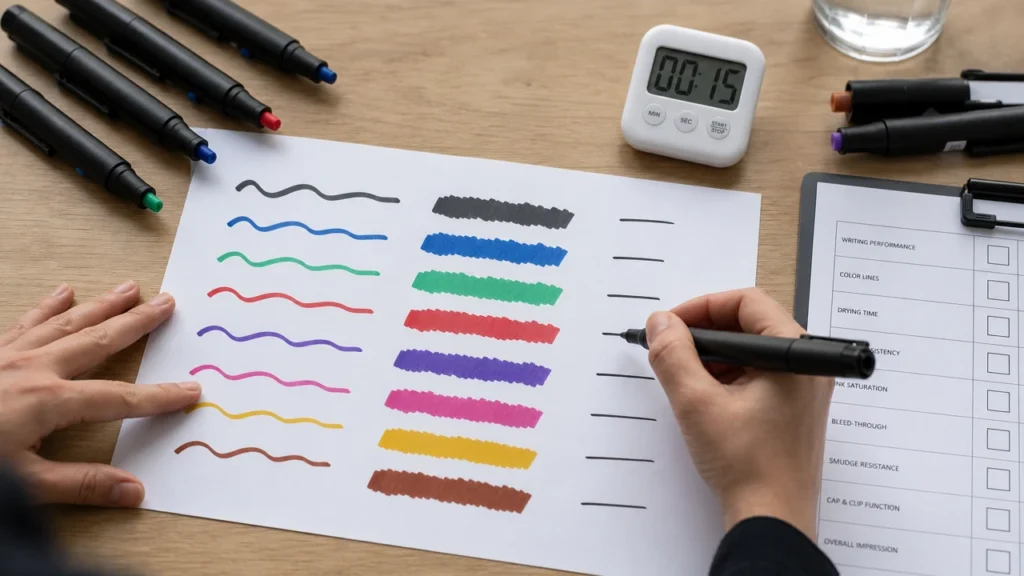
Start with the marker itself. Photos can show art position. They cannot show writing feel, cap tightness, tip recovery, or how even the ink reaches the nib. The buyer should test the sample by hand.
| Élément à vérifier | Comment vérifier | Approuver uniquement lorsque |
|---|---|---|
| Corps du marqueur | Comparez la forme du corps, la longueur, le diamètre, la couleur, la finition et la zone de préhension | Il correspond au SKU convenu et est agréable en main |
| Logo et impression | Vérifiez la position, la taille, la couleur, la netteté des bords et la résistance au frottement | La marque semble propre lors d'une manipulation normale |
| Ajustement du capuchon | Ouvrez et fermez plusieurs fois, puis vérifiez le jeu | Le capuchon tient fermement sans être difficile à retirer |
| Pointe | Vérifiez la forme de la pointe, la fermeté, la largeur du trait et les dommages après écriture | La pointe correspond à l'utilisation prévue et ne s'effiloche pas trop rapidement |
| Écoulement de l'encre | Écrivez des traits courts, des traits longs et des formes remplies après repos | Le débit est régulier et adapté au type de produit |
| Ordre des couleurs | Comparez la séquence de l'ensemble avec l'emballage et le nuancier | L'acheteur peut identifier chaque couleur sans confusion |
For valve-controlled acrylic projects, the valve press marker technology page explains why tip prime and flow control should be checked on the finished marker. Do not check only an ink swatch.
Liste de contrôle de l'échantillon d'emballage
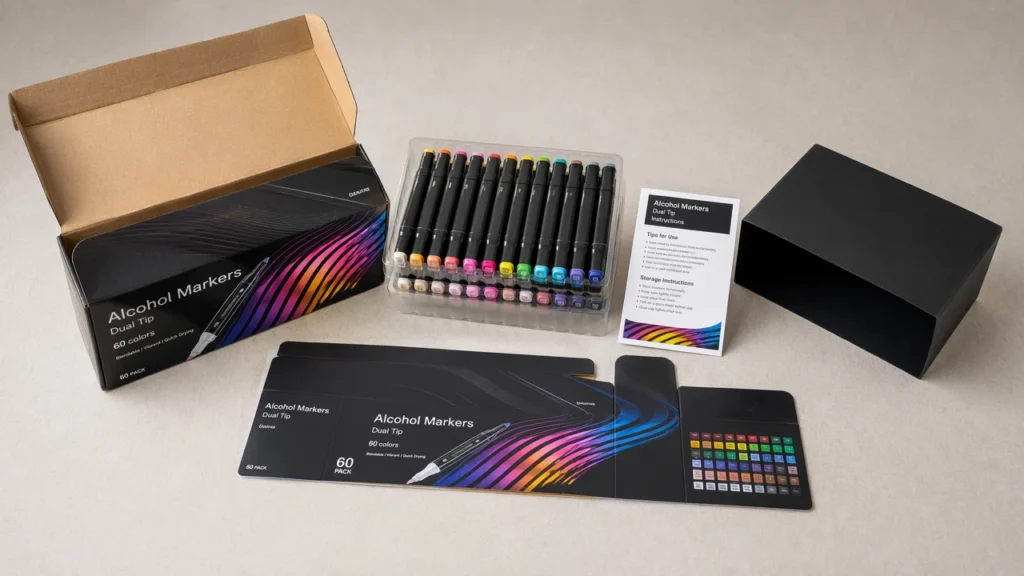
Packing sign-off is where many private label orders get messy. The buyer may pass the product sample first. Then the tray is too loose. The retail card covers a warning line. Or the carton cannot take the planned shipping route.
| Point d'emballage | Quoi confirmer | Risque courant |
|---|---|---|
| Boîte de détail ou pochette | Taille, matériau, méthode d'ouverture, surface de fenêtre et direction d'affichage en rayon | Le produit semble correct sur les photos mais donne une impression fragile lors de la manipulation en magasin |
| Insert plateau | Ajustement du marqueur, ordre des couleurs, épaisseur du plateau et pression du capuchon | Le mouvement du plateau raye le marqueur ou pousse les capuchons |
| Fichier d'illustration | Logo, noms de couleurs, icônes, texte d'avertissement, espace code-barres et marges d'impression | Une modification tardive de l'illustration retarde la production |
| Carte d'instructions | Langue, mentions de sécurité, guide d'utilisation et correspondance SKU | Des instructions génériques ne correspondent pas au produit réel |
| Boîte intérieure | Nombre d'articles par ensemble, orientation, besoin de séparateur et emplacement de l'étiquette | Les ensembles se frottent les uns contre les autres pendant le transport |
| Carton extérieur | Résistance du carton, marquages, poids brut, dimensions et plan de palettisation | Le coût du fret ou la réception en entrepôt échoue plus tard |
Carton calls should link to logistics. The le guide de la taille des cartons, du poids brut et du CBM helps buyers check whether the passed packing still works for LCL, FBA, or warehouse receiving.
Vérifications du code-barres et du carton
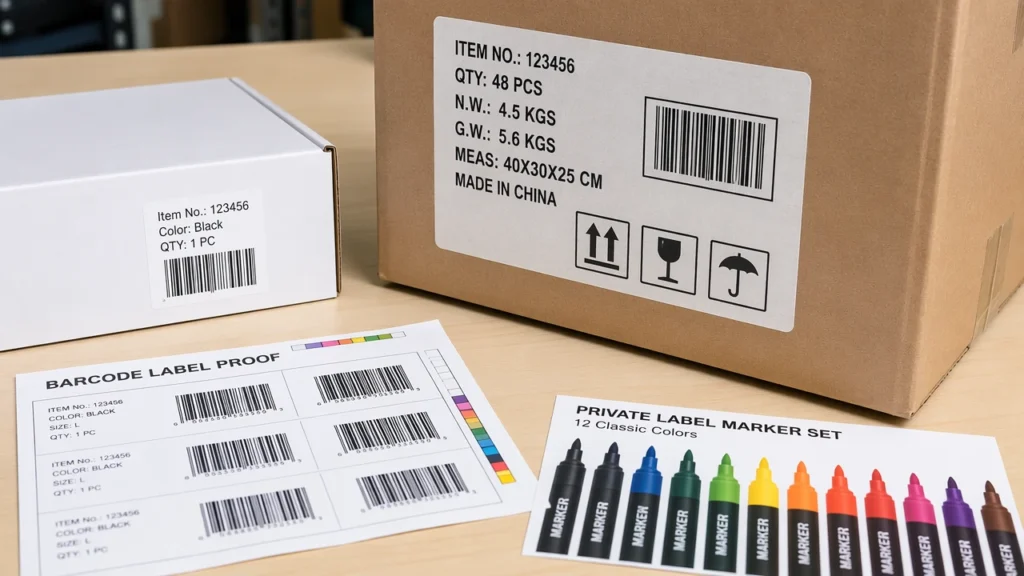
Barcode and carton sign-off should happen before mass production art is locked. The aperçu GTIN GS1 explains how GTINs name trade items. For a private label order, the buyer should give the barcode data and confirm it scans with the planned retailer or platform.
- Vérifier le numéro de code-barres, la taille du code-barres, la zone de silence, le contraste d'impression et l'emplacement.
- Confirmer si le code-barres doit figurer sur l'unité de détail, la boîte intérieure, le carton maître ou les trois.
- Vérifier le SKU, le nombre de couleurs, le nom de l'ensemble, le texte du pays d'origine, la quantité par carton, le poids brut, le poids net et la taille du carton.
- Pour les commandes Amazon, confirmer le FNSKU, l'étiquetage des cartons, le nombre d'articles par ensemble et le plan d'expédition avant l'approbation de l'échantillon de carton.
- Utiliser le guide Amazon FBA pour les vendeurs de stylos lorsque l'expédition sera envoyée directement vers un entrepôt de traitement des commandes.
Fichiers de conformité
Compliance sign-off is separate from visual sample sign-off. For US art products, the Guide sur les matériaux d'art de la CPSC points buyers to ASTM D-4236 marking needs. The official ASTM D4236 page covers chronic health hazard marking for art products. These sources help review labels. They do not replace the buyer's own legal or retailer check.
If packing or shipment testing is part of the project, the official ASTM D4332 page covers conditioning containers, packages, or packing parts before testing. Most private label marker orders do not need a lab program for every shipment. Buyers should know when a retailer or internal QA team expects conditioning or transit checks.
Pour les fichiers ZH Stationery, les acheteurs peuvent examiner le page des certifications and ask for current documents that match the product, market, and order needs. A generic file is not enough if the SKU, ink system, or age grade changes.
For a deeper paper checklist, the Guide des rapports de test ASTM D-4236 explains how buyers should read art-material reports before treating them as order-ready proof.
Champs du formulaire d'approbation
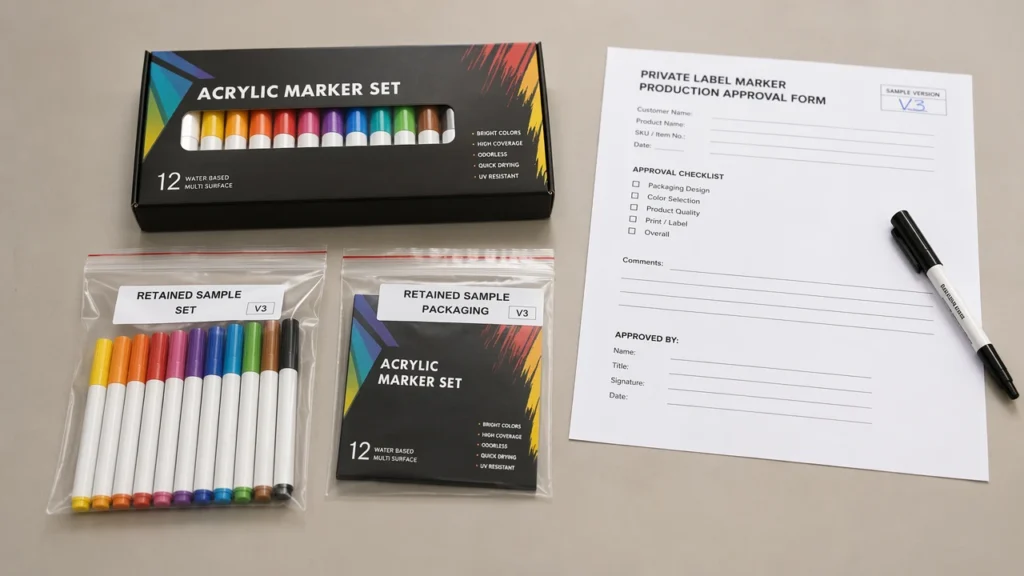
A signed sample is useful only when the sign-off record is specific. The form should be short enough for the buyer to use. It must be detailed enough for production and QC to follow.
| Champ | Que rédiger | Pourquoi c'est important |
|---|---|---|
| Projet et bon de commande | Nom de l'acheteur, nom du projet, SKU, numéro de bon de commande et date | Relie l'échantillon à la commande commerciale |
| Version de l'échantillon | Numéro de version, date de l'échantillon et notes de modification | Empêche la réutilisation par erreur d'anciens échantillons |
| Portée approuvée | Produit, emballage, illustration, code-barres, carton ou tous les éléments | Rend claire l'approbation partielle |
| Exceptions | Toute déviation approuvée et son caractère temporaire ou non | Évite les surprises lors de l'inspection |
| Échantillons conservés | Emplacements de l'échantillon acheteur, de l'échantillon usine et de l'échantillon contrôle qualité | Donne aux deux parties une référence physique |
| Signature | Approbateur acheteur, approbateur fournisseur et date d'approbation finale | Indique qui a accepté le standard de production |
Erreurs d'approbation courantes
Most sample problems are ordinary. The buyer is busy. The supplier wants to move production. Both sides assume the missing detail is obvious. It usually is not.
- Approuver la couleur du marqueur à partir d'une photo de téléphone au lieu d'un échantillon physique.
- Approuver le graphisme avant de confirmer la taille du code-barres et les règles d'étiquetage du détaillant.
- Considérer un échantillon de produit comme une approbation pour plusieurs tailles de coffrets ou formats d'emballage.
- Oublier de signer et d'étiqueter l'échantillon témoin.
- Modifier la pointe, l'encre, le corps, le capuchon, le plateau ou le carton après approbation sans nouvel enregistrement d'échantillon.
- Vérifier l'emballage de vente au détail mais ignorer les marquages du carton principal et les étiquettes d'expédition.
Posez de meilleures questions au fournisseur
The best sample questions force the supplier to explain the sign-off line. A yes answer is not enough.
| Question | Une réponse utile du fournisseur doit inclure |
|---|---|
| Quelles parties de cet échantillon sont définitives ? | Une liste claire : corps du marqueur, pointe, encre, logo, emballage, code-barres, carton, ou uniquement certaines parties. |
| Quels changements nécessitent encore une approbation ? | Tout élément en suspens, tel que la couleur du graphisme, le matériau du plateau, le fichier de code-barres, le marquage du carton ou la formulation de conformité. |
| Combien d'échantillons témoins seront conservés ? | Au moins un échantillon acheteur et un échantillon usine, tous deux marqués avec le projet et la date. |
| Comment la production sera-t-elle comparée à l'échantillon approuvé ? | Points d'inspection, calendrier d'échantillonnage et procédure en cas d'écart de production. |
| Quels documents doivent correspondre à l'échantillon ? | Fichier graphique, spécification produit, liste de colisage, fichier de code-barres, rapport de test et étiquette de carton. |
| Que se passe-t-il si l'acheteur demande une modification après approbation ? | Déterminer si un nouvel échantillon, une nouvelle soumission, un nouveau délai ou une approbation écrite de dérogation est requis. |
FAQ
These FAQs cover the sample questions buyers usually ask before private label marker production starts.
Qu'est-ce qu'un échantillon doré pour les commandes de marqueurs en marque privée ?
A golden sample is the signed physical base that mass production should follow. It should show the passed marker, packing, art, barcode or label spot, and any agreed exceptions. Both buyer and supplier should keep a marked copy.
Can I pass a private label marker sample from photos?
Photos help quick design review. They are not enough for final sign-off when color, nib feel, ink flow, cap fit, packing strength, barcode print, or carton marks matter. Use a physical sample for final sign-off whenever the risk touches quality or retail acceptance.
Should packing be passed apart from the marker?
Yes. A marker can be right while the tray, retail box, label, barcode, or carton is wrong. Treat product and packing sign-off as separate gates. Then sign one final production base.
What should be in a sample approval checklist?
Marker body. Color. Logo. Nib. Ink flow. Cap fit. Packing build. Art. Barcode. Carton marks. Compliance language. Kept samples. Sign-off date. Approved exceptions.
When does a sample need re-sign-off?
When the buyer or supplier changes the ink, nib, barrel, cap, logo style, packing build, barcode, warning language, carton, or any detail that touches retail look, compliance, shipment, or performance.
How do I stop sample delays?
Send the supplier final art, barcode data, market needs, packing style, destination country, set size, and shipping plan before sampling. Also decide who can sign samples and how many kept samples are needed.
Conclusion
Sample sign-off is where a private label marker order becomes real. The buyer should not pass a sample as a general idea. Pass a specific product. Pass a specific package. Pass a specific barcode or carton label. Pass a specific set of documents.
If you are preparing a private label marker order, send ZH Stationery your target market, set size, art, barcode needs, packing format, expected order quantity, and shipping route. The team can turn those details into a sample approval checklist before production starts. Buyers who want to check the production side can also review the visite de l'usine et qui nous sommes pages before talking samples.
Guide connexe : Pour la planification de conformité connexe, voir Fabricant de stylos à forme animale personnalisés.