Dual Tip Markers Explained: Brush, Chisel, Fine — What’s Best?
If you have stood in front of a marker display, or a supplier catalog, wondering whether to pick brush-and-chisel or fine-and-bullet, you are asking the right question. Dual tip markers are not just two nibs for the price of one. Each tip shape changes how ink flows, how wide the stroke runs, and what kind of work the marker can do. See why premium markers are worth it.
The wrong pair frustrates the end user. The right pair becomes the marker they reach for every time.
That split matters whether you are an artist building a kit or a brand owner sourcing private-label markers. For buyers placing bulk orders, there is another layer. The build calls behind tip material, ink fit, and nib bond decide whether those markers perform the same across thousands of units. A tip that frays on day five. A fine point that clogs mid-stroke. A color that does not match between the two ends. These are not random failures. They trace back to specific production picks.
This article walks through what each tip type does, how pairs serve different use cases, and which factory-level factors separate a reliable dual tip marker from one that makes returns.
Table of Contents
Quick Answer: What Dual Tip Marker Combination Should You Choose?
If you need a fast pick by use case:
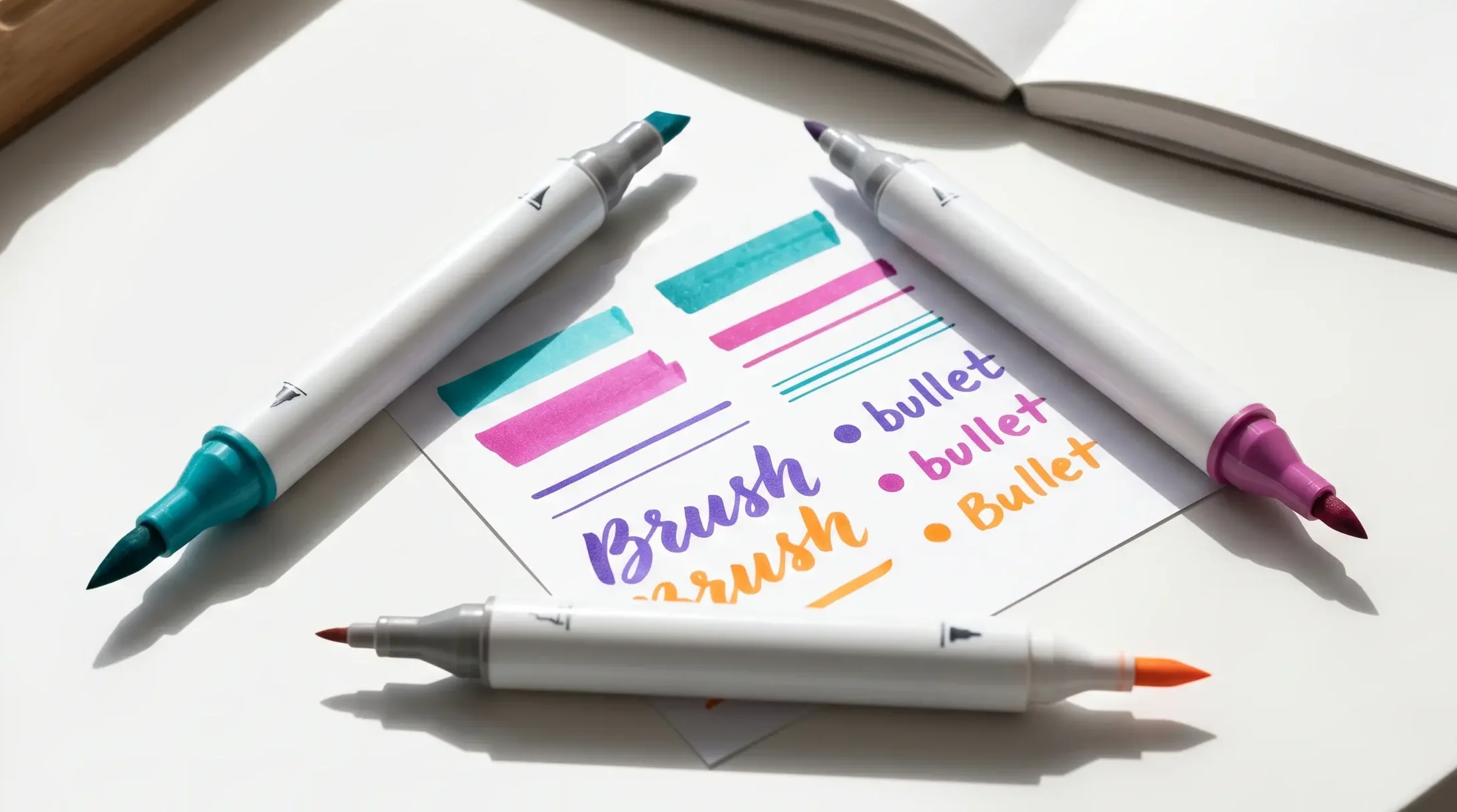
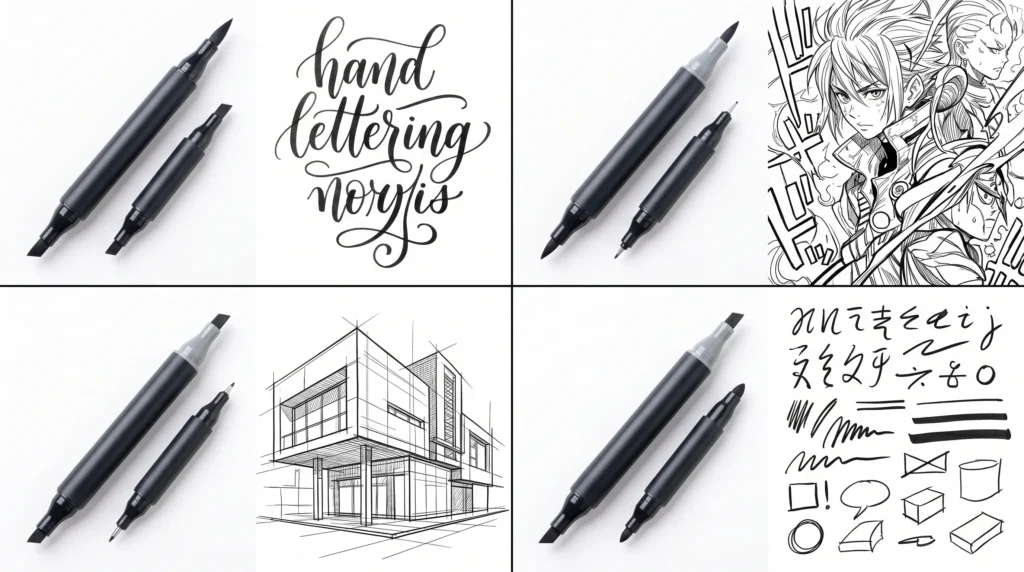
Brush + Chisel: Best for illustrators, lettering artists, and designers who need expressive strokes plus broad coverage. The brush handles organic line work; the chisel covers backgrounds and bold fills in a single pass.
Brush + Fine: Best for manga artists, colorists, and detail-heavy illustrators who need both fluid brush work and precision line control in one tool without switching markers.
Chisel + Fine: Best for technical illustrators, architects, and note-takers who prioritize structured lines, consistent width control, and detailed annotations over expressive brushwork.
Chisel + Bullet: Best for general-purpose writing, sketching, and starter-level art kits where versatility at a lower per-unit manufacturing cost matters more than specialized tip performance.
For brand owners and buying teams, these use-case gaps help set sharper sourcing and quality check bars. The tip pair you pick shapes your target buyer and the QC marks the product must meet.
Dual tip marker combinations comparison brush chisel fine bullet tips with usage examples
Dual Tip Marker Combinations: Matching Use Cases to Factory Quality Control
What users notice about dual tip markers almost always goes back to a line-side call. The table below ties the most common complaints to what you should verify before signing a PO.
Common Feature/Issue
Why It Matters/Fails (Root Cause of Customer Complaints)
Factory Quality Control Metric
Brush tip frays or loses shape after moderate use
Low-density fiber construction or poorly bonded nib-to-body adhesive; ink solvent gradually breaks down the tip material at the bond point.
Verify nib density (≥0.35 g/cm³ for brush tips) and solvent-resistance testing on adhesive bonds under accelerated aging.
Chisel tip produces uneven lines, one edge consistently darker
Misaligned tip cutting during production; the chisel angle varies across units within the same batch.
In-process tip-cutting angle tolerance ±2°; batch sampling of line-width consistency at 3 stroke angles (broad, medium, fine edge).
Fine tip clogs or stops delivering ink mid-stroke
Ink pigment particle size exceeds the nib’s capillary channel width; pigment aggregates form blockages over time.
Specify filtration suitable for the actual pigment or decorative particle system, then check settling and writing performance under agreed storage conditions.
Ink color visibly differs between the two tips
Different ink reservoir saturation rates between tips; one tip draws from a drier section of the reservoir core.
Spectrocolorimeter verification of ΔE < 1.5 between both tips after 24-hour vertical rest.
One tip dries out noticeably faster than the other
Uneven capillary wicking rates between tip materials; the denser tip pulls ink away from the lighter one.
Measure output from both tips using the same writing conditions and compare with the approved sample. Agree acceptable differences for the intended tip combination.
Marker barrel leaks at the tip joint
Insufficient ultrasonic welding or mechanical pressing force at the nib-to-barrel seal; thermal expansion creates gaps during shipping.
Pressure-decay leak testing at both tips; seal integrity verified at -10°C and 50°C to simulate shipping and storage extremes.
Every row in that table turns into a checkpoint that either exists in a factory QA plan or does not. When you source dual tip markers at scale, the gap between a supplier who can walk you through these metrics and one who cannot is the gap between a brand that grows and one that bleeds returns and bad reviews.
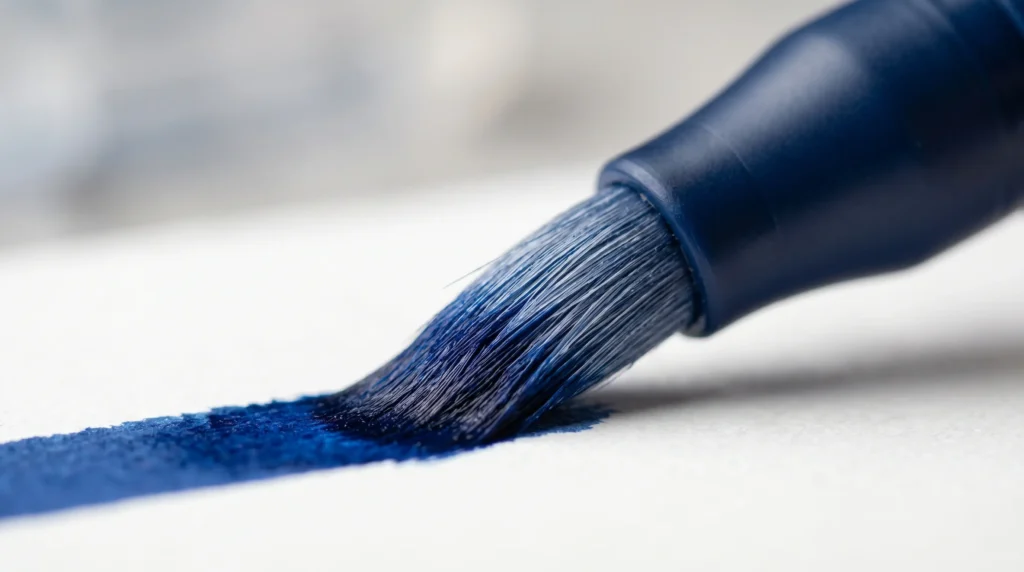
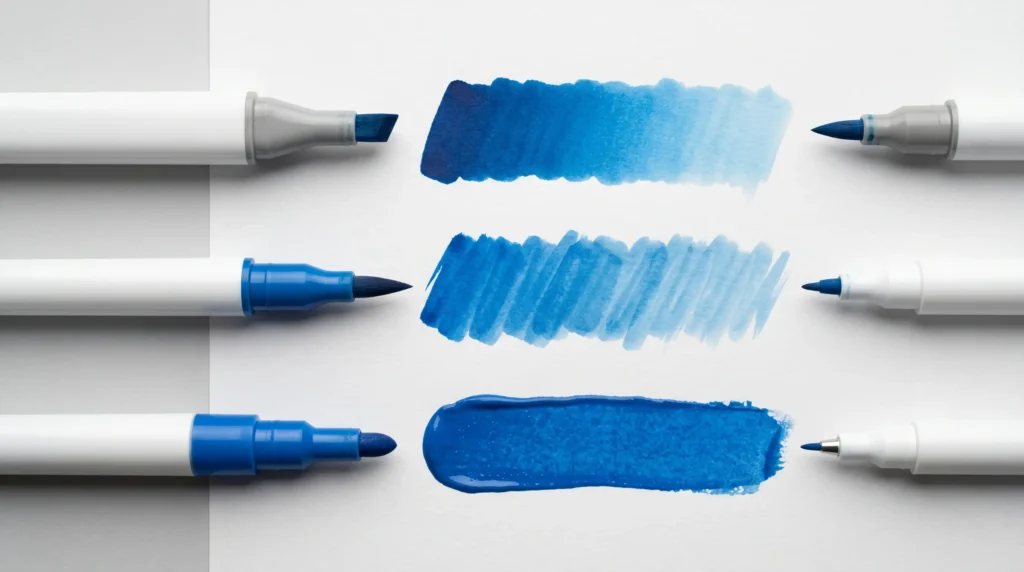
Brush tip marker close-up showing fiber flexibility and ink flow on paper
How Marker Tip Shapes Actually Work
A tip is not just a shape. It is a precision ink delivery system. Before you judge a dual tip pair, know what each shape does at the physical level. How the fibers sit. How ink moves through them. What can go wrong in production.
The Brush Tip: Organic Flow, Controlled Flexibility
A brush tip is a tapered cone of pressed fiber, usually polyester or a nylon-polyester mix. It flexes under pressure and springs back. What makes it work is not softness alone. The fibers sit lengthwise. That creates micro-channels that wick ink from the reservoir to the nib face by capillary action.
Press harder and the tip flares. More fiber touches the paper, making a wider line. Lighten up and only the tip touches. That pressure-to-width feel is what makes brush lettering fluid. The tip behaves like a sable brush, with less care and no dipping.
The Quality Difference: A tip with fiber density below 0.30 g/cm3 collapses under repeated pressure and will not fully spring back. By the 50th stroke, the user feels it. The fine end of the brush turns mushy. Lines lose precision.
The Chisel Tip: Structured Coverage With Three Lines in One
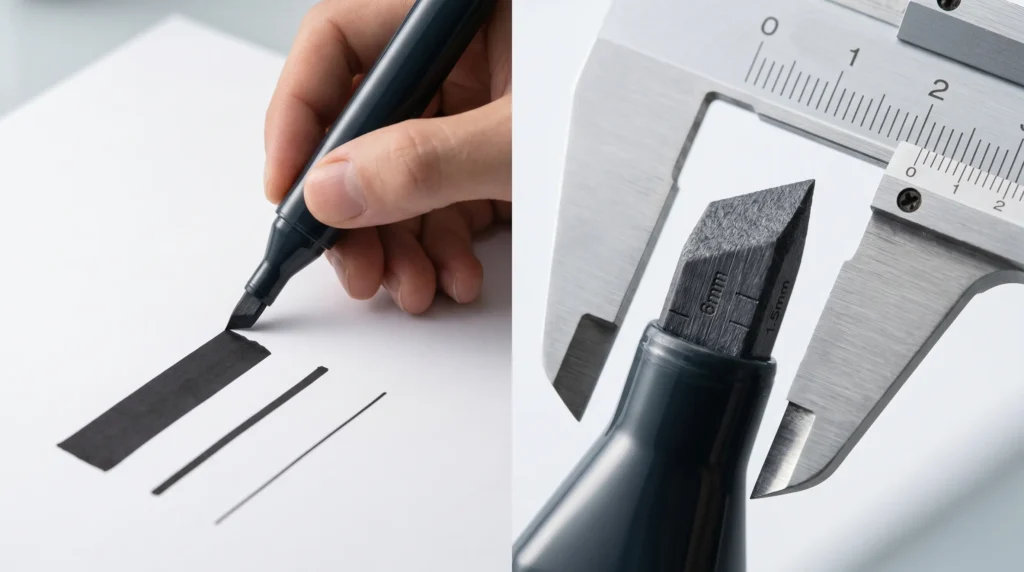
A chisel tip is cut at an angle, usually 45 to 60 degrees. That makes a wedge face. This simple shape gives three line widths from one nib. The wide flat edge fills. The narrow edge makes medium lines. The corner makes fine detail.
The build test for chisel tips is the cut itself. A loose cut, even half a degree off, makes a chisel lean to one side. The user does not see the angle. They see one edge of the stroke look darker. Steady chisel performance needs automatic angle checks at the tip-cutting station.
Chisel tip marker showing three line widths and angled cut geometry close-up
The Fine Tip: Precision Where a Millimeter Matters
Fine tips run from 0.5mm to 1.0mm. They are a narrow bullet shape or needle-point build. They use the same fiber parts as brush and chisel. The production tolerance gets much tighter.
Fine tips are made by molding the fiber into a narrow cone or grinding a wider tip to spec. The lasting issue with fine tips in dual tip markers is ink hunger. The narrow tip has fewer capillary channels than a chisel. It draws ink slower. If the ink mix is too thick, the fine tip runs dry mid-stroke.
The Bullet Tip: The Workhorse That Deserves More Respect
The bullet tip, a rounded cone nib, usually 1.0mm to 2.0mm at its widest, often gets called basic. That is a mistake. A well-made bullet tip is the most rugged of all marker nibs. No sharp corners to bend. No odd shape to lose line. It writes smooth in any path. That makes it ideal for sketch, general writing, and kids' art kits.
Ink Type and Tip Compatibility: It’s a System, Not a Menu
Marker tips do not live alone. They are half of a system. The other half is the ink.
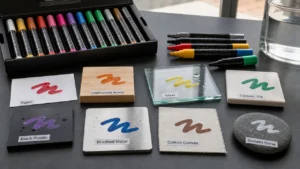
Alcohol-Based Ink: The standard for professional-grade dual tip markers. It evaporates quickly, blends smoothly, and produces vibrant color. Polyester fiber tips handle alcohol ink beautifully because polyester resists solvent degradation.
Water-Based Ink: Common in student-grade and children’s markers. It’s lower-cost and washable, but water molecules are larger, slowing capillary wicking through dense fiber tips. Water-based ink can also cause lower-density nylon blends to swell over time.
Paint-Based Ink: Acrylic and oil-based paint markers introduce a third variable: pigment particle size. A tip that handles alcohol dye may choke on paint ink. Manufacturers need tips with wider capillary channels to accommodate pigment flow.
That is why you rarely see the same body offered across alcohol, water, and paint versions with identical tips. The tip specs have to be tuned to the ink during R&D.
Alcohol water and paint-based ink comparison on marker paper with dual tip markers
What Makes a Dual Tip Marker Actually Dual (Not Just Two Tips Sharing a Barrel
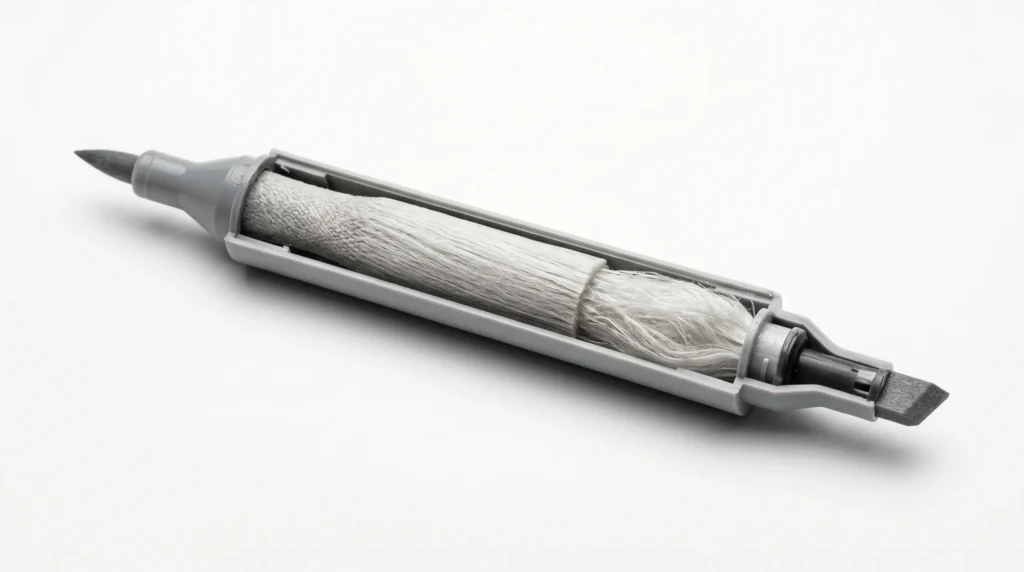
There is a build insight that separates a real dual tip marker from two nibs glued into opposite ends of a barrel. It is the ink reservoir design.
In a right-built dual tip marker, one porous reservoir runs the full barrel and feeds both tips at once. Each tip draws from the same ink. Both tips should give the same color depth and flow rate.
The build test is balance. If the two tips have different density, the denser tip pulls ink faster by capillary action. Factories fix this with layered density zones inside the core. Tighter packing near the dense tip. Looser near the lighter one. That balances the draw rate.
Dual tip marker internal structure cutaway showing reservoir core and tip assemblies
If your dual tip markers are headed for US or EU retail shelves, certification is a market-entry need. It also acts as a practical quality signal.
ASTM D-4236: Required for art materials sold in the U.S. Ensures the ink has been reviewed by a toxicologist for long-term exposure risks.
EN71 (Parts 1–3): The EU Toy Safety Directive. Part 3 sets migration limits for heavy metals (lead, cadmium, chromium) from inks, barrel materials, and tip components.
REACH: This EU regulation governs Substances of Very High Concern (SVHC).
ISO 9001: Baseline quality management certification showing production processes are documented and repeatable.
For B2B buyers sourcing custom dual tip markers, check these abilities:
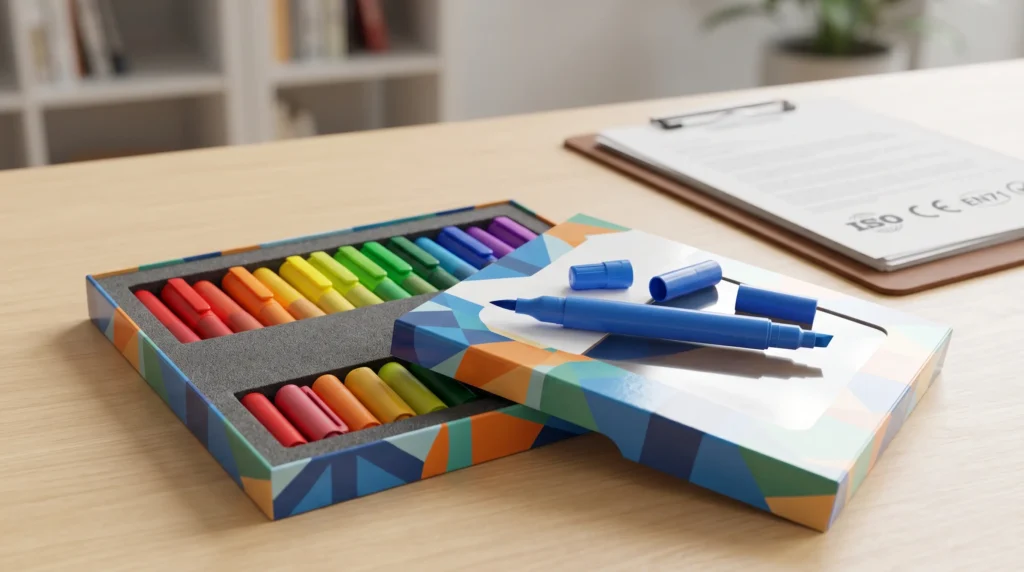
Fully customized packaging: Blister cards, window boxes, tin cases, or branded sleeves.
In-house ink R&D and 3D design support: Custom color matching with spectrocolorimeter verification.
Free pre-production samples: Hold the markers, test both tips, and check cap seals before committing to bulk.
100% inline automated inspection per unit: Every marker checked for fill weight, cap torque, and nib retention; writing tests follow AQL sampling, cap seal integrity, and tip alignment.
Custom packaged dual tip markers in branded window box with certification documents
Frequently Asked Questions
Q: What's the difference between alcohol-based and water-based dual tip markers?
A: Alcohol markers use dye in an alcohol solvent that flashes off fast. That gives bright, blendable color on most non-porous surfaces. Water markers use water-soluble dye or pigment. They dry slower and do not blend as clean. They offer washability.
Q: Which dual tip pair is best for beginners or student-grade products?
A: Chisel plus Bullet is the most forgiving pair for beginners. The chisel covers without asking for the pressure control a brush tip needs. The bullet handles daily writing. It is also the cheapest pair to make.
Q: Do dual tip markers dry out faster than single tip markers?
A: Not by nature. They can if the cap seal is poorly built. A dual tip marker has two loss points instead of one. Good production tests cap seal integrity per unit to hold an airtight fit for 18 to 24 months in shelf storage.
Q: How do I verify that a factory's dual tip markers will perform the same across a bulk order?
A: Ask for three things:
A batch test report showing line-width consistency across both tips.
Accelerated aging results (markers stored at 50°C for 72 hours).
A physical pre-production sample you can test yourself.
Q: Can I mix different tip types in a custom order, some brush plus chisel, some chisel plus fine?
A: Yes. Most custom programs allow mixed tip pairs, such as brush plus chisel and chisel plus fine, within the same order. Confirm the pairing on the approved sample and test both nibs for flow and cap seal, because each pair adds a separate QC point.
Q: Why do some dual tip markers smell stronger than others?
A: The smell comes from the ink solvent. Alcohol markers use ethanol or isopropanol. Stronger smell often means a higher solvent-to-dye ratio or industrial-grade solvent instead of clean cosmetic-grade alcohol.
There is a quiet joy in picking up a marker where both tips perform exactly right. The brush flexes and snaps back. The fine point lays clean ink without pause. The color matches between both ends. That feel does not happen by luck. It is the result of calls made months earlier on the floor.
For artists, the right dual tip marker makes creative work flow without friction. For brand owners, it makes the product sell and keep selling. If you are judging dual tip markers for your line, use this article as your sourcing list. Ask about tip density. Ask about wick balance. Ask about ink-to-tip fit tests. The suppliers who answer those questions straight are the ones whose markers will perform.