












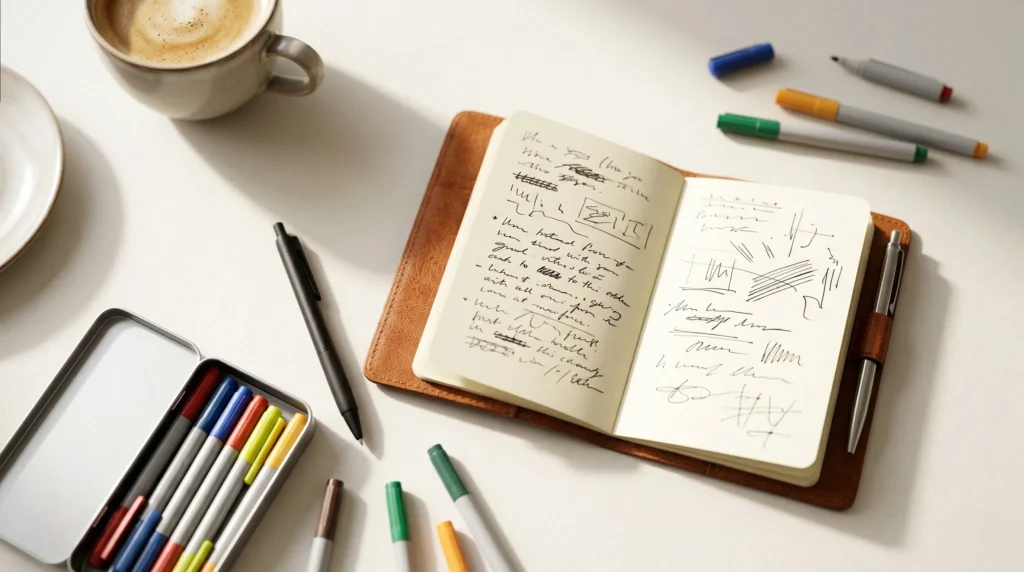
For a while, everything went digital. Notes migrated to apps. To-do lists lived inside phones. Ideas got typed into cloud documents and, often enough, forgotten. But something shifted. Across design studios, procurement offices, and creative workspaces, a quiet counter-movement has been gaining ground — the return of the physical, the portable, the pocket-sized tool that’s always within reach. Pocket stationery sits at the center of this shift.
Designers are sketching in cafés. Brand managers are annotating samples on factory floors. Writers are capturing phrases before they dissolve. None of them want to carry a full pencil case or a 15-inch laptop sleeve to do it. They want something that disappears into a pocket, a bag, a notebook band — and surfaces the moment an idea needs catching.
This isn’t nostalgia. It’s practicality meeting intentionality. And in 2026, the demand for compact writing tools — mini pens, pocket markers, slim notebooks — has moved from niche enthusiasm to genuine market force. For brand owners and procurement teams, it also signals a product category worth understanding at the manufacturing level.
目录
Quick Answer: Why Is Pocket Stationery Surging In 2026?
The term “pocket stationery” now covers a product ecosystem: mini ballpoints under 10 cm, compact dual-tip markers, clip-on fineliners, and notebooks small enough to ride along in a back pocket. Their collective rise isn’t random. It tracks a few converging trends:
- Digital fatigue is real. After years of all-screen workflows, creatives and professionals are pairing digital tools with physical ones — not replacing, but balancing. A pocket pen and a small notebook act as a “thinking space” away from notifications.
- Portability drives adoption. Tools that fit into daily carry — not just desk drawers — get used more often. A marker that’s always in your jacket gets more miles than the best pen left at home.
- Sustainability expectations have shifted. Consumers — and increasingly, B2B buyers — favor products built to last. Refillable mini pens and markers with replaceable nibs fit the “buy less, buy better” ethos.
- Social media fuels discovery. Platforms like TikTok and Instagram have turned pocket-friendly stationery into visual content. A satisfying pen mechanism or a compact color swatch set makes for shareable material — and organic brand exposure.
- Planners and journals are back. The 2026 planner resurgence has created companion demand: pens slim enough to slip into a journal loop, markers small enough for a travel kit.
For brand owners and procurement managers, understanding these drivers helps establish more precise product specifications and quality inspection standards.

Mini Pens And Compact Markers: A B2B Buyer’s Quality Evaluation Framework
When evaluating mini pens or pocket-sized markers for retail or private-label programs, the consumer’s experience hinges on engineering decisions made at the factory level. A pen that skips after three uses or a marker cap that cracks in a pocket isn’t just a return — it’s a brand reputation problem. Here’s how common end-user complaints map to manufacturing quality control:
| 常見特徵/問題 | Why It Matters / Fails (Root Cause of Customer Complaints) | 工廠品質管控指標 |
| Ink dries out within weeks of light use | Cap seal doesn’t maintain airtight closure; solvent evaporates through micro-gaps between cap liner and barrel | Cap pull-force consistency testing (target: 8–15N); airtight seal verification per batch using pressure-decay method |
| Ink flow skips or blobs during writing | Inconsistent ink viscosity — too thick causes skipping; too thin causes leakage through the nib | In-house ink viscosity measurement per production batch; spectrocolorimeter verification of pigment suspension stability |
| Pen body cracks at the threading or clip attachment point | Substandard plastic formulation or inconsistent injection molding parameters (temperature, pressure, cooling time) | Drop-test protocol (1.2m onto concrete, 3 angles); tensile strength testing on barrel threads; injection mold temperature logging per shift |
| Color varies noticeably between units in the same SKU | Pigment batch variation; third-party ink suppliers may not hold tight color tolerances | Spectrocolorimeter reading against master standard per batch; ΔE tolerance ≤ 2.0 for consumer-grade markers |
| Nib frays or deforms after moderate use | Tip fiber density insufficient for the ink solvent type; alcohol-based inks degrade low-density felt faster | Accelerated wear testing (500m write-out distance); nib material specification matched to ink chemistry at R&D stage |
| Mini pen mechanism (click/retractable) jams or fails | Spring tension inconsistent; internal track molding flash interferes with smooth actuation | Cycle testing to 10,000 actuations; go/no-go gauge check on internal track dimensions per production lot |
A factory that can show you these QC logs by batch has nothing to hide. One that says “we check quality” without specifying methods either doesn’t track this data or doesn’t want you to see it.
The Forces Behind The Pocket Stationery Revival
Digital Fatigue And The Analogue Return
Screen time in creative professions has climbed steadily for a decade. The backlash was predictable — but what’s interesting is the shape it’s taken. People aren’t abandoning digital tools. They’re supplementing them with physical ones that serve a different cognitive function.
Research on handwriting and memory suggests that the physical act of writing engages different neural pathways than typing. A pocket notebook and pen don’t replace Notion or Figma. They complement them — capturing the raw, unstructured thinking that happens between structured work sessions. That’s why the format matters: the tool has to be small enough to be present during those in-between moments. (A full-size notebook stays on the desk; a pocket one goes everywhere.)
Portability Shapes The Product, Not Just The Packaging
Designing a writing instrument for pocket carry isn’t simply about shrinking a standard pen. It introduces engineering constraints that don’t exist at full scale. The ink reservoir must be smaller, which means the formulation needs to perform consistently across a shorter column of fluid. The cap seal becomes disproportionately important — because a mini marker has less ink to lose before it’s dry.
The mechanism, too, needs rethinking. A click pen that’s 14 cm long has room for a standard spring-and-cam assembly. At 9 cm, the same mechanism needs tighter tolerances. A cap that seals with an audible click — the kind you can feel as much as hear — signals to the user that the seal is intact. That tactile feedback isn’t decorative. It’s functional quality assurance built into the product experience.
What Makes A Great Mini Marker? Inside The Engineering
Ink Formulation At Small Scale
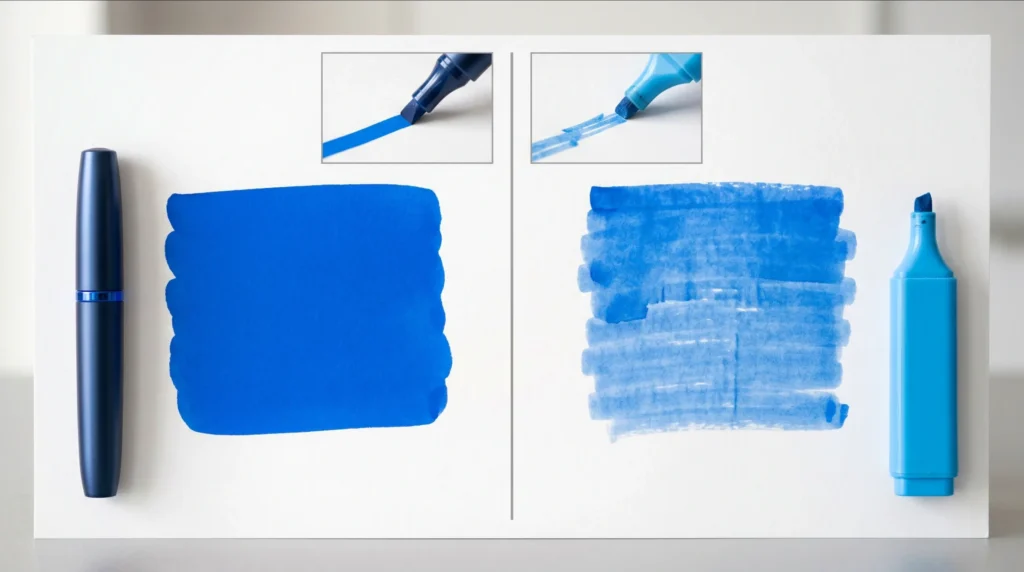
Alcohol-based ink — the kind found in nearly every professional-grade marker — evaporates through a different mechanism than water-based formulations. The solvent flashes off quickly upon contact with air, which is what gives alcohol markers their fast drying time and their ability to layer without reactivating previous strokes. It’s also what makes them vulnerable to drying out in a pocket-sized format.
When the total ink volume in a marker is 1.5–2 ml (versus 4–6 ml in a full-size marker), even minor cap-seal leakage becomes catastrophic. A 5% solvent loss in a full-size marker might mean slightly drier performance after six months. In a mini marker, the same 5% loss can render the nib unusable.
This is where the ink formulation has to pull double duty. It needs the right solvent blend to deliver clean, streak-free coverage on paper — but it also needs additives that slow solvent migration through the nib when the marker is capped and stored. At facilities where ink is formulated in-house and verified via spectrocolorimeter per batch — the kind of setup you’d find in a manufacturer with an independent R&D lab and 26 years of OEM experience serving global brands — the lab-to-production color variance can stay within a ΔE of 2.0. That’s tight enough that a consumer opening two markers from different production runs won’t see a visible difference. When ink is sourced from third-party suppliers, those tolerances drift. Sometimes by a little. Sometimes by enough to generate returns.
Tip Precision And Cap Seal Integrity
The most common marker failure isn’t the ink.
It’s the cap.
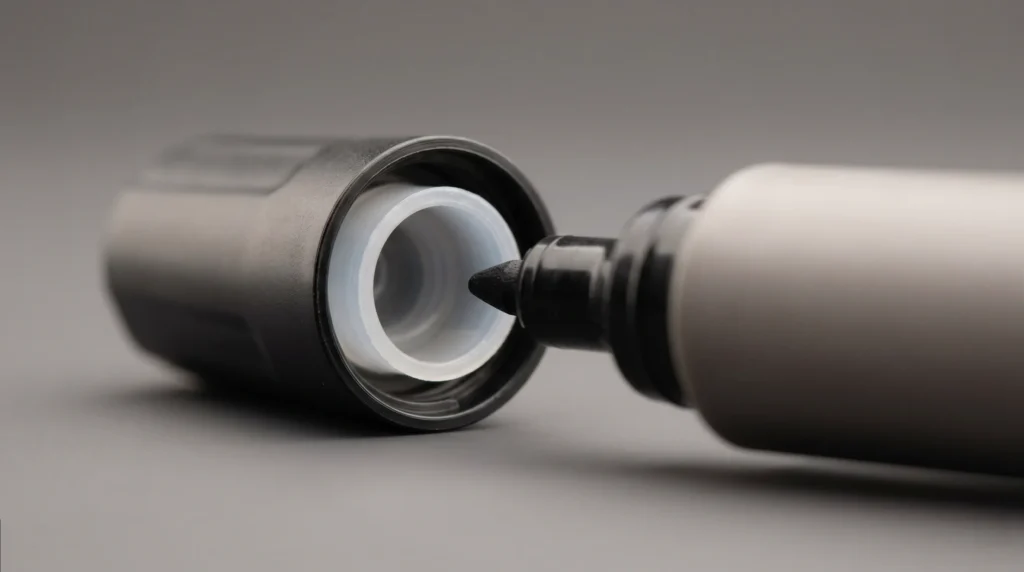
A cap that doesn’t seat fully lets solvent escape around the nib. Over days and weeks — the usage pattern for a pocket stationery item that lives in a bag and gets used occasionally — that slow leak adds up. The user picks up the marker after a month and finds it dry. They don’t blame the cap design. They blame your brand.
On a well-run production line, cap pull-force is tested per batch. The spec range — typically 8 to 15 Newtons — ensures the cap clicks shut with enough force to seal but not so much that a user can’t open it one-handed. The inner cap liner, usually polyethylene or a similar soft polymer, needs to form a complete circumferential seal against the nib housing. Even a 0.2 mm molding flash on the liner edge creates a micro-channel for solvent vapor to escape.
These aren’t exotic engineering problems. They’re straightforward quality-control challenges — but they require systematic testing, not spot checks. A good QC protocol samples 200–300 units per batch, not five. It logs results. It traces defect patterns back to mold maintenance schedules or ink batch numbers. And it does this for every production run, not just the ones shipped to key accounts.
For brand owners sourcing compact markers, asking to see these logs during a factory audit tells you more about actual quality than any certificate on the wall.
Certifications & Custom Manufacturing For Pocket-Sized Products
Selling mini pens and compact markers into regulated markets means navigating a web of safety and compliance requirements. These aren’t optional — they’re the baseline for market access:
- EN71-3 (EU): Tests for migration of 19 heavy metals from accessible components. This is the most expensive and critical test for ink-based products. Products marketed to children must pass Parts 1, 2, and 3. A supplier offering only Part 1 and Part 2 reports has effectively skipped the chemical safety verification.
- ASTM D-4236 (US): Mandatory for all art materials sold in the US market. Requires a toxicological risk assessment reviewed by a qualified toxicologist. The “Conforms to ASTM D-4236” statement printed on packaging is the visible output of this process.
- REACH (EU): Broader chemical regulation covering SVHC (Substances of Very High Concern). Applies to all products, not just children’s items.
- CE Marking: Required for products classified as toys under the EU Toy Safety Directive. The manufacturer must maintain a Declaration of Conformity and technical file.
When you’re sourcing pocket stationery for retail or private-label programs, the supplier’s certification portfolio is the starting point — not the finish line. Verify that the test reports cover your specific product SKUs, your actual ink formulations, and your production batches. A “golden sample” passing a lab test means nothing if the mass production uses different materials.
B2B manufacturing capabilities to evaluate:
- MOQ starting at 2,000 pieces per SKU — a threshold that works for boutique brands testing new markets.
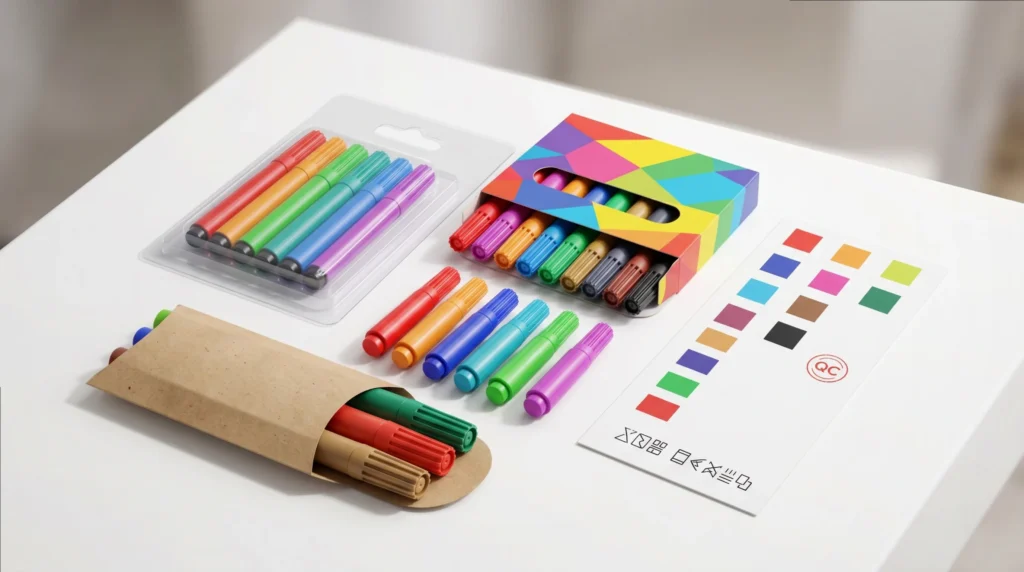
- Full packaging customization: blister cards, color boxes, display stands, eco-friendly options.
- 3D design and physical sampling: prototypes in 72 hours, mold development in 4–6 weeks.
- Free sample policy for qualified buyers — enables side-by-side evaluation before committing to a production run.
- 100% visual and functional inspection on every unit before packing — not statistical sampling, complete inspection.
If you’re sourcing mini markers or pocket-sized pens for your brand and want to discuss specifications, you can reach the ZH STATIONERY team.
常見問題解答
Q: Are mini markers less durable than full-size markers?
Not inherently. Durability depends on the cap seal, the ink formulation’s resistance to solvent evaporation, and the mechanical integrity of the barrel and nib assembly. A well-engineered mini marker with an airtight inner cap liner and alcohol-based ink formulated with evaporation inhibitors can perform consistently for 12–18 months after opening — comparable to many full-size markers. The failure point in most compact markers is the cap seal, not the ink volume.
Q: Can mini pens and markers be customized with my brand logo and packaging?
Yes. OEM pen manufacturers with molding, pad printing, and packaging capabilities in-house can produce fully customized pocket stationery — from barrel color and material to logo placement, packaging design, and ink formulation. At ZH STATIONERY, for example, MOQs start at 2,000 pieces per SKU, and the factory handles the full process from mold design through final packaging, including 3D prototype sampling within 72 hours. This makes pocket stationery a viable private-label category even for smaller brands testing new markets.
Q: What safety certifications should I look for when sourcing mini markers?
At minimum, request EN71-3 (migration of heavy metals) and ASTM D-4236 test reports for the exact product SKU and ink formulation you’re ordering. Do not accept a generic “we have certification” statement or reports that cover only Part 1 (mechanical) and Part 2 (flammability) of EN71 — Part 3 is the chemical safety test that matters for ink-based products. For EU distribution, confirm REACH compliance and CE marking documentation as well.
Q: Why do some mini pens skip or stop writing after a short time?
Skipping in compact pens typically traces to one of three root causes: (1) a nib that didn’t receive adequate ink saturation during the initial filling and priming process, (2) ink viscosity that’s too high for the narrow feed channel in a mini pen body, or (3) cap seal failure allowing the nib to dry between uses. In manufacturing, these issues are controlled through ink viscosity testing per batch, automated filling with volume verification, and cap pull-force consistency checks.
Q: What’s the minimum order quantity for custom pocket stationery?
MOQs vary by manufacturer and customization complexity. For fully custom mini markers with branded packaging, typical MOQs range from 2,000 to 5,000 pieces per SKU. Some manufacturers — particularly those with in-house mold shops and flexible production lines — can accommodate batches as low as 2,000 pieces. If you’re evaluating suppliers, ask about their minimums for injection molding (new barrel designs), pad printing (logo application), and packaging separately — these often have different thresholds.
Q: How can I get samples to evaluate mini marker quality before placing a bulk order?
Most B2B stationery manufacturers offer free samples to qualified buyers. When requesting samples, ask for production-line samples (not hand-assembled prototypes) so you’re evaluating what customers will actually receive. Test cap seal integrity by leaving a sample uncapped for 2 hours, then 24 hours — the marker should recover and write normally at both intervals. Also test vertical storage (nib up, nib down) for leakage. You can contact ZH 文具.
Pocket stationery isn’t a passing aesthetic trend. It’s a product category shaped by real shifts in how people work, create, and carry their tools. The demand drivers — digital balance, portability, sustainability, planner culture — aren’t going anywhere in 2026. Neither is the expectation that a compact pen or mini marker should perform every bit as well as its full-size counterpart.
For brand owners watching this space, the opportunity isn’t in chasing a moment. It’s in building products that solve the engineering challenges of the format — and sourcing from manufacturers who can prove their quality, batch by batch.