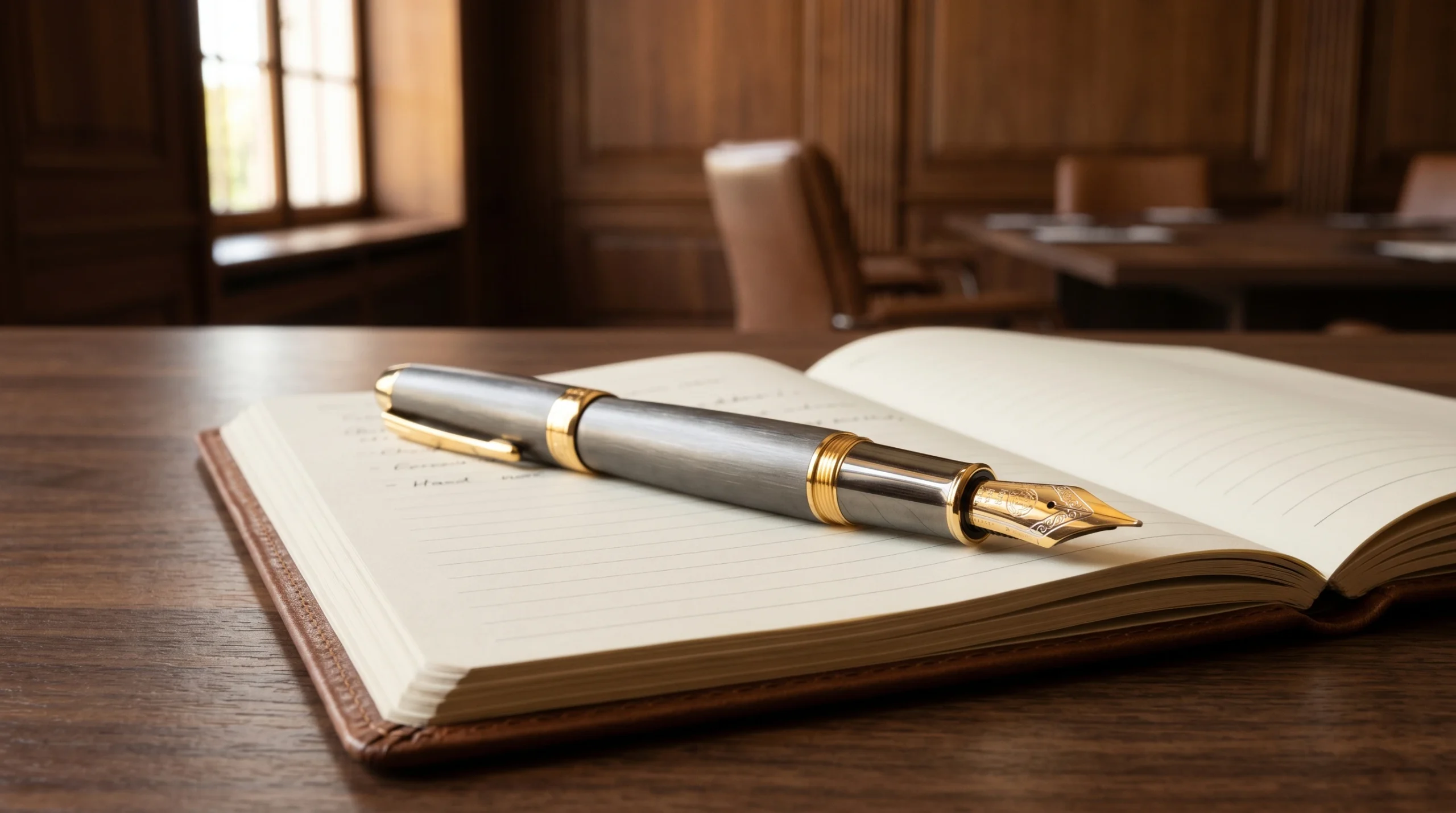
A procurement manager at a Düsseldorf-based engineering firm pulls a lacquered fountain pen from his jacket to sign a €4.7 million contract. Nobody in the room thinks it’s pretentious. They’d notice if he didn’t have one.
That reflex — the unspoken expectation that serious business deserves a serious writing instrument — explains more about the luxury corporate pen market than any market report ever could. Europe didn’t just build the luxury pen industry. Europe built the cultural context that makes luxury pens matter.
The numbers back this up. Of the roughly $2.3 billion global luxury pen market, Europe accounts for approximately 36% of value share. The high-end fountain pen segment tilts even further: €628 million in European revenues in 2025, representing 34.5% of the global total, according to DataIntelo. The region’s dominance isn’t accidental. It’s the product of 120 years of accumulated manufacturing expertise, concentrated in a corridor stretching from Hamburg to Milan — a corridor where brands like Montblanc, Pelikan, Montegrappa, and Caran d’Ache still produce pens within 200 kilometers of where their founders set up the first workshops.
For brand owners and procurement managers sourcing custom writing instruments, understanding why Europe holds this position reveals how to compete. You don’t need to be Montblanc. You need to understand what Montblanc’s existence says about buyer psychology, quality expectations, and the gap between a promotional giveaway and a pen someone keeps for a decade.
目录
Quick Answer: Why Does Europe Control 36% Of The Global Luxury Corporate Pen Market?
Europe’s dominance in the luxury corporate pen market rests on four structural advantages that compound each other:
- Concentrated manufacturing heritage spanning over a century. Germany alone hosts Montblanc (Hamburg, founded 1906), Pelikan (Hanover, 1838), Lamy (Heidelberg, 1930), and Graf von Faber-Castell (Stein, 1761) — the densest cluster of premium pen-making expertise anywhere. Italy adds Visconti, Montegrappa (1912), and Aurora (1919). Each of these brands still operates primary production within a 300-kilometer radius of its founding city, preserving the skilled labor pool that high-end pen assembly requires.
- Corporate gifting culture that treats writing instruments as relationship capital. In German, French, and British business environments, a premium pen is a standard executive gift — not an extravagant gesture. The annual corporate gifting cycle across Europe generates steady demand independent of consumer retail cycles, with Ken Research reporting that corporate procurement drives the office segment’s dominant market share.
- Per-capita luxury expenditure among the highest globally. European consumers in Germany, France, Italy, and Switzerland spend disproportionately on premium writing instruments per capita compared to North American or APAC counterparts. This domestic demand base provides the volume that sustains specialized manufacturing.
- Regulatory environment that favors quality over disposability. EU sustainability directives — including single-use plastic restrictions and extended producer responsibility frameworks — make the disposable pen model economically disadvantageous. Premium, refillable writing instruments align structurally with European regulatory direction.
For brand owners and procurement managers sourcing writing instruments for corporate programs, understanding these factors helps establish more precise quality and positioning benchmarks when evaluating manufacturing partners.
Understanding The European Luxury Pen Landscape: Buyer Criteria That Define The Market
The European luxury pen market isn’t one market. It’s four distinct demand profiles stacked on top of each other, each with different quality thresholds and price tolerance. A procurement manager sourcing for a German corporate gifting program needs something different from a retailer stocking an Italian boutique — and both differ from a brand owner developing an own-label luxury pen line.
The table below maps the most common failure points buyers encounter — and the factory-level controls that prevent them.
| 常見特徵/問題 | Why It Matters / Fails (Root Cause of Customer Complaints) | 工廠品質管控指標 |
|---|---|---|
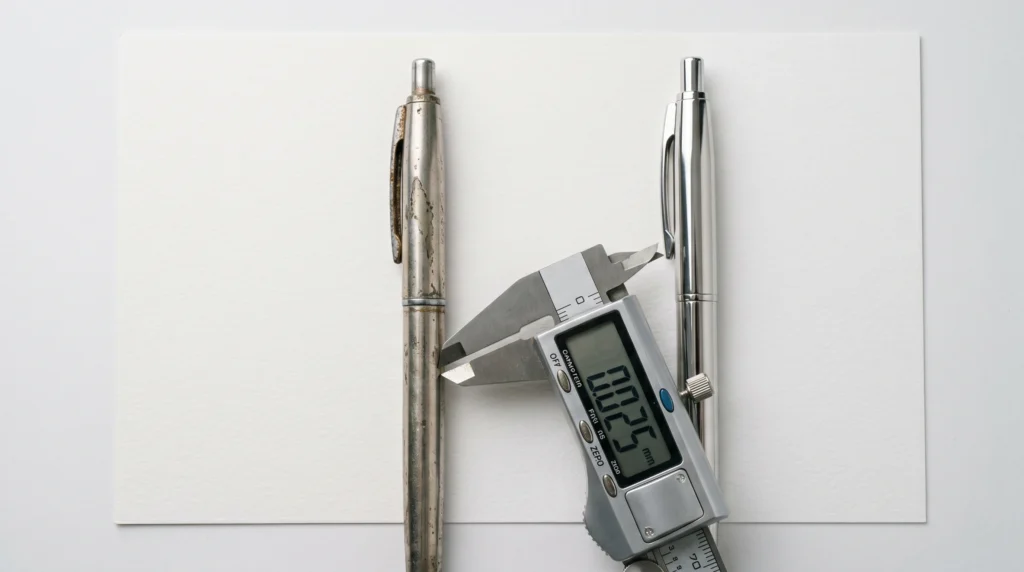
| Nib scratchiness / inconsistent ink flow | Misaligned tines or improper slit width. A deviation of 0.02mm in the nib slit changes capillary flow enough to cause skipping. The user blames the brand. | Nib slit width verified under 40x magnification per unit; ink flow rate tested at 22°C ±2°C for consistent capillary draw across production batches |
| Plating wear on metal components (clips, rings, nibs) | Gold or palladium plating below 3 microns thickness fails after 18–24 months of pocket contact. The pen looks cheap long before it stops writing. | X-ray fluorescence (XRF) spectrometry per batch measures plating thickness to ±0.1 micron; salt-spray corrosion testing (ISO 9227) for 48 hours minimum |
| Cap seal failure (ink dries out within weeks of non-use) | A cap that doesn’t engage with consistent force creates a microscopic vent — solvent evaporates, nib dehydrates. It’s a one-cent tolerance problem destroying a product worth fifty euros or more. | Cap engagement force measured with digital force gauge; vacuum decay test confirms seal integrity (pressure loss <5% over 60 seconds) |
| Color / finish mismatch across batches | Anodized aluminum barrel colors shift between production runs when dye bath temperature or concentration isn’t controlled. A customer reordering six months later receives a visibly different product. | Spectrophotometer readings (Delta E ≤1.0 between batches); dye bath temperature maintained at ±1.5°C with automated circulation; master swatch retained for each production run |
| Barrel threading failure | Threads that cross or bind after 50–100 open/close cycles destroy the perceived quality of the entire pen. The mechanism feels cheap even if the materials aren’t. | Thread engagement tested on automated cycling rig for 500 open/close cycles; dimensional inspection of thread pitch via laser micrometer; 200-unit random sample per 10,000-unit batch |
What this table makes clear: the difference between a pen that becomes a corporate signature piece and one that ends up in a drawer is rarely visible to the naked eye at the point of sale. It lives in tolerances, test protocols, and whether the factory has the discipline to reject a batch that most customers wouldn’t notice was slightly off.
That discipline is what European heritage brands spent a century institutionalizing. It’s also what a new generation of manufacturing partners must demonstrate to earn a place in European buyers’ supply chains.

The Geography Of Luxury: Why Germany, Italy, And France Became Pen-Making Capitals
Why Hamburg and not London? Why Florence and not Tokyo?
The answer isn’t about pen-making in isolation. It’s about adjacent industries creating the conditions pen-making needed.
Germany: Precision Manufacturing Infrastructure
Germany’s pen industry grew alongside its precision engineering sector. The same tool-and-die expertise that built German camera, watch, and automotive supply chains also produced the nib-making equipment and injection-molding precision that fountain pens require. When Montblanc set up in Hamburg in 1906, the city already had a trained workforce comfortable with sub-millimeter tolerances — watchmakers, jewelers, instrument builders.
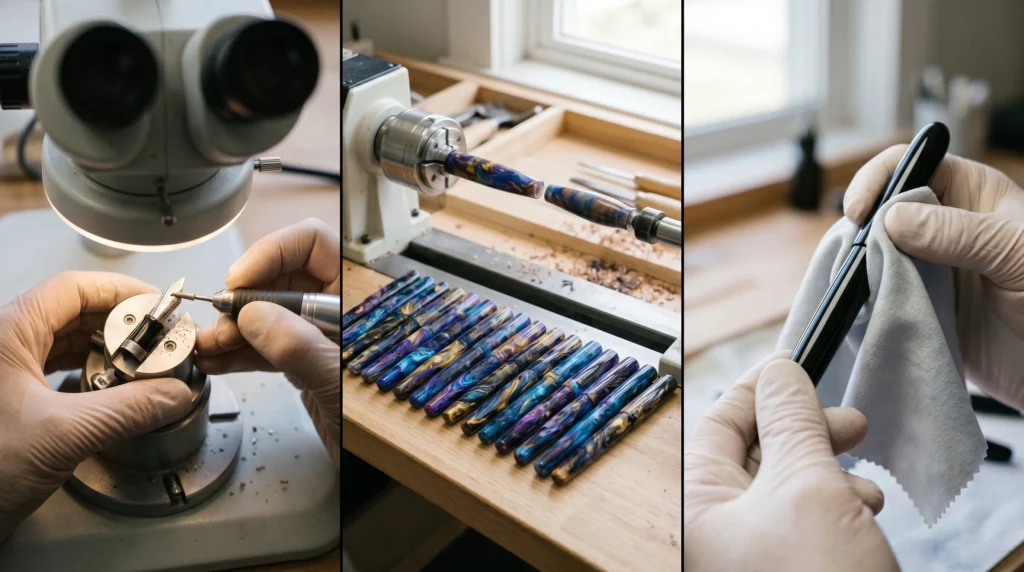
Today, Montblanc’s Hamburg factory still makes every pen in-house. The workforce includes former dental technicians — a career path that makes sense when you realize that nib grinding under a microscope is skill-adjacent to crown preparation. That depth of specialized labor doesn’t transfer easily. It accumulates.
Italy: Artisanal Aesthetics And Material Science
Italian pen-making took a different path. Where Germany optimized for precision, Italy optimized for expression. Brands like Montegrappa (founded in Bassano del Grappa, 1912) and Visconti (Florence, 1988) built their reputations on materials — celluloid, ebonite, hand-poured resin — and techniques borrowed from jewelry manufacturing, including lost-wax casting for metal components and hand-applied enamel work.
The Italian approach matters for a specific reason: it trained a generation of buyers to expect pens as aesthetic objects, not just functional tools. A procurement manager who grew up seeing Montegrappa’s sterling silver overlays in a Milan stationery shop has a different quality benchmark than one who only encountered BIC ballpoints in a blister pack. The former will scrutinize finish. The latter won’t know what to look for.
France And Switzerland: Brand Heritage As Competitive Moat
French brands occupy the intersection of luxury positioning and technical competence. S.T. Dupont (founded 1872) leveraged its expertise in lacquer-work — originally developed for lighters and leather goods — to create pen finishes with depth and durability that competitors couldn’t replicate without equivalent lacquer chemistry.
Switzerland’s Caran d’Ache, meanwhile, sits at the nexus of Swiss precision engineering and French color theory, producing limited runs where the color formulation itself is the differentiator. A single Caran d’Ache limited edition can involve six months of color development before a single pen body is produced.
The thread connecting these geographies: deep specialization accumulated over decades. A factory in Hamburg doesn’t just “make pens.” It has thirty-seven years of institutional knowledge about how a specific palladium alloy behaves under a specific polishing compound at a specific rotational speed. That knowledge is the real barrier to entry.
For B2B buyers outside Europe, understanding these regional specializations shapes sourcing strategy. A factory with 26 years of OEM experience — one operating a 4,000 sqm facility with in-house ink R&D — brings a different type of accumulated knowledge: the ability to reproduce specific finish qualities, color matches, and tactile experiences at commercial scale and reasonable MOQs. The manufacturing precision exists. The question is whether the buyer knows how to specify it.

Tapping The European Corporate Pen Market: What OEM Buyers Need To Know
So you’re a brand owner or procurement manager looking to enter the European corporate pen market. You’re not trying to compete with Montblanc at the €500+ level. Your target is the professional-grade segment — corporate gifts, branded executive accessories, the pen that gets handed out at a conference and kept rather than thrown in a hotel wastebasket.
Here’s what the European buyer profile demands, based on observable procurement behavior rather than survey data:
Sustainability Isn’t Optional — It’s Table Stakes
The EU’s regulatory trajectory is unambiguous. Single-use plastic restrictions, extended producer responsibility (EPR) frameworks, and the EU Green Deal are reshaping what “acceptable” means in corporate procurement. A German Mittelstand company issuing an RFP for 5,000 corporate pens now routinely includes sustainability criteria in the scoring matrix.
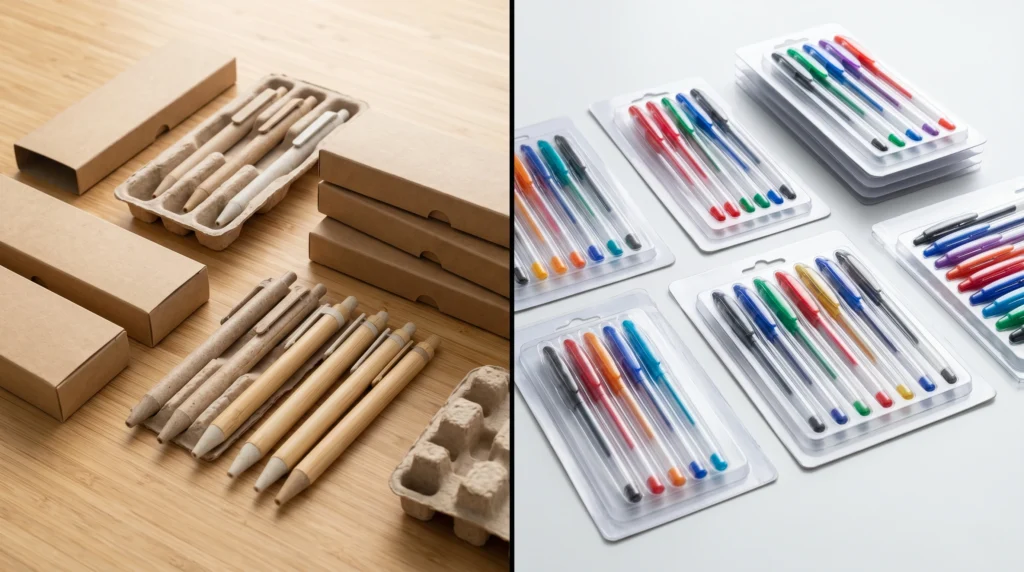
The operational implication for OEM buyers: you need a manufacturing partner that can supply refillable designs, recycled-content barrel materials, and packaging that doesn’t arrive wrapped in three layers of non-recyclable plastic. These specifications need to be documented and verifiable — not claims in a brochure.
At facilities where in-house ink R&D is paired with production capability, sustainable formulations — water-based alternatives to solvent-heavy inks, bio-derived pigments, low-VOC carrier systems — can be developed to spec rather than selected from an off-the-shelf catalog. The ink chemistry doesn’t need to be invented from scratch. It needs to be adapted to a specific buyer’s requirements, which is what an in-house lab enables.
Customization Depth Differentiates — But Only If The Base Quality Is Right
European corporate buyers personalize heavily. Engraved logos, custom color matching to brand guidelines, co-branded packaging — these are standard requests, not premium upsells. Pen Heaven, the UK-based corporate pen specialist, processes thousands of laser-engraved corporate orders annually, with same-day dispatch on standard designs.
The trap OEM buyers fall into: overinvesting in customization while underinvesting in base quality. A perfectly engraved logo on a pen whose cap doesn’t click shut with authority is worse than no logo at all — it actively damages the gifting brand’s perceived quality.
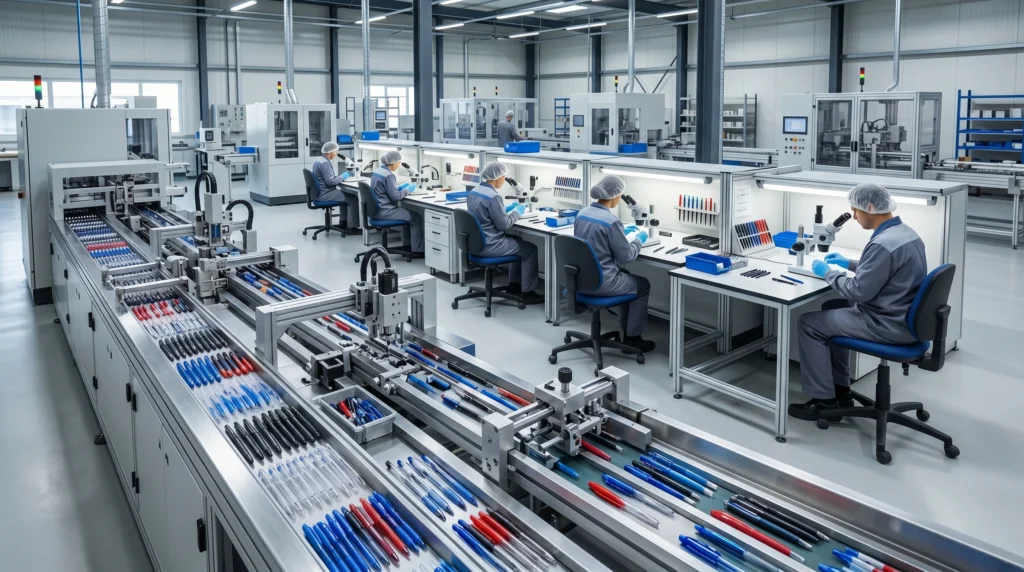
This is where manufacturing partners with 100% full inspection protocols become relevant. Full inspection means every unit — not a sample — gets checked. For a 2,000-unit corporate order, that’s 2,000 cap-seal tests, 2,000 writing-start tests, 2,000 visual finish inspections. The labor cost of doing this isn’t trivial. The reputational cost of not doing it is higher.
Price Anchors Are High — But Quality Expectations Rise Proportionally
European corporate pen budgets cluster in two bands: the €3–€8 promotional tier and the €25–€80 executive gifting tier. The promotional tier competes on unit economics. The executive tier competes on perceived value.
For the executive tier, buyers evaluate differently. They’ll open the box, hold the pen, test the mechanism, and — critically — compare it against the €50–€80 benchmark set by German and Italian mid-market brands. If the pen feels hollow, the threading catches, or the plating shows wear after a month, it doesn’t matter what it cost. The buyer won’t reorder.
Partnering with a manufacturer that operates automated assembly lines in a 4,000 sqm facility changes the cost equation. Automation reduces per-unit labor variance — the difference between the best-made unit and the worst-made unit in a batch shrinks. When every pen in a 5,000-unit corporate order performs consistently, the perceived value of the batch is the value of the median unit, not the best one shown in the sample.

How Asia-Based OEM Manufacturers Can Compete In The European Corporate Pen Segment
Let’s address the obvious question: can a factory outside Europe credibly supply the European corporate pen market?
The short answer is yes — but not by competing on heritage. Compete on technical execution.
European premium pen brands built their reputations over generations. An OEM manufacturer in China or Southeast Asia doesn’t have that timeline. What it has: production economics that enable equivalent quality at 40–60% of the European unit cost, provided the quality control infrastructure is in place.
Here’s what matters in practice:
Certification Infrastructure.
EN71 certification (mandatory for any writing instrument sold in the EU) and ASTM D-4236 (required for the US market, increasingly referenced in EU tenders) are minimum requirements. Buyers who can’t produce these certificates don’t get past the first round of supplier qualification. Factories that hold both and maintain batch-level testing documentation eliminate the single most common disqualifier.
Minimum Order Quantity Flexibility.
European corporate pen orders run small relative to mass-market stationery volumes. A typical German corporate order might be 2,000 units — not 50,000. Manufacturers whose production lines can accommodate 2,000-piece MOQs without pricing themselves out of the deal have a structural advantage in this segment.
Sampling Speed And Accuracy.
European procurement timelines are tight. A buyer requesting a pre-production sample needs it in 7–10 days, not 30. The sample needs to match the production spec exactly — color, weight, mechanism feel, packaging quality. A manufacturer that can produce 3D design samples and ship them via express within two weeks signals operational competence before the buyer places an order.
Transparent Quality Documentation.
Batch-specific QC logs, not generic claims. A factory that can hand a buyer a spreadsheet showing the actual cap-force measurements, ink-flow rates, and visual inspection pass/fail counts for their specific production run builds trust faster than any marketing copy. This is the operational equivalent of the transparency that made European heritage brands credible — applied at a different scale and price point.
Incorporating ESG And Ethical Manufacturing Into European Supply Chain Strategy
Europe’s regulatory environment is moving faster than most markets on sustainability and ethical sourcing requirements. The EU Corporate Sustainability Reporting Directive (CSRD) and the proposed Corporate Sustainability Due Diligence Directive mean that European companies are increasingly required to audit their supply chains for environmental and social compliance.
For a European brand sourcing custom writing instruments from an OEM partner, the questions they’ll face from their own compliance teams include:
- What materials are in the product, and can the factory trace them?
- Are worker conditions independently audited?
- What’s the carbon footprint of the production facility?
- Is packaging recyclable and does it minimize plastic content?
Manufacturing partners that have already invested in ethical manufacturing programs — documented worker wellbeing initiatives, waste reduction systems, energy efficiency improvements — remove friction from the buyer’s compliance process. The buyer doesn’t need to audit from scratch. They can reference existing documentation.
Operationally, this translates to things like: water-based ink formulations that eliminate solvent VOCs from the factory environment, recycled polypropylene barrel material certified to GRS (Global Recycled Standard), and packaging designed for single-material recycling streams (no mixed-material laminates that can’t be separated).
These are not premium features. They’re becoming baseline requirements. A procurement manager at a mid-sized European company evaluating two otherwise equivalent suppliers will choose the one with documented ESG compliance — because it reduces their own reporting burden. The sourcing decision is already being made on compliance efficiency, not just unit price.

常見問題解答
1. Why does Europe dominate the global luxury corporate pen market?
Europe’s dominance stems from concentrated manufacturing heritage (Germany, Italy, France, and Switzerland host the world’s highest density of premium pen factories, many operating continuously for over a century), a corporate gifting culture that normalizes premium writing instruments as standard business protocol, and a regulatory environment that economically favors durable, refillable products over disposables. The cluster effect matters: skilled labor trained at one factory moves within the region, preserving specialized knowledge that would dissipate in a more geographically dispersed industry.
2. What makes a corporate pen “luxury” versus “promotional”?
The distinction is tactile, not semantic. A promotional pen is evaluated on cost per unit and logo visibility. A luxury corporate pen is evaluated on weight, mechanism feel, finish durability, and how long the recipient keeps it. Technical markers include: metal rather than plastic barrel construction, plating thickness above 3 microns on metallic components, cap engagement with consistent audible and tactile feedback, and ink that writes on first contact without priming — even after weeks of non-use. A factory producing to EN71 and ASTM D-4236 standards with 100% inspection on these characteristics produces a fundamentally different product class than one relying on batch sampling.
3. Can an OEM manufacturer outside Europe produce pens that meet European corporate quality expectations?
Yes — but the factory’s quality control infrastructure matters more than its location. Key indicators to evaluate: does the manufacturer test every unit (100% inspection) or rely on batch sampling? Does test documentation exist at the batch level that a buyer can review? Is the ink formulated and tested in-house, or sourced from third-party suppliers whose quality control the manufacturer can’t verify directly? A 4,000 sqm facility with automated assembly lines, in-house ink R&D, and full-inspection protocols can achieve quality parity with mid-market European brands at a more competitive price point. The advantages are structural — automation reduces per-unit variance — not geographic.
4. What certifications does a corporate pen need to be sold in the European market?
The minimum requirements are EN71 (European toy safety standard, Parts 1–3, which also applies to writing instruments as items that may be handled by children) and REACH compliance (Registration, Evaluation, Authorisation and Restriction of Chemicals). For international buyers serving multiple markets, ASTM D-4236 (US standard for art materials) adds credibility. Beyond mandatory certifications, ISO 9001 quality management certification signals process discipline. Buyers should request current certificates — not just confirmation that the factory “meets standards” — and verify certificate validity dates. Some European corporate procurement departments now require supplier declarations of conformity (SDoC) for each production batch.
5. What’s a realistic minimum order quantity for custom corporate pens?
Realistic MOQs for custom corporate pens range from 500 to 5,000 units, depending on customization depth. Logo engraving on stock designs can be done at the lower end. Full OEM development — custom barrel design, proprietary color formulation, branded packaging — typically starts around 2,000 pieces. One of the structural advantages smaller European buyers encounter when sourcing from manufacturers that accept 2,000-piece MOQs is the ability to run multiple smaller programs — different designs for different departments, events, or client tiers — rather than committing to a single large order. If you’re evaluating suppliers and want to understand what’s achievable at your volume, you can reach the team for specifications and current MOQ options.
6. How are European corporate pen buying trends changing in 2026?
Three shifts are accelerating. First, sustainability requirements are moving from “nice to have” to mandatory — French and German corporate RFPs now routinely include recycled-content minimums and packaging restrictions. Second, the premiumization trend continues: average per-unit spend on corporate pens is rising as companies consolidate from larger quantities of cheaper items to smaller quantities of higher-perceived-value items. Third, direct-from-manufacturer sourcing is increasing as e-commerce and B2B platforms reduce the friction of international supplier evaluation. A buyer in Lyon can now evaluate a factory in China with the same depth of documentation they’d expect from a regional distributor — and at 30–50% lower unit cost.

Where The European Pen Market Is Headed — And What It Means For Sourcing Strategy
The European luxury corporate pen market isn’t shrinking — it’s segmenting. The middle is hollowing out. At the bottom, disposable promotional pens face margin compression from both regulation and commoditization. At the top, heritage brands command loyalty based on accumulated cultural capital that new entrants can’t replicate.
The opportunity lives in the professional-grade middle: pens that aren’t sold on heritage but on verifiable quality, pens where the buyer’s criteria are technical (does it write consistently? does the finish last? can I get it in my brand colors?) rather than aspirational.
For procurement managers and brand owners, the sourcing calculus is shifting. The traditional trade-off — European quality or Asian pricing — is becoming false. The real question is: does the manufacturing partner have the quality control infrastructure, certification portfolio, and customization depth to deliver a product that competes on technical merit?
A factory that batch-tests its output to EN71 and ASTM D-4236, maintains automated production in a 4,000 sqm facility, and has refined its processes across 26 years of OEM partnerships — for thousands of different buyer specifications, packaging formats, and ink formulations — isn’t competing on claims. It’s competing on documentation. And in the European corporate market, documentation is what separates a supplier from a partner.