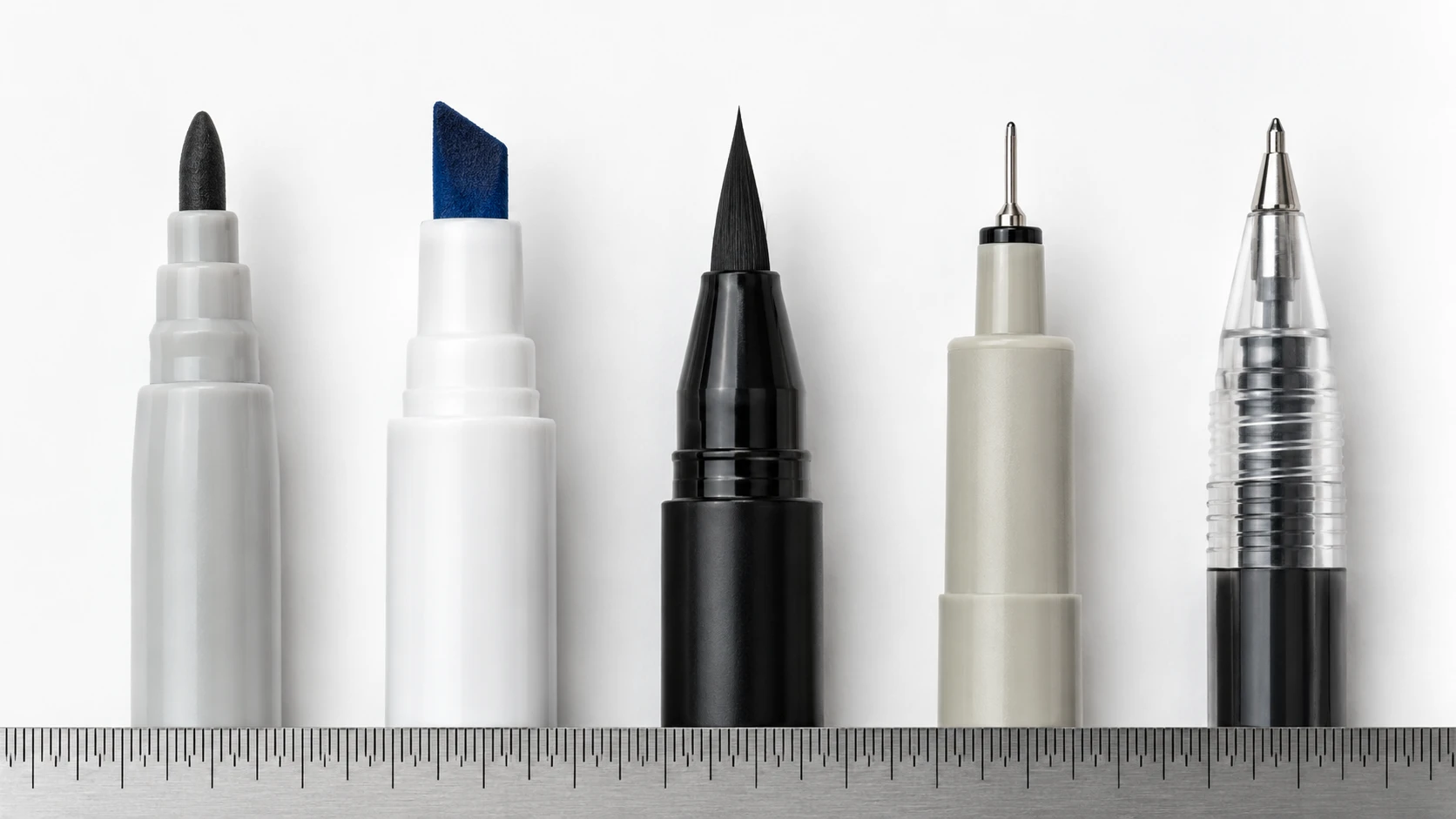
Most B2B buyers spend weeks comparing ink mixes, barrel designs, and packing options. Then they pick a pen tip from a dropdown in five seconds. That mistake costs more than most sourcing teams realize.
The tip is the only part of the pen your end customer touches while writing. It sets line width, ink flow, smoothness, and how long the pen lasts. A marker with great ink and a nice barrel will still bring complaints and returns if the nib frays fast. A gel pen with perfect color will frustrate users if the tip skips on the first stroke after sitting overnight.
For B2B buyers building private-label pen programs, pen tip types are not a small technical detail. They decide whether your line builds repeat customers or generates warranty claims. This guide covers four choices: tip material, tip shape, tip size, and the quality signals that separate steady suppliers from unsteady ones.
Indice
Risposta rapida: Cosa dovrebbero sapere gli acquirenti B2B sulla selezione della punta della penna?
Here are the three factors that set tip performance, and the customer complaints they prevent:
- Il materiale del puntale controlla la durata e la sensazione di scrittura. I puntali in fibra (poliestere, acrilico) garantiscono un flusso di inchiostro fluido ma si usurano più velocemente sotto pressione. I puntali in plastica (POM, nylon) durano più a lungo ma risultano più rigidi sulla pagina. La scelta sbagliata del materiale per il tuo caso d'uso target significa punte che si sfilacciano o puntali che sembrano ruvidi.
- La forma del puntale determina l'esperienza di scrittura. I puntali a punta tonda sono il cavallo di battaglia multiuso. I puntali a scalpello consentono tratti ampi e larghezza variabile del tratto. I puntali a pennello creano segni espressivi e sensibili alla pressione. I puntali a punta fine offrono precisione. Ogni forma ha una specifica modalità di guasto che gli acquirenti dovrebbero testare prima di ordinare.
- La dimensione del puntale controlla lo spessore del tratto (and the numbers on the spec sheet rarely match the user’s actual experience. A 0.5mm tip can produce a 0.3mm or 0.7mm line depending on ink viscosity, paper absorbency, and writing pressure.
These factors help brand owners and procurement managers set clearer sourcing and inspection standards before bulk production.
Come i Fallimenti dei Suggerimenti si Traducono in Reclami dei Clienti
Every nib complaint has a root cause in production. Here is how common issues map back to factory-level decisions:
| Problema comune del puntale | Causa principale del reclamo del cliente | Metrica di controllo qualità della fabbrica |
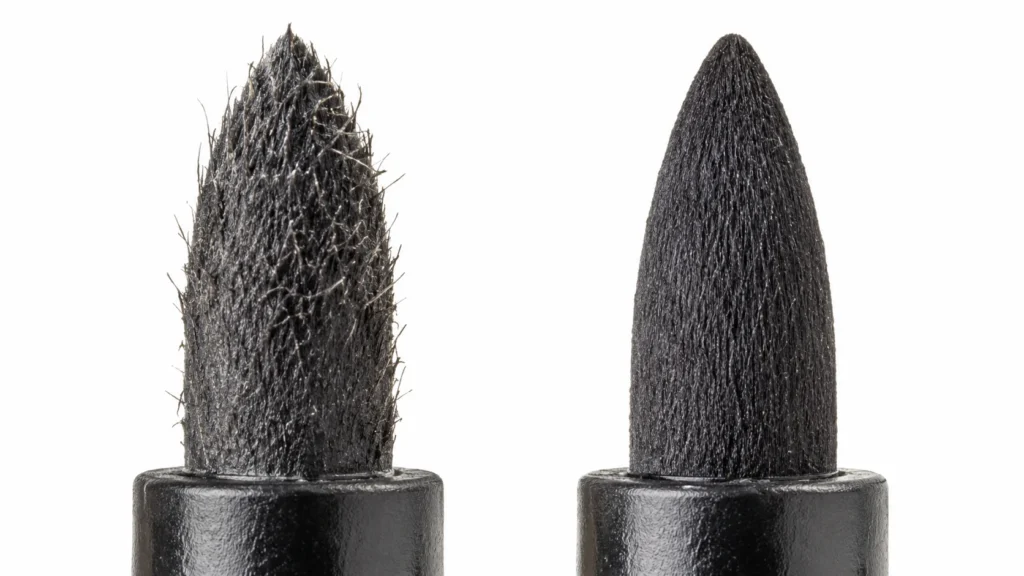
| La punta si sfilaccia o si spacca dopo un uso moderato | Materiale in fibra a bassa densità; rapporto errato tra fibra e legante nella produzione del puntale | Test di resistenza all'abrasione della punta sotto pressione di scrittura e numero di tratti controllati; verifica della specifica di densità del materiale del puntale |
| L'inchiostro salta o scrive a secco dopo essere rimasto fermo | Scarsa capillarità tra puntale e serbatoio; porosità del puntale non uniforme tra i lotti | Test del tasso di assorbimento in fase di assemblaggio; misurazione della consistenza della porosità su campioni di puntale dello stesso lotto di produzione |
| Lo spessore del tratto varia tra penne dello stesso SKU | Tolleranza di rettifica o stampaggio del puntale non uniforme; variazione del diametro dell'orifizio del puntale | Misurazione del diametro dell'orifizio del puntale con calibri passa/non passa; test di consistenza dello spessore del tratto su carta standardizzata |
| Il puntale sembra ruvido o striscia sulla carta | Rugosità superficiale del puntale dovuta a utensili di rettifica usurati; durezza del materiale del puntale non corretta per il tipo di carta target | Profilometria superficiale del puntale (misurazione della rugosità); test di attrito di scrittura su più substrati di carta |
| Il puntale perde o rilascia gocce di inchiostro durante la scrittura | Orifizio del puntale sovradimensionato rispetto alla viscosità dell'inchiostro; scarsa tenuta dell'interfaccia tra puntale e serbatoio | Tolleranza dimensionale dell'orifizio del puntale; misurazione della forza di pressatura tra puntale e barile |
| La sfera del puntale della penna gel si blocca o smette di ruotare | Usura della sede della sfera; contaminazione dell'alloggiamento della sfera durante l'assemblaggio; lubrificazione insufficiente della sfera | Test di resistenza alla rotazione della sfera; ispezione dimensionale della sede della sfera; protocolli di pulizia della linea di assemblaggio |
Each row in this table is a sourcing decision, not just a defect. When you pick a tip type, you also choose which failure modes your QC process must catch.
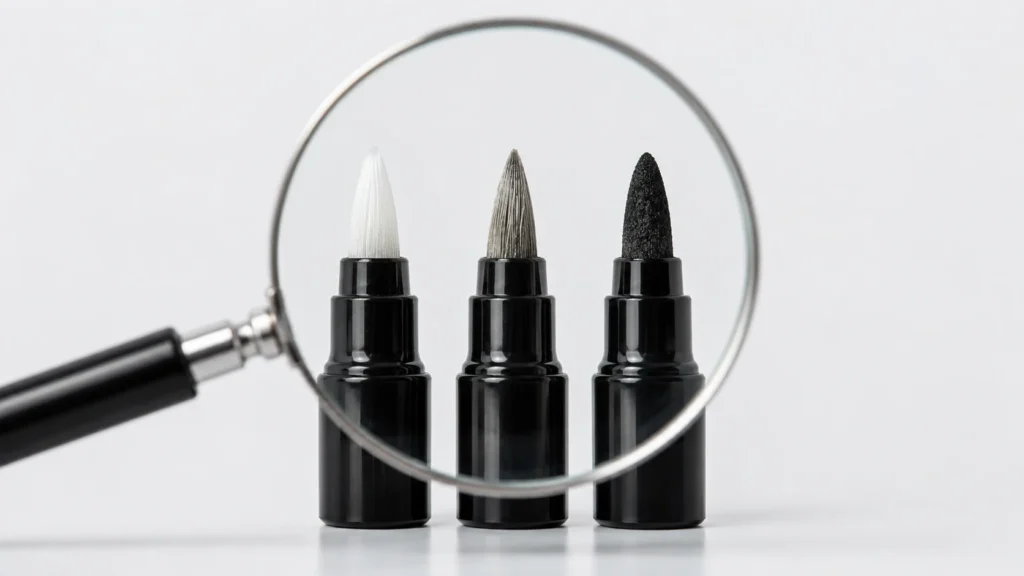
Tipi di punte e materiali: fibra, feltro, plastica e metallo
The tip material decides writing life, feel on paper, and fit with different inks. Here is what each material delivers, and where it falls short.
Punte in Fibra (Poliestere e Acrilico)
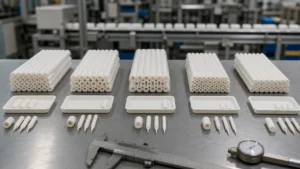
Fiber tips are the most common nib for markers. They are made by bonding synthetic fibers, usually polyester, acrylic, or a blend, into a porous rod. The rod wicks ink from the reservoir to the paper. Fiber density, binder, and the grinding process all affect performance.
Per the China Writing Instrument Association standard T/CWIA 1005.1-2019, fiber nib specs cover diameter, length, water absorption, hardness, writing performance, and dimensional change rate. These set the baseline for a quality-controlled fiber tip. Factories that produce to these specs control the variables that most affect user satisfaction.
Polyester fiber tips are the workhorse of the marker industry. They offer good ink flow, solid durability, and fit with water-based and alcohol-based inks. They are the standard choice for classroom markers, whiteboard markers, and general-purpose permanent markers.
Acrylic fiber tips are harder and last longer. They resist wear better, which helps on rough surfaces like cardboard, wood, or concrete. They also keep their shape under heavy writing pressure. That matters for industrial and warehouse use. The tradeoff is a firmer feel. Some users see that as lower quality when they expect the soft glide of polyester.
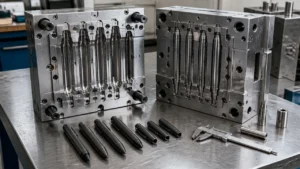
The most common fiber tip failure is fraying. Individual fibers separate from the tip body after repeated use. The result is a fuzzy surface and uneven lines. Fraying happens when the fiber-to-binder ratio is off, or when grinding leaves a rough surface that speeds up fiber loss. In nib production, grinding and bonding are where quality is won or lost. Lower-cost factories often use less binder or skip post-grind treatment.
Pennarelli a punta di feltro
Felt tips are made from compressed felt fibers, not extruded rods. They are softer and more porous than fiber tips. They deliver ink more generously, which suits paint markers and high-coverage jobs. The tradeoff is durability. Felt tips wear down faster than polyester or acrylic tips, especially on rough or textured surfaces.
Felt tips show up in paint markers, metallic markers, and art markers where ink coverage matters more than tip life. For B2B buyers, the practical question is simple. Will users accept a tip that wears down over the life of the marker? Or do they expect the tip to keep its shape until the ink runs out? Your answer decides whether felt is a workable spec.
Punte in plastica (POM, Nylon)
Plastic marker nibs and ballpoint tips are different parts. A plastic nib delivers ink through channels or pores. Ballpoint, gel, and rollerball refills use a rotating ball held in a precision tip, often metal alloy. Premec lists metal tip materials and tungsten-carbide balls. Do not specify a POM marker nib as though it were the standard ballpoint socket.
A POM stock shape spec does not set the service life of a finished tip. Ask for the actual nib or tip drawing. Ask for material grade, dimensions, and writing-test results for the assembled refill. Evaluate ball rotation, ink delivery, and wear with the intended ink and paper.
A ballpoint tip needs a ball that spins freely. It needs a correctly formed seat. It needs ink matched to the assembly. Line consistency also depends on angle, pressure, and paper. Inspect skipping, blobbing, and wear on the assembled refill. Tip material alone does not promise uniform performance.
Gel pen tip sizes are easy to misread. A 0.5mm gel tip uses a 0.5mm ball, which makes a line of about 0.3 to 0.4mm, depending on paper and pressure. A 1.0mm tip uses a 1.0mm ball. Ball size is the most important spec, but not the only one. Ball material, socket material, and ink viscosity all shape the final writing feel.
Punte in Plastica Porosa (Sinterizzate)
Some specialty markers use sintered plastic tips. Plastic powder is compressed and heated into a porous structure. It works like a fiber tip but is all plastic. These tips are less common in standard markers. They appear in industrial, fabric, and specialty uses where chemical resistance matters. Sintered tips resist solvent attack better than fiber tips. That helps when the ink holds strong solvents like xylene or acetone.
For a marker program, compare fiber, felt, and porous plastic nibs against the intended ink and surface. For gel pens and rollerballs, judge the metal tip and ball assembly as part of the full refill. Base your choice on writing trials. Test smoothness, wear, line width, and ink delivery. No single material is best for everything.
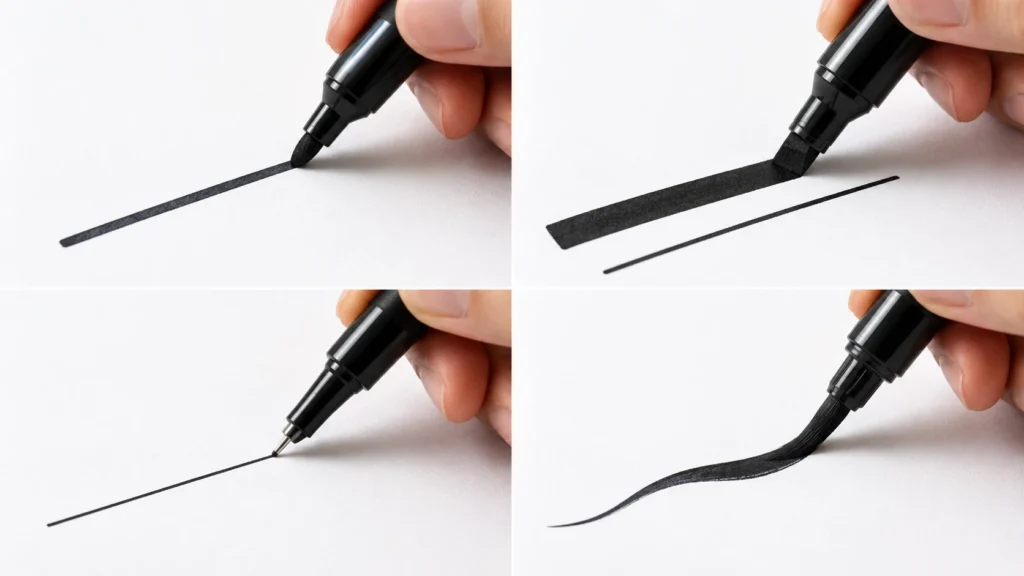
Forme della punta della penna: Rotonda, A scalpello, A pennello, E Fina
Tip shape decides how the marker writes. It sets line width variation, stroke character, and the range of marks one tip can make. Each shape has a use case and a failure mode.
Suggerimenti per i proiettili
The bullet tip is the universal standard. It is a rounded cone that gives a steady line width at any writing angle. For most markers that line is medium, around 1.0 to 2.0mm. Bullet tips are the default for classroom markers, office whiteboard markers, and general-purpose permanent markers.
The bullet tip's strength is predictability. Users know what to expect. Watch for tip flattening. The rounded point wears into a flat surface over time, making wider, less even lines. That happens when the material is too soft for the user's pressure, or when the grind shape concentrates wear on a small area.
Punte per scalpelli
Chisel tips are cut at an angle. They give a broad flat edge and a narrow side. Rotate the marker and you get wide strokes from the flat edge, medium lines from the corner, or thin lines from the narrow side. That range makes chisel tips popular for calligraphy, signage, highlighting, and any job that values variable line width.
The chisel failure mode is edge rounding. The sharp corners wear down over time, and the user loses thin lines. Once the edges round, the tip works like a wide bullet tip. It works, but it is no longer versatile. Edge rounding comes faster with softer materials and rough surfaces.
Consigli per la spazzola
Brush tips are made from flexible fiber bundles that bend under pressure. They work like a paintbrush. Light pressure gives thin lines. Heavy pressure gives broad strokes. The tip springs back when you release the pressure.
Brush tips are the hardest to make consistently. The bundle must be dense enough to hold its shape when idle. It must also be flexible enough to bend smoothly. The fibers must be bonded at the base but free to flex at the tip.
The most common brush-tip complaint is splitting. The bundle separates into two or more sections and makes a forked line. Splitting happens when the binder is weak, when fibers are too stiff and break, or when grinding damages the fiber structure. Making brush-tip markers at scale needs special equipment and QC. Those differ from bullet or chisel tip lines.
Punte Fini e Extra-Fini
Fine-point tips from 0.3 to 0.8mm and extra-fine tips under 0.3mm are precision tools. They show up in fineliners, technical pens, detail markers, and gel pens where line precision matters more than coverage.
Fine tips face a durability problem at small sizes. A 0.3mm fiber tip has little material to resist wear. The writing surface is tiny, so pressure per square millimeter is high. Fine tips wear faster than medium or broad tips. Users notice sooner, because line-width consistency is the whole reason they chose a fine tip.
When you specify fine-point pens, make tip durability part of sample testing. Write continuously on standard paper. Check line width and ink flow at set intervals. Compare the tip before and after. A tip that looks worn after moderate use will not satisfy buyers of fine-point precision.
Experienced OEM/ODM factories, like ZH STATIONERY with 26+ years in the field, have tip-testing protocols for every material and shape. Tip failures are among the most common complaints in stationery. Ask how the supplier tests each tip type. Look for abrasion resistance, shape retention, wicking consistency, and writing smoothness. A supplier that cannot explain testing for each tip it offers may not control tip quality. ZH STATIONERY's in-house R&D runs dedicated tip tests in every new-SKU flow. With 2,000+ new SKUs per year, that testing is constant.
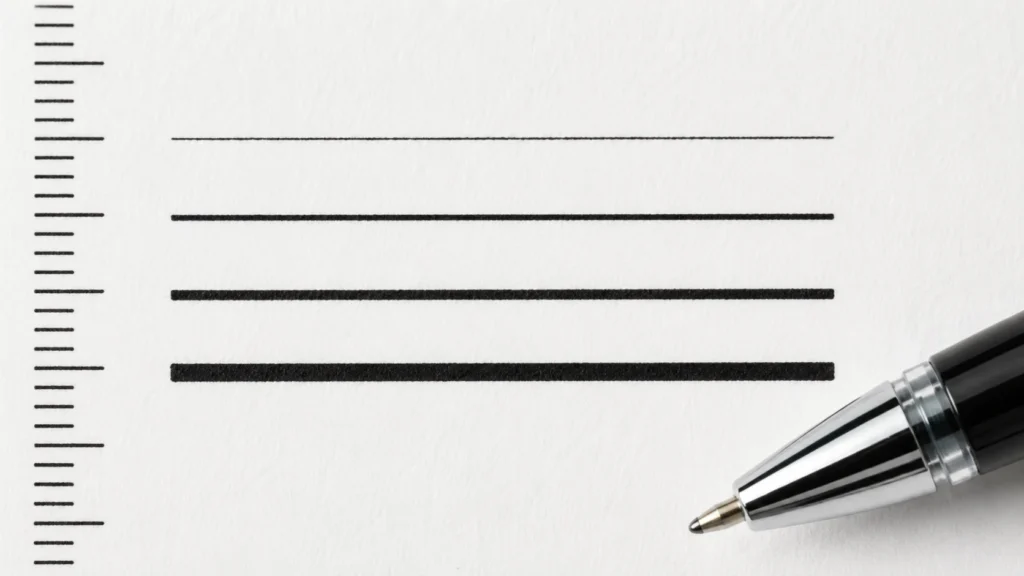
Dimensioni delle punte delle penne: cosa significano realmente i numeri
Tip size numbers like 0.5mm, 0.7mm, or 1.0mm are often misread. The number is the tip diameter, not the line width. The line a user sees depends on four more variables. Ink viscosity matters, because thinner ink spreads more. Paper absorbency matters, because porous paper wicks ink outward. Writing pressure matters, because heavier pressure flattens the tip. Writing speed matters, because slower strokes lay down more ink per millimeter.
For gel pens, a 0.5mm tip makes a line of about 0.3 to 0.4mm on standard office paper. A 0.7mm tip makes about 0.4 to 0.5mm. A 1.0mm tip makes about 0.6 to 0.8mm. These are rough ranges, not exact conversions. They shift with ink and paper.
Marker tip sizes are larger because the writing surface is larger. A fine marker tip might be 0.8 to 1.5mm. A medium tip might be 1.5 to 3.0mm. A broad or jumbo tip might be 3.0 to 6.0mm or more. Marker sizes are less standard than gel sizes. The only reliable method to judge line width is to test the real product on the real paper your customers will use.
That is why tip selection should include a substrate-specific writing test. A marker that writes a clean 1.0mm line on coated paper may bleed into 2.0mm on uncoated notebook paper. If your customers use several paper types, test on all of them. Specify the worst-case line width in your quality requirements, not the best case.
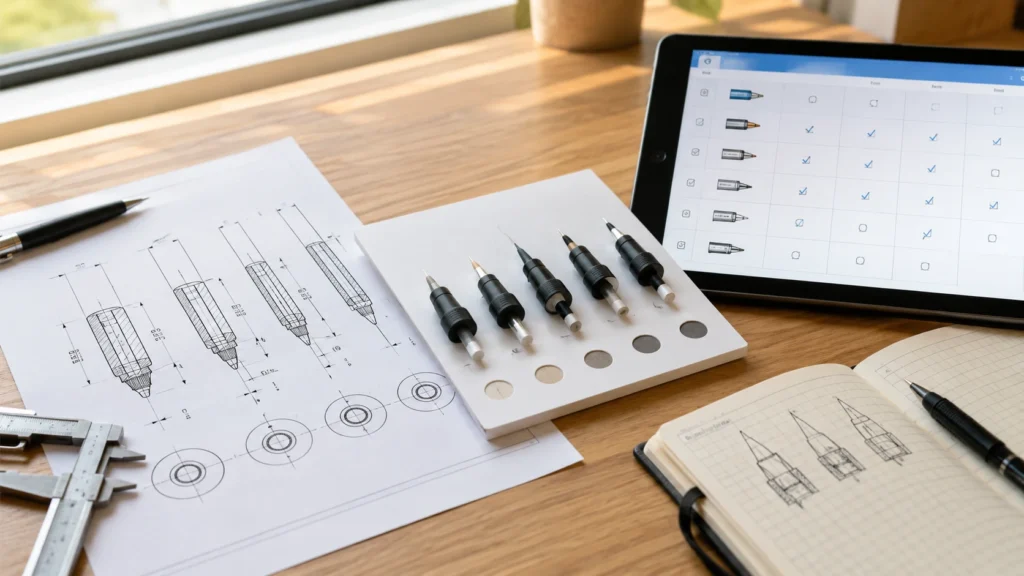
Specificare la punta giusta per il tuo programma a marchio privato
When you build a private-label pen line, the tip spec is not a single checkbox. It is a set of connected choices that together shape the user experience.
Il quadro di riferimento che funziona per la maggior parte degli acquirenti B2B:
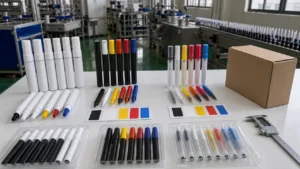
Step one: define the primary use case. Is this a classroom marker for broad strokes on construction paper? A fineliner for bullet journaling and notes? An industrial permanent marker for plastic bins and metal shelves? The use case sets material, shape, and size. A classroom marker may use a polyester bullet tip at 2.0mm. An art fineliner may use an acrylic fine point at 0.4mm. An industrial marker may use an acrylic chisel tip at 4.0mm. Same factory, same line, completely different tip specs.
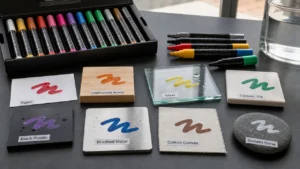
Step two: test across the paper types your customers actually use. Office paper, notebook paper, construction paper, cardboard, plastic film, coated paper. Each surface reacts differently with tip and ink. A tip that writes well on one surface can feel scratchy, skip, or bleed on another.
Step three: request production-line samples, not hand-built prototypes. A hand-assembled tip shows what the product can be. A production-line tip shows what the product will be. That difference is often the line between a good launch and a batch of returns.
Step four: lock the tip spec into the production agreement. Include material grade, shape, diameter tolerance, and the testing standards for each batch. Verbal promises about good quality tips are not enforceable. Written specs with measurable limits are.
Factories that develop 2,000+ new SKUs per year have refined their tip workflow across hundreds of client projects. ZH STATIONERY is one of them, with in-house R&D and 3D design. When you work with an experienced OEM partner on custom tips, expect guidance through material, shape, and size testing. Do not settle for picking from a catalog photo.
Domande Frequenti
Qual è la differenza tra una penna a punta in fibra e una penna a punta in feltro?
Fiber tips are extruded synthetic fibers, polyester or acrylic, bonded into a porous rod. They are durable, consistent, and used in most standard markers. Felt tips are compressed felt fibers. They are softer and more porous, laying down more ink per stroke, but they wear faster. Fiber tips are the default when tip life matters. Felt tips suit paint markers where coverage matters more.
Cosa significano effettivamente le dimensioni della punta delle penne gel come 0,5 mm e 0,7 mm?
The number refers to the ball diameter in the tip mechanism. A 0.5mm spec means a 0.5mm ball. The line on paper is usually narrower than the ball, because ink only deposits through the contact area. A 0.5mm gel tip makes a line of about 0.3 to 0.4mm on standard paper. A 0.7mm tip makes about 0.4 to 0.5mm. Real line width shifts with ink viscosity, paper absorbency, and pressure.
Come scelgo tra un pennarello a punta tonda e uno a punta a scalpello?
Bullet tips give a steady line width at any angle. They are predictable and reliable for general writing and marking. Chisel tips give variable line width. Rotate the marker for broad strokes or thin lines. Choose bullet for single-purpose writing. Choose chisel for calligraphy, highlighting, signage, and art. If you are unsure, order samples of both and test with real users.
Quali sono le cause dell'usura o dello sfilacciamento delle punte delle penne e può essere prevenuta?
Tip fraying has two main causes. The first is weak binder in the fiber material. Individual fibers separate because they are not bonded well enough. The second is rough grinding that damages fibers at the writing surface. Prevention means controlling both at the production level. Use the right fiber-to-binder ratio. Grind with sharp, well-maintained tools that leave a smooth surface. During supplier review, ask for durability data. Inspect sample tips under magnification after a standard wear test.
Le punte delle penne possono essere completamente personalizzate per progetti OEM a marchio privato?
Yes. OEM tip customization includes material, shape, and size. Material options are polyester, acrylic, felt, and POM. Shape options are bullet, chisel, brush, fine point, or custom geometry. Size covers tip diameter and line width tolerance. Custom tips usually start with sampling. The factory makes tips to your spec. You test them with your ink and paper. The spec is refined before mass production. A manufacturer with in-house R&D, like ZH STATIONERY, has supported custom tips for 26+ years across markers, metallic markers, and gel pens. Contact ZH STATIONERY to discuss your tip specs and request samples.
Quali test di qualità delle punte dovrei richiedere prima di effettuare un ordine all'ingrosso?
Ask for abrasion-resistance testing under set pressure and stroke count. That shows how many meters of writing pass before visible wear. Ask for line-width consistency across tips from the same batch. Ask for wicking-rate tests to confirm steady ink flow. Ask for writing tests on the paper your customers actually use. Ask for internal QC records: tip orifice measurements, grinding tool logs, and material batch certificates. Do not accept only a final visual report. A factory running 100% inline automated inspection before packing, plus strict AQL sampling for shipment, will have this data ready.
Understanding pen tip types gives you a sourcing framework. It covers materials, shapes, sizes, and the quality signals behind each. That framework stops the most common complaints before they reach your inbox. If you are developing marker pens, gel pens, or metallic markers for a private-label brand, contact ZH STATIONERY to discuss samples and performance testing for your target specs.
Guida correlata: Pennarello acrilico a valvola a pressione vs punta in fibra.
Letture correlate
- Dual Tip Markers Explained: Brush, Chisel, Fine) What’s Best?
- Pennarelli acrilici a doppia punta vs pennarelli a punta singola: Guida alla strategia di prodotto B2B
- Approvvigionamento di Pennarelli ad Acquerello: Spiegazione della Differenza tra Liquido Diretto e Punta in Fibra
- Pennarelli a Cancellazione a Umido vs. Altri Tipi di Penne: Una Strategia di Approvvigionamento B2B per il 2026
- Penne Personalizzate Incise per Clienti Aziendali: La Guida Completa all'Approvvigionamento B2B