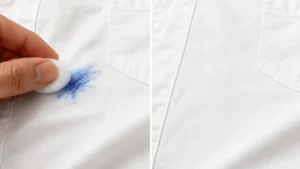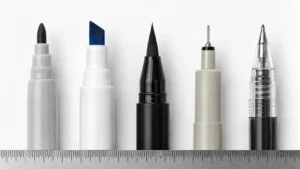












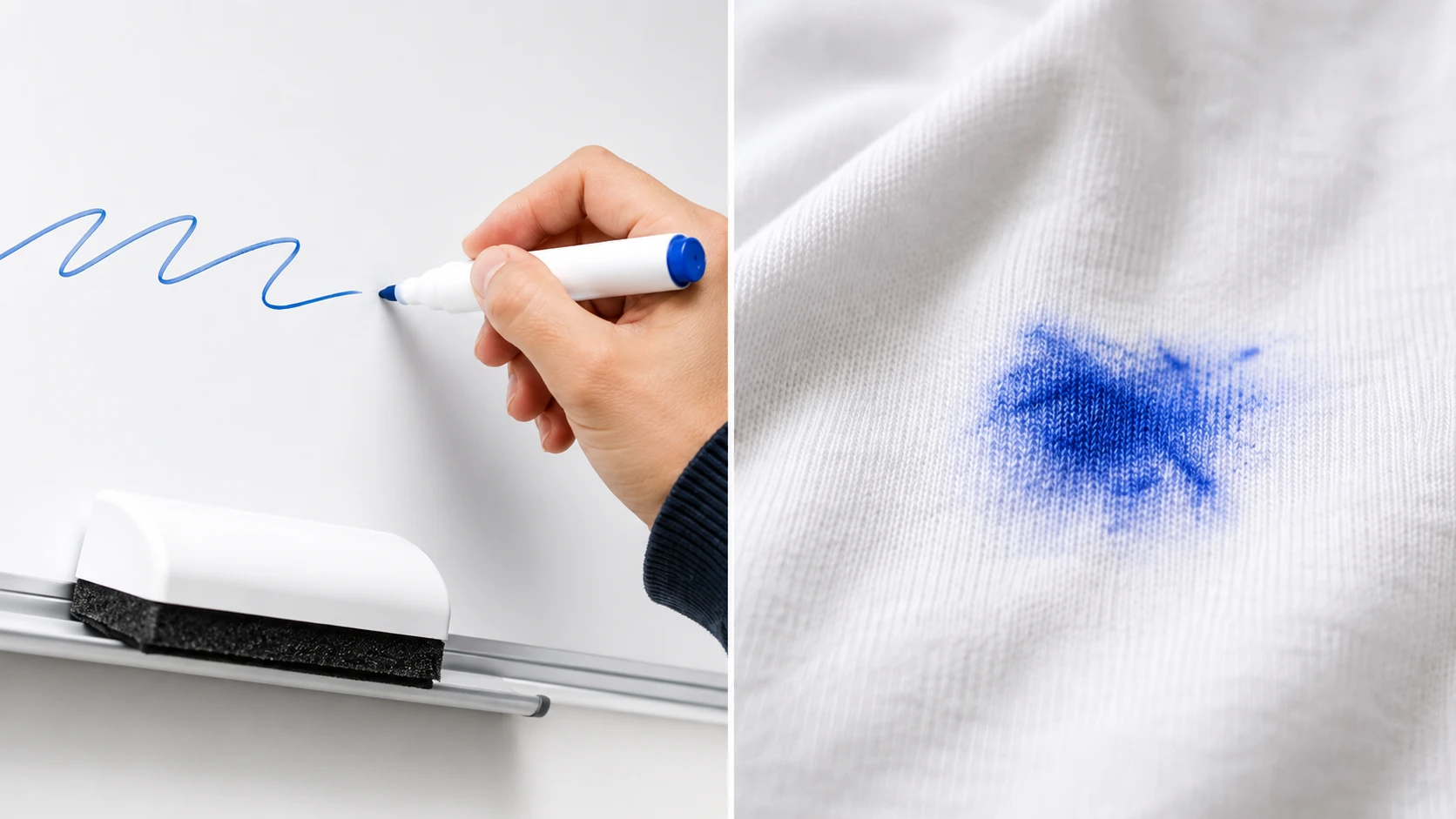
Every teacher has a story about a dry erase marker ruining a shirt. Every office manager has fielded complaints about whiteboard ink that would not wash out of a blouse. These are not random incidents — they are predictable outcomes of ink formulation decisions made at the factory level, long before the marker ever reaches a classroom or conference room.
For B2B buyers sourcing whiteboard markers, understanding dry erase marker ink chemistry is not just interesting science. It is the difference between a product that generates customer loyalty and one that generates return requests. When you know why some formulas stain fabrics while others wash out, you can ask suppliers questions that go beyond catalog descriptions and pricing sheets.
This article breaks down the four components of dry erase ink, explains the formulation tradeoff that determines stain behavior, and gives B2B buyers a practical framework for evaluating whiteboard marker quality before placing a bulk order.
目录
Quick Answer: Why Do Dry Erase Markers Stain Clothes?
Here is the core chemistry in four points:
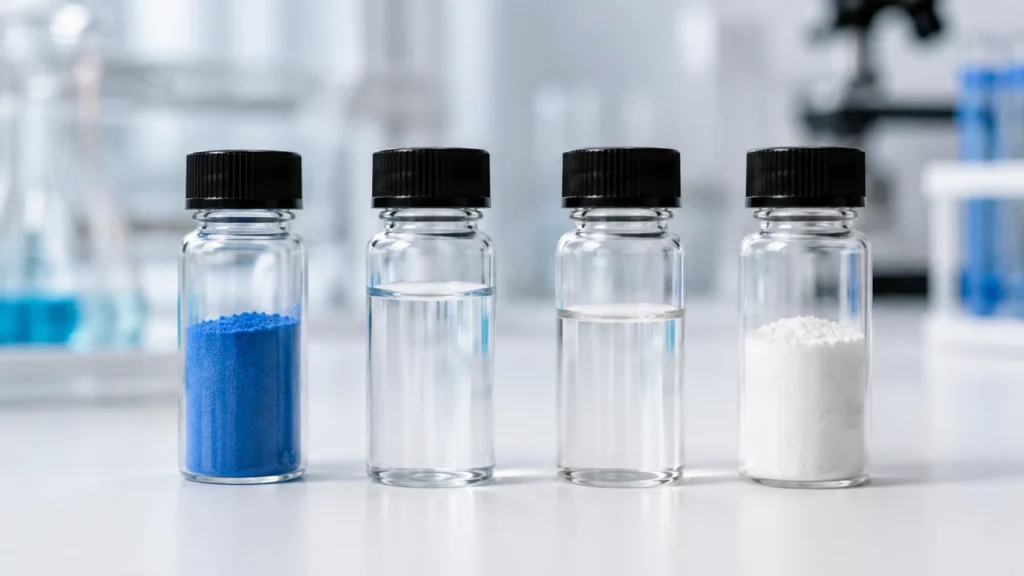
- Dry erase ink contains three active ingredients: pigment (color), an alcohol solvent (keeps ink liquid, evaporates on contact), and a silicone-polymer release agent (prevents ink from bonding to the whiteboard surface).
- The release agent only works on non-porous surfaces. On a smooth whiteboard, the silicone forms a slippery film that lets you wipe the pigment away. On fabric — cotton, polyester, or blends — the porous fibers absorb the pigment-carrying solvent before the release agent can do its job.
- Pigment particles are the stain culprit. Once the alcohol solvent evaporates inside fabric fibers, pigment particles become physically trapped in the fiber structure. Water-based detergents cannot reach them because the release agent coating resists water.
- Dye-based and dyeblocker-enhanced formulas wash out more easily. Some manufacturers use polymeric dyes instead of pigments, or add anionic dyeblocker compounds that prevent the colorant from bonding to fabric receptor sites — making the ink machine-washable.
對於品牌所有者和採購經理而言,了解這些因素有助於在承諾批量生產之前,建立更精確的採購和品質檢驗標準。.
How Dry Erase Ink Formulation Determines Customer Complaints
Every whiteboard marker complaint — ghosting on the board, staining on clothes, drying out in storage — traces back to a formulation decision. Here is how the four components of dry erase marker formulation create the complaints your customers experience:
| Ink Component | What It Does | Common Complaint When Formulated Poorly | Factory-Level Quality Metric |
| Pigment or dye (colorant) | Provides color; 30–50% of formula | Ink stains clothing permanently (pigment trapped in fabric fibers); colors look faded or streaky on the board | Pigment particle size distribution; color spectrophotometer readings per batch; fabric washability testing on cotton and poly-cotton blends |
| Alcohol solvent | Keeps ink liquid in the barrel; evaporates in 2–3 seconds on the board surface | Marker dries out quickly (too much volatile solvent); ink feels wet too long (too little solvent, or wrong solvent type) | Solvent evaporation rate testing; cap-off time testing (minimum 2-hour exposure); solvent purity verification per batch |
| Release agent (silicone polymer) | Prevents pigment from bonding to the whiteboard; 10–20% of formula | Ink ghosts or leaves residue on the board (insufficient release agent); ink smears instead of erasing cleanly | Release agent concentration verification; erasability testing after 24-hour set time on standard whiteboard surface |
| Binder resin | Forms a film that holds pigment on the writing surface; water-soluble in quality formulations | Ink permanently bonds to board surface (wrong resin type — acrylic instead of water-soluble); ink flakes off before erasing (insufficient resin) | Resin solubility testing; film-formation testing; adhesion-to-release ratio measurement |
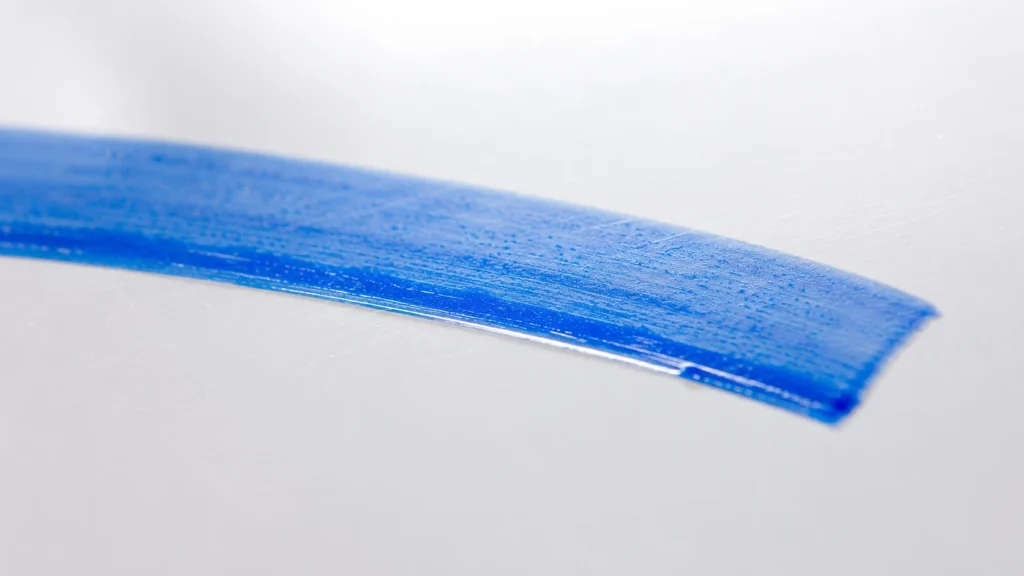
根據 Royal Society of Chemistry, the key difference between dry erase and permanent markers comes down to the polymer choice: permanent markers use acrylic, which bonds permanently to the surface once dry; dry erase markers use silicone, which creates a non-bonding film. But that silicone film only prevents bonding on smooth, non-porous surfaces. The moment the ink touches fabric, the solvent carries pigment deep into the fiber structure where the release agent cannot intervene.
The Formulation Tradeoff: Pigment Vs. Dye-Based Dry Erase Ink
This is where B2B buyers need to understand a manufacturing tradeoff that most end users never see.
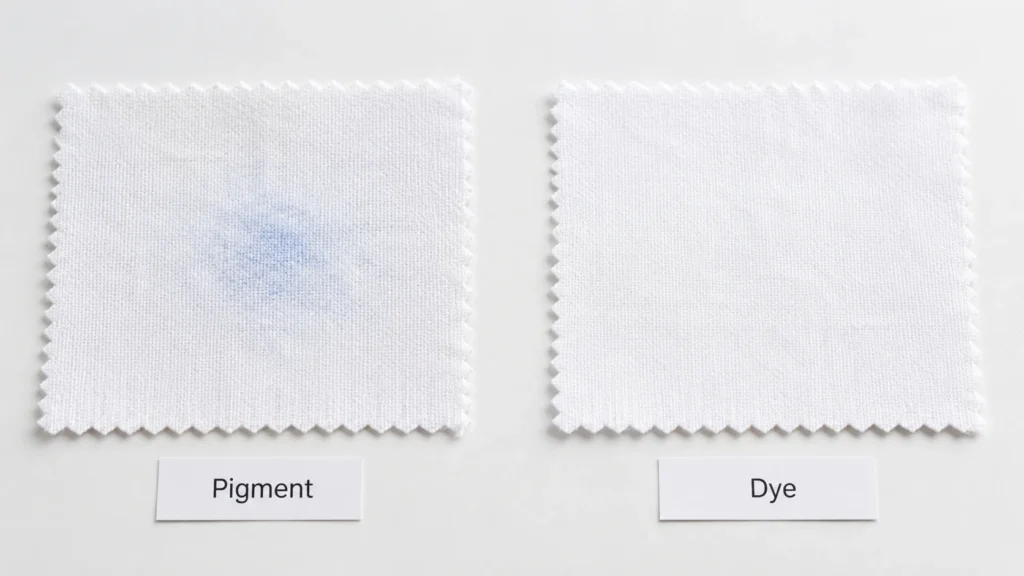
Most commercial dry erase markers use pigment-based ink. Pigments are solid color particles suspended in the solvent — they deliver strong, vibrant color, resist fading under office lighting, and produce consistent line opacity on the board. But those same pigment particles are the reason 白板筆 stain clothes. When the alcohol solvent evaporates inside cotton or polyester fibers, the pigment particles remain physically lodged in the fiber matrix — too large to dissolve, too deep to rinse out with water.
The alternative is dye-based ink, where the colorant is dissolved at the molecular level rather than suspended as solid particles. According to patent specifications for washable dry erase compositions, polymeric dyes — specifically poly(oxyalkylene) substituted colorants — remain water-soluble even after the solvent evaporates. This means the ink can be removed from fabrics in a standard laundry cycle. The tradeoff: dye-based inks may produce slightly less opaque color on the board and can be more susceptible to fading under prolonged UV exposure.
Some manufacturers add dyeblocker compounds — anionic materials such as sulfonated naphthalene condensation products or sulfonated phenol-formaldehyde condensation products — that bind to the reactive sites on skin and fabric before the dye or pigment can attach. These additives function as a chemical barrier, reducing staining without requiring a complete switch from pigment to dye. Per the patent literature on washable coloring compositions, dyeblocker concentrations as low as 2–5% by weight can produce measurable improvements in fabric washability, though higher concentrations (up to 15%) deliver the best results.
For B2B buyers, the practical question is: which formulation does your market need? A school supply distributor selling to K–12 classrooms may prioritize washability over color intensity — teachers and parents will forgive slightly lighter ink if it means the marker does not ruin a student’s uniform. An office supply wholesaler selling to corporate procurement departments may prioritize board performance and color vibrancy — their end users are adults less likely to get ink on clothing, but more likely to complain about ghosting and poor erasability.
A factory with dedicated ink R&D capability — such as ZH STATIONERY, which operates an in-house ink laboratory developing custom formulations — can help buyers navigate this tradeoff by producing samples with different pigment-to-dye ratios or dyeblocker concentrations and testing them against the specific end-user scenarios that matter most for the target market.
What B2B Buyers Should Test Before Ordering Dry Erase Markers
Catalog descriptions and spec sheets will not tell you how a dry erase marker performs in real-world conditions. Here are the four tests that reveal formulation quality:
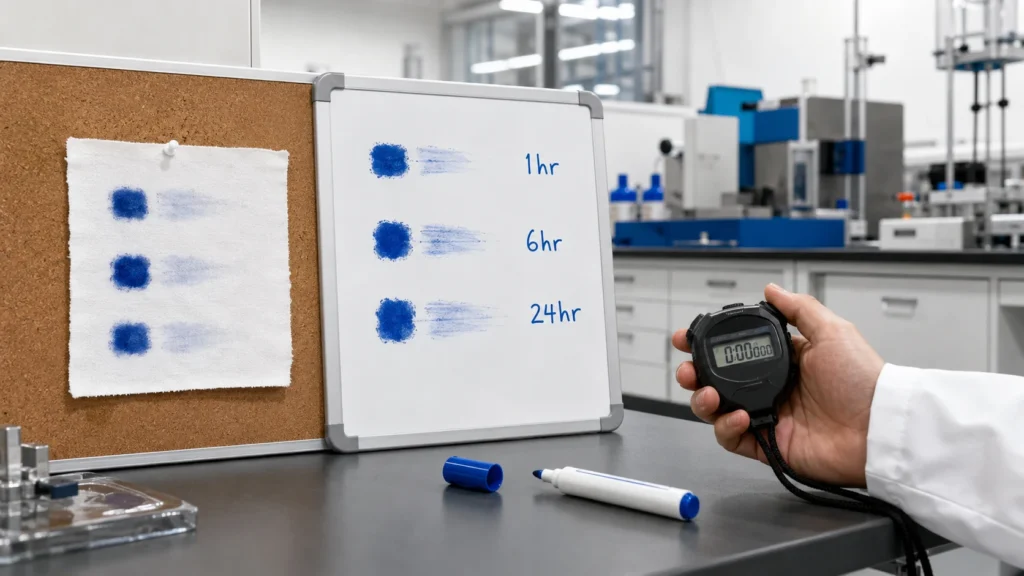
- Board erasability after set time. Write on a standard whiteboard surface and let the ink sit for 24 hours before erasing. A quality formulation should wipe away cleanly with no ghosting or shadow residue. Ghosting indicates insufficient release agent or the wrong resin type — problems that will generate customer complaints from offices and schools that leave writing on boards overnight.
- Fabric washability on cotton and poly-cotton blends. Apply ink to both 100% cotton and 50/50 poly-cotton swatches, let dry for one hour, then run through a cold-water laundry cycle. A dye-based or dyeblocker-enhanced formulation should come out clean or nearly clean. A standard pigment-based formulation will leave visible staining — which may be acceptable for adult office markets but not for school products.
- Cap-off time. Remove the cap and leave the marker exposed to open air for two hours, then test writing performance. The marker should write immediately without skipping. Cap-off failure is the most common complaint for all marker types and is driven by solvent volatility and cap-seal design — both of which the factory should control with batch-level testing.
- Batch-to-batch color consistency. Request spectrophotometer readings from three separate production batches. The delta-E between batches should be under 1.5 for a professional-grade product. Color drift between orders is a red flag for inconsistent pigment sourcing or formulation control.
A factory that processes 2,000+ new SKUs per year with 100% visual and functional inspection before packing — as ZH STATIONERY does across its 4,000 sqm automated facility — has the testing infrastructure to generate this documentation. The question to ask suppliers is not “do you test quality?” but “can you show me the batch-level test data for the specific SKU I am ordering?”
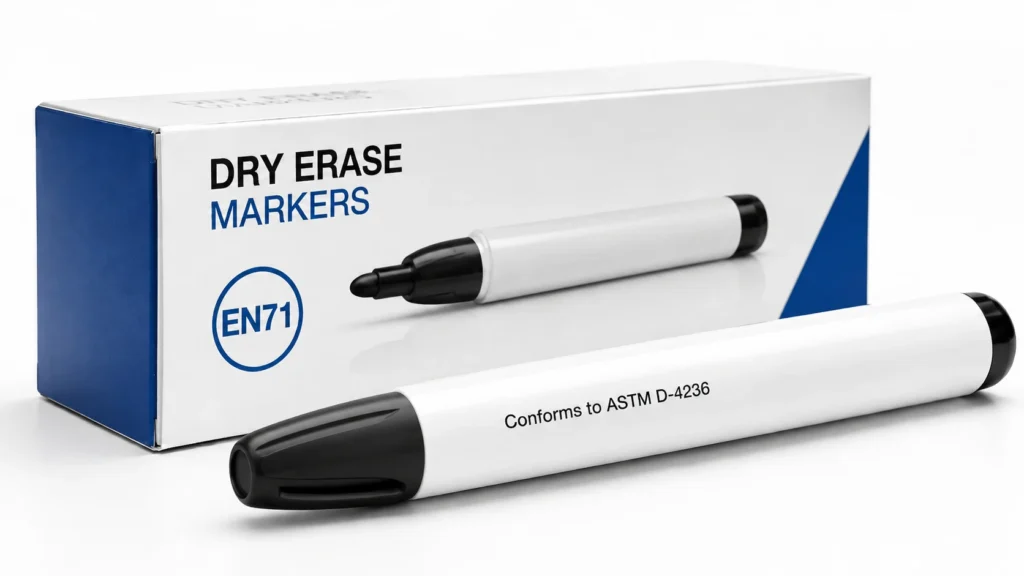
Certifications And Safety: The Compliance Layer For Dry Erase Markers
乾擦馬克筆 fall under the same safety regulations as all art and writing materials sold in the U.S. and European markets. For school and children’s products, the compliance bar is higher.
根據 美国消费品安全委员会, all art materials must undergo toxicological review under the Labeling of Hazardous Art Materials Act and carry the “Conforms to ASTM D-4236” statement. For whiteboard markers marketed to children under 12, additional CPSIA requirements apply — third-party testing for lead content and phthalates from a CPSC-accredited laboratory, plus a Children’s Product Certificate.
In the European Union, whiteboard markers classified as toys must comply with EN71 — specifically EN71-3 for heavy metal migration. The alcohol solvents used in dry erase ink (isopropanol, ethanol) are generally considered safer than the ketone-based solvents (methyl ethyl ketone) used in older formulations, but every ingredient must be documented and tested.
For B2B buyers, the practical steps are:
- Request current, dated EN71 and ASTM D-4236 test reports that specifically reference the dry erase SKU you are ordering
- Confirm the testing laboratory is ISO 17025-accredited
- Verify that all ink ingredients are documented in an MSDS for customs clearance
- For school-channel products, confirm CPSIA Children’s Product Certificate availability
ZH STATIONERY maintains EN71 and ASTM D-4236 certified product options with batch-level testing documentation tied to actual production runs.
常見問題解答
Why Do Dry Erase Markers Stain Clothes When They Wipe Off Whiteboards So Easily?
The silicone-polymer release agent in dry erase ink only works on non-porous surfaces. On a smooth whiteboard, the release agent forms a slippery film that prevents pigment from bonding, so a dry cloth lifts the entire ink film off. On fabric — which is porous — the alcohol solvent carries pigment deep into the fibers before the release agent can create its protective barrier. Once the solvent evaporates, pigment particles are physically trapped inside the fiber structure, making them extremely difficult to remove with water alone.
What Is The Difference Between Pigment-Based And Dye-Based Dry Erase Ink?
Pigment-based ink uses solid color particles suspended in the solvent — it delivers strong color and resists fading, but the solid particles become trapped in fabric fibers and cause permanent stains. Dye-based ink dissolves the colorant at the molecular level, so it can wash out of fabrics in a standard laundry cycle. The tradeoff: dye-based formulations may produce slightly less opaque color on the board and can be more susceptible to UV fading. Some manufacturers blend pigments and dyes to balance color performance with washability.
Are “Low-Odor” Dry Erase Markers Safer Or Higher Quality Than Standard Ones?
Low-odor formulations typically replace stronger solvents with less volatile alternatives — for example, using ethanol instead of isopropanol. This reduces the solvent smell but does not necessarily change staining behavior or board performance. The key quality indicator is not “low odor” on the label but the specific solvent chemistry and whether the release agent concentration is sufficient for clean erasability. A low-odor marker with insufficient release agent will ghost on the board regardless of how pleasant it smells.
How Can I Test Dry Erase Marker Quality Before Placing A Bulk Order?
Run four tests: board erasability after 24-hour set time (no ghosting should remain), fabric washability on cotton and poly-cotton blends (cold water cycle, one hour after ink application), cap-off writing performance after two hours of air exposure, and batch-to-batch color consistency using spectrophotometer readings. A factory that can provide this data from its production QC records — not from a single hand-assembled sample — demonstrates genuine quality control infrastructure.
What Certifications Do Dry Erase Markers Need For U.S. And European School Markets?
All dry erase markers sold in the U.S. require ASTM D-4236 (LHAMA) compliance. Products marketed to children under 12 additionally require CPSIA third-party testing and a Children’s Product Certificate. For the European market, EN71-3 compliance is required for products classified as toys. Always request current, dated test reports from ISO 17025-accredited laboratories that reference your specific product SKU. A factory with documented batch-level compliance testing — such as ZH STATIONERY — can provide this documentation as part of the standard order process.
What Makes A Dry Erase Marker “Washable” From A Manufacturing Perspective?
Washability comes from formulation choices, not marketing claims. Three approaches exist: using polymeric dyes instead of solid pigments (the colorant dissolves at the molecular level and washes out), adding dyeblocker compounds that prevent colorants from bonding to fabric fibers, or blending pigments with water-soluble binder resins that release their hold on fibers during a wash cycle. If a supplier claims their markers are “washable,” ask which specific formulation approach they used and request fabric washability test data — not a verbal assurance.
If you are sourcing dry erase markers for school supply programs, office retail channels, or private-label stationery lines, 联系ZH STATIONERY to discuss ink formulation options, request washability test samples, and evaluate whiteboard marker specifications for your target market.