
Marker Ink & Surface Safety Note by: Zh Stationery (In-House Marker Ink Formulation & OEM Manufacturer · Tonglu, Hangzhou)
You burn a mix CD or photo backup, grab the nearest Sharpie, and scribble the tracklist across the top. It looks fine at first—then six months later, track seven starts skipping in the exact same spot every time.
Using a permanent marker on CDs is something millions of people do without a second thought. Most discs survive just fine; some quietly degrade. Whether your disc stays readable for decades depends on three variables: the solvent chemistry inside the ink, how a CD’s protective layers are built, and exactly where on the disc you write.
Liên Kết Nhanh
- Câu trả lời nhanh: Bút dạ vĩnh viễn trên đĩa CD có gây hư hỏng không?
- Cấu tạo của đĩa CD và tại sao vị trí bạn viết lại quan trọng
- Thực sự có gì trong mực bút dạ vĩnh viễn
- Bút dạ an toàn cho CD: Điều gì khiến chúng khác biệt
- Cách ghi nhãn đĩa CD an toàn
- Câu hỏi thường gặp
Câu trả lời nhanh: Bút dạ vĩnh viễn trên đĩa CD có gây hư hỏng không?
It depends on two things: the ink solvent và where you write.
- bút lông gốc nước are completely safe for labeling CDs. They contain no organic solvents that soften disc lacquer or plastic.
- Alcohol-based markers (standard Sharpie) are low-risk on the label side for casual use. Alcohol flashes off quickly, usually before penetrating the protective lacquer—low risk, though not zero risk if you trace over the same spot repeatedly.
- Xylene- or toluene-based industrial markers can damage CDs over time. These aromatic solvents slowly attack the thin lacquer barrier protecting the reflective metal layer, allowing oxidation to spread weeks or months later.
- Acetone or nail polish remover ruins a CD immediately by dissolving polycarbonate plastic on contact.
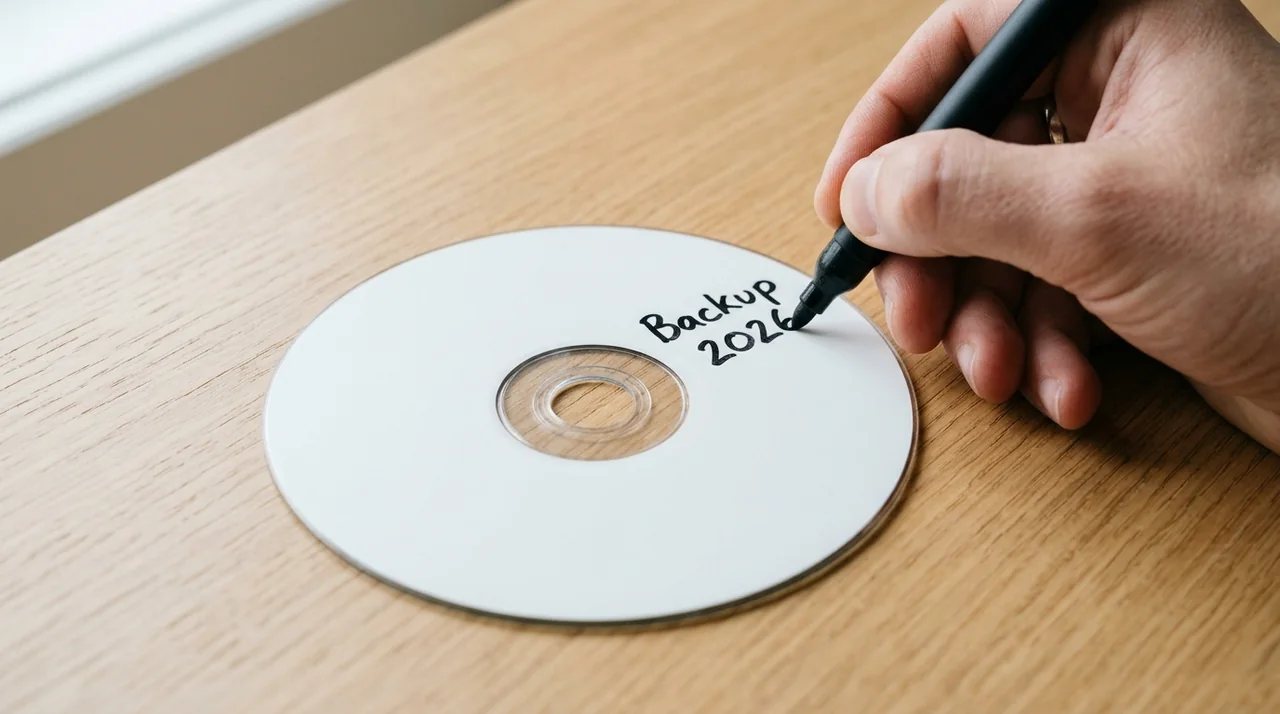
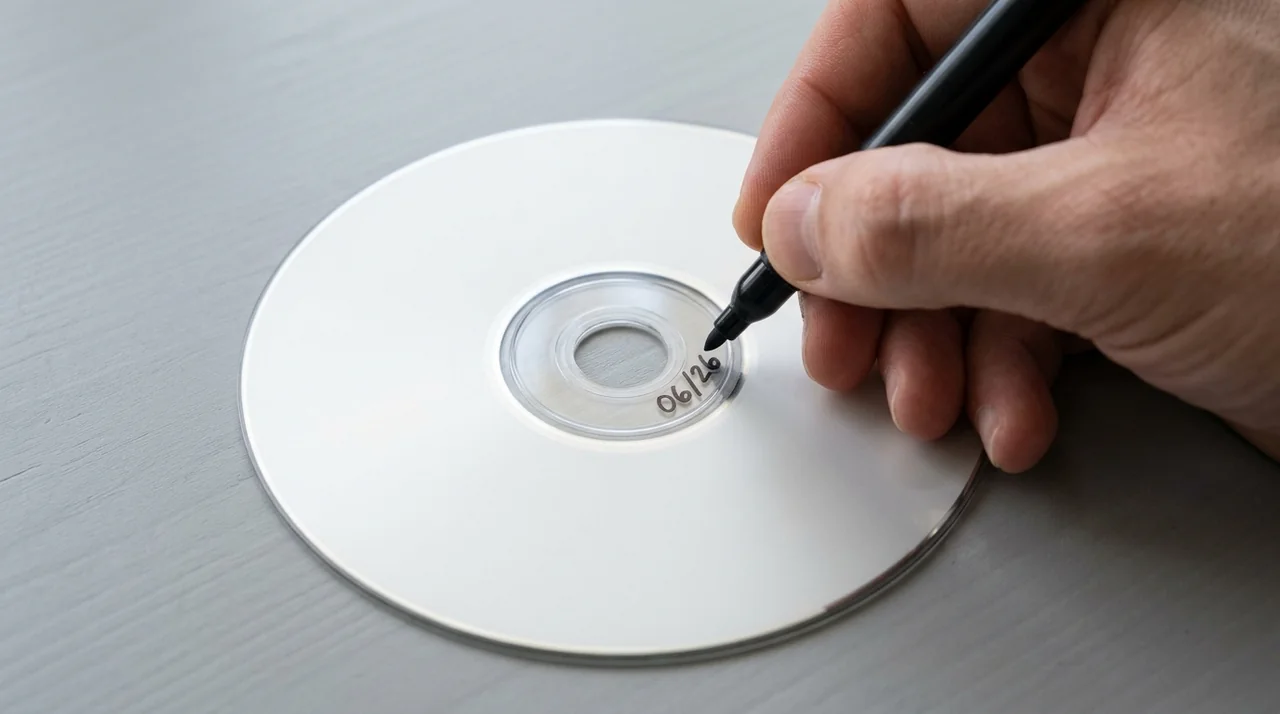
- Where to write: Never mark the shiny bottom read side. Write only on the matte top label side—or better yet, strictly inside the clear plastic inner clamping ring around the center hole, where zero data is stored.
Cấu tạo của đĩa CD và tại sao vị trí bạn viết lại quan trọng
A compact disc is not a solid slab of plastic—it is a precision multi-layer stack. From bottom to top: a thick, clear Polycacbonat substrate (the shiny side the laser reads through), a microscopic reflective metal layer (usually aluminum or a gold/silver alloy on recordable CD-Rs), a thin acrylic protective lacquer coating, and the top printed or writable label surface.
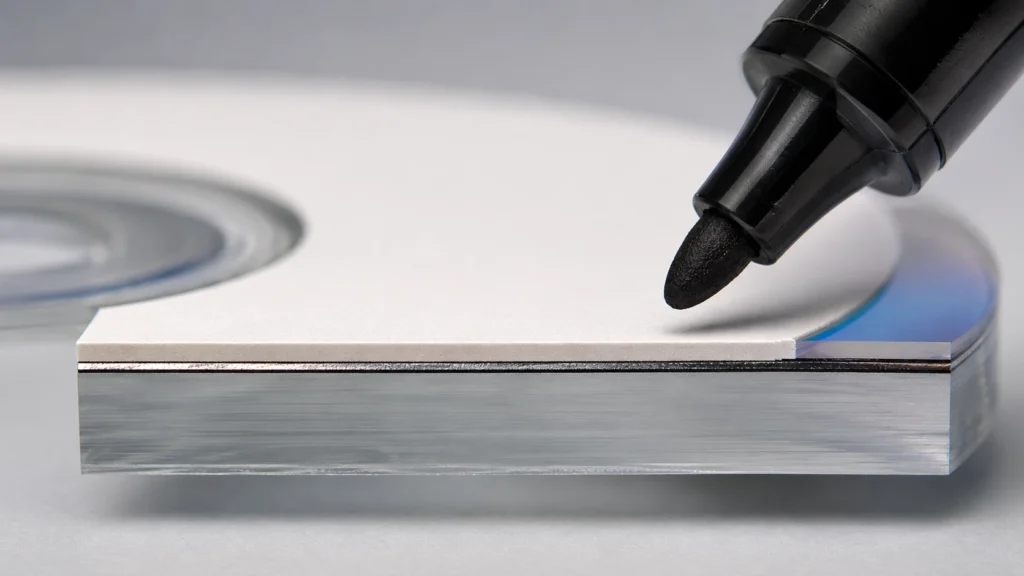
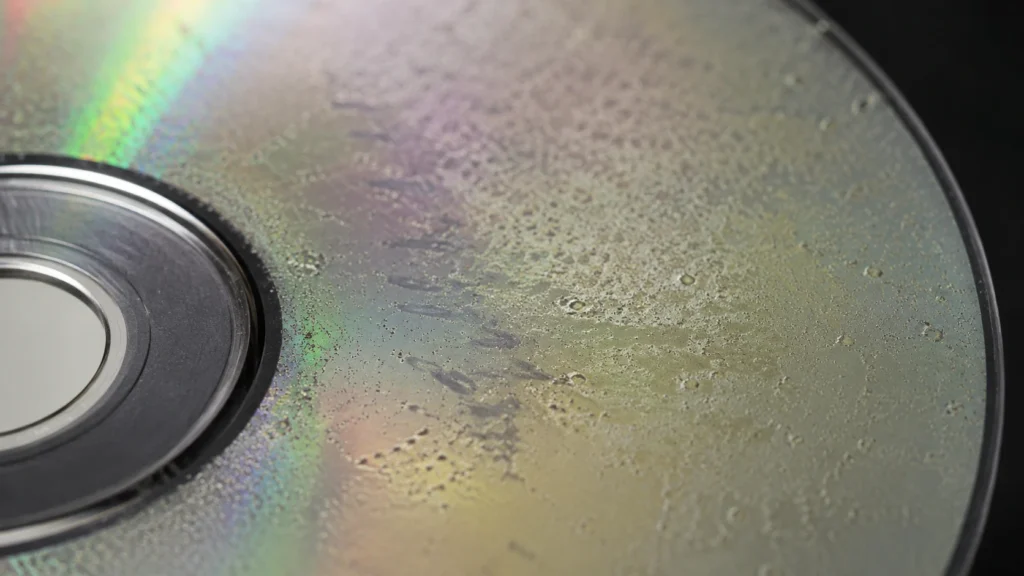
Because the data-bearing metal layer sits directly under the top label surface, the label side of a CD is actually more fragile than the shiny bottom. The protective lacquer shielding that metal is only a few microns thick, and its sole job is keeping oxygen and moisture away from the aluminum underneath. A hard pen tip can scratch straight through the lacquer, while an aggressive solvent can chemically soften or craze it. Once air reaches the metal layer, oxidation dulls reflectivity and causes permanent read errors.
DVDs are structurally more forgiving because the reflective data layer is bonded in the middle, sandwiched between two thick 0.6 mm polycarbonate halves—leaving far more plastic between your marker tip and the data.
Blu-ray discs (BD-R / BD-RE) take a different approach: their data layer sits closer to the bottom read surface behind a proprietary scratch-resistant hard coating, while the top label side still carries a printable or protective finish. Even with that tougher coating, archiving guides still recommend using a water-based or toluene- and xylene-free soft-tip marker on Blu-ray discs so harsh solvents do not cloud or weaken the surface film.
Theo Council on Library and Information Resources (CLIR), whose optical media preservation manual serves as the global reference for libraries and archives, the safest rule for labeling optical discs is straightforward: choose a water-based or mild solvent-free disc marker with a soft tip, and whenever possible, write only on the clear inner hub.
Thực sự có gì trong mực bút dạ vĩnh viễn
Every permanent marker formula combines three core components: colorant (pigment or dye), chất kết dính nhựa (which forms the waterproof film after drying), and a carrier solvent that keeps the ink fluid until it hits the surface. It is the solvent system—not the pigment—that determines whether a marker threatens a CD’s lacquer:
| Solvent | CD Risk | Key Characteristics |
|---|---|---|
| Nước | Very Low | Safest option; dries slightly slower with no organic solvents to dissolve lacquer or plastic. |
| Alcohol (IPA) | Low | Flashes off rapidly; safe for light single-pass labeling, but avoid saturating one spot repeatedly. |
| Toluene / Xylene | High (Delayed) | Industrial aromatic solvents that slowly erode protective lacquer and trigger aluminum oxidation. |
| Acetone / MEK | Extreme (Instant) | Directly softens and dissolves polycarbonate plastic on contact, causing irreversible warping or clouding. |
A Pen Manufacturer’s Perspective on Ink Flow & Evaporation: From our experience formulating marker inks in-house (see our ink color management and formulation standards), solvent chemistry alone is only half the story. Two physical variables also determine whether an ink attacks a disc coating: solvent evaporation rate và nib ink flow rate. A fast-flashing alcohol ink delivered through a controlled fine fiber nib evaporates off the lacquer in seconds with minimal dwell time. By contrast, a high-flow broad nib—or tracing over the same letters three or four times—floods the surface with liquid solvent, keeping the coating wet long enough for softening or crazing to begin.
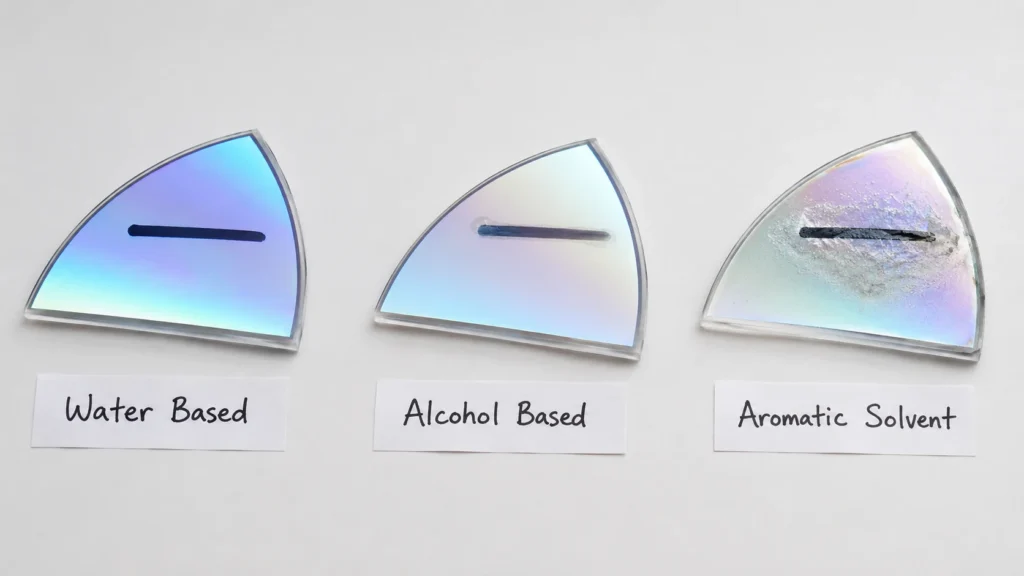
This explains why the CLIR preservation guidelines note that standard alcohol-based markers (ethanol or isopropanol) are widely used to label optical discs without widespread immediate failure, even though no multi-decade controlled study guarantees zero long-term interaction. Water-based formulas developed for custom stationery and archival markers dry a touch slower, which is actually an advantage on CDs: the ink cures cleanly on top of the surface instead of biting into it.
Bút dạ an toàn cho CD: Điều gì khiến chúng khác biệt
Dedicated CD markers rely on two safeguards: either water-based pigment ink or mild, toluene- and xylene-free formulations tested not to penetrate disc lacquer—paired with an extra-soft tip. Different leading brands achieve disc safety through slightly different technical routes:
- edding 8400: Uses a water-based pigment ink formula paired with a soft round nib engineered not to score lacquer coatings.
- Schneider Maxx 244: Uses a low-odor, fast-drying formulation certified free of toluene and xylene, paired with a gentle fiber tip for CD, DVD, and Blu-ray surfaces.
- Staedtler Lumocolor 310: Relies on a mild, smudge-proof permanent ink specifically formulated not to penetrate optical data protection layers, combined with an extra-soft tip.
On the mechanical side, nib softness and capillary delivery matter just as much as the ink inside. Soft sintered felt or fine nylon fiber tips cushion writing pressure so you cannot gouge the lacquer—similar to how nib geometry and capillary flow are engineered across specialized marker lines (explored further in our dual-tip alcohol marker nib and barrel specs và valve-press vs. capillary delivery overview).
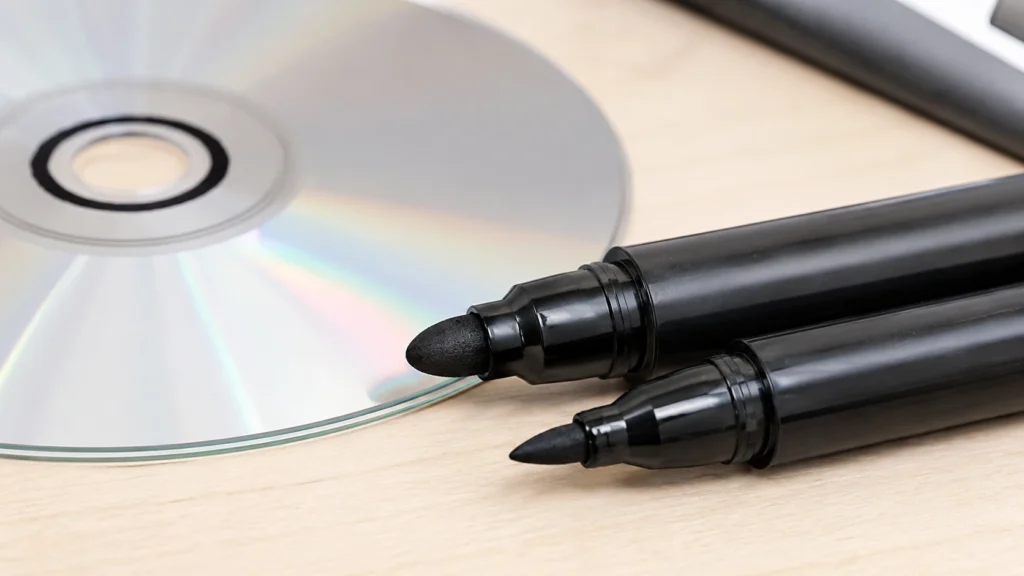
No dedicated CD pen within reach? A standard water-based permanent marker with a soft felt tip is the next safest choice. Fine-point Sharpies and similar low-odor alcohol markers are generally acceptable for everyday casual discs, provided you write lightly in a single pass—but for irreplaceable family archives or master backups, a dedicated disc marker is cheap insurance.
Cách ghi nhãn đĩa CD an toàn
Follow five simple habits to eliminate virtually all labeling risk on CDs, DVDs, and Blu-ray discs:
- Write on the clear inner hub whenever possible: The transparent plastic clamping ring around the center spindle hole stores zero data. Even a standard alcohol marker is safe there because there is no reflective metal layer underneath.
- Use a soft felt or fiber tip—never a ballpoint or pencil: Metal ballpoints, sharp pencils, and dried-out marker nibs concentrate force onto a tiny point and can cut straight through the top lacquer into the aluminum layer.
- Keep strokes light and avoid tracing over the same spot: Each extra pass with an alcohol marker deposits fresh solvent and slows evaporation. One light stroke flashes off harmlessly; five heavy passes over the same word raise chemical exposure dramatically.
- Skip sticky paper CD labels on recordable discs: Pressure-sensitive adhesives can slowly react with lacquer, pull the foil layer off if peeled, or create rotational imbalance inside high-speed drives. Write directly with a disc-safe pen or use inkjet-printable discs instead.
- Store labeled discs upright in cases away from UV and humidity: Heat, direct sunlight, and moisture accelerate dye breakdown and metal oxidation far faster than a proper marker ever will.
Câu hỏi thường gặp
Bút Sharpie có làm hỏng CD không?
Usually not, though it is not guaranteed for long-term archiving. Standard Sharpies use alcohol-based ink, which is far milder than xylene or toluene and evaporates quickly. CLIR notes that alcohol markers are widely used to label optical discs without widespread reported failures, yet no controlled multi-decade study confirms zero risk. Use a single light pass on the label side—or better, write on the clear inner hub—and switch to a dedicated CD-safe pen for irreplaceable archives.
Loại bút an toàn nhất cho CD là gì?
A dedicated CD/DVD/BD marker with an extra-soft tip and water-based or certified toluene- and xylene-free ink. Well-known options include the edding 8400 (water-based pigment ink), Schneider Maxx 244 (low-odor, toluene- and xylene-free), and Staedtler Lumocolor 310 (mild, non-penetrating ink). If none is available, a standard soft-tip water-based permanent marker is safer than using an alcohol-based marker.
Can I write on a DVD with a permanent marker?
Yes—DVDs are structurally safer to label than CDs. A DVD’s reflective data layer sits sandwiched in the middle between two thick polycarbonate layers rather than directly beneath the top lacquer. Even so, harsh solvents like xylene or acetone can still mar the top plastic surface, so a water-based or mild CD-safe marker remains the best choice.
Can you write on a Blu-ray disc with a permanent marker?
Yes, on the top label side using a soft-tip water-based or toluene- and xylene-free disc marker. Although Blu-ray discs feature a durable scratch-resistant hard coat on the read side, the top printable or branded surface can still be dulled or weakened by aggressive industrial solvents or hard ballpoint tips. Stick to dedicated CD/DVD/BD markers or write strictly inside the transparent inner clamping ring.
Why is the label side of a CD more fragile than the shiny bottom?
Because the reflective aluminum data layer sits just microns below the label surface. The shiny underside is thick polycarbonate, where light surface scuffs can sometimes be polished out. A deep scratch or solvent etch on the top label side reaches the metal layer directly, permanently destroying the data stored at that spot.
Nếu tôi đã viết lên đĩa CD bằng bút không đúng loại thì sao?
Back up the disc immediately while it still reads cleanly. Copy every file onto a fresh drive or archival medium right away. Once solvent penetration or lacquer scratches initiate aluminum oxidation on the label side, deterioration tends to spread outward and cannot be reversed.
Can you remove permanent marker from a CD without ruining it?
Do not try to scrub ink off the label side with solvents—back up the data first instead. Acetone and nail polish remover will melt polycarbonate instantly, and rubbing alcohol plus paper-towel friction can strip or scratch the thin protective lacquer over the metal layer. If you only need to wipe ink off the clear center hub or a jewel case, lightly dabbing a cotton swab dampened with isopropyl alcohol works—but never scrub across the top data zone of a CD.
Are printable CDs better than writing on regular discs?
For long-term archiving, yes. Inkjet-printable CDs feature a specialized matte top coating designed to absorb water-based printer inks evenly without allowing solvents to reach the lacquer below. Paired with a disc-capable inkjet printer, they offer the cleanest archival labeling—while a dedicated soft-tip disc marker handles everyday labeling effortlessly.
Whether you are archiving family photos or organizing an audio collection, labeling optical discs safely comes down to three habits: mild solvent-free or water-based ink, a soft felt tip, and light strokes on the matte label side or clear inner hub.
Bài đọc liên quan
- Tìm nguồn cung ứng bút lông B2B: Hóa học mực bút lông vĩnh viễn tiết lộ điều gì về chất lượng nhà cung cấp
- Water-Based vs. Oil-Based Paint Markers: Which to Choose?
- Marker sơn acrylic và marker cồn: mực, hiệu năng và OEM
- Are Acrylic Paint Markers Permanent and Waterproof? 9-Surface Lab Test & Sealing Guide
Sourcing Low-Odor, Xylene-Free Permanent Markers for Your Brand?
At ZH Stationery (ISO 9001:2015 and amfori BSCI A-rated manufacturer in Tonglu, Hangzhou), our in-house ink lab formulates water-based pigment and low-odor, xylene- and toluene-free permanent inks matched to precision felt and fiber tips for archival, office, and industrial labeling brands. Explore our ink color management capabilities or contact our OEM team for formulation samples and custom specs.