Marcadores de Doble Punta Explicados: Pincel, Cincel, Fino — ¿Cuál es el Mejor?
If you have stood in front of a marker display, or a supplier catalog, wondering whether to pick brush-and-chisel or fine-and-bullet, you are asking the right question. Dual tip markers are not just two nibs for the price of one. Each tip shape changes how ink flows, how wide the stroke runs, and what kind of work the marker can do. See why premium markers are worth it.
The wrong pair frustrates the end user. The right pair becomes the marker they reach for every time.
That split matters whether you are an artist building a kit or a brand owner sourcing private-label markers. For buyers placing bulk orders, there is another layer. The build calls behind tip material, ink fit, and nib bond decide whether those markers perform the same across thousands of units. A tip that frays on day five. A fine point that clogs mid-stroke. A color that does not match between the two ends. These are not random failures. They trace back to specific production picks.
This article walks through what each tip type does, how pairs serve different use cases, and which factory-level factors separate a reliable dual tip marker from one that makes returns.
Tabla de Contenidos
Respuesta rápida: ¿Qué combinación de rotuladores de doble punta debería elegir?
If you need a fast pick by use case:
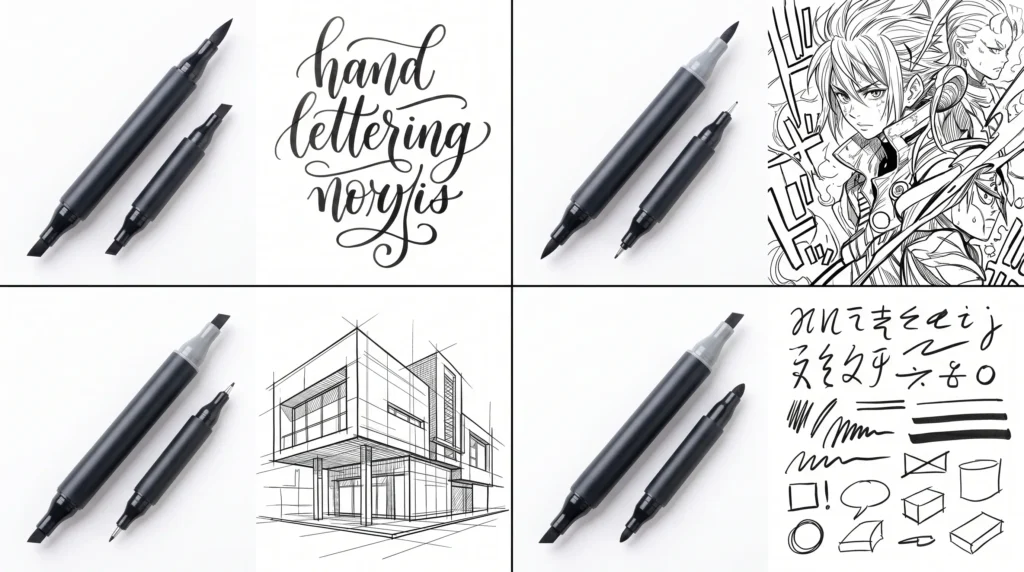
Brocha + Bisel: Ideal para ilustradores, artistas de lettering y diseñadores que necesitan trazos expresivos además de una cobertura amplia. La brocha maneja el trabajo de línea orgánica; el bisel cubre fondos y rellenos audaces en una sola pasada.
Brocha + Fina: Ideal para artistas de manga, coloristas e ilustradores con mucho detalle que necesitan tanto un trabajo fluido con brocha como un control de línea de precisión en una sola herramienta, sin cambiar de marcador.
Bisel + Fina: Ideal para ilustradores técnicos, arquitectos y tomadores de notas que priorizan líneas estructuradas, control de ancho consistente y anotaciones detalladas sobre el trabajo expresivo con brocha.
Bisel + Bala: Ideal para escritura de uso general, bocetos y kits de arte para principiantes donde la versatilidad a un costo de fabricación unitario más bajo importa más que el rendimiento especializado de la punta.
For brand owners and buying teams, these use-case gaps help set sharper sourcing and quality check bars. The tip pair you pick shapes your target buyer and the QC marks the product must meet.
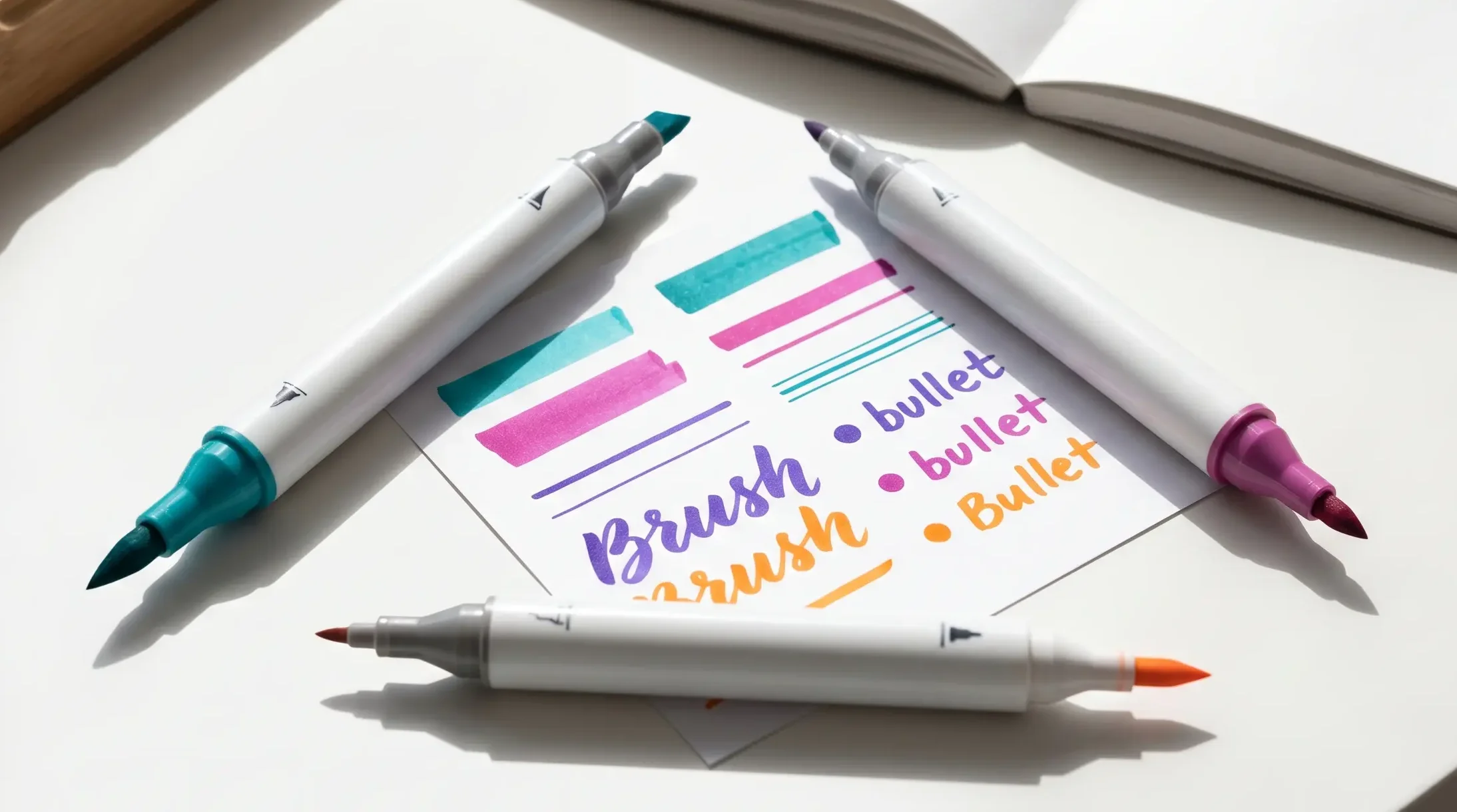
Comparación de combinaciones de marcadores de doble punta: puntas de pincel, bisel, fino y bala, con ejemplos de uso.
Combinaciones de Rotuladores de Doble Punta: Correspondencia de Casos de Uso con el Control de Calidad de Fábrica
What users notice about dual tip markers almost always goes back to a line-side call. The table below ties the most common complaints to what you should verify before signing a PO.
Característica/Problema Común
Por qué es importante/falla (Causa Raíz de las Quejas del Cliente)
Tapa se seca / evaporación de la tinta
La punta de brocha se deshilacha o pierde su forma después de un uso moderado
Construcción de fibra de baja densidad o adhesivo de unión punta-cuerpo mal adherido; el solvente de la tinta descompone gradualmente el material de la punta en el punto de unión.
Verificar la densidad de la punta (≥0.35 g/cm³ para puntas de brocha) y las pruebas de resistencia a solventes en las uniones adhesivas bajo envejecimiento acelerado.
La punta de bisel produce líneas desiguales, un borde consistentemente más oscuro
Corte de punta desalineado durante la producción; el ángulo del bisel varía entre unidades dentro del mismo lote.
Tolerancia del ángulo de corte de la punta en proceso de ±2°; muestreo por lotes de la consistencia del ancho de línea en 3 ángulos de trazo (borde ancho, medio, fino).
La punta fina se obstruye o deja de suministrar tinta a mitad del trazo
El tamaño de partícula del pigmento de la tinta excede el ancho del canal capilar de la punta; los agregados de pigmento forman obstrucciones con el tiempo.
Especifique una filtración adecuada para el sistema real de pigmentos o partículas decorativas, luego verifique la sedimentación y el rendimiento de escritura en las condiciones de almacenamiento acordadas.
El color de la tinta difiere visiblemente entre las dos puntas
Diferentes tasas de saturación del depósito de tinta entre las puntas; una punta se alimenta de una sección más seca del núcleo del depósito.
Verificación con espectrocolorímetro de ΔE < 1.5 entre ambas puntas después de 24 horas de reposo vertical.
Una punta se seca notablemente más rápido que la otra
Tasas de absorción capilar desiguales entre los materiales de las puntas; la punta más densa extrae la tinta de la más ligera.
Mida la salida de ambas puntas utilizando las mismas condiciones de escritura y compárela con la muestra aprobada. Acuerde diferencias aceptables para la combinación de puntas prevista.
El barril del marcador tiene fugas en la unión de la punta
Soldadura ultrasónica o fuerza de presión mecánica insuficiente en el sello punta-barril; la expansión térmica crea espacios durante el envío.
Prueba de fugas por caída de presión en ambas puntas; integridad del sello verificada a -10°C y 50°C para simular condiciones extremas de envío y almacenamiento.
Every row in that table turns into a checkpoint that either exists in a factory QA plan or does not. When you source dual tip markers at scale, the gap between a supplier who can walk you through these metrics and one who cannot is the gap between a brand that grows and one that bleeds returns and bad reviews.
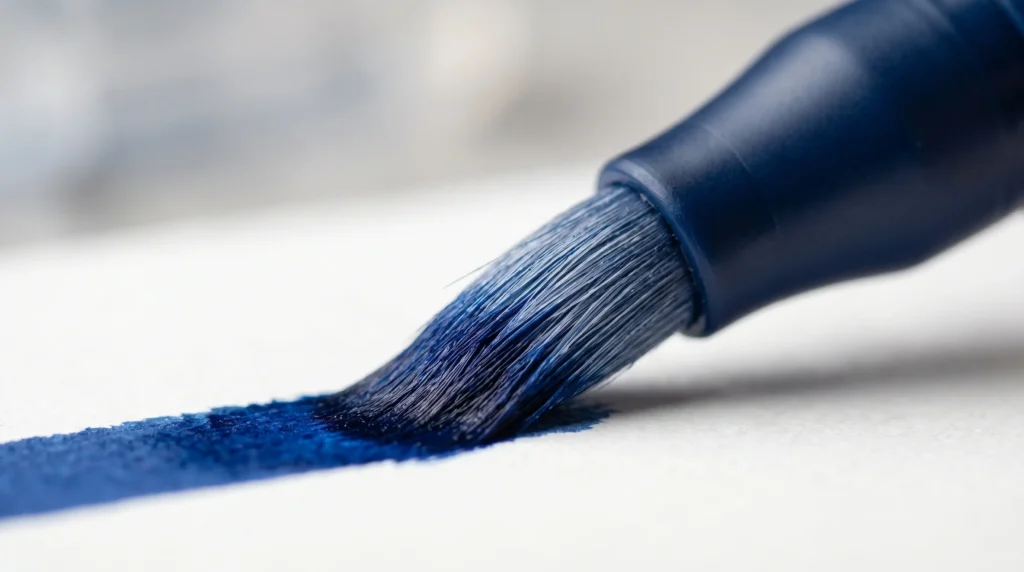
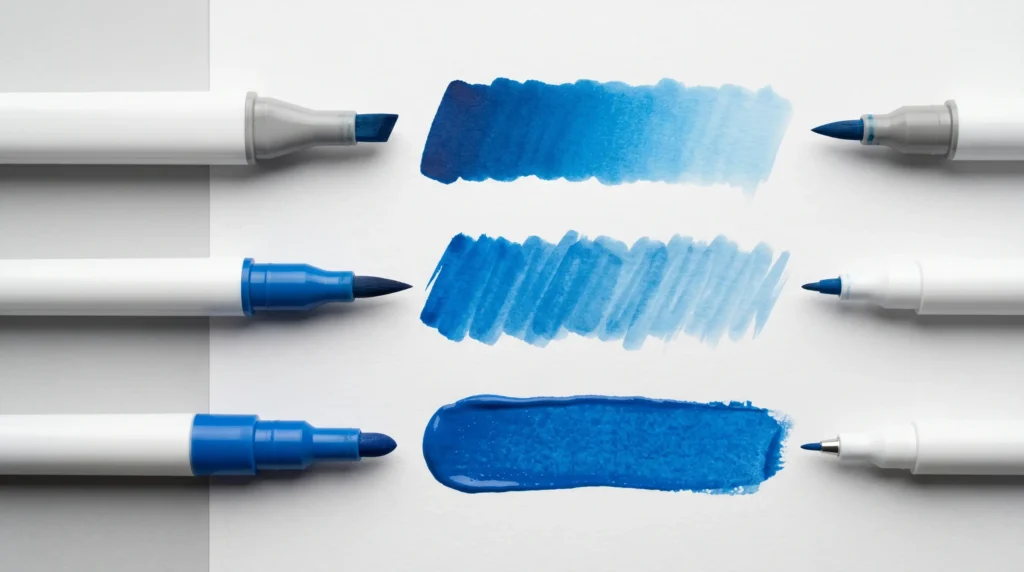
Primer plano de un rotulador de punta de pincel que muestra la flexibilidad de la fibra y el flujo de tinta sobre el papel.
Cómo Funcionan Realmente las Formas de las Puntas de los Marcadores
A tip is not just a shape. It is a precision ink delivery system. Before you judge a dual tip pair, know what each shape does at the physical level. How the fibers sit. How ink moves through them. What can go wrong in production.
La Punta del Pincel: Flujo Orgánico, Flexibilidad Controlada
A brush tip is a tapered cone of pressed fiber, usually polyester or a nylon-polyester mix. It flexes under pressure and springs back. What makes it work is not softness alone. The fibers sit lengthwise. That creates micro-channels that wick ink from the reservoir to the nib face by capillary action.
Press harder and the tip flares. More fiber touches the paper, making a wider line. Lighten up and only the tip touches. That pressure-to-width feel is what makes brush lettering fluid. The tip behaves like a sable brush, with less care and no dipping.
The Quality Difference: A tip with fiber density below 0.30 g/cm3 collapses under repeated pressure and will not fully spring back. By the 50th stroke, the user feels it. The fine end of the brush turns mushy. Lines lose precision.
La Punta Biselada: Cobertura Estructurada Con Tres Líneas en Una
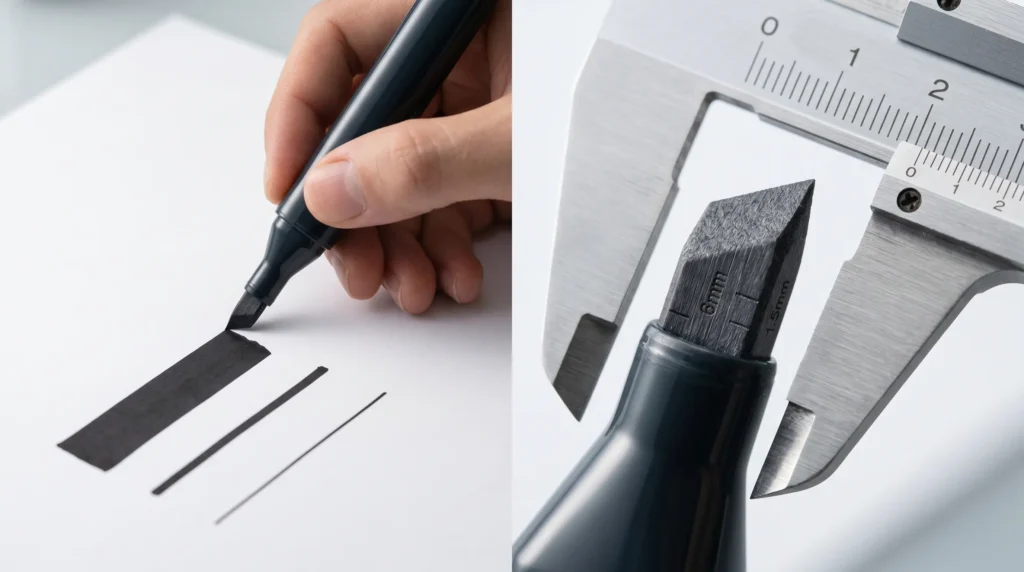
A chisel tip is cut at an angle, usually 45 to 60 degrees. That makes a wedge face. This simple shape gives three line widths from one nib. The wide flat edge fills. The narrow edge makes medium lines. The corner makes fine detail.
The build test for chisel tips is the cut itself. A loose cut, even half a degree off, makes a chisel lean to one side. The user does not see the angle. They see one edge of the stroke look darker. Steady chisel performance needs automatic angle checks at the tip-cutting station.
Primer plano de un rotulador de punta biselada que muestra tres anchos de línea y la geometría del corte angular.
La Punta Fina: Precisión Donde un Milímetro Importa
Fine tips run from 0.5mm to 1.0mm. They are a narrow bullet shape or needle-point build. They use the same fiber parts as brush and chisel. The production tolerance gets much tighter.
Fine tips are made by molding the fiber into a narrow cone or grinding a wider tip to spec. The lasting issue with fine tips in dual tip markers is ink hunger. The narrow tip has fewer capillary channels than a chisel. It draws ink slower. If the ink mix is too thick, the fine tip runs dry mid-stroke.
La Punta de Bala: El Caballo de Batalla que Merece Más Respeto
The bullet tip, a rounded cone nib, usually 1.0mm to 2.0mm at its widest, often gets called basic. That is a mistake. A well-made bullet tip is the most rugged of all marker nibs. No sharp corners to bend. No odd shape to lose line. It writes smooth in any path. That makes it ideal for sketch, general writing, and kids' art kits.
Tipo de Tinta y Compatibilidad de Puntas: Es un Sistema, No un Menú
Marker tips do not live alone. They are half of a system. The other half is the ink.
Tinta a Base de Alcohol: El estándar para marcadores de doble punta de grado profesional. Se evapora rápidamente, se mezcla suavemente y produce colores vibrantes. Las puntas de fibra de poliéster manejan la tinta de alcohol perfectamente porque el poliéster resiste la degradación por solventes.
Tinta a Base de Agua: Común en marcadores para estudiantes y niños. Es de menor costo y lavable, pero las moléculas de agua son más grandes, lo que ralentiza la absorción capilar a través de puntas de fibra densa. La tinta a base de agua también puede hacer que las mezclas de nailon de menor densidad se hinchen con el tiempo.
Tinta a Base de Pintura: Los marcadores de pintura acrílica y al óleo introducen una tercera variable: el tamaño de partícula del pigmento. Una punta que maneja tinte de alcohol puede atascarse con tinta de pintura. Los fabricantes necesitan puntas con canales capilares más anchos para acomodar el flujo de pigmento.
That is why you rarely see the same body offered across alcohol, water, and paint versions with identical tips. The tip specs have to be tuned to the ink during R&D.
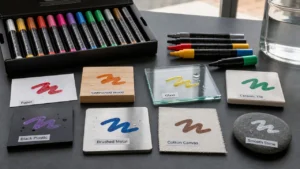
Comparación de tinta base alcohol, base agua y base pintura sobre papel para rotuladores, con rotuladores de doble punta.
What Makes a Dual Tip Marker Actually Dual (Not Just Two Tips Sharing a Barrel
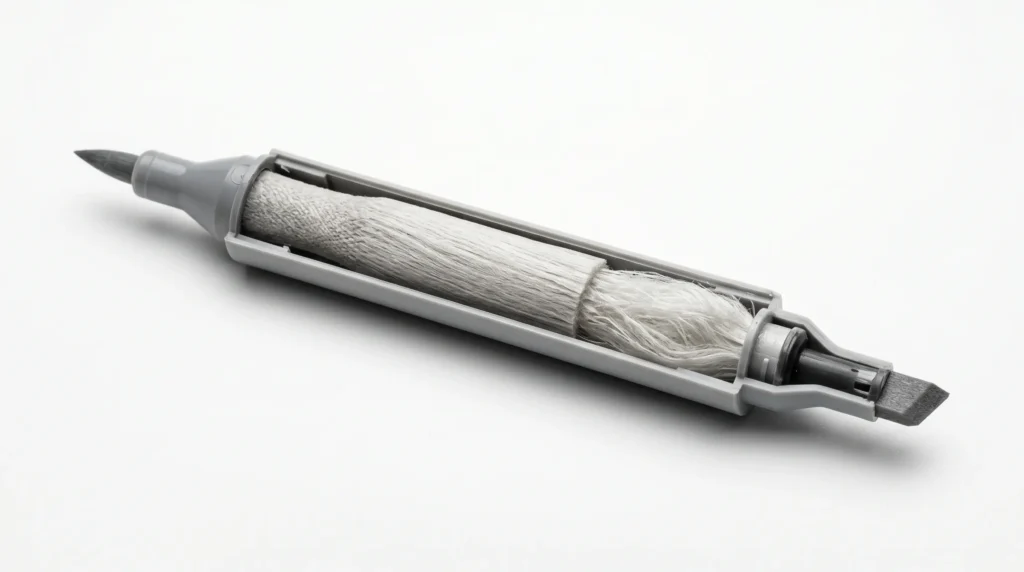
There is a build insight that separates a real dual tip marker from two nibs glued into opposite ends of a barrel. It is the ink reservoir design.
In a right-built dual tip marker, one porous reservoir runs the full barrel and feeds both tips at once. Each tip draws from the same ink. Both tips should give the same color depth and flow rate.
The build test is balance. If the two tips have different density, the denser tip pulls ink faster by acción capilar. Factories fix this with layered density zones inside the core. Tighter packing near the dense tip. Looser near the lighter one. That balances the draw rate.
Corte transversal de la estructura interna de un rotulador de doble punta que muestra el núcleo del depósito y los conjuntos de puntas.
Certificaciones y Capacidades de Fabricación Personalizada
If your dual tip markers are headed for US or EU retail shelves, certification is a market-entry need. It also acts as a practical quality signal.
ASTM D-4236: Requerido para materiales de arte vendidos en EE. UU. Garantiza que la tinta ha sido revisada por un toxicólogo para evaluar riesgos de exposición a largo plazo.
EN71 (Partes 1–3)): La Directiva de Seguridad de Juguetes de la UE. La Parte 3 establece límites de migración para metales pesados (plomo, cadmio, cromo) provenientes de tintas, materiales del barril y componentes de las puntas.
REACH: Este reglamento de la UE regula las Sustancias de Alta Preocupación (SVHC).
ISO 9001: Certificación de gestión de calidad básica que demuestra que los procesos de producción están documentados y son repetibles.
For B2B buyers sourcing custom dual tip markers, check these abilities:
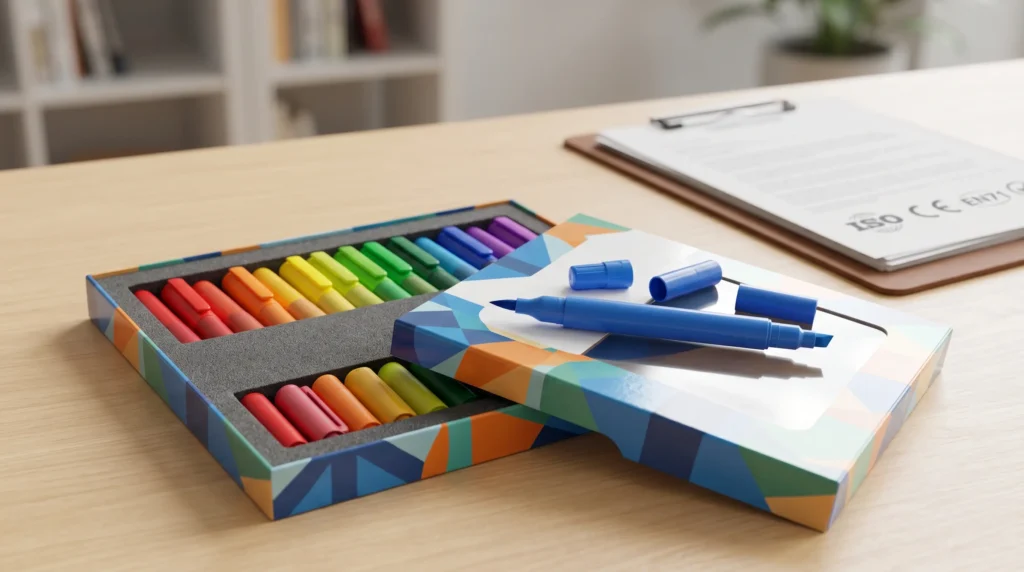
Empaque completamente personalizado: Tarjetas blister, cajas con ventana, estuches de hojalata o fundas con marca.
Investigación y desarrollo interno de tintas y soporte de diseño 3D: Combinación de colores personalizada con verificación mediante espectrocolorímetro.
Muestras gratuitas de preproducción: Sostenga los rotuladores, pruebe ambas puntas y verifique los sellos de la tapa antes de comprometerse con un pedido al por mayor.
100% inline automated inspection per unit: Every marker checked for fill weight, cap torque, and nib retention; writing tests follow AQL sampling, cap seal integrity, and tip alignment.
Rotuladores de doble punta empaquetados personalizadamente en una caja con ventana de marca, con documentos de certificación.
Preguntas Frecuentes
Q: What's the difference between alcohol-based and water-based dual tip markers?
A: Alcohol markers use dye in an alcohol solvent that flashes off fast. That gives bright, blendable color on most non-porous surfaces. Water markers use water-soluble dye or pigment. They dry slower and do not blend as clean. They offer washability.
Q: Which dual tip pair is best for beginners or student-grade products?
A: Chisel plus Bullet is the most forgiving pair for beginners. The chisel covers without asking for the pressure control a brush tip needs. The bullet handles daily writing. It is also the cheapest pair to make.
P: ¿Los rotuladores de doble punta se secan más rápido que los de punta única?
A: Not by nature. They can if the cap seal is poorly built. A dual tip marker has two loss points instead of one. Good production tests cap seal integrity per unit to hold an airtight fit for 18 to 24 months in shelf storage.
Q: How do I verify that a factory's dual tip markers will perform the same across a bulk order?
A: Ask for three things:
Un informe de prueba de lote que muestre la consistencia del ancho de línea en ambas puntas.
Resultados de envejecimiento acelerado (rotuladores almacenados a 50°C durante 72 horas).
Una muestra física de preproducción que pueda probar usted mismo.
Q: Can I mix different tip types in a custom order, some brush plus chisel, some chisel plus fine?
A: Yes. Most custom programs allow mixed tip pairs, such as brush plus chisel and chisel plus fine, within the same order. Confirm the pairing on the approved sample and test both nibs for flow and cap seal, because each pair adds a separate QC point.
P: ¿Por qué algunos rotuladores de doble punta huelen más fuerte que otros?
A: The smell comes from the ink solvent. Alcohol markers use ethanol or isopropanol. Stronger smell often means a higher solvent-to-dye ratio or industrial-grade solvent instead of clean cosmetic-grade alcohol.
There is a quiet joy in picking up a marker where both tips perform exactly right. The brush flexes and snaps back. The fine point lays clean ink without pause. The color matches between both ends. That feel does not happen by luck. It is the result of calls made months earlier on the floor.
For artists, the right dual tip marker makes creative work flow without friction. For brand owners, it makes the product sell and keep selling. If you are judging dual tip markers for your line, use this article as your sourcing list. Ask about tip density. Ask about wick balance. Ask about ink-to-tip fit tests. The suppliers who answer those questions straight are the ones whose markers will perform.