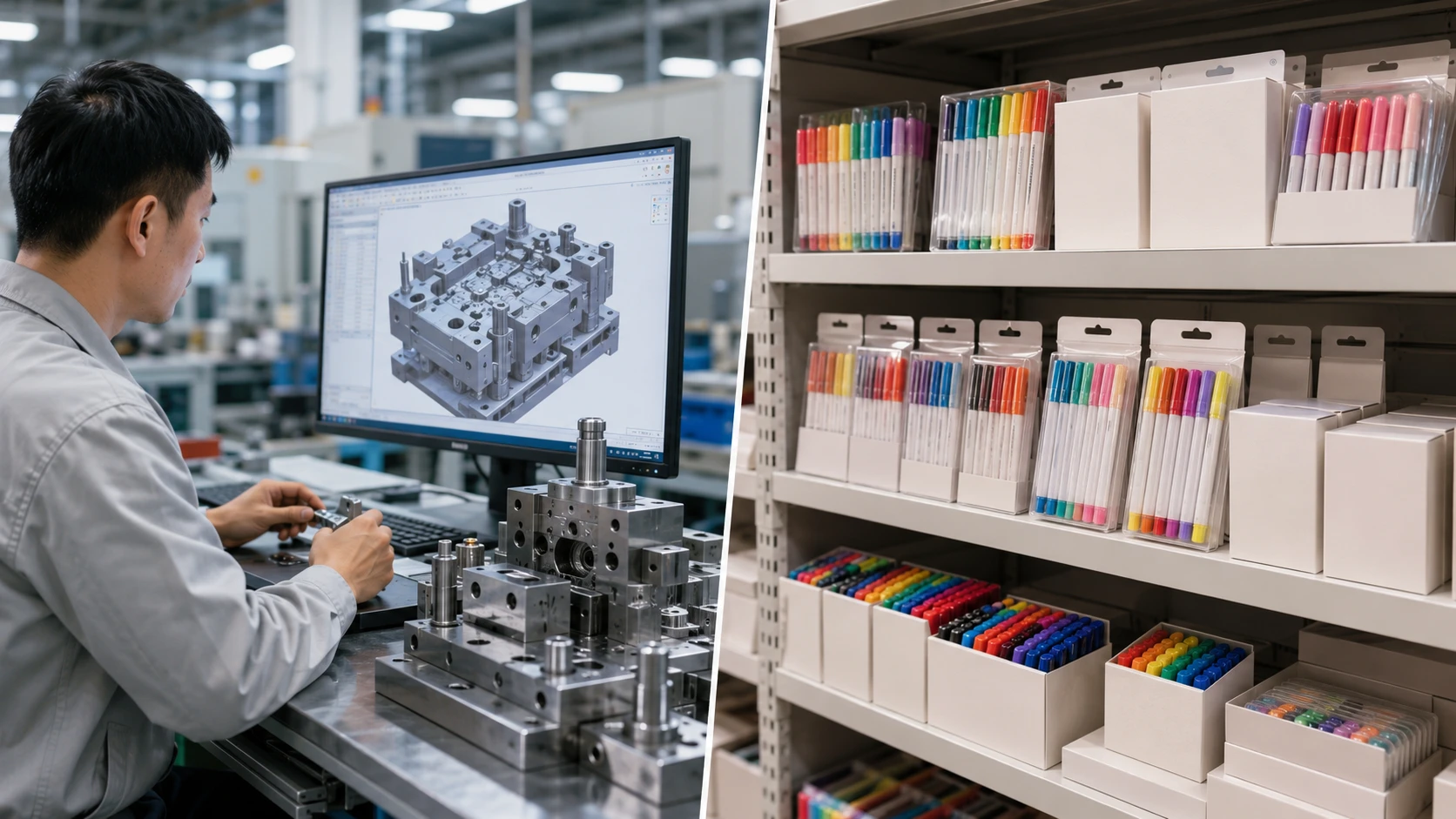
Every B2B buyer who starts pen manufacturing for a private label meets two terms early: OEM and ODM. They appear in every supplier call and sourcing checklist. Yet few guides explain what each model means for a real buying decision.
The confusion is costly. The wrong model can lock you into a product that is hard to tell apart from rivals. It can add mold costs your order volume cannot support. It can also pair you with a factory that lacks the skills your brand needs. Buyers who mix up OEM vs ODM pen manufacturing often face late launches, surprise tooling bills, uneven batch quality, and customs delays.
Dieser Leitfaden erklärt beide Modelle als praktische Beschaffungsrahmen. Er behandelt Zeitplan, Budget, Designkontrolle, Compliance-Pflichten und Lieferantenbeziehungen. Einige Leser sind Markeninhaber, die eine Eigenmarken-Markerlinie aufbauen. Andere sind Distributoren, die individuelle Schreibwaren hinzufügen. Wieder andere sind Einzelhändler, die zum ersten Mal direkt ab Werk kaufen. Für alle sind die entscheidenden Faktoren hier zusammengefasst.
Inhaltsverzeichnis
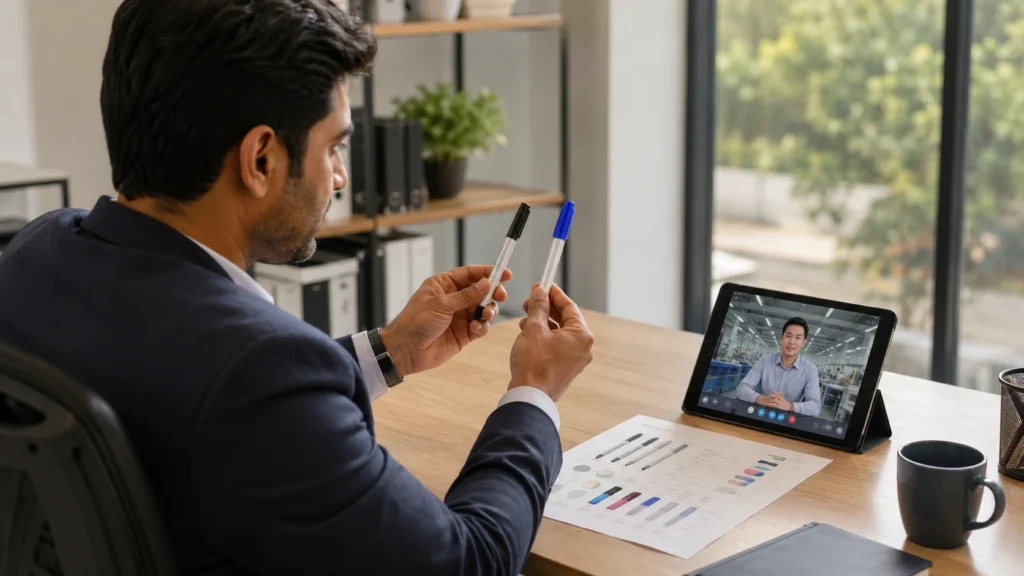
Kurze Antwort: Welches Fertigungsmodell sollten Sie wählen?
Hier eine kurze Übersicht, wann welches Modell sinnvoll ist:
- Wählen Sie OEM, wenn Sie ein spezifisches Produktdesign haben, die volle Kontrolle über Tintenformulierung und Spitzenspezifikationen benötigen, exklusives Formeneigentum wünschen und bereit sind, in Entwicklungszeit und Werkzeugkosten zu investieren.
- Wählen Sie ODM, wenn Sie schnell einen neuen Markt testen müssen, ein bestehendes Produkt mit Ihrem Logo und Ihrer Verpackung branden möchten, ein begrenztes Budget für die anfängliche Entwicklung haben und sich damit wohlfühlen, innerhalb des bestehenden Produktkatalogs der Fabrik zu arbeiten.
- Wenn Sie eine Marke skalieren, beginnen Sie mit ODM, um die Nachfrage zu validieren, und wechseln Sie dann zu OEM für Ihre Vorzeigeprodukte, sobald das Volumen die Investition rechtfertigt.
- Wenn Compliance und Sicherheit entscheidend sind (Schulbedarf, Kinderprodukte, EU/US-Einzelhandel), verifizieren Sie, dass Ihr Lieferant unabhängig vom gewählten Modell aktuelle, chargenbezogene Zertifizierungen besitzt.
Diese Faktoren helfen Markeninhabern und Beschaffungsmanagern, klarere Beschaffungs- und Qualitätsstandards zu setzen, bevor sie Fabriken kontaktieren.
OEM vs. ODM: Was der Unterschied für Großabnehmer von Stiften bedeutet
The difference between OEM and ODM is not academic. It sets who owns the design. It sets who pays for the molds. It sets how long development takes. It also sets whether your brand can build a strong market position.
| Faktor | OEM (Original Equipment Manufacturer) | ODM (Original Design Manufacturer) |
| Wer liefert das Design? | Käufer liefert vollständige Spezifikationen und technische Zeichnungen | Fabrik liefert vorgefertigte Produkte; Käufer individualisiert Logo, Farben, Verpackung |
| Wem gehört das geistige Eigentum? | Käufer behält Design-IP und Formeneigentum | Fabrik behält in der Regel die Kern-Design-IP |
| Anschaffungsentwicklungskosten | Höher (Formenbau, Designvalidierung, Bemusterung | Niedriger) Arbeit mit vorhandenen Vorlagen |
| Typischer Entwicklungszeitplan | 3–6 Monate (inkl. Formenbau und Musterfertigung) | 2–6 Wochen (Artwork-Freigabe und Verpackungseinrichtung) |
| Mindestbestellmenge | 50.000 Stifte pro Bestellung | 50.000 Stifte pro Bestellung |
| Individualisierungstiefe | Volle Kontrolle: Tinte, Spitze, Schaftform, Materialien, Verpackung | Begrenzt auf Katalogoptionen: Farben, Logoplatzierung, Verpackungsstil |
| Konsistenz bei Nachbestellungen | Spezifikationsgebunden an Ihr Design; Fabrik kann ohne Zustimmung nicht ändern | Abhängig davon, dass die Fabrik dieselbe SKU in Produktion hält |
| Am besten geeignet für | Etablierte Marken, einzigartige Produktanforderungen, langfristige Eigenmarkenprogramme | Markttests, Aktionsläufe, Marken mit begrenzten F&E-Ressourcen |
The table shows a pattern that surprises many first-time buyers. OEM is not simply a better version of ODM. Each model solves a different business problem. The right choice depends on your brand strategy, budget, timeline, and the level of differentiation your market demands.
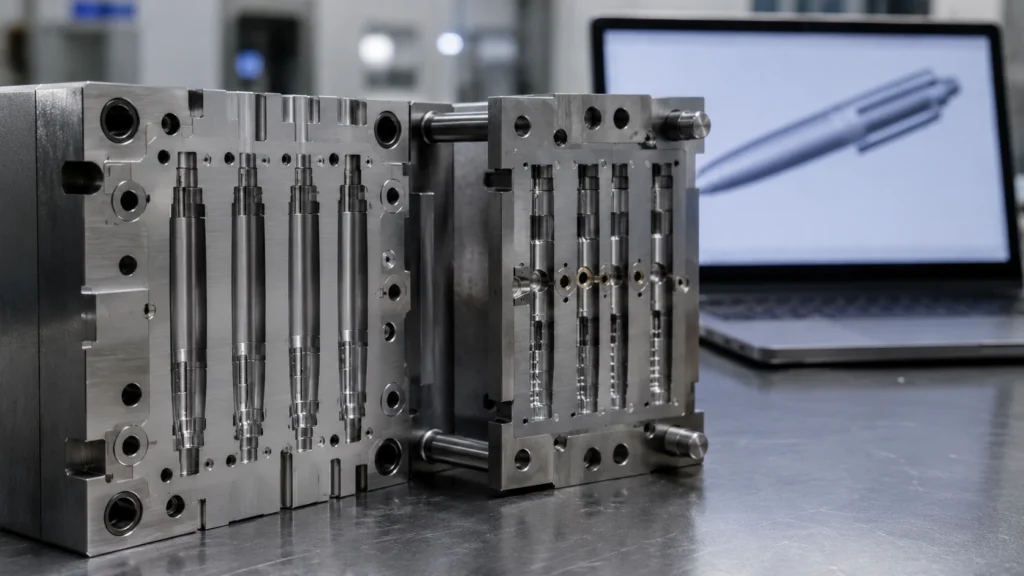
Wann die Investition in die OEM-Stiftherstellung die richtige Wahl ist
OEM pen manufacturing means you, the buyer, control the product spec. You define the ink chemistry, tip shape, barrel feel, cap seal, and every part of the packaging. The factory executes your design to that spec.
This model suits established stationery brands that know their end users. A brand selling permanent markers to warehouses may need a resin system that bonds to plastic bins and metal shelves. No stock ODM product will reliably deliver that. The brand must order a custom ink mixing formula. It must also pick a nib that resists wear on rough surfaces. And it needs a cap that keeps an airtight seal through months of use.
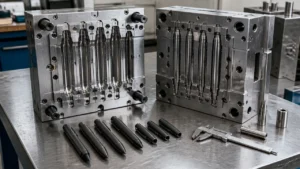
The cost structure reflects this depth of control. New mold development for a custom barrel, cap, or end plug is a major line item. Complex multi-cavity molds need precision machining and trial runs. That is why OEM minimum order quantities start higher. The mold cost must be spread across production volume to reach a workable per-unit price.
Der Ertrag ist ebenso real. Wenn Sie die Form und die Spezifikation besitzen, kann kein Wettbewerber in dieselbe Fabrik gehen und Ihr Produkt bestellen. Ihre Lieferkette ist geschützt. Ihre Nachbestellungen bleiben spezifikationsgebunden. Die Fabrik kann ohne Ihre Genehmigung und eine neue Musterrunde weder Tintenlieferanten, Schaftmaterialien noch Spitzengrößen ändern.
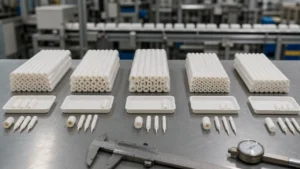
A factory with genuine OEM ability should walk you through a clear workflow. The stages start with requirement confirmation. Then come 3D design and mold making. Next is sampling and performance testing. After that come spec lock, mass production with in-process QC, and final inspection. If a supplier cannot explain these stages, they may not have real OEM capability.
Some buyers work with an experienced design team. Others have already proven product-market fit through ODM sales. For them, OEM is the next step toward a brand that is hard to copy.
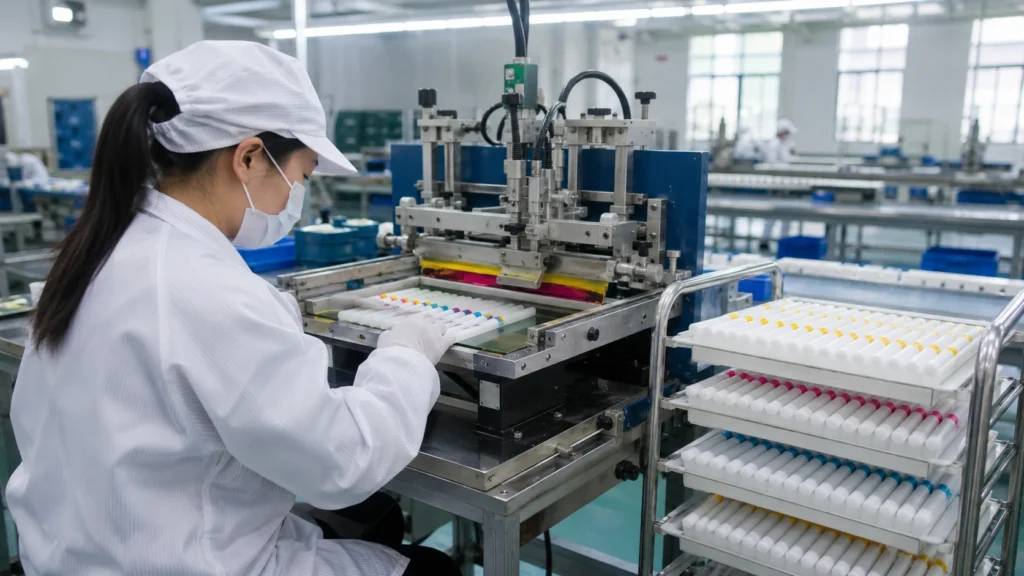
Wenn ODM Ihnen die Geschwindigkeit bietet, die Sie benötigen
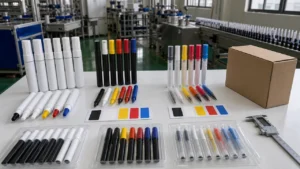
ODM flips the equation. The factory has already designed the product, built the molds, and proven the line. You choose from their catalog. Then you add your branding: logo printing, custom barrel and cap colors, and branded packaging. Retail display design is available where supported.
The speed gain is real. Without mold development, an ODM project can move from artwork approval to finished goods in two to six weeks. That makes seasonal launches, trade show inventory, and market tests feasible on short notice.
ODM is also the right start for businesses that still need to prove product-market fit. Why pay for custom mold development before you know what customers prefer? Do they like alcohol-based ink or water-based? Do they value a brush tip over a chisel tip? ODM lets you test SKUs, gather sales data, and refine your needs before you commit capital.
The tradeoff is differentiation. When three brands source the same ODM marker from the same factory, only the logo, packaging, and price differ. That may be fine for commodity categories where price drives purchases. For premium brands, the limits of ODM become a ceiling on growth. Think of art supply brands selling to pros. Think of school brands selling to buyers who remember failed products.
Many successful brands follow a hybrid path. They use ODM for catalog products that fill out the line, and OEM for the hero SKUs that define the brand. This is not a compromise. It is a deliberate use of development resources.
Was die Fabrik benötigt, um beide Modelle gut umzusetzen
Beide Modelle hängen von Fertigungsgrundlagen ab, die im Katalog unsichtbar, in der Praxis aber entscheidend sind. Drei Fähigkeiten unterscheiden Fabriken, die eines der beiden Modelle umsetzen können, von solchen, die es nicht können.
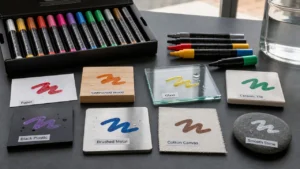
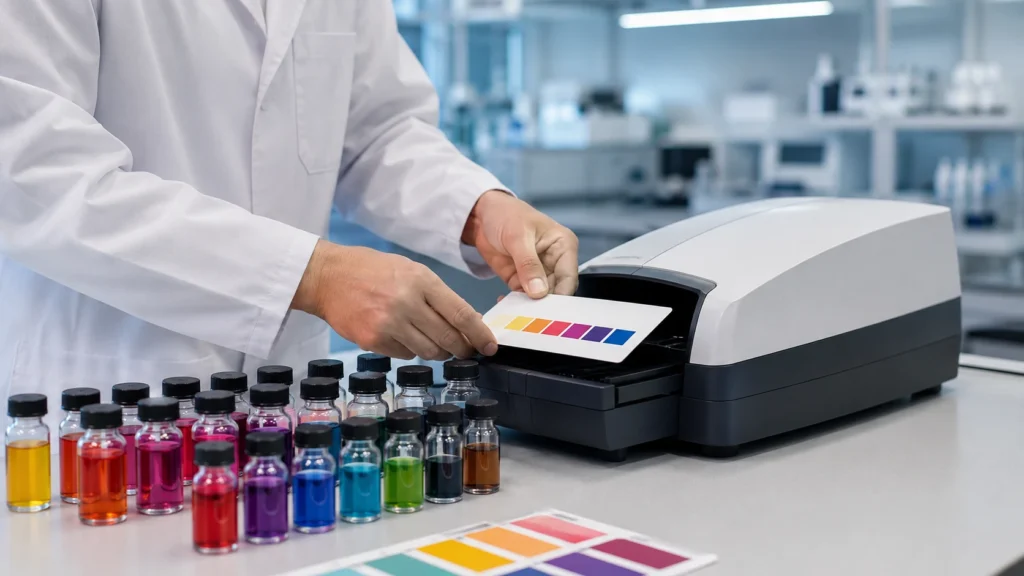
Ink control. Batch differences come down to one question: is the ink mixed in-house or bought outside? This applies to a custom mix for your OEM spec and to a standard ODM ink. When ink is bought outside, changes can happen without the factory knowing. A pigment supplier may switch sources. A solvent grade may drift. Then a color that passed lab testing no longer matches the run. Factories with in-house labs control the mix at the source. ZH STATIONERY runs such a team for marker, metallic, and acrylic pens. The team checks batch color with a spectrophotometer and records the source of every ingredient.
Mold and tooling. Even in ODM, the condition of the factory's molds decides part quality. Worn molds give uneven barrel walls, caps that fit loose, and threads that strip fast. For OEM projects, mold design and making decide how well your 3D design becomes real parts. A factory with in-house 3D design and sample making, rather than outsourced molds, can adjust faster and hold tighter limits.
Quality control. The QC difference is not about whether inspection happens. It is about what gets checked and when. In ODM, the factory should already have checkpoints: raw material checks, in-process checks, and final AQL sampling. In OEM, the QC plan must be built for your spec. What color variance, measured as delta-E, is acceptable? What cap-off time is the minimum? What drop-test standard fits your packaging? A factory that runs 100% inline automated inspection before packing can support both models. It also applies strict AQL sampling for shipment, covering fit, sealing, print alignment, cap tightness, and writing performance.
ZH STATIONERY operates from a 10000+ sqm factory area with 8 workshops and automated assembly lines, backed by 26+ years of OEM/ODM experience. You can verify these claims with factory audits, sample tests, and batch-level QC records.
Sicherheitskonformität: Was beide Modelle für die US-amerikanischen und europäischen Märkte benötigen
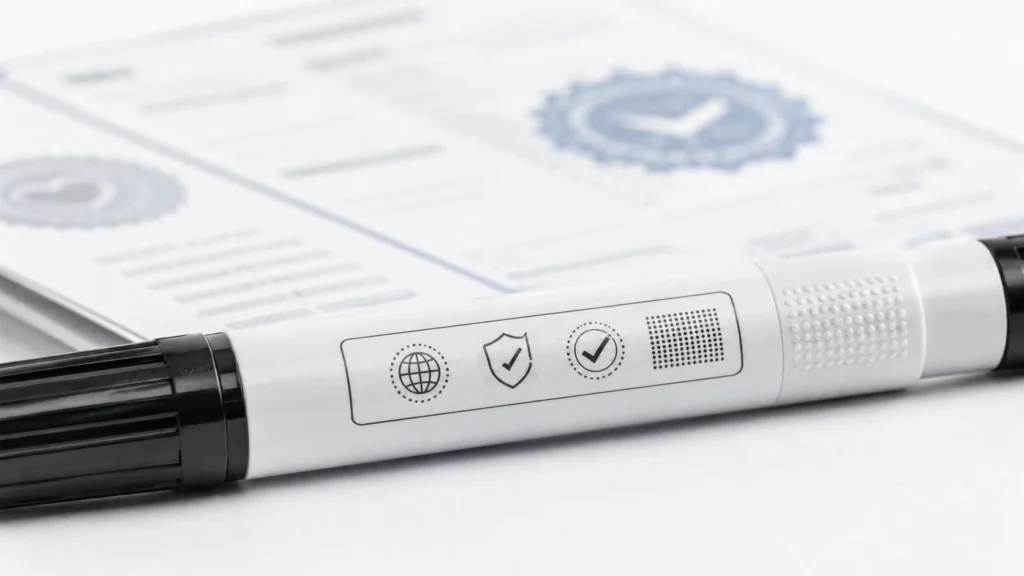
Compliance is not optional, and it does not depend on the model. If your pens enter the U.S. or European market, they must meet the applicable safety standards. The burden of proof falls on you, the buyer, not on the factory's marketing team.
In the United States, the Consumer Product Safety Commission, or CPSC, requires all art materials to pass a toxicological review under LHAMA. That includes markers, gel pens, and paint pens. The product or packaging must carry the statement Conforms to ASTM D-4236. The rule covers adult and children's products. For markers sold to children under 12, the CPSIA adds lead limits and mandatory third-party testing by a CPSC-accredited lab.
In the European Union, markers classed as toys fall under the Toy Safety Directive and must meet EN71. EN71-3 sets migration limits for 19 heavy metals, including lead, cadmium, arsenic, and mercury. The test mimics what a child may take in through chewing, licking, or swallowing.
A factory with current EN71 and ASTM D-4236 certificates shows that its sourcing, ink mixing, and production align with recognized safety limits. Ask for dated, batch-specific test reports from labs like SGS, Intertek, or TUV. Ask to see the full report, not a certificate screenshot. Check the date. Confirm it covers the exact product and ink mix you are ordering.
ZH STATIONERY keeps EN71 and ASTM D-4236 certified options with batch-level test records. That ties the paperwork to real production runs, not to a sample sent to a lab years ago.
Für Käufer, die Private-Label-Schreibwaren aufbauen, ist die praktische Compliance-Checkliste kurz:
- EN71-3-Prüfberichte für den Vertrieb in Europa (aktualisiert innerhalb von 12–24 Monaten)
- ASTM D-4236 / LHAMA-toxikologische Prüfung für den Vertrieb in den USA
- REACH-Dokumentation, wenn der EU-Markt eine Registrierung chemischer Substanzen erfordert
- CPSIA Children’s Product Certificate (CPC), wenn Produkte in den USA für Kinder unter 12 Jahren vermarktet werden.
- MSDS (Sicherheitsdatenblatt) für jeden Tintentyp, erforderlich für internationalen Transport und Zollabwicklung
Häufig gestellte Fragen
Was ist der Unterschied zwischen der OEM- und ODM-Herstellung von Stiften?
OEM means you provide the design, specs, and technical needs. The factory makes to your exact spec, and you keep IP ownership. ODM means the factory offers pre-designed products from its catalog, which you customize with your logo, colors, and packaging. OEM gives full control but needs higher upfront spend. ODM gives speed and lower cost but limits how different your product can be.
Wie hoch sind die Kosten für die Entwicklung einer kundenspezifischen Form für OEM-Markierungsstifte?
Die Werkzeugkosten variieren stark je nach Komplexität. Eine einfache Einkavitäten-Kappenform kostet weit weniger als eine Mehrkavitäten-Schaftform mit strukturierten Griffen und individueller Form. Betrachten Sie statt einer einzelnen Zahl die gesamten Landed-Kosten pro Einheit bei Ihrer Bestellmenge, einschließlich der Werkzeugumlage. Eine Fabrik mit hauseigenem 3D-Design und Formenbau wie ZH STATIONERY kann in der Regel schneller anpassen und Kosten besser kontrollieren als eine, die Werkzeuge extern vergibt.
Was ist die typische Mindestbestellmenge (MOQ) für OEM- im Vergleich zu ODM-Stiftbestellungen?
Die Mindestbestellmenge für kundenspezifische OEM/ODM-Programme beträgt 50.000 Stifte pro Bestellung, gezählt als Gesamtzahl der produzierten Einzelstifte. Bei einer 12-Farben-Packung entspricht das etwa 4.200 Sets, nicht 50.000 pro Farbe. Standard-Lagerware kann in kleineren Testmengen bemustert werden.
Kann ich mit ODM beginnen und später zu OEM wechseln?
Yes, and this is a common growth path. Many brands start with ODM to prove fit, gather feedback, and build sales data. Then they move hero SKUs to OEM when volume supports the mold spend. Ask suppliers whether they can handle both models. An ODM-only factory may lack the design and project skills that OEM demands.
Welche Sicherheitszertifikate benötige ich für die Einfuhr von Stiften in die USA und nach Europa?
For the U.S., ASTM D-4236, or LHAMA, compliance is required for all art materials. Products for children under 12 also need CPSIA testing for lead and phthalates, plus a Children's Product Certificate. For Europe, EN71-3 applies to products classed as toys or children's items, and REACH documents may apply. Always ask for current, dated test reports from ISO/IEC 17025-accredited labs, not a logo on a website.
Wie kann ich überprüfen, ob eine Fabrik tatsächlich OEM-Qualität liefern kann und nicht nur ODM?
Ask the factory for its OEM project flow: requirement confirmation, 3D design, mold making, sampling, spec lock, mass production QC, and final inspection. Ask for physical samples from a past project, not catalog samples. Ask for batch QC records: color readings, viscosity checks, cap-seal results, and surface adhesion data. A factory with 26+ years of experience and 100% inline automated inspection before packing can usually share these records, because the testing is built into the workflow.
Every B2B sourcing decision comes back to one question. Which model gives your brand the right mix of control, cost, and speed? Look at where you are today. Then look at where you plan to be in 24 months.
OEM ODM pen manufacturing is not a binary choice between better and worse. It is a strategic call about how much of your brand's value lives in the product versus the marketing around it. ODM gets you to market fast with low upfront cost. OEM builds a defensible product that rivals cannot copy by walking into the same factory.
The best long-term partners support both stages. ODM gives speed and market testing. OEM builds the brand and improves margins. The factory should not cut corners on ink quality, assembly precision, safety compliance, or batch consistency.
ZH STATIONERY sources marker pens, metallic markers, and gel pens for private-label brands, retail programs, and wholesale channels. We can send samples and discuss your specs. We support ODM and OEM production. Reach out through the Kontakt Seite, um ein Gespräch über Ihr Projekt zu beginnen.
Verwandter Leitfaden: Für die Compliance-Planung siehe Nass-abwischbare Marker im Vergleich zu anderen Stiftarten.